In God We Trust

O that you would tear open the heavens and come down,
so that the mountains would quake at your presence—

We have all become like one who is unclean,
and all our righteous deeds are like a filthy cloth.
We all fade like a leaf,
and our iniquities, like the wind, take us away.
7 There is no one who calls on your name,
or attempts to take hold of you;
for you have hidden your face from us,
and have delivered us into the hand of our iniquity. Isaiah 64:1, 6-7

The late M. Scott Peck’s opening sentence in his landmark book, The Road Less Traveled is relevant for our times, “Life is difficult.” If Mr. Peck had lived to see our day of vitriol outside the church and inside the church, I believe he would have put the font of that sentence in all caps. What are we to do when life is difficult? We have some help from the pen of the prophet Isaiah.

Isaiah is convinced that the only way to invoke the presence of God is for the people to be honest about their tepid and lukewarm approach to Yahweh. The times in which this prophecy was written were not a happy time. They were oppressed and being brutalized by a vicious regime.

Those times are not that much different from our times. If you watch the news today, with what is happening in Portland, Kenosha Wisconsin, and Washington D.C.—-it is not a happy time.

The forces of hate are pitting us against each other and trying to force us into a binary choice between fascism and socialism. Two words that carry so much freight they need separate engines to pull them up the political train tracks.

We fought a war to rid the world of fascism. (WW2) We fought a cold war to rid the world of Communism/Socialism. So, if one side of the political divide can successfully get folks to believe that Joe Biden is a socialist, they will motivate people, who remember the cold war, to get out and vote for Trump. But if the left can successfully describe Trump as a fascist, they can motivate their group to vote for Biden.

So, I guess those are our choices this November:

Biden the Socialist.

Trump the Fascist.

Really? The implication is that if you vote for Trump YOU are a fascist. Or if you vote for Biden YOU are a socialist. The world system and the Devil is counting on this simplistic choice to put us at each other’s throats. That kind of fear sets us up for mass manipulation by a political propaganda machine. (Historically, those ARE favorite tactics of socialist and fascist)

Their strategy is working and in too many instances Christians are playing into the manipulation of fear and loathing. Christians must be wise to that manipulation.

This week I ran across a quote by C.S. Lewis that put all of this into perspective for me:

The devil always sends errors into the world in pairs–pairs of opposites. And he always encourages us to spend a lot of time thinking which is the worse. You see why, of course? He relies on your extra dislike of the one error to draw you gradually into the opposite one.

It is possible that a person can hate what they perceive as the evil of socialism to such a degree that they back their way into fascism. And the same might be possible for those who hate fascism.

Isaiah is unflinching about the mess that exists in the world, and in the depth brokenness of a human soul. This is why I have begged family and friends to step out of the conservative echo chamber where everyone espouses the fear of chaos of Black Lives Matter and socialism.

Certainly, I have irritated some in my family and group of friends to step outside of the liberal echo chamber where everyone espouses that a revolution needs to occur in order to bring about the needed social change. I’m afraid all I’ve succeeded in doing is irritate my conservative and liberal family and friends. And yet, it seems, that no one wants to come out from behind the security of their political and social prejudices.

There is much fear manifesting itself as anger in our culture these days.

Peacock Emotions

Psychologists distinguish between primary emotions and secondary emotions. Primary emotions are fear, despair, shame, guilt, anxiety, etc.

A secondary emotion is anger. It is the “display” emotion. Like a peacock displaying its tail feathers, anger is what we show.

I believe that there is a lot of fear on display as anger these days. I see it everywhere. I wonder if that is true about your heart as well. On the off chance that it might be true, let these words bring you some comfort from Dallas Willard.

“The gospel of the kingdom steadies us against believing anything bad about God. This world is a perfectly safe place to be as long as you’re in the Kingdom of God.”

Be a Kingdom person, not a conservative, progressive, libertarian, or even an American. Be an apprentice of Jesus Christ and you might get some sleep tonight.

We need some hope that God is going to do something about this. Isaiah gives us some hope,

Yet, O Lord, you are our Father;
we are the clay, and you are our potter;
we are all the work of your hand. Isaiah 64:8

Trusting in God teaches us to hope even in the moments when the world seems uncertain and we don’t have a whole lot of confidence in ourselves.

Over twenty years ago Lynette and I were rebuilding our marriage. It was summertime and I had sent her and the boys to spend three or four weeks in Colorado with her parents and family. I stayed in the Seattle area to work.

We made plans to meet in Idaho, just outside of Yellowstone, and I would take them back to the Northwest. We had turned the corner in our relationship and the anticipation of seeing each other was beyond words.

As I drove through the winding roads of the mountains of Idaho towards the campground, my heart began to beat faster, and my foot got heavier on the gas pedal. A song came on the radio that reminded me of my love for her and I had to pull over to the side of the road because I couldn’t see through the tears in my eyes.

Finally, I pulled up in their rented space in the KOA and there was the Motorhome that held my family. I got out of the car and knocked on the door. Someone looked out the window and yelled, “It’s dad!” I opened the outside door and could hear my young boys squealing with excitement. Then Lynette appeared in the door opening. The only thing separating me from the bride of my youth was a screen door, but it was locked. Lynette struggled to unlock it…her urgency to get to me was so intense I thought one of two things were about to happen:

One, she was going to start cussing.

Second, she was going to tear through that screen door.

Finally, the screen door released and out she came, threw her arms around my neck, kissed my face, bawled so much that tears were smearing on my cheeks.

What does trustful waiting do to you? It increases the intensity of desire for the one you are waiting for. It enlarges our hearts. It deepens our capacity to love. It widens our souls and what our souls were designed for: Love for God and love for one another. It opens up caverns of space in our soul for the good Father and Divine Potter to come and abide inside us.

And that is a perfectly safe place to be.

So, hear our prayer, Lord. Go ahead and tear the heavens open and come down. Any time before November 4th would be great.
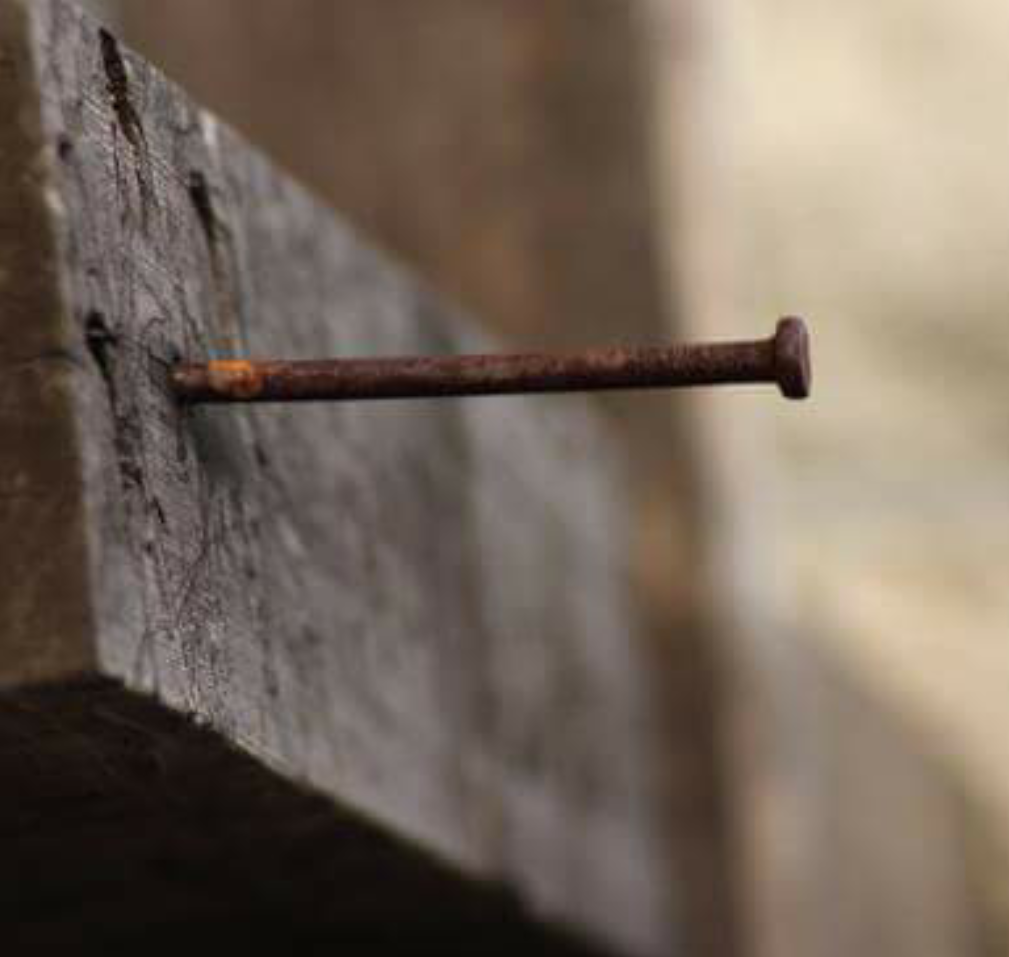
Posted in Uncategorized | Tagged , , , , , , | Leave a comment

At the End of the Day

Here is the world.
Beautiful and terrible things will happen.
Don’t be afraid. – Frederick Buechner

“How are you doing these days, Joe?” my friend asked.

“I’m doing really well.”

“Well, you are about the only one I’ve asked lately that can say that,” he said.

As soon as he asked me the question, I flashed on the flow of activity on a recent Sunday. It has been a few days since that day, and I am still feeling the afterglow. Would you like to know what made it so good that it echoes down through the corridors of my mind until today?

Thanks for asking.

First, I participated in a few things that are essential to my vocation. Like standing in front of a congregation and leading in prayers, confessions, officiating silence, and sharing God’s Word. I’ve grown as comfortable doing this as making coffee every morning, I’ve been doing it so long.

On this particular Sunday, I experienced what theologian John Claypool calls the “preaching event”. That is when a preacher connects with the Holy Spirit and then reaches out and connects with the soul of a congregation he loves. That moment becomes a “thin place” between heaven and earth—where the distance between the eternal and the temporal is thin as a baby’s breath. It doesn’t happen every Sunday or every sermon, but when it happens the divine spark of eternity ignites preacher and people. The temptation is to try to replicate it as if you could catch lightning in a jar. It can’t be done.

Then, after church, my wife and I were invited to my youngest son’s home for Sunday lunch. He and my daughter-in-love prepared a wonderful and satisfying meal. It was sacramental to sit across the table from my son and hear him say grace over the meal he had prepared in his home for his parents. But, before the meal, I bounced my youngest granddaughter on my knee and gave her so many gray whisker kisses on her little neck that she laughed out loud. Her laughter made my eyes brim with tears.

Sitting on their sofa, drinking rich, dark, black coffee, and putting my arm around my wife while we ate a Haagen Daz ice cream treat made me feel as loved as I have felt in a long time. All was well in my familial world.

As we arrived home to our mountain cabin after lunch it was unusually hot for the mountains. I remember looking at the indicator on the dash of my truck and seeing 88 degrees glow in a garish blue light.

I said to my wife, “I’m going to go into the coolest part of the house, lay down, and see what happens.”

You know what happened. My mouth eased open, my breathing got heavy, and I growled in about 25 grace-filled minutes of sleep that was as delicious as the ice cream I had tasted on my tongue earlier and as satisfying as the laughter of my granddaughter.

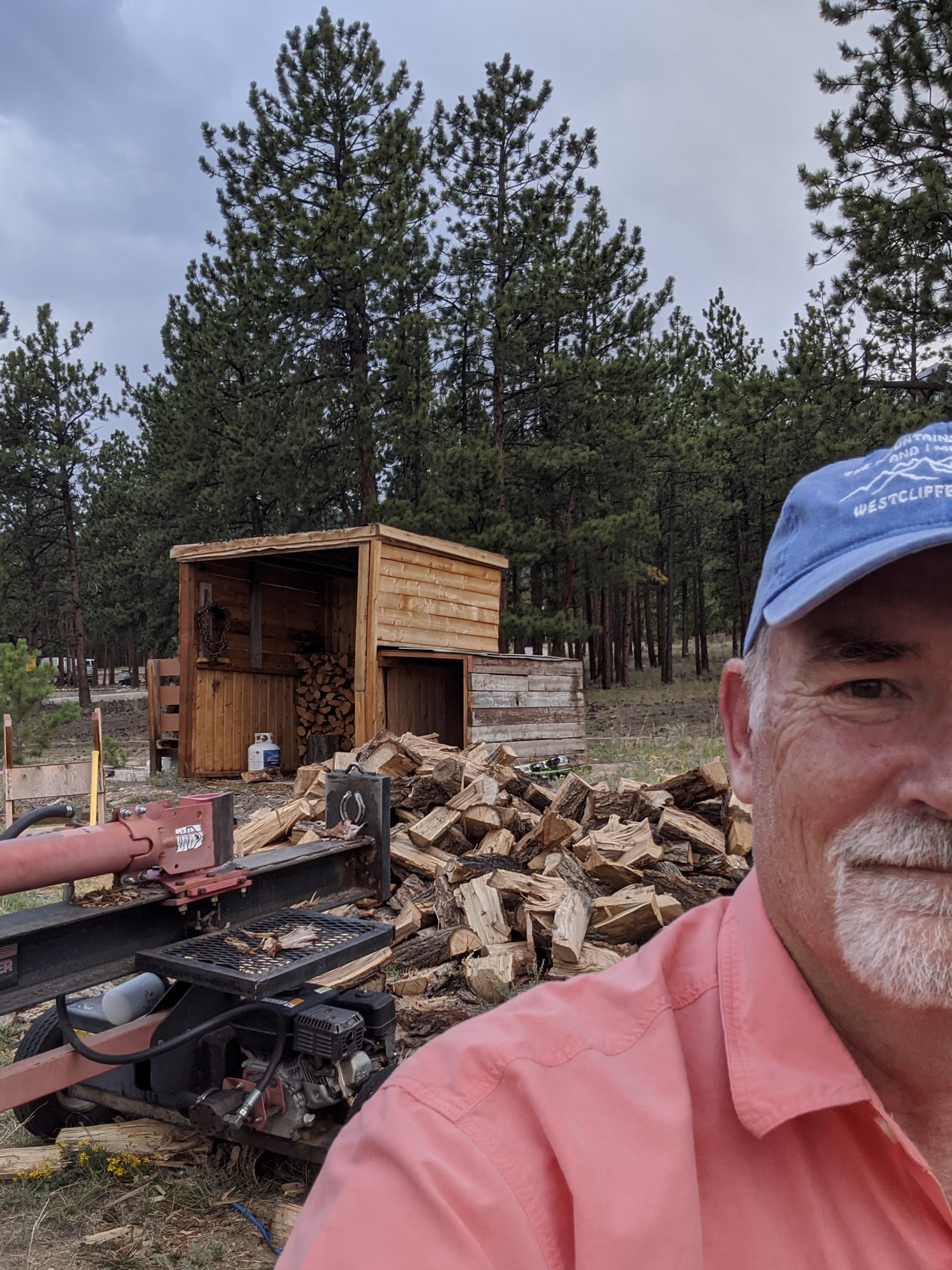
Refreshed, I walked out off our deck and into the shadow of Mount Princeton, fired up my wood splitter, and spent the next two hours splitting two cords of green Chinese Elm I had piled up by my woodshed. The rounds were extremely heavy with moisture and the splitter often moaned as much as I did working the rounds into manageable fuel for a future mid-winter fire.

The interior of the split wood was a mixture of streaks of mocha colored layers that gave way to pancake colored swirls. It was warm to the touch inside the damp wood. Fermenting. Like it was preparing for winter itself.

My arms and, more significantly, my lower back began to give way as I counted how many more rounds were left that needed to be split so that they would cure in time to be burned by December. Five, four, three, two, and finally—as the sun slipped behind the shoulder of the mountain, I split the last piece of wood.

I turned off the noisy splitter, walked into the house to get a cold drink.

My wife asked, “Did you have fun?”

A recent Sunday

I winked at her, smiled, and closed the door behind me and with drink in hand, walked out to sit on the deck to admire my pile of firewood and my mountain. I stayed there until the bats came out to hunt mosquitoes. I watched them flit here and there in their erratic flight patterns and said to myself, “Yes, I had fun.”

Vocational fulfillment, love of my family, deep rest, and splitting firewood.

That happened on a recent Sunday. And I am still enjoying it these many days later. I’m doing well, in the midst of a world that is not.

Thanks be to God.

And thanks for asking.

Posted in Uncategorized | 1 Comment

We Need A Savior

Amazing love, how can it be?
That you, my king. would die for me
Amazing love, I know it’s true
Its my joy to honor you.

If you don’t believe in original sin, I can only surmise that you have never attended a Baptist business meeting or an HOA annual meeting.

Every time I look in the mirror, I am reminded that we need a savior. Every time I watch the nightly news, I am reminded that we need a savior. There is so much hatred and violence that, at times, it can feel overwhelming.

A North Carolina man has been arrested in connection with the shooting death of a 5-year-old boy who was playing in his front yard with his two sisters. Darius N. Sessoms, 25, of Wilson, N.C., has been charged with first-degree murder.

The 5-year-old was identified by family members as Cannon Hinnant.

Cannon was shot in the head while playing outside of his father’s home Sunday, his family said. He died after being taken to the Wilson Medical Center.

The young boy’s father is next-door neighbors with Sessoms.

A woman who said she witnessed the horrific incident claimed Sessoms shot Cannon, then ran back into his own house.

“My first reaction was he’s playing with the kids,” said Doris Lybrand. “For a second, I thought, ‘That couldn’t happen.’ People don’t run across the street and kill kids.”

Cannon’s mother said the boy’s 7-year-old and 8-year-old sisters witnessed the shooting, which police were alerted of at around 5:30 p.m. Sunday.

The racial unrest that white America wants to ignore is on the news almost every night. I recently listened to a podcast featuring African American Willie Jennings.

Willie Jennings is an associate professor of systematic theology Africana studies and religious studies at Yale University. He’s an ordained Baptist Minister and his author of Christian ImaginationTheology and the Origins of Race as well as a commentary on the book of Acts.

I remember my first time—you never forget your first—the first time a white police officer pulls you over.

I was 14 riding a brand-new bicycle that my eldest brother had bought for me on my birthday. I had outgrown the old Stingray bike. I rode all over town this extraordinary gift from my brother that marked my step into young adulthood.

It also marked, unfortunately, the step into the sickening ordinary that would be part of my life.

The police officer yelled from his car get off the bike. I quickly obeyed remembering the words of my father and my brothers when they said, “Stay out of trouble. Do what they tell you.”

“Whose bike is this?”

“It’s mine,” I said.

“Sit on the curb and don’t move,” the police officer said, as he took my bike back to the patrol car and left me sitting on the curb.

I saw people drive by watching me sitting near flashing lights and I wish someone, anyone who knew me, and knew what a good church boy I was, would drive by, stop and help me.

This was the first time I felt that helplessness.

I did not feel helpless because it was nothing I could do. I felt helpless because there was nothing that this police officer could do to me that I could stop in any way. After what seemed like hours to check the serial number on my bike, he told me I could take it and go.

That was it. No apology. No words of advice or wisdom. He just drove off. I have had such encounters with police officers multiple times in every decade of my life since then until now.

Not the same, but exactly with the same dynamic—I’ve been pulled over or stopped on the street or stopped in a store—for doing nothing wrong.

And then I left each encounter with the return that feeling of helplessness.

We need a Savior to do something about the darkness of our hearts. What would change our hearts? Nothing but the blood of Jesus. What can wash away my sins? Nothing but the blood of Jesus. We are the beast and He is the beauty.

The ancient Scriptures teach us that Jesus became a beast on a cross to transfer his beauty to our lives.

What would be strong enough to hold down the arms of the One who created the stars? What would be strong enough to bind the limbs of the Maker of the universe to the cross? Nails? Chains?

No.

Nothing but his love for you. Jesus’ death shows the depth of his love.

He lost everything. He was crushed. He was marred beyond human likeness. He was the Lord of the worlds. He lost the universe. He lost his glory. He lost his beauty. He lost everything.

He loves you more than the world. He loves you more than the glacier-carved mountains. He was willing to let everything go in order to get us.

As a pastor, I’ve talked to people who were dying. They never say, “I regret I didn’t spend more time at the office.” What do they regret? They always have regrets with regard to relationships and love.

Are you melted by spiritual understandings of how much he loves you? Do you live in the reality of it? Is it a walking reality? Can you breathe it? Can you feel it? Can you taste it? Can you touch it? Do you know how different you’d be if you’d realize the magnitude of his love?

In his book Mortal Lessons, Richard Selzer, M.D., writes:

“I stand by the bed where a young woman lies, her face postoperative, her mouth twisted in palsy, clownish. A tiny twig of the facial nerve, the one to the muscles of her mouth, has been severed. She will be thus from now on. The surgeon had followed with religious fervor the curve of her flesh; I promise you that. Nevertheless, to remove the tumor in her cheek, I had to cut the little nerve.

Her young husband is in the room. He stands on the opposite side of the bed and together they seem to dwell in the evening lamplight, isolated from me, private. Who are they, I ask myself, he and this wry mouth I have made, who gaze at and touch each other so generously, greedily?   The young woman speaks. ‘Will my mouth always be like this?’ she asks. ‘Yes,’ I say, ‘it will. It is because the nerve was cut.’  She nods and is silent.  But the young man smiles.  ‘I like it,’ he says, ‘it is kind of cute.’

All at once, I know who he is. I understand and I lower my gaze. One is not bold in an encounter with a god. Unmindful, he bends to kiss her crooked mouth and I am so close I can see how he twists his own lips to accommodate to hers, to show her that their kiss still works.”

Once upon a time, in the most surprising reversals in the history of stories, the beast in me and the beast in you needed the beauty of the Son of the Living God to rescue us. And at Calvary, God twisted His lips to meet our hideous and disfigured souls–to show that the kiss still works.

Posted in Uncategorized | 1 Comment

Pastor, It’s Not Your Church

And I saw the holy city, the new Jerusalem, coming down out of heaven from God, prepared as a bride adorned for her husband. Revelation 21:2

When I was in 4th grade, our family lived in the Wet Mountain Valley. We rented a house from Lee Adams right in the middle of the valley. A large, three-story red barn was on the place. When folks would come to visit our family all you had to do was tell them, “When you get to the valley, look for the Big Red Barn. You can see if for miles. We live next door to it.”

One day I watched a movie about gladiators. Like most boys, I wanted to then play “gladiators” with my brother and little sisters. I told them the game would include sword fighting and dying. They decided they didn’t want to play. That meant that I was going to need to find other combatants. The only combatant I could find was an evergreen tree about my height. I found my enemy in the front yard.

I drew my curtain rod sword, lifted my trash can lid shield and the battle began. Shortly, there were appendages of my new combatant laying on the ground; I felt pretty sure I was winning the fight when my mother came out and stopped me. Said I would have to explain to my Dad why I had nearly destroyed a beautiful tree in the front yard. I tried to explain to her that it wasn’t a tree, but a barbarian from Germanica, but she would have none of it.

When Dad got home, he scolded me in such a way that it is etched in my memory as if it happened yesterday. I don’t remember everything he said, mostly I remember the emotion in his voice and ominous of his presence. But I do remember one thing he said, “You have no right to destroy that tree. It’s not your tree. It’s Mr. Adams tree and now I have to explain to him why and how his tree in the front yard of his house was destroyed.”

“It’s not your tree, son.”

I sat yesterday on one of the back pews of my church beside my father as we were looked out at the congregation sparsely seated in the auditorium. The guitar, flute, and keyboard were playing gentle strains of music as more masked Baptist shuffled in to find their seats. Our conversation turned to the difficulties of holding worship services during a pandemic.

I said that I was saddened by the impact the Covid-19 precautions, the racial unrest, the peaceful and violent protests in our cities, and the incredible strife the election season of 2020 was having on our ability to gather as a people of faith without an underlying layer of fear and anxiety if not outright anger.

Then I turned to him and said, “Dad, if anyone should be willing and equipped to model for the watching world how to behave during this kind of national crisis, it ought to be the followers of Jesus that meet week after week in this country. But, sadly, they are often the most toxic and divisive people in the culture.  Christians have become a laughingstock in our culture. Dad, I said, I feel like as a pastor, my generation failed to teach and lead the church to be prepared to model for the world a better way to live in these strange times. I feel like we failed.”

He said, “Not just your generation of pastors failed. Mine did too.”

Then I stood up and walked to the front of the room and led in prayer and we began to sing our halting songs of worship to Bridegroom of the church.

Your discipleship program is perfectly designed to produce the disciples you have.  – Dallas Willard

Many times, during the rest of the day I mulled that conversation over in my mind. And, to be fair, I can only really speak for myself when I say that for a long time, I led the church from mixed motives. For the most part, I was hell-bent on building a kingdom for myself. I used the church to work out my own spiritual pathologies and insecurities. When the church grew, I felt good about myself. Public affirmation became my addiction and the pragmatism of church growth became my methodology for acquiring that affirmation. I was using the church as if she were my own private ego enhancement tool.

That objectification did incredible damage to the bride of Jesus. When you objectify a person or a people, you distance yourself from a soul-to-soul relationship with them. And without that soul-to-soul relationship—prayers (if they are uttered at all) are tainted, love is manipulative, encouragement is weaponized, and the eternal kind of life is pinched off from flowing soul to soul.

I have repented of that sin of betrayal years ago. I am extremely sensitive to the idea of manipulating the people of God these days. But I see the residual effects of my style of leadership today when I see how the church across our country is behaving during a national crisis.

One day I will stand before Jesus and must give an account of how I brutalized his bride.

I can almost hear Jesus say, “It’s not your church, Joe. Never was.”

Gratefully, the Jesus I have come to know is gentle and forgiving of leaders like me. And he is more than willing to walk with me through these times of upheaval and show me how to treat his bride.

As a friend of mine has said, “We pastored our way into this mess, and we are going to have to pastor our way out.”

First step: Acknowledgement.  “Hi, I’m Joe. I used the church for my ego enhancement.”

Second step: Repentance. “I am walking with Jesus moment-by-moment from now on, anyone want to walk with me?”

Third step: Humble inquiry and submission.  “Jesus, where would you like us to go?”

I have a hunch that Jesus will say, “Come and see. But be certain you have thought this through—because we are headed for a tree.” But this sober journey is made joyful because we are going with Jesus—our bridegroom.

It’s His church, after all.

Posted in Uncategorized | Tagged , , , | 1 Comment

Experiencing God

Happy are those
who do not follow the advice of the wicked,
or take the path that sinners tread,
or sit in the seat of scoffers;
but their delight is in the law of the Lord,
and on his law they meditate day and night. Psalm 1:1-2

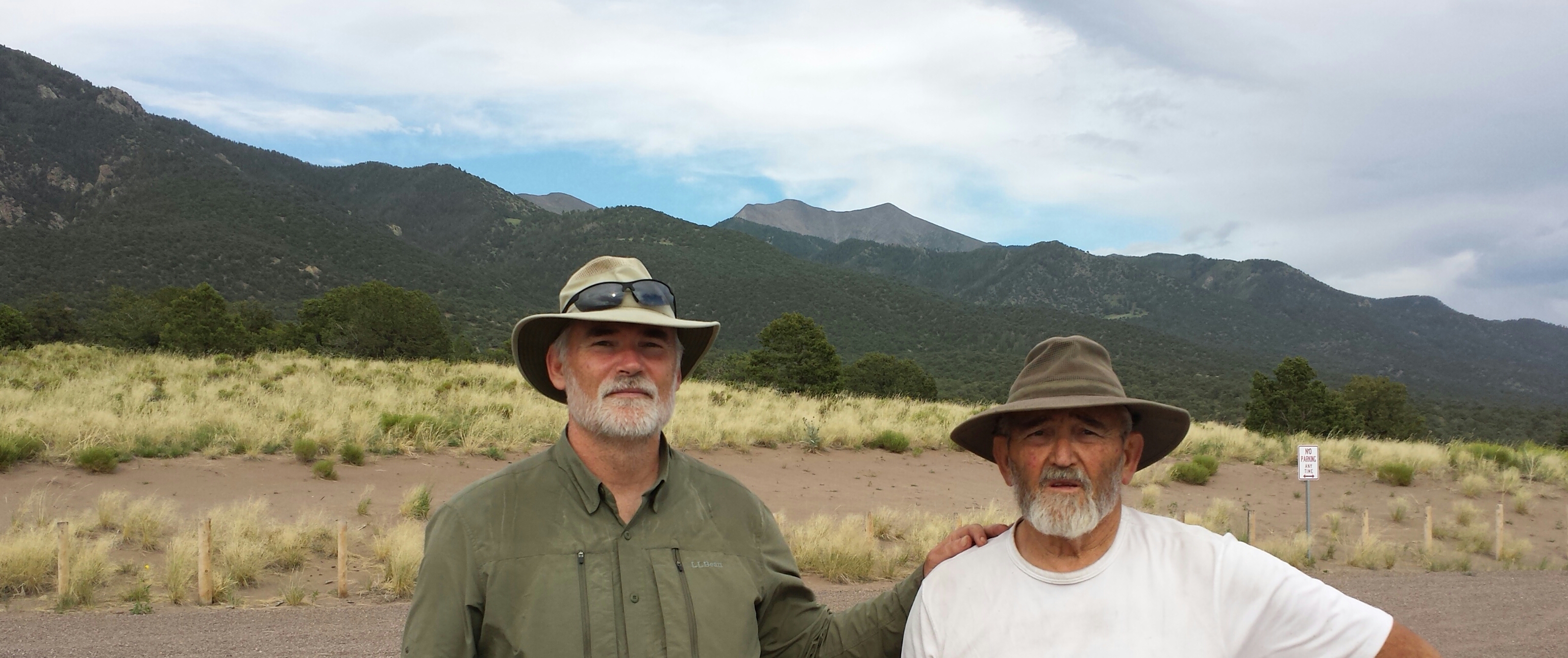
This week I went backpacking with my prayer partner, Dexter. I went to a place that is special in the Chambers family down in the Sangre De Cristos. As I walked the trail up to North Colony Lakes it occurred to me that I first walked that trail 50 years ago. I noticed the meadows had shrunk since the first time I walked through them. The beaver ponds were gone. The lone tree in lone tree meadow was dead—beetle kill.

The trail was steeper too. The lake was smaller, but the fish were bigger.

Dexter Dog

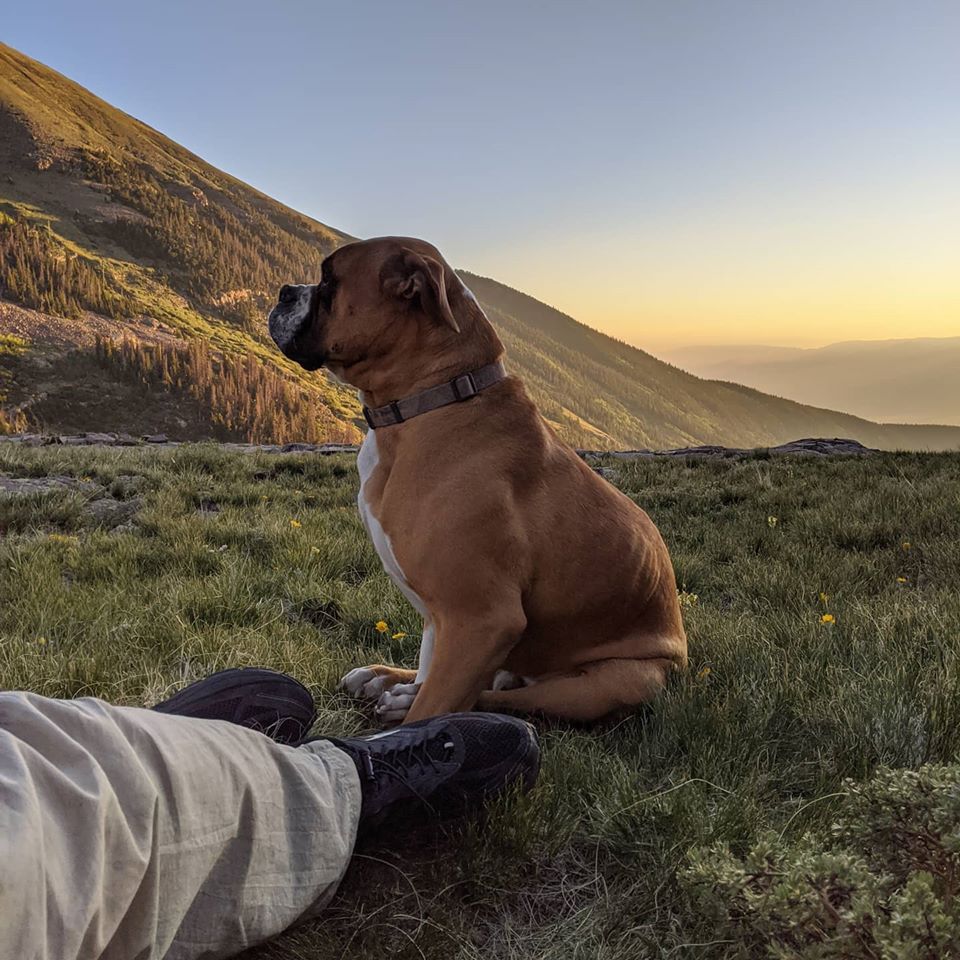
I noticed a couple of other things on that trip. First, Dexter Dog never moved very far from me. He would run off a little way, smell what he needed to smell and explore what he needed to explore, but always looking back towards me as if needed assurance that his master was nearby. When we would rest or just sit on the alpine tundra above treeline, he would sit at my feet and look out over the vistas.

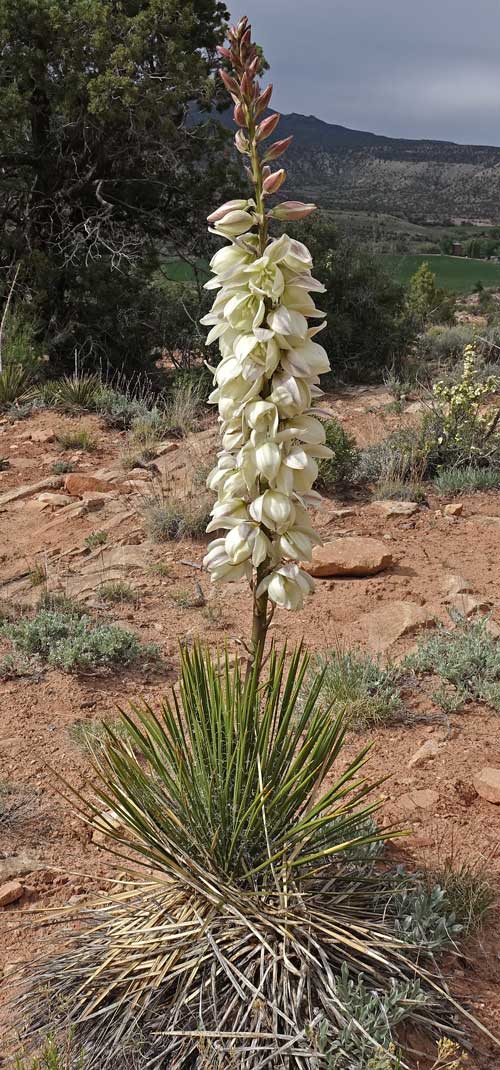
The second image is of a flower. A Rocky Mountain Sunflower. (AKA, Alpine Sunflower, Four-nerved Daisy, Graylocks Rubberweed, or Old-man-of-the-mountain) The sunflower doesn’t have much to do to fulfill its purpose. Really, if the soil conditions are right, all it has to do is face the rising sun and follow its movement across the cobalt blue sky all day long. All it has to do is keep facing the sun.

The Old Man of the Mountain

The ancient Church fathers have been known to say that nature is the second book of God. God spoke to me in that Alpine Sunflower. Do you know what he said? No matter what is happening in your world or not happening, always, always, always, keep your face towards the Son. I remember wondering what my life would look like if I related to God the way Dexter related to me in the wilderness.

Dexter found security at my feet and leaning against me in the tent at night. The sunflower felt the sustenance from the sun by day and the expectation of morning warmth through the night.

How do I experience what the dog and the flower found naturally?

The Hebrew word “meditate” is the word hagah. Which means to mutter to yourself, to talk to yourself, to muse, to ponder.

You’ve seen a dog “worry” its bone. He chews on it beside the fireplace, picks it up and takes it in the other room and licks, chews, and even lays on top of it.

This tells us a couple of things about meditation:

Think about the Word of God.

In eastern meditation, you are to empty your mind of all thoughts, but here we are told to worry over the “love letter” of the Lord. To sit with it. To reflect on it. To internalize it. Meditation is a prayerful reflection on what God has told you in His word. It is responding to God. It is answering God. It’s listening to God. It’s asking questions of the imagery. It’s asking questions of the meaning of the phrases.

Feel the Word of God.

Notice it says that happiness will come our way when we delight in the law of the Lord. This tells me that meditation is not just an intellectual pursuit, but also involves my heart. The purpose of meditation is to take the truths that we discover in our analysis, chew on them until they drop 18 inches into our hearts so that it actually affects us.

The purpose of meditation is not so much to make the truth clear to your heart, but real to our heart. It’s tasting the goodness and the sweetness and the flavor of God’s Word for you. It’s shaping your feelings and your imagination by making it real in your heart. Meditation is the mind descending into the heart.

My Process of Meditation

Begin with 1-2 minutes of silence.
Invite the Holy Spirit to reveal to you the message Jesus wants you to hear.
Read a selected passage aloud very slowly with long pauses. Feel the words on your tongue.
Notice a word or a phrase that seems to resonate with your heart. Stop. Say the word and hagah.
Sit with that word or phrase. Chew on it.
Finish reading the passage.
Sit in silence saying the word or phrase several times to yourself. (hagah)
Read the entire passage a second time engaging your five senses.
What do you see?
What do you smell?
What do you taste?
What do you feel?
What do you hear?
Journal or speak those images aloud.
Sit with the sights, sounds and smells of the passage for a few minutes.
Read the passage again a third time this time listening, seeing, and noticing what Jesus might be inviting you to do or say in your life for this given day. Imagine Jesus is sending you an encrypted message through the passage and you are to hear it and decode it.
Do what he tells you to do.

What if one of my grandkids habitually were so busy playing that every time they passed my chair and I offered them my lap to sit in or offered to read them a book they just kept on playing like I wasn’t even there. I offer to sit with them, but they are too busy watching T.V. or playing video games or wanting to blow bubbles. No matter what I do they are so absorbed in their only play-world that they don’t take the time to “be” with me.

If they consistently operated that way is it possible that they might grow up and complain to their parents, friends, or therapist that they never felt loved by their grandpa. Is it possible that they could grow up with that viewpoint? Of course.

You’re heavenly Father is more than willing to go for walks with you, sit with you beside a bubbling stream, whisper to you through the laughter of a child—but you have to notice.  And that comes from hagah. Pondering on the Word that became flesh for you. If you do that over time, you will be changed, and you will feel adored by your Heavenly Father.

This process is not complicated, but it does require an intention to be still and know that he is God.

Just turn your face towards the Son and sit at his feet with His love letter open on your lap and see what happens.

Posted in Uncategorized | Tagged , , , | Leave a comment

Following Your Father

The righteous man walks in his integrity;
His children are blessed after him.  Proverbs 20:7

Through tear-filled eyes and searing pain, I remember seeing him running down the hallway of the hospital like a fullback running for the goal line as I lay on my stomach gripping the edges of the bed. Only hours before I had caught my pajamas on fire and the doctors were pulling charred flesh off the back of my right leg to apply a dressing to my 3rd-degree burn. Somehow, even though the pain would not go away, I knew I was going to be fine. I don’t remember what he said. I don’t remember him touching me. I don’t remember him holding me. I remember him running to me.

While he ran I remember a look of urgency and intensity on his face that I will never forget. He was not running to stop the pain, for he could not. He was not running to solve a problem, for he could not. He was not running to get me out of danger, for he could not.  He was running to be with me. I ached for that. I cried out for that.

My mother was already with me. She had saved my life by wrapping a housecoat around my flaming leg.  She had cared so tenderly for me. She had called the neighbor to watch my brother and sister and another neighbor take us to the hospital. She was there. She was present. But when you are in pain and the pain won’t’ relieve, you want the other parent.  I wanted my father. My father had always fixed the problems of my five-year-old world.  Not this time.

That was fifty-seven years ago. I still want my father. I want him for different reasons than I did that day almost six decades ago. I want him now to show me how to be…old. My body hurts every time I get out of my chair. I have to get up several times in the middle of the night to go to the bathroom. I barely recognize the man in the mirror. How do I become comfortable in these sunset years?

I am read a wonderful book called Walking Home, by Lynn Schooler. The author is about my age and he is building a cabin in the wilderness outside of Juneau, Alaska. He is selecting various woods to use in his home and writes,

In time, I hoped, day-to-day wear, weather, guests, and rambunctious children or grandchildren would eventually mark and smooth the various parts of the structure into what the Japanese call a wabi-sabi home.  At its simplest, sabi can be defined as the beauty that comes to physical things with the passage time, such as the way an old wooden door weathers into striking colors and patterns, or the grip of a tool develops a glowing patina after years of respectful use.  Wa, the root of wabi, means “harmony” and connotes a life of ease within nature.  When applied to objects, wabi-sabi implies the beauty of simple practicality.  More important, the phrase carries a Zen overtone of living in the moment and accepting the inevitability of decay.

That last sentence is a good description of my father. At eighty-two years of age, he has developed the art of living in the moment and accepting the inevitability of decay. He reads his Bible every day. He prays every day. He talks with someone about Jesus of Nazareth nearly every day. He goes big game hunting every year. He has a vegetable garden in which he enjoys the produce thought out the cold winters of the mountains of Colorado.

But beyond the things he does what I appreciate about him is who he has become. In the last twenty years or so I am not sure I have heard him say a mean-spirited word about another human being. He is more accepting of the shortcomings of others. He is a kinder and gentler man than I remember when I lived in his home. He still desperately longs for God. He longs for everyone he meets to know the God he knows. He is easy and comfortable being himself.

I am not sure if he ever saw his father run. But do know that he has a Heavenly Father who ran for him all the way to a place called Calvary to co-labor with Jesus to make atonement for sin. That same God lives inside the spirit and soul of my father even though he is not a perfect man. The list of his transgressions is long. But he is a man who loves God and has developed the ability to live in the moment. He has about him is the well-worn sheen of a tool that has grown accustomed to a nail-scarred hand.

It is that patina that I admire most.

“When he was still a long way off, his father saw him. His heart pounding, he ran out, embraced him, and kissed him. Luke 15:20 (MSG)

Posted in Uncategorized | Tagged , , , | 2 Comments

Learning to Wait

Richard Foster, in Celebration of Discipline, says, “Superficiality is the curse of our age. The doctrine of instant satisfaction is a primary spiritual problem. The desperate need today is not for a greater number of intelligent people, or gifted people, but for deep people.”

The psalmist describes this kind of deep person as being…

like a tree
Planted by the rivers of water,
That brings forth its fruit in its season,
Whose leaf also shall not wither… (Psalm 1:3)

As Foster pointed out, the number of firmly rooted trees on the Christian landscape is growing smaller, and it’s largely because of an unwillingness to wait on God. We tend to replace waiting on God with hurried attempts at pursuing growth on our own. And so we settle for shallow roots destined to yield only mediocre growth.

Carl Jung once said, “Hurry is not of the Devil; it is the Devil.”

And the more we graft this attitude of hurry into our pursuit of God, the more it stunts the growth of our inner being. Our physical stature may mature over the years, but there will be only a few rings of maturity in our godly character.

Old King David helps us with a line from one of his poems,

“My soul waits in silence for God only” Psalm 62:1

The literal Hebrew sentence reads almost backward from the English translation: “Only for God in silence does my soul wait.” The word translated “silence” comes from the Hebrew verb that means “to whisper softly.” It’s the idea of whispering a secret to somebody you love—not loud enough for anyone else to hear. In this case, it’s only for God to hear. For David, there’s no one else but the Lord.

Some of the best times in prayer are wordless times. I stop speaking, close my eyes, and meditate upon what I have been reading or upon what I have been saying, and I listen inside of myself. I listen deeply. I listen for reproofs.

I think of myself as a home with many doors.

As I am meditating—and often it helps to close my eyes so I won’t be distracted—I unlock doors and open them as I wait. It is here that the Holy Spirit invades. Then, I take circumstances before Him and I listen with doors open.

Please be assured that I have never heard an audible voice. It isn’t that kind of answering. It’s a listening down inside. It’s sensing what God is saying about the situation.

It’s like what you do when you’re in love with a person. Isn’t it true—the deeper the love, the less that has to be said? You can actually sit alone together by a fireplace for an hour or two and say very, very little, but it can be the deepest encounter and relationship you know anything about.

My brother and I were enthralled by all things Native Americans when we were boys. One day my dad asked if we wanted to learn to make a rope like the Indians used. We did.

So, Dad taught us to cut the green fronds from a Yucca plant that grew on our property. We would gently pound the fronds with a rock until the plant fibers would appear. We pulled out those single plant fibers, which were not were strong at all, by the way. Then we would twist them together between our palms to form long “twists” of plant fibers. We would add another link of twisted plant fiber and twist them together at the ends to create a flimsy fiber cord. Then we would braid three of these fibrous cords together. Then we braided the braids together to make a strong rope.

It is still tied up in a tree at our house in our boyhood home.

The prophet Isaiah reminds us,

But those who wait on the Lord
Shall renew their strength;
They shall mount up with wings like eagles,
They shall run and not be weary,
They shall walk and not faint.
Isaiah 40:31

In this instance, the word “wait” means “to twist or to stretch in order to become strong.” In noun form, it means “a line” or “a rope.” In other words, it’s the idea of stretching or twisting strands of hemp so that, in the process, far greater strength comes.

Someone has called this “the exchanged life,” where we trade in our weakness for God’s strength. I take my strand (like that of a little Yucca plant fiber) and wrap it around a steel cable of His character (via the waiting process), and then my strand is as strong as His character. I exchange my weakness for His cable-like strength. It never gives way in the heat of the fight; it holds firm.

Those who wait (those who exchange their weakness for His strength) upon the Lord will gain new strength. But remember: The key to the Lord’s strength is waiting.

We live in an age of headlines, Twitter posts, and sound bites. It is easy to spend our time scrolling a screen. At best, we see the world through a glass of darkly if this is our primary soul food; at worst it lulls us into a superficial lethargy that creates a soul-stupor that makes us shallow, dull, and reactive.

We were meant for greater things. Deeper things. Wiser things. Jesus is calling us to live moment by moment wrapped around his great love. This with-God life is ever so fulfilling. It changed the world once; it can do it again.

Wait and see.

Posted in Uncategorized | Tagged , , , | Leave a comment

Black Lives Matter

“Pastor Joe! Please, when can I be baptized?”

An eight-year-old precocious and adorable little girl wrote that sentence every Sunday for what seemed like an entire school year on the prayer request card at the church. With her parents, the little girl and I would talk about salvation, sin, and having a covenant relationship with Jesus. At first, she rarely answered any of my questions correctly. Or one week she would answer a few correctly and then the next time she would get those wrong and answer previous questions with understanding.

Again, “Pastor Joe! Please, when can I be baptized?”

And again, “Pastor Joe! Please, when can I be baptized?”

Every single week.

Eventually, she lined up the questions with the right answers enough times, that I felt as is she knew what she was doing.

She prayed and invited Jesus to be her Lord and Savior.

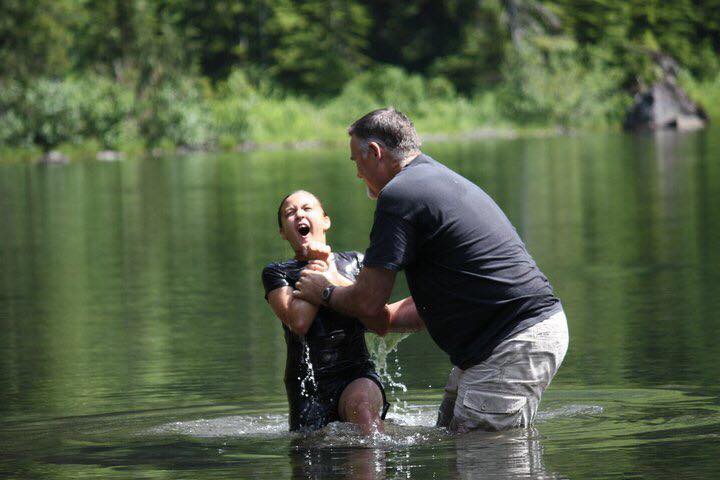
A group of us hiked up to Heather Lake in the Northern Cascades for her and her sister’s baptism in the alpine water. It has been one of my favorite memories as a pastor.

Her life matters.

Two nights ago, her parents called and asked if I would publish a piece their daughter wrote in response to the murder of George Floyd and the riots that are raging around the world. I said I would read it and consider publishing something about it. You can read what she wrote at the end of this blog.

Black Lives Matter vs. All Lives Matter

I’m not sure that my white family and friends understand that when people of color say, “Black Lives Matter” that they are not saying that only black lives matter and that “blue lives don’t matter.” What they are saying is something like, “Pay attention to the disproportionate killings of black people at the hands of police.”

What if my little town of Buena Vista, Colorado was wiped out by a flood of the Arkansas River with the death toll a staggering 80% of the town’s population? And what if the government aid that might help with the devastation went disproportionally to Canyon City to help them? And what if a movement was started to draw attention to the pain and sorrow we are feeling with a slogan that says, “BV Matters”?

Does that slogan and sentiment mean that the folks in Canyon City don’t matter? Or the folks in Joplin, Missouri don’t matter? No. It doesn’t mean that. It means, “We are hurting, and we are getting neglected! Please see us. Please hear us. Please help us.”

When we white people say in response to “Black Lives Matter” that “All Lives Matter” or “Blue Lives Matter” it is insulting to the hurting in the African American Communities because it diminishes their pain and it signals that white America is not listening to the broken hearts of the black community.

…A riot is the language of the unheard. And what is it America has failed to hear? … It has failed to hear that the promises of freedom and justice have not been met. And it has failed to hear that large segments of white society are more concerned about tranquility and the status quo than about justice and humanity.” —Rev. Dr. Martin Luther King, Jr., “The Other America” speech at Stanford University, 1967

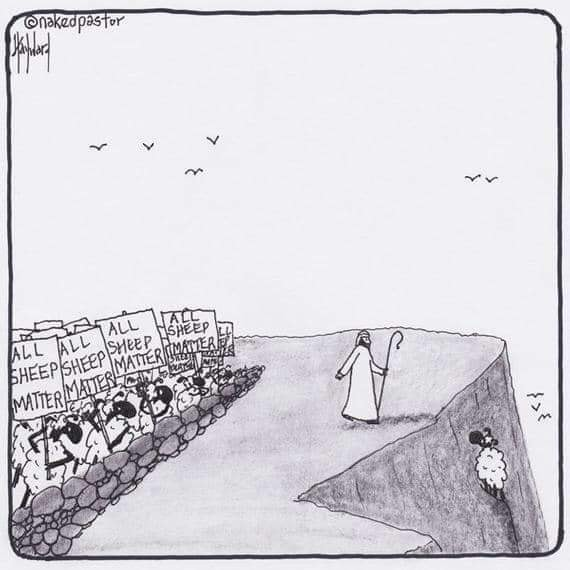
All Sheep Matter

In Luke chapter 15 Jesus tells the story of 100 sheep, but one goes missing and Jesus implies that he would leave the 99, and searches for the one. Can you imagine the 99 complaining, “But…what about us? Don’t we matter?” Of course they matter, but they aren’t the ones in danger. The one is.

When my little friend kept writing on her prayer request card, “Pastor Joe! Please, when can I be baptized?” At one level she might have just been a little girl wanting to enjoy the thrill of being dunked, but at another level, she might have been saying, “Pastor, Joe, see me! Hear me! Notice me and my heart for Jesus. Come find me!”

Please read what that little girl, who has grown up now, wrote in response to the death of George Floyd and the Black Lives Matter protests:

My name is Anonymous

I am Black and White.

Born of a Black Mother,

Born of a White Father.

Being a light skin,

I have been able to watch and learn from both sides.

I have been privileged enough to not have to put my hands on the wheel.

I have been privileged enough to be approached in public by authorities and not been scared because of what I look like.

I have been lucky enough.

 I have been lucky enough to not have the cops called on my mother because I am “not her child.”

I have been lucky enough that when I experience racism to not hold hatred from it, but disappointment.

I have been unlucky. 

I have been unlucky to feel neither accepted from the White community or Black community.

I have been unlucky to be told I have no say in the matter of racism.

I have been unlucky to witness the rifts that we have created whether between whites, light skins, or dark skins.

I have witnessed.

 I have witnessed both black and white categorizing ethnicities into a single bubble.

I have witnessed White men and women showing hatred towards Blacks.

I have witnessed Black men and women show hatred towards Whites.

I have learned.

 I have learned that The Black Lives Matter Movement holds an amazing statement.

I have learned that the movement is about raising our voices and fighting for social justice and equality.

I have learned that certain individuals within that community, both black, white, and all skins of color—have replaced their fight for social justice and equality with hatred.

I have learned that by replacing the fight for social justice and equality with hatred, has caused blindness to what the movement is meant to represent.

I have learned that hatred towards another race, no matter their origins, have kept us living in the past.

I have learned that only by accepting one another can we move forward.

I have learned that the violence during protests, whether caused by Blacks, Whites, Latinos, Asians and so on, have withheld us from moving forward.

I have learned that this violence has been uprooted through generations of hatred.

I have learned that this hatred that we have held onto will keep this country and this world in treachery.

I have learned that we won’t change every person’s heart,

But I have also learned that if we do not walk, side by side, hand in hand, with all ethnicities, that this movement holds no meaning.

And we will continue to live in a world of darkness forever.

We are all born,

But we cannot help who we are born from.

This serves for all ethnicities, not just one.

We can no longer show fear.

We were meant to demonstrate the voice with which we were given.

But we cannot do it without acceptance of one another,

And we cannot do it with hatred still carried in our hearts.”

Can you hear her? Will you listen to her?

Her life matters.

Posted in Uncategorized | Tagged , , , , | 2 Comments

Everyone Has a Story

But we had hoped that he was the one… Luke 24:21

Once upon a time, two men had placed all their hopes in a young leader. They just knew he was going to be the answer to all the questions they had asked all their lives. Not just the answer to their questions, but the answer to all the questions of their community. They had a story that they were part of a people, a special people, Israel, and they had a destiny. They had a calling. Their life wasn’t just about themselves.

They were going to be the glorious representatives of God and good and hope on earth, but their story had gone all wrong. There was no glory in Israel, just suffering. Way back at the very beginning they were in exile in Egypt in slavery, and then it was just one oppressor after another: Syria, and Babylon, and Persia, and Greece, and Rome. It was a story in search of an ending.

In the musical Les Misérables, the character Fantine found herself in a story that was heartbreaking. Through a combination of poor choices on her part and the sinful choices of others in her world, she finds herself on the backstreets of a French town doing unspeakable things to survive. In one of the most moving moments I’ve ever experienced either in the stage production or in film, Fantine sings a lament of her life:

There was a time when men were kind

When their voices were soft

And their words inviting

There was a time when love was blind

And the world was a song

And the song was exciting

There was a time

Then it all went wrong

…there are dreams that cannot be

And there are storms we cannot weather

I had a dream my life would be

So much different than this hell I’m living

So different now from what it seemed

Now that life has killed

The dream I dreamed

Jesus came along, and he was a prophet, powerful in word and deed. He said things nobody else ever said. He did things nobody else ever did, and they thought maybe he’d set the story right. He’d lead kind of a revolution on this world of goodness in the human heart, and overthrow oppression and the enemy, and make their people prosperous and great so all the world would know that Israel’s God rules the world, is King of the world. They had all these hopes, and things seemed to be going so well, and then he ends up on a cross.

The story went all wrong. But what they didn’t know yet was that it was a story searching for an ending. Rumors had swirled about sightings of their dead hope-bearer, but they were just idle tales and fake news, they thought.

Then this stranger came alongside them on their walk home, listened to them, asked them questions about their story, and told a better ending to the story they were living. With broken bread in his hands, they suddenly recognized that their hope had not died. It was sitting right in front of them. It was across the table from them. They saw the nails in his hands, they saw crumbs in his beard, and they saw the dance of delight in his eyes. Then he was gone.

Hearts swollen with hope, they scrambled to grab a cloak and ran back the seven miles to Jerusalem to be with their friends. They could not help themselves. They have to tell the story.

From which story are you living your life? Everyone has a story.

Our culture screams at us to live out the “Success Story”—get enough money, power, health, prestige, status you can. The problem with that is if you live with that long enough, eventually you will die, and they will bury your attractive, successful, wealthy corpse in the ground. What do you do then? What about all the suffering in this sorry world? It has to be something more than a success story.

Another story that is popular for many is the “Good old Days” story for our culture. The good old days, the good old days. This narrative of our culture wants to roll back the years and have it the way it was way back when. But I have a question about those good old days. How far back do we have to go to find the good old days?

The decade of the ’70s? Double-digit inflation and interest rates? Watergate? Iran taking over the US Embassy?

The decade of the ’60s? Were those the good old days? Vietnam…student protests…assassinations.

What about the ’50s? Were those days good for black people? Where they were being forced to attend separate schools? Drink at different water fountains?

Wanna go back to the ’40s? Were they good years? With the World War? The birth of the atomic bomb?

What about the ’30s? What about the Great Depression?

What about the ’20s when Ku Klux Klan was reborn to terrorize people of color, Catholics, and non-Nordic Europeans?

Wanna go back to the 1800’s where women couldn’t vote and the only good Indian was a dead Indian?

What some of us long for when we say the good old days…is that we long for a time when the rule of God will be everywhere. We long for shalom. We long for a time when no one is lost, and nothing is broken.

But those days are not behind us, they are in front of us. They are in little spheres of influence as kingdom-bringers walk this world and bring light to dark places.

The story we long for is the story of shalom, where up there comes down here. We long for the new heavens and the new earth. What is exciting is that because of the resurrection we get to be the remnant that brings shalom to our culture. How? By legislating morality; by putting prayer back in school; by electing the candidate that checks off all our boxes? No. By loving your neighbor as yourself.

You are not here by accident. You are made and loved by a God who cares about you more than you can imagine. Your story gets all messed up because we live in a sin-infected world bent on turning away from God, and we get it all wrong, and we can’t fix it ourselves.

There was a time

Then it all went wrong

So, one day this stranger came and lived and walked among us, and he said things nobody has ever said, and he did things nobody has ever done. He went to a cross, and it looked for all the world like a death like any other death, like that was the end of his story, but it turns out that when he was dying on that cross, he was dying for you and me. And because he was Jesus, he just couldn’t stay dead. On the third day, he was raised again.

The best news I can tell you is that because a dead man got out of a grave, your story is not over. And you and the risen Jesus can write the most glorious ending to your story.

You both can write a hope-story together.

O soul, are you weary and troubled?
No light in the darkness you see?
There’s light for a look at the Savior,
And life more abundant and free!

Turn your eyes upon Jesus,
Look full in His wonderful face,
And the things of earth will grow strangely dim,
In the light of His glory and grace.

So, get up my friend. There are miles and miles to go before we sleep.

Posted in Uncategorized | Tagged , , , | Leave a comment

Beautiful Scars

Jesus showed them His hands and His side…[and] said to them again, “Peace to you! John 20:20

This story in the life of the first disciples of Jesus is both haunting and hopeful. I know that sentence sounds strange, but it is still true.

Their future was before them and it was exciting. But that was seven days earlier when the thirty-three-year-old Jesus had ridden into Jerusalem and the crowds were singing his praises. On this night, however, they were fearful, uncertain, and hopeless. Their hopes had been brutalized on an instrument of torture and execution. On this night they were huddled together with the doors locked, the windows shuttered, and a lookout posted. On this night they were certain that every clamor of metal on the street below meant that soldiers with swords, shields, and spears were coming to arrest them.

They had possessed such grand hopes just days earlier about the coming of the Kingdom of God. Now those hopes lay on a cold slab somewhere. They must have wondered about how the Kingdom of God was going to come into the world now that Jesus was dead and gone.

And yet, while cowering in fear in that upper room, Jesus appeared in the midst of them. It must have scared them deeply because the first words Jesus said to them was “Peace be with you.” When you are so afraid that you have locked the doors and windows and a phantom of a friend you saw die materializes before your very eyes, I suppose peace would be very necessary because that would be haunting to anyone.

But then Jesus extended his hands to reveal the nail-holes in his wrists and lifted his robe to show a jagged open wound in his side and they knew this was no ghost. This person is their living, breathing, and locked-door-defying friend from Nazareth. They were ecstatic! Jesus tells them again, “Peace be with you.”

Have you ever lost hope and found despair?

There was a time I thought my life was over. I was forty-one and could not see a future. I was so broken, shattered, and lost I was sure that I would never know peace again. I needed to feel the peace of his presence.


One day I was at a bookstore thumbing through an art book and came across a form of art that gave me hope. It’s from Japan and called Kintsugi. It is a process that restores cracked vessels or broken ceramics with gold, leaving the piece even more beautiful than it started out.

The word Kintsugi is Japanese for ‘golden joinery’. The idea behind it is not to hide the ugliness and brokenness but instead to use gold to make it shine; to illuminate and expose the damage. And at the end of the process, the piece is even more beautiful having been broken.

That art reminds me of a stanza from a Leonard Cohen poem that says,

Ring the bells that still can ring
Forget your perfect offering
There is a crack a crack in everything
That’s how the light gets in.

What I had to offer Jesus would never be a “perfect offering.” Besides, He did not want my talent, gifting, or abilities. Jesus just wanted me, my wounds, and brokenness. They are his medium. They are his canvas, his clay, his art.

They are his specialty.

Just as the wounds of Jesus were the cracks in which the grace of God came into the world and healed me of my sin-disease, my wounds, and my weaknesses; my scars are the cracks through which Jesus’ resurrection grace will leak out into the darkness. It is his peace that is the mortar that holds my broken life together and brings resurrection art into the world.

So, no matter what you have done in your past or what you have failed to do, no matter the sins, even the self-inflicted ones, bring your brokenness to Jesus and receive his breath of peace into your life.

For his woundedness and our brokenness is his art.

He uses both in this dark world.

That’s how the light gets in.

Posted in Uncategorized | Leave a comment