Interruptions (A Christmas Sermon)

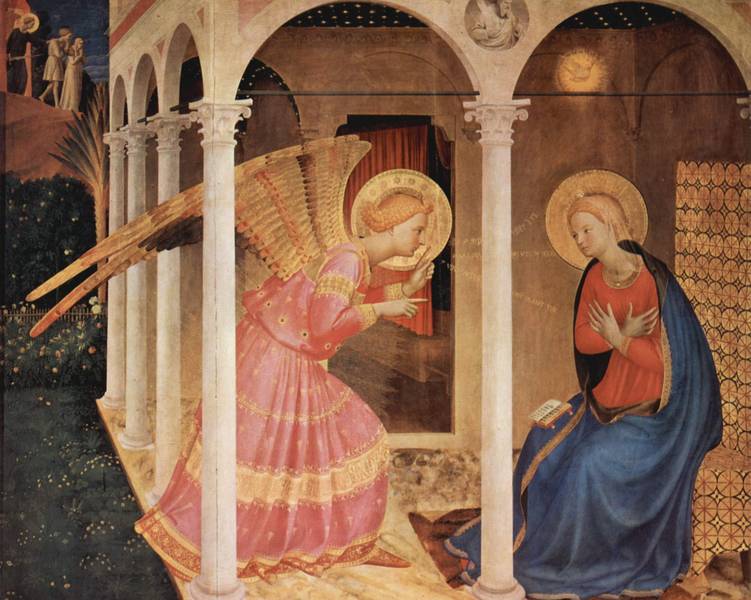
Now in the sixth month the angel Gabriel was sent by God to a city of Galilee named Nazareth, to a virgin betrothed to a man whose name was Joseph, of the house of David. The virgin’s name was Mary. And having come in, the angel said to her, “Rejoice, highly favored one, the Lord iswith you; blessed are you among women!”

But when she saw him, she was troubled at his saying, and considered what manner of greeting this was. Then the angel said to her, “Do not be afraid, Mary, for you have found favor with God. And behold, you will conceive in your womb and bring forth a Son, and shall call His name JesusHe will be great, and will be called the Son of the Highest; and the Lord God will give Him the throne of His father David. And He will reign over the house of Jacob forever, and of His kingdom there will be no end.”

Then Mary said to the angel, “How can this be, since I do not know a man?”
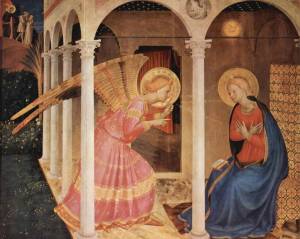
And the angel answered and said to her, “The Holy Spirit will come upon you, and the power of the Highest will overshadow you; therefore, also, that Holy One who is to be born will be called the Son of God. Now indeed, Elizabeth your relative has also conceived a son in her old age; and this is now the sixth month for her who was called barren. For with God nothing will be impossible.”

Then Mary said, “Behold the maidservant of the Lord! Let it be to me according to your word.” And the angel departed from her.  Luke 1:26-38

This is God’s Word.

I believe that one of the bravest people in the bible was a young girl named Mary. God comes to her with this incredible request: “Will you be the mother of the savior of the world?”

This isn’t, “Can you do me a little favor, Mary?”

This is a big ask.

And she says, “Yes.” Even though it comes as a huge interruption to her plans. She’s engaged to get married to Joseph, which means she’s about thirteen years old, that was the time that girls got engaged in that culture, and she’s got a lot of plans.

She’s got a wedding to plan and all kinds of stuff. But God interrupts those plans and says, “I’ve got a great idea, Mary. How about if, before you get married, you get pregnant, only Joseph, your fiancé, he won’t be the father, I will. What do you think, Mary?”

Talk about messing up your plans. When Joseph finds out he’ll probably cancel the wedding or worse, because in that culture the penalty for being unmarried and pregnant was death by stoning.

But Mary says, “I am the Lord’s servant, may it be to me according to your will.”

What a brave sentence. What a courageous girl. How many of us, when God asks us to do something, obey his commands, serve in his name, tell other people about him?

How many of us can say to God, “If you say so, Lord, I will, even if it interrupts my plans.”

I don’t know about you, but I don’t like to have my plans interrupted.  For I know the plans I have for me, plans to make me happy, very happy, and I do not want those plans interrupted.

The problem, though, is that life is filled with interruptions, isn’t it? Some of them wanted, and most of them not.

  • We get a health crisis,
  • or we get laid off,
  • or we don’t get married when we want to,
  • or we don’t get the promotion that we went after.

Now God doesn’t cause those kinds of interruptions, but they’re still interruptions.

But then there are the kinds of interruptions that do come from God. God asks us that we obey his commands:

  • Such as observe the Sabbath
  • Save sex for inside marriage
  • Avoid gossip, and that interrupts our plans to do exactly what we want when we want to do it.
  • Be reconciled with people that we are mad at:, and that interrupts our plans to stay mad, and nurse a grudge, and feel self-righteous and bitter, and die of a heart attack because of the stress of it all. It’s a bad plan, but it’s ours, and we don’t want to let go of it.
  • God invites us to participate with him in redeeming the world by serving in some way, maybe just caring for a neighbor, and that interrupts our plans.

But Mary seems to understand a couple of things about interruptions that we don’t, and that allows her to say yes to God…

  1. God is our Discomforter, as well as our Comforter.

God is definitely moving Mary outside of her comfort zone, but she knows that that is a good thing. We often think of Jesus as our comforter in times of trial, and he does do that. But Jesus not only comforts the afflicted, he also afflicts the comfortable, for our own good.

Because we need to get out of our comfort zones from time to time, otherwise we get stuck in life and we don’t grow.

You’re probably bored. Probably looking for some kind of artificial thrill like…

  • Substance abuse,
  • or pornography,
  • or workaholism,
  • or just buying more things for the thrill of the purchase.

God will often take us out of our comfort zone in order for us to begin to grow and to have life again.

When you’re green you’re growing, when you’re ripe you’re rotting.

If you want a spiritual rush in life, pray this prayer, “Lord Jesus, take me out of my routine, stretch me so I can experience you in a new way.”

Just pray that prayer. I dare you. I double dog dare you, because God will answer it, and will give you an adventure that will light up your life.

God is our discomforter, as well as our comforter, and that’s a good thing.

The second thing that Mary understands about interruptions that allow her to say “yes” to God, is…

  1. With God all things are possible.

God’s request to Mary seems impossible, and she points that out. “Lord, don’t mean to nitpick the details here, but how am I going to have this kid since I am a virgin. Don’t mean to be fussy, but that seems like a problem.”

The angel says, “With God all things are possible.”

Often the interruptions in our lives seem impossible to handle.

  • A health crisis,
  • A financial problem
  • A relationship problem seems impossible.
  • Or the things that God asks us to do seem impossible.
  • It seems impossible to serve in his name, impossible to obey his commands.

We often think,

  • I don’t have the time,
  • I don’t have the talent,
  • I don’t have the resources,
  • I don’t have the discipline.

But with God all things are possible.

A while back I was feeling a little worried about some challenges I was facing.  So, a few weeks ago I was sharing deeply from my soul about this, AKA whining, to a friend of mine, and you know what he did? He mocked me. He mocked a pastor. I don’t know where it is in the bible but I’m sure that that is a sin. I’m sure it says somewhere “thou shalt not mock thy pastor.

He said, “Yeah, God created the universe out of nothing, he parted the Red Sea, he raised Jesus from the dead, but Joe, you’re right, your problems, he can’t handle those, those are too big for him.

In fact, God is up there wringing his hands right now saying, “Man, I’ve held the universe together for all of eternity, but Chambers’ problems,— they’ve got me stumped!””

I indicated to my friend that he did not have a future in pastoral care. But he did have a good point. Do we trust? Do we trust that the God who is big enough to make the universe out of nothing is big enough to handle the interruptions and problems in our life?

God brings life in the interruptions. God is our discomforter, for our own good. With God nothing is impossible.

The third thing that Mary understands about interruptions is…

  1. God’s plan is sometimes harder, but better.

When the angel greets Mary he says what I think is a very ironic thing.

He says, “Greetings, you who are highly favored!”

Highly favored? And what is this great privilege that Mary gets for Christmas?

  • She gets to be pregnant and unmarried, the penalty for which was death;
  • She gets to give birth in an cave around dirty animals with animal stuff everywhere; then
  • She has to flee to Egypt as a refugee so the insane King won’t kill her son; and then
  • She has to be the mother of Jesus, which I think would be pretty hard, not because he was bad, but because he was perfect.

(Can you imagine how irritating a perfect child would be? You can’t send the son of God to his room, he sends you to yours. And you’d have to go.)

  • She has to watch her special gift from God die on a cross.

And this makes her the “highly favored one?”

And yet…and yet that first Christmas night…

  • She gets to hold the God who made her in her arms, and ponder the mystery that the child that she just delivered will soon deliver her from her sins.
  • She gets to see her son turn water into wine.
  • She gets to see him raised from the dead on Easter morning.

God’s promise to her is that she will be called “blessed” for generations, and that’s what has happened.

For 2,000 years she has been revered as one of the greatest heroes of Christian faith. Sometimes a little too revered, but nevertheless, a genuine, authentic hero.

“Hail, O favored one,” indeed. God’s interruptions to our plans are sometimes harder, but always better.

Mary was planning a nice peaceful life: get married to Joseph; have a couple of kids; maybe move out to the burbs. But God said, “Mary, I’ve got so much more for you than that.

  • I don’t want you just to have a kid; I want you to have a king.
  • I don’t want you just to raise a son; I want you to raise a savior.
  • I don’t want you just to have a family;
  • I want you to have a faith that’s worth dying for, but more importantly, a faith that’s worth living for.

God interrupted her plans, but in a glorious kind of a way.

The last thing that Mary understands is…

  1. God brings life in the interruptions.

John Lennon said that “life is what happens when you’re busy making other plans.”

For Mary this is a huge interruption, but there’s life in that interruption. She gets to be the mother of Jesus, that’s life.

I love what Henri Nouwen wrote in, Reaching Out,

While visiting the University of Notre Dame, where I had been a teacher for a few years, I met an older experienced professor who had spent most of his life there.  And while we strolled over the beautiful campus, he said with a certain melancholy in his voice,

“You know…my whole life I had been complaining that my work was constantly interrupted, until I discovered that my interruptions were my work.”

29 Mary was greatly troubled at his words and wondered what kind of greeting this might be.

Part of what might have troubled Mary besides having an angel appear before her—that doesn’t happen every day—is that inside her womb would be life that was not there yesterday.

That is an interruption of eternal significance.

In 2011 I planned to go backpacking for a week. But my plans were interrupted when two days in to my trip I broke my leg.

I was in an isolated place in the mountains, by myself, and without cell phone coverage.

I had slipped on some wet grass and the torque of my fall broke the fibula in my right leg. I endured severe pain for several days as I waited for someone to come along and send for help.

My rescuer was a young man named Boris, who volunteered for Search and Rescue. He was hiking on his day off when he found me and radioed for a helicopter to come to our location. While we waited, we talked. I found out he was born in America and moved with his folks back to the Netherlands when he was quite young.

I asked if he was married and he said he was going through a divorce.

The Search and Rescue helicopter arrived, and I said goodbye. I yelled as loud as I could over the sound of the chopper blades, “Thank you, Boris!”

End of story, right?

Wrong.

On Sunday, September 1, 2013, I stood up to preach in my church, and sitting in the congregation was Boris. I announced his presence to the congregation and they gave him a hero’s welcome. What Boris didn’t realize was that it was the anniversary of the day he had found me in the wilderness two years before.

I invited him to our house for Sunday lunch and asked him why he had come to church that day. He said many things, but the one thing that stood out to me was that he said he was missing something in his life and wanted to explore Christianity. We made plans to go on a hike together later that week. Then he came to church again, and we met for coffee and talked further about issues that had prevented him from embracing faith in Jesus.

After answering as many questions as I could over the course of several conversations, I finally asked Boris if he wanted to become a Christian by pledging his life to Jesus. He said yes and was converted

Boris was baptized on September 19, 2013, in an alpine lake in the Northern Cascades of the Pacific Northwest. We stood waist-deep in icy water and I recited words that I have said hundreds of times in my ministry: “I baptize you, my brother, in the name of the Father, Son, and the Holy Spirit.” This time, my voice quivered not from cold, but from the mystery of how God accomplishes His will.

The rescuer had been rescued. It was an interruption that brought life…eternal life to a lonely man named Boris.

  • When I broke my leg, that was an interruption.
  • When Boris had to cut short his day hike to rescue me, that was an interruption.
  • When Boris came to my church and then to lunch at my house that Sunday (which was my wife’s birthday), that was an interruption.
  • When Boris prayed to become a follower of Jesus, that was an interruption to the life he had planned.
  • It was an interruption, but God brought life out of it.

Question

If tonight God came to you just like he came to Mary, and he said, “I want to be born through you. I want to use your body to bring the savior into the world.”

What would you say?

The fact is, God is asking that of each one of us. He asks each one of us,

  • Will you be my hands?
  • Will you be my feet?
  • Will you be my voice?
  • Will you show who I am to a hurting world?

It can simply be caring for a neighbor or coworker to show them who Jesus is.

He doesn’t force us to do it. He didn’t force Mary. He simply invites us into it.

So, what are the interruptions in your life? And whether they’re just the normal part of life, or the ones that come from God, this week, can you pray, “Lord, show me how you want to use these interruptions, to bring life, to get me out of my comfort zone.”

Pray that prayer, knowing in your heart that with God, all things are possible, and that even if it’s harder, with God it’s always better.

And then ask, “how can I begin to live a life that is interruptible?” so that you can follow God in those interruptions into a deeper, more fulfilling life than you could ever have planned on your own?

He promises us that, and he always keeps his promises.

Posted in Uncategorized | 2 Comments

Feeling Alone and Unloved This Christmas?

Madelyn Murray O’Hair, the outspoken atheist who was instrumental in getting prayer removed from public schools seemed, on the surface, to be tough as nails. Yet recently her journal was uncovered and numerous times she had written, “Somebody, please love me.”

People will do just about anything in order to feel loved. Some people think, “If I succeed enough, people will love me,” or “If I sleep with this person, he or she will love me,” or “If I am pitiful enough, people will feel sorry for me and begin to love me.” The problem is, none of these strategies work. Those who pursue love by means of success usually end up feeling used and unappreciated. The same can be said for those who try to trade sex for love. Those who use a pity as a means of earning affection usually find that pity soon turns to contempt, and they end up feeling alone and abandoned.

I have discovered that most people who feel unloved have a distorted view of reality. They aren’t really completely unloved–they just don’t recognize the love that is in their life. Their emotional pain blinds them to the fact that they have friends and family who love them very much.

I want to say this to you: If you sometimes feel unloved, or if you really are in a position in life where there is no one at all that loves you, there is hope for you today.

Most of you have heard of Kurt Cobain. He was in the band Nirvana, and he single-handedly started a new trend in the world of rock music–it was called “Grunge” music. He sold millions of albums, he had millions of fans, and the critics loved him. He had a beautiful wife and a daughter. And then, on April 5, 1994, he committed suicide. After it happened I saw an interview with a psychiatrist on CNN, and the question was asked, “How could a man who was loved by so many reach such a level of despair?” The psychiatrist said, “The adoring fans were a very small part of Kurt Cobain’s life. His misery was caused by the fact that he felt estranged from the people that mattered most.”

If you feel unloved, there is a hope I can offer you today: There is someone who loves you, and he matters very, very much. And he has gone to amazing lengths to prove it.

God loves you. Most of you have heard that statement thousands of times throughout your life–maybe so many times that the statement has lost some of its impact. Some people think, “Yeah, God loves me. So what? He has to–he loves everybody.”

I want to make something clear: God loves you with all of his heart, and it’s not because he got stuck with you. He doesn’t love you just because you’re part of the big mass of humanity. He loves you individually. He loves you as if you were the only one in the world to love. No matter what you have done, or no matter what your life has been like, God loves you. He wants to share his love with you.

The Lord did not set His love on you nor choose you because you were more in number than any other people, for you were the least of all peoples; but because the Lord loves you… Deuteronomy 7:7-8

…the Lord loves you.

Need proof?

Greater love hath no man than this, that a man lay down his life for his friends. John 15:13

Look at the cross.

Beyond this God cannot go.

Posted in Uncategorized | Tagged , , , , , | 1 Comment

The Peaceable Kingdom

The wolf shall live with the lamb… and a little child shall lead them. Isaiah 11:6

There is a movie that I enjoyed a few years ago called “Grand Canyon.” And one of the characters in that film is an attorney named Mack and he is locked in an L.A. traffic jam. He takes a short cut through a part of L.A. that is notorious for its street gangs. He moves deeper into bad neighborhoods until finally his fancy sports car stalls in a sketchy looking neighborhood.

Mack calls a tow truck, but before the truck could arrive a low-riding car with base-pounding music pulls up behind Mack’s car. A group of neighborhood street thugs start piling out of that low-rider and move towards Mack and his nice car.

They surround his car and begin to hassle him and just about that time the tow truck pulls up and out steps an earnest and serious looking man named Simon (who is played by Danny Glover).

All of the street thugs start to protest and threaten both Mack and Simon until Simon takes aside the leader of the street gang and says this:

Man, the world ain’t supposed to work like this. I mean, maybe you don’t know that yet. I’m supposed to be able to do my job without having to ask you if I can. That dude is supposed to be able to wait with his car without you ripping him off. Everything is supposed to be different than it is.

That is a graduate ethics course on a street corner. Simon’s street-side speech is a summary of what all of us experience in this world. Everything is supposed to be different than it is.

What we see on our news, what we see in our cities, what we see in our own community, and what we see in the mirror every morning is not the way it is supposed to be.

When you go to your kitchen faucet and fill a glass of tap water and then turn on the news to learn that every year in our world 3.4 million people die of simple, curable water related diseases…you might think to yourself, Everything is supposed to be different than it is.

When you think about the fact that most of us in this room grew up in a family that supported your education experience so that you can read, write, and do basic math— you will have exponentially more opportunities in life than many of the kids that grow up in the inner cities like Denver and Dallas. If you are honest you will say to yourself, Everything is supposed to be different than it is.

When you open the first pages of the book that we love we see a story of a Creator who fashions the cosmos, galaxies, worlds and a human family that is deeply good. God creates the world as an interwoven tapestry of relationships and goodness that is woven together in beauty and delight.

God creates a world that is good, just, and kind. It is swollen with possibilities. But early in the story our primal parents turned their backs on our Creator. And as that happens the fabric of the tapestry of God’s good creation is torn and begins to unravel.

The unraveling that sin has brought into this world tears at families, societies, and even the molecular structure of creation itself. Everything is supposed to be different than it is.

No other approach to God is like the Christian story. Lots of other religions talk about God’s compassion for the poor—but only the Christian story says God becomes poor. When Jesus came to us in that manger, God became the poor and the powerless. God suffers injustice to draw out its sting, undo its power, and begin the work of restoring his world.

As we see what God has done for the weak and poor in Jesus, we who follow him—if we follow him close enough for the dust of his sandals to get on our clothes—then we will follow him down into obscurity, weakness, and poverty.

If you want to do the works of the One who is high and lifted up, serve the ones who are low and leveled down. ~ Beth Moore

This is why it is hard for some of us to understand why so many “Christians” are so supportive of policies in local, state, and national governments that seem to do so much harm to the poor and the powerless of our society.

If we follow closely the Jesus described in Scriptures, He will lead us to places that He would go and do the work that he would do. Honestly, I’m not certain that is where the majority of Christians in America want to go. They want to stay insulated and away from the poor and marginalized.

It is customary for self-righteous preachers from pulpits and Christian celebrity wags on television to whine and complain about how commercialized and materialistic Christmas has become. The war on Christmas that so many are concerned about is about getting back the true meaning of Christmas that does not include materialism.

But may I be so bold as to say that I think just the opposite is accurate. Christmas is a very materialistic celebration. Because the Christmas story is a narrative of a God who came to inhabits cells, sinews, and sinuses—and to do something about what is wrong with this material world.

What this means is that was we walk closer to our rabbi and Savior, we will learn how to have a more materialistic Christmas. Christmas is good news for this material world. And that means that you and I ought to be diligent about how we can address the tears of this world.

So, go out and tell your family and friends that your pastor told you to go out and have a more materialistic Christmas. Maybe instead of singing “Have yourself a Merry little Christmas” we could adapt those lyrics to say, “Have yourself a materialistic little Christmas.”

How do we do that?

When you look at the life of Jesus, you don’t see him standing up for the poor out of anger or paranoia. But out of the deep communion with the God he calls Father. Out of a deep interior life of love with the one he calls Abba.

When you look at Jesus you see someone who is brim-full with God’s Spirit; who delights in the presence of God. All of Jesus’ preaching, teaching, and ministry comes from those deep wells of communion with God in prayer.

We pray and then we act.

When you look at Jesus, you are actually looking at God getting dirt under his fingernails in the pain, suffering, and wrong of this world. And God invites us to be like Jesus and actually do something about the wrong and neglected in our community.

You could start by noticing a neighbor who looks lonely and begin a relationship with them. You could start by opening your home to someone who needs someone to talk to.

Start somewhere, start small, and do something.

There is a “Now” that God has accomplished in Jesus in the manger in Bethlehem, but there is a tomorrow that is not here yet.

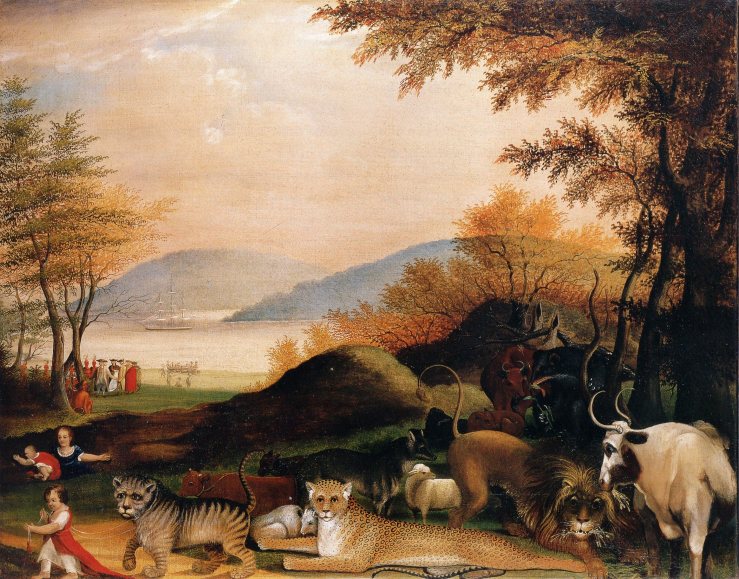
Maybe you have seen the artist Edward Hicks depiction of this scene in a painting called The Peaceable Kingdom. Edward Hicks was a 19th century Quaker minister and painter. During the course of life, he was fascinated by this vision of a healed world and actually, painted this vision at least 62 times.

As he painted that scene over and over again in his life, the painting morphed as did his understanding of life in this world. Towards the end of his hard life, disillusionment began to creep into his faith so that one of the last versions of Peaceable Kingdom shows a darker scene. The child is still there but the animals have changed so that they all look more predatorial. Their claws are showing, and their fangs are bared.

If we are honest, you and I still live in a claws-out, fangs-bared kind of world. So, this “Not Yet” half of Isaiah’s vision invites us to discipline of waiting.

I find it interesting that in our world that is allergic to waiting, we Christ-followers still have to endure bared fangs and claws as we look out our windows towards the eastern skies and wait for the coming of our Lord. That is the day when everything that is supposed to be different—is different.

In the meantime, we are called to wait now—for a great future in which God will make all things new. Waiting is holy not-doing. It is disciplined looking ahead with your mental and emotional energy, your imagination, and your deep yearnings for that NOT YET day.

And so, my friend I hope you have yourself a materialistic little Christmas this year.

Posted in Uncategorized | Tagged , , , , | Leave a comment

Sturdy Hope

Phillip Brooks was an American Episcopal clergyman and author. In the month of December of 1865, he took a trip to the Holy Land. He wanted to study and reflect on the life of Jesus on Christ’s native soil. On Christmas Eve he made the short journey from Jerusalem to Bethlehem, where he assisted in the celebration of a midnight communion service.

When he returned to America and was reflecting on his experience in Israel and specifically that night in Bethlehem, he wrote the Christmas song, O Little Town of Bethlehem.

You can almost imagine him remembering that clip-clop horseback ride down through the narrow streets in the dark night on Christmas Eve in 1865 when you hear the words from that favorite old hymn.

O little town of Bethlehem

How still we see thee lie

Above thy deep and dreamless sleep

The silent stars go by

Yet in thy dark streets shineth

The everlasting Light

The hopes and fears of all the years

Are met in thee tonight.

That line in that old hymn distills in eight words what the Christian family has experienced for two thousand years. The great and deep longings of the human heart for spiritual reality; for peace, for justice, for a sense of home in the world—all find their resolution in the person of Jesus.

I wonder what kinds of images and emotions come to the surface of your heart when I say the word “hope.” How might you have used that word in the last week or so?

As you plan your holiday parties, you might glance at the weather and whisper, “I hope the weather cooperates.” You get ready to watch the Denver Broncos play another football game and you say to yourself, “I hope they don’t embarrass me again this week.” Perhaps you got into a car after Thanksgiving this year and you drove home alone and thought to yourself, “I hope next year someone will be with me on this journey home.”

What do we mean when we use the word “hope”? Often, we are really saying, “I wish this would happen, but I don’t seriously expect anything to happen.” But followers of Jesus have meant something stronger, more stable, and more energetic when they use the word “hope.”

The prophet Isaiah gives us a vision of hope and he tries to paint a picture for us of a great promised day when God would step into history to heal it and to restore it.

He shall judge between the nations,
and shall arbitrate for many peoples;
they shall beat their swords into plowshares,
and their spears into pruning hooks;
nation shall not lift up sword against nation,
neither shall they learn war any more.
Isaiah 2:4

While these words are emblazoned on the United Nation building in New York, they are more than about cease fires in the middle east and nuclear containment. This is a vision of a world put back together and restored to pre-fall status.

Isaiah is pointing to the day when God steps into this broken world to heal it. Restorative justice will triumph. Truth will prevail, wrongs will be made right and God will stand up for all of the kicked down and trampled upon of all history. And on this great day—peace, shalom will win the day. On this day weapons of death and human destruction will be transformed into tools to be used for human life and flourishing. This day will be a day where humanity will forget how to harm each other.

When we purchased our home, the owner left several antiques and I would take pictures of them and send them to my brother, who is an antique dealer, and ask, “What is this and what was it used for?”

Isaiah is telling us that there is coming a day when we are going to come across a bomb, or a drone, or AR-15 and ask God, “What is this and what was it used for?” 

     Many peoples shall come and say,
“Come, let us go up to the mountain of the Lord,
to the house of the God of Jacob;
that he may teach us his ways
and that we may walk in his paths.”
Isaiah 2:3

This is describing a gathering of folks from every tribe, color, and language that would otherwise never associate with one another, but who are worshipping God. So, if associating with people of color is awkward for you, you are going to find heaven an uncomfortable place. At the center of this gathering is this vision of a mountain.

 In days to come
the mountain of the Lord’s house
shall be established as the highest of the mountains,
and shall be raised above the hills;
all the nations shall stream to it.  
Isaiah 2:2

Now, mount Zion in Israel is not that tall, as mountains go. The point here is that where God’s house or Temple is a transcendent place.

Some sights have taken my breath away—appetizers of transcendence. Like the first glimpse of my wife in her white wedding gown as she walked down the aisle of the church. Like the sight of my first son squirming, screaming, chin quivering and arms flailing as the nurse wiped gunk off his nearly ten-pound body. Like the first time I saw the Grand Tetons and averted my eyes because it was as if I were looking at the very face of God.

The way the Jews thought of the Temple is that it was a thin place where God’s dimension of reality and mankind’s dimension of reality overlapped and interlocked. It’s where flawed people like you and I could be in God’s perfect presence. It’s where God’s presence was available to sinners like us.

Isaiah is promising that there will come a day when all kinds of people from all over the world will be gathered together in God’s presence. A world-wide family connected to each other and connected to their creator in this thin place.

The Christian story, properly understood and practiced, ought to make us hope-bringers and peacemakers in a fallen world starving for both. Christian hope is a vision of tomorrow that gives us direction, energy, and strength for today.

O house of (O people of God),
come, let us walk
in the light of the Lord!

We live, serve, create, educate, work, love, forgive, make peace, and study now with sturdy hope because we have our eye on this great promise of tomorrow. We know where God is taking us, so we walk in the light of that great tomorrow—today.

The late Lewis Smedes reminds us, “Keep hope alive, and hope will keep you alive.”

Jesus is that blessed hope. That’s where all your hopes and fears belong.

Posted in Uncategorized | Tagged , , , , | 1 Comment

Be The Change You Want To See In The World

All empty souls tend toward extreme opinions. ~ William Butler Yeats

Your discipleship program is perfectly designed to produce the disciples you have. ~ Dallas Willard

In my first pastorate in Oklahoma there was a crusty old man named Steve. He was a charter member of the fifty-year-old Baptist Church. He was mean, cranky, and critical. I’m not sure any pastor that ever pastored that church met his expectations.

One day in the gravel parking lot in front of the parsonage next door to the church, Steve mentioned a list of sins that he thought was wrong and that I needed to preach about. It was the stock list of Baptist sins: Drinking, dancing, going to movies, and women wearing pants in church.

In, what I was sure was a snarky tone of voice, I said, “That’s quite a list, Steve. You left off smoking.” I winked.

With a fierce look in of his eye and a filter-less camel hanging from his lips he said, “Pastor, I don’t’ care if Jesus Christ walked around the corner of that Church right there and told me that smoking cigarettes was a sin and that I should quit, I would NOT do it.”

I stepped back a few feet, in case of lightning strike, and whispered, “Get him, God!”

Steve was not changing. He didn’t love his family much. He didn’t love other people much.  He was easily irritated. He had a judgmental spirit in him. And he was a legalist.

But was troubling was not just that he wasn’t changing. What was troubling was the fact that nobody was surprised by it!

Nobody said: “We ought to call in a consultant from some place, or we ought to have an emergency meeting of the deacons to consider this strange situation where there’s somebody who’s come into our church week after week, year after year, and kind of been doing church life the way that we say church life ought to be done, but he’s not changing.”

Often folks in that church would just say, “Pastor, that’s just Steve being Steve. It’s just the way he is.”

I’m sorry, but that is not good enough for Steve. It is not good enough for me either.

I want to be a man of peace, but I fear, more often than not, I’m an agitator. How can I change? More importantly, how can you change?

Train yourself to be godly. For physical training is of some value, but godliness has value for all things, holding promise for both the present life and the life to come.  1 Timothy 4:7-8

To train means that I arrange my life around those activities that enable me to do what I cannot now do by direct effort.

If you want to be free to make great music, you’re probably going to have to practice scales and do some training. It’s true of intellectual transformation, and it is no less true of transformation in the spiritual realm.

I think largely because we live in a society of instant gratification—this wisdom has almost been lost in our day.

I want to change. So, I wonder if you would join me in in a training program to do whatever it requires to be a person of peace this Christmas season. To be a peacemaker, like Jesus called us to be. How in the world could we be people who make peace?

Well, one of the ways is to figure out what stimulations you allow in your life that bring agitation. To identify and isolate your agitation triggers. So, for me that means that in the month of December, I am going to fast from the trigger points of my lower angels.

  • Cable News—For me what happens coming from the White House can send me into spirit of anger. For you that might be anything that comes from CNN or MSNBC. Here’s an idea: Don’t watch it.

Here is some great advice from Dorothy Day:

“Turn off your radio. Put away your daily paper. Read one review of events a week and spend some time reading good books. They tell too of days of striving and of strife. They are of other centuries and also of our own. They make us realize that all times are perilous, that men live in a dangerous world, in peril constantly of losing or maiming soul and body. We get some sense of perspective reading such books. Renewed courage and faith and even joy to live.”

(Journal Entry, 28 September 1940)

  • Social Media—If what is showing up on your Facebook page causes you heartburn, curb your access to it. For instance, if you have a smart phone you could take social media off of your smart phone. I love seeing pictures of my grandkids on Facebook. So, I don’t think it necessarily a positive to do away with it completely, but I can discipline myself to log in at my computer and set a limit to how much time I give myself to surf through social media.
  • Email Chains—If someone forwards you an email about Hillary Clinton, Barak Obama, or Judge Roy Moore, don’t read it. Just delete it without reading it. You can do this.
  • Spread Peace—instead of passing along the bile that you feel about the culture wars locally, nationally, or globally, try sending positive scripture verses and sentence prayers.
  • Spend more time praying than complaining about anything.

Would you consider joining me in these disciplines for a few weeks? Let’s claim and live during the month of December the words of the wise old Apostle Paul,

Whatever is true, whatever is noble, whatever is right, whatever is pure, whatever is lovely, whatever is admirable—if anything is excellent or praiseworthy—think about such things. Whatever you have learned or received or heard from me, or seen in me—put it into practice. And the God of peace will be with you.

We ought to be the kind of people that if Jesus Christ himself walked around the corner of our church and said that a certain attitude was a sin and for us to stop it, we would move heaven and earth to be obedient to the One who died for us.

Then maybe people would say about me, “That’s just Joe being Jesus. It’s just the way he is.”

And peace would have found its way into this world.

Posted in Uncategorized | Tagged , , , , | 7 Comments

Weird Stuff Jesus Said

Very truly, I tell you, unless you eat the flesh of the Son of Man and drink his blood, you have no life in you. Those who eat my flesh and drink my blood have eternal life… ~ Jesus

Whoa. Imagine hearing this for the first time. Imagine hearing this without any previous experience of the Lord’s Supper. Imagine a young, perhaps educated, couple attending church for the first time in their lives—this Sunday as this passage is read!

Imagine hearing Jesus say these words.

We know that some in the crowd took such offense at Jesus that they stopped following him because he said these things.

Eat my flesh. Drink my blood. If you don’t you’ll die. If you do, you’ll live forever.

He drives this point home with clarity and repetition.

We hear it—as people who are “churched”—and I think we largely let the bombshells land around us without much reaction. I mean, of course Jesus is talking about Communion…right? We hear these words against a lifetime of hearing: take, eat, this is my body…take drink, this is my blood of the new covenant.

For us, they have lost their offensiveness.

But, Jesus didn’t launch these rhetorical bombshells so that they’d fizzle with time.

No, I think it’s clear that Jesus was stirring the pot on purpose. He wanted to say things that challenged people, even to the point of having to decide that they’d have to leave.

One thing is clear here: Jesus isn’t about people-pleasing. He’s not about glad-handing, and smoothing out the wrinkles so that everyone can go away happy, and come again happy. He’s not about just saying and doing just about anything to attract a crowd.

Jesus and Eugene Peterson agree where Peterson said,

Being a pastor who satisfies congregations is one of the easiest jobs in the world. If we are content to please congregations.

If you read through the rest of chapter six of the Gospel of John, you will see that many people are offended and leave Jesus after this teaching. And in the very earliest days of the Christian Church, one of the main charges of the critics of Christianity was that followers of Jesus were cannibals. (Today we think it difficult that we are associated with white supremacists or shady politicians.)

How can he say that?

Jesus knows that there is a hunger that is deeper in and further down than all of our physical hungers, thirsts, and cravings.

Jesus is saying that behind every biological hunger is a spiritual hunger—and that is what I have come to satisfy. Behind every physical and social craving is a spiritual longing that only Jesus can provide.

All of theirs and our cravings and longings are aches for God. His love, mercy, grace and presence in our inner most being.

As a pastor, I can tell you that I know many people who have full stomachs and emaciated souls.

Listen to your hungers; listen to the rumblings in your own life right now. Jesus is saying, “I am what you are aching for—come to me for life.”

I love the way the old hymn writer, Clara T. Williams, writes about this life…

All my life I had a longing
For a drink from some clear spring,
That I hoped would quench the burning
Of the thirst I felt within.

Feeding on the husks around me,
Till my strength was almost gone,
Longed my soul for something better,
Only still to hunger on.

Poor I was, and sought for riches,
Something that would satisfy,
But the dust I gathered round me
Only mocked my soul’s sad cry.

Well of water, ever springing,
Bread of life so rich and free,
Untold wealth that never faileth,
My Redeemer is to me.

Hallelujah! I have found Him
Whom my soul so long has craved!
Jesus satisfies my longings,
Through His blood I now am saved.

May you come to Jesus for life, no matter how weird what he says may sound to your hungry heart.

Posted in Uncategorized | Tagged , , , | Leave a comment

Fierce Spirituality

When I was a twenty-eight-year-old pastor I thought it would be a good idea to preach through the book of Romans verse-by-verse. I was out of my depth. If you have ever spent much time in the book you might know that it is a complicated book. But I had moxy, if not naivete, when I was twenty-eight, so I went for it.

One morning I was preaching hard on a complicated passage. And as often was the case for me back then, if I was uncertain about a text, I turned up the volume. There’s an old preacher legend that says he wrote in his notes, “Weak point here, yell louder.”

That was me.

At one weak area I got loud and then I got quiet, not really knowing what to say next. In that pause in my sermon, a little eight-year-old boy said in a loud voice to his mother, “Mamma, what’s that man talking about?”

I looked at him and said, “I have no idea, son. No idea at all.”

The church laughed, and I bowed my red-face and closed in prayer. It was a scarring moment for me. I rarely preach from Romans to this day.

And from the days of John the Baptist until now, the kingdom of heaven suffereth violence, and the violent bear it away.”  ~ Matthew 11:12

Mamma, what’s Jesus talking about?

The context is Jesus telling us about John the Baptist. In the beginning John the Baptist came preaching a message, and the message was, “The Messiah is coming to bring in the kingdom of heaven.”

That’s not as esoteric as you might think. Bottom line, the kingdom of heaven means someone is coming to put everything right, to right all wrongs. We are all looking for hearth and home that will allow us to flourish as God intended. My problem is that I have a habit of looking in all the wrong places.

The Kingdom of God is the natural home of the soul. ~ Dallas Willard

We all long for a place like that. And in that search for home we will find ourselves in places that make it hard to come home. It will take a fierce spirituality to make that journey.

My son, Clinton, was raised in the Church but now is deeply immersed in the art world of Los Angeles. No one in his world is interested in the Kingdom of God. In fact, they are violently opposed to it. My wife and I love him very much and pray for him almost every day that he would return to the faith of his youth.

But one of the most powerful reasons it will be difficult for Clinton to come back to the faith is because he would have to go against the flow.

We hold our world views for a combination of three reasons:

1. Intellectual: It makes sense to us.
2. Emotional: It resonates with my feelings.
3. Social: My friends or important influencers hold a similar position

That’s why I can out argue someone on an intellectual basis and still not convince them to change their minds. Statistics, facts, reasonable arguments often don’t work in winning someone to faith because of the other two factors that are still in play.

That is why I pray that God will send my son, a spiritual guide, an influencer, who will win his heart over and then, maybe, just maybe, he will change his mind about Jesus.

Jesus says, “Look at John the Baptist. Because he got radicalized by the kingdom of heaven and that message, he’s an outsider. Anyone who wants the kingdom of God, anyone who wants to follow me, must be willing to take the scorn of other people.”

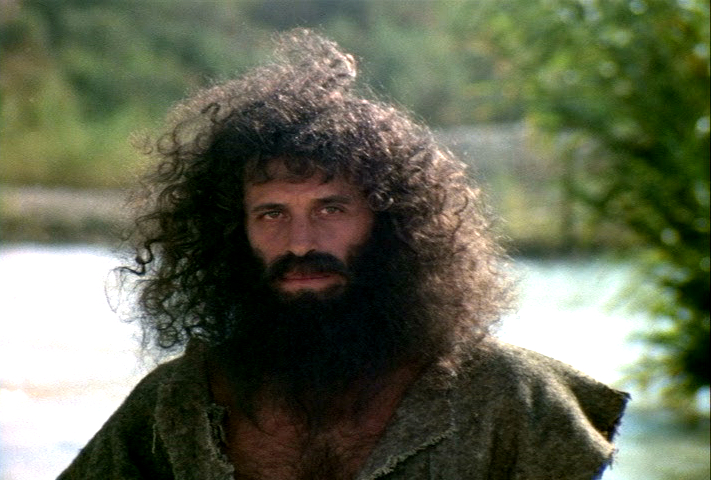
If or when my son comes back to his faith and is radicalized by the grace of Jesus, he will be scorned in the community that he loves right now. They will see him as a man in a hair shirt, eating locust, and crying out in the desert. They will see him as a wild man. It will take a move of God and the heart of a hero for Clinton to go against that social flow.

Jesus says anyone who will receive the kingdom of heaven and realize its truth is going to look like John the Baptist to some people, sometimes. You have to be willing to have people think you’re crazy.

Once John the Baptist got ahold of the idea of the Kingdom and a coming King, what did it do to him? It turned him into someone crying out in the wilderness, wearing a hairy shirt. It meant everything to him. It radicalized him. It also put him outside of the power structures of the day.

Jesus says, “When you see him, you don’t see a person who’s a nobleman. He’s not someone from the king’s palaces. He’s spiritually intense.” Once he realized the kingdom of heaven was real and it was coming, it meant everything to him. It dominated his life.

Then Jesus says, “Look at yourselves. Look at how you listen to the message of the kingdom.” Some of you say, “Hey, that’s very interesting and thought provoking.” Some of you find it inspirational. Yet the status quo in your life has not been challenged. You want to hear about the kingdom of God and go on with business as usual. That’s impossible.

Like my son, and, perhaps your child or grandchild, I was not living a life of faith when I was in my late teens and early twenty’s. I was Living a very prodigal life of doing whatever I wanted with whomever I wanted. My parents were quite concerned for my life and they both prayed daily for my soul. One time my father told me about the nature of his prayer for me and it went something like this:

Lord, You have set your heart upon my son’s soul. As sure as the sun rises in the east and sets in the west, I trust you to do whatever it takes to make Joe like Jesus—even if it breaks every bone in his body.

My Dad said that was a hard prayer to pray. It was a spiritual forceful prayer; even a violent prayer. But it worked, didn’t it? I’ll pray for your loved one; you pray for mine.

Be bold. Be fierce.

Mamma, that’s what Jesus was talking about.

Posted in Uncategorized | Tagged , , , , , | 1 Comment

A Lament for the Soldier’s Widow

Great is your mercy, O Lord; give us life according to your justice.
Our leader cannot, will not, show mercy and compassion to widows.
How could you, O Lord, allow such a soulless man be our leader?
Would you cut out his heart of stone and give him a heart of flesh?

Our leader cannot, will not, show mercy and compassion to widows.
O Lord, provide for those who are hurting—the oil of gladness instead of mourning.
Would you cut out his heart of stone and give him a heart of flesh?
Come near to the brokenhearted, and save the crushed in spirit.

O Lord, provide for those who are hurting—the oil of gladness instead of mourning.
How could you, O Lord, allow such a soulless man be our leader?
Come near to the brokenhearted, and save the crushed in spirit.
Great is your mercy, O Lord; give us life according to your justice.

Posted in Uncategorized | Tagged , , , | 3 Comments

Turn Up the Quiet

A sabbath rest still remains for the people of God…Let us therefore make every effort to enter that rest. Hebrews 4:10,11

“We stay busy so that the truth of our lives can’t catch up.”~ Brene Brown

Two of the top prescribed medications in America are Valium and Tagamet. The former is a muscle relaxant to help people deal with stress. The latter stops the flow of hydrocholoric acid to ease a churning stomach plagued with ulcers. If pharmaceuticals are any barometer to where our culture is at emotionally, we’re the most uptight, stressed-out, anxiety-ridden culture on the face of the earth.

Why?

Because we’ve never understood what it really means to rest. We tend to equate rest with sleeping in on a rainy morning…with basking on the beach, while pouring on the sunscreen and reading the latest best-seller…with an afternoon snooze on the couch to the soothing T.V. background music of marching bands and half-time activities.

The American devotional writer Lettie Cowman wrote about a traveler visiting Africa and engaging a group of carriers and guides. Hoping to make her journey a swift one, she was pleased with the progress of the many miles they covered that first day. On the second day, though, all the carriers she had hired remained seated and refused to move. She was greatly frustrated and asked the leader of her hired hands why they would not continue the journey. He told her that on the first day they had traveled too far too fast, and now they were waiting for their souls to catch up to their bodies.

God wants us to live in the rhythm of the way He has made the world. Because rest recovers our humanity. When we rest, we keep time with God.

In the summer of 2013 I met with a young church planting pastor at a Mexican restaurant in the Seattle area. I had been meeting with him regularly for a couple of years. We got our basket of chips and salsa, diet drinks and began to small talk.

I love this guy. He is handsome, intelligent, and fearless. He has a lovely wife and three delightful young girls. He was trying to plant a church in the heart of downtown Seattle. Perhaps the single most secular city in the country. Rent for a modest apartment is somewhere around $4,000 per month.

We talked about his family, his calling, and his soul. At one point, I invited him to join me on my trip to hike the Pacific Crest Trail through Oregon. He said he couldn’t do it. Didn’t have time. I said, “How about you just come for a week and not the entire 34 days?” He said he didn’t have time. Couldn’t justify it.

I asked him if it were a leadership conference to help him grow his church would he go?

He said yes.

“But,” I said, ‘Spending that time in silence and solitude will grow and strengthen your soul.”

“Joe, I can’t justify it to my partnership churches who are funding me and I can’t justify it to my planting team,” he said.

“It’s an open invitation,” I said.

The next morning, I got an email from him thanking me for loving him and inviting him to go on the trip with me. Then he said, “Joe, I’ve decided to go with you. Not for a week, but for the entire 460 miles.” I was delighted. We had the time of our lives.

About day fifteen of our trip, we took a break and sat on a gray log and he asked me what was the most important driving value of my life.

I told him, I wanted to live a life so compelling that people who know me would want to walk closer with God.

He stared at me. I could see that he was thinking about something, but I couldn’t tell if the thoughts swirling in his head had anything to do with my statement. He looked down and his chin began to quiver. He stood up and walked a few feet and began to cry.

At first just a few tears came, then a few more.  No sound; then heavy sighs and inaudible moans, and soon with a full-on lament worthy of Jeremiah.  I have witnessed a man weep like that about three times in my life. This went on for about five minutes—wailing.

Instantly my pastor’s heart was aroused to offer some comfort.

I opened my mouth wanting to say:  What’s going on inside you?  What are you feeling?  Do you want to talk about the pain?  How can I help you?  Do you want to pray? I opened my mouth, but nothing came out.

“Shut up,” God said.

So, I kept my mouth shut. In time, he wiped his eyes on the sleeve of his brown shirt, blew his nose, cleared his throat, and apologized to me for his emotions.

I said nothing.

To this day I have no idea what was going on in that moment.  What I do know is that I was to give him space—sacred space—to let that moment happen between him and God.

This summer on the four-year anniversary of our meeting at the Mexican Restaurant he sent me a message that said:

This was a pivotal moment for me. Joe, thank you for being there for me and for inviting me to go along on the journey for my soul. Bless you my friend.

You and I need to do whatever it takes to position ourselves to rest in the presence of God.

When I was in high school I worked on a cattle ranch every summer and we cooked on a wood burning stove. My girlfriend and I exchanged letters and in one letter she said, “I love the smell of your letters. They smell like wood smoke.” When we enter into a rhythm of practicing Sabbath we take that aroma into our world so that others might say, “I love your life. It smells like rest.”

And so, dear friend, may you slow down so your souls can catch up with Jesus.

Posted in Uncategorized | Tagged , , , , | 2 Comments

Holes to Heaven

Fallen! Fallen is Babylon the Great!…Come out of her, my people, so that you will not share in her sins, so that you will not receive any of her plagues… Revelation 18:2,4

Go your way, eat the fat, drink the sweet, and send portions to those for whom nothing is prepared; for this day is holy to our Lord. Do not sorrow, for the joy of the Lord is your strength.” Nehemiah 8:10

Now think for a moment about the relationship between joy and strength. When you have a joyful marriage, it’s not terribly hard to resist sexual temptation. When you have the joy of serving in an area of your spiritual gifts and passion, you find yourself looking forward to being a servant, not tempted to drop out.

In general, there is an inverse correlation between joy level and vulnerability to temptation. The higher your joy, the less likely Babylon is to be tempting.

So, Nehemiah says, “Construct your life around certain activities that will produce the joy of the Lord in your life. Have a day occasionally set aside for the joy of the Lord.” Eat food that brings joy. Drink sweet drink that brings joy. Read Scriptures that produce joy. You have some people that bring joy to you. Have a day of celebration and hang out with them. You have other people that suck joy out of you. They’re like black holes of joy. So, on those days of celebration just tell them, “I can’t be with you today. This is my joy day. I’ll be with you tomorrow, but not today.”

You need to develop a joyful life if you want to make it through to the end.

Several years ago, I took my two oldest boys to Deadman Lakes in Colorado.  A place I first went to when I was a boy with my father and brother.  It was our rite of passage in to manhood.  So, when Cole and Clinton were of age, I took them as well.  Cole was 15 and Clinton was 12.

The following is a journal entry from that trip in 2001:

I got cold last night so I decided to go to bed a little early.  Since my bed is in the cook area under the rain fly, the boys had to leave.  They decided to go fishing in the shallows where the fish were spawning.  I could hear them laughing like it was Christmas morning.

They had been gone about 30 minutes when Clint came running over the little rise and yelled, “Hey Dad!  I caught a really big one!”  I said, “Good job son.”

He ran back over the rise to fish some more.

I lay in my purple sleeping bag with my face to the lake and began to weep.

“Thank you Lord for my boys.
Thank you for this moment.
Thank you for this place.”

I suppose I prayed that about 20 times while the tears puddle around my cheeks in my sleeping bag.  It was a very precious moment and one I will cherish the rest of my life.

I wondered why Clinton ran over the rise to tell me he caught a fish.  I had seen him catch them yesterday and earlier that day.

I imagined him landing the fish, laughter dancing between brothers as they together got the hook out of the fish’s mouth and put it back in the water.  Then Clint, with joy still bubbling out—not wanting to waste any of it—brought me some as I lay in my purple sleeping bag.

Is that the nature of true and pure joy—the giving and the sharing of it?  He didn’t come tell me about the fish because he needed my approval.  He knows he already has that.  He didn’t come tell me the good news because he wanted me to help him do something or to get anything from me.  He came and told me the good news because joy had filled him up and he wanted to share it.

That brings me to another question:  Can one give joy or must it be shared?  I suspect that true joy that anyone else experiences is joy-overflowed.  Clint didn’t’ give me manufactured joy.  He shared his joy.  And in the sharing —I was filled.  But, as I was filled—none of his joy diminished.

But where did Clint’s joy come from?  Did his joy come from the act of catching a big trout?  Can true and pure joy come from an accomplishment?  I don’t think so.  I think it is nurtured in relationship.  No relationship—no joy.

As I have thought about this journal entry written at 12,000 feet above sea-level so many years ago, I have wondered if somehow joy is tied to sorrow.  Perhaps it is accentuated by sadness.  Towards the end of his life Jesus was comforting his disciples about his soon-coming death and said that their sorrow would be turned into joy.

Maybe when we are acutely aware of what sin has done to this world and the utter ruin that seems to dominate the headlines, it could be, if we let it, a reminder of the joy that is promised to us in the coming life—a joy unspeakable and full of glory.

If we don’t bow our knee to Babylon. It we stay true to the Lord. If we keep walking in obedience—a long obedience in the same direction.

One of Clinton‘s favorite musical artists when he was a boy was a guy named Jack Johnson. Johnson has a song about childhood colliding with the harsh realities of adulthood and there is a line in that song that says,

And there were so many fewer questions
When stars were still just the holes to heaven

Maybe when Clint ran over the little rise and told me about the fish he caught he really just poked a hole into heaven.

To the degree we stay true to the Lord and are diligent to bring ‘up there down here,’ we are joining Jesus in poking holes into heaven. And that is a good thing because this world needs all the light it can get.

And I need the joy.

Posted in Uncategorized | Tagged , , , , , | 2 Comments