For you yourselves know very well that the day of the Lord will come like a thief in the night...Therefore encourage one another and build up each other. 1 Thessalonians 5:2,11
Our words hold vast and immense power. When you use words, you may do so in a Godly or ungodly way, but you always will do so in a God-like way. Your words, because you’re made in the image of God, are powerful.
With the words that you speak, you can create hope and another person or destroy it. You can lift someone up, or you can erode their dignity. You can build faith and encouragement in another human life, or you can tear it to pieces.
You know this in your own story. You know what it’s like to have someone who’s a trusted colleague or a mentor look you in the eye and say, “I believe in you. You can do this.” You know what it’s like to have somebody you’ve offered your whole life to look you in the eye and say, “I don’t love you anymore. You’ve betrayed me.”
Words hold immense power.
It has been said that 125 people died for every word of Hitler’s Mein Kampf in WWII. It is a thick book of 720 pages.
A suicide note left by a teenage girl simply read, “They said…,” and then she took her life.
Words can kill.
I remember what a coach said to me about my body when I was a boy that caused me to be insecure until this day.
Words can leave scars.
The president can give a speech that causes the stock market to soar or tank. A dictator can boast of weapons of mass destruction and a war is the result.
Words can influence.
I have a file with notes and cards that church members have sent me over the years. I get them out from time to time when I need to remind myself that I am not always a horrible person. I have a note from my father that he sent me when I was in college when I was questioning my call to the ministry. I’ve kept it for 45 years. I have a note that my oldest son sent me on pastor appreciation month about 12 years ago that I have taped to the inside of my Bible. They are words of affirmation and admiration.
Words are life-giving treasures.
And we’re invited to use our words to build faith, hope, and love, in the lives of people that God puts around us.
We live in a cultural moment in which it’s urgent that we learn how to do this.
“Two epidemic illnesses of our time…. are the disintegration of communities and the disintegration of persons. My impression is that we have seen, for perhaps a hundred and fifty years, a gradual increase in language that is either meaningless or destructive of meaning.” Wendell Berry, Standing by Words
Here’s the thing, Wendell Berry has never even been on Facebook or Twitter. Those words were written in 1979.
We live in a time where we have ever more efficient ways, on the one hand, to connect with each other, but on the other hand to lob insults at each other. We think that insult in political discourse is a normal thing.
But Paul says that in times of uncertainty, we need to be people committed to building up other people, seeking their good, and choosing to bless them. In a time when the world is frightened and therefore tearing each other apart, we need to be a community that is committed to building each other up. That would be a powerful picture of Christian hope.
I want to just invite you to consider who it is that you might offer gospel encouragement.
Who needs a phone call from you?
Who needs a handwritten letter from you?
Who needs a cup of coffee with you?
Who needs a meal with you?
Words can bring such life and hope to a sagging soul. This came home to me last winter when our friend and deacon at my church, Jerry Thornhill, was in his last months of life. I tried to visit him every day. One day I promised him that I would bring him a meal. So, I went home and made a pot of potato soup for him.
Lynette and I loaded up the soup in the car and drove into town to take it to our friend. As we were driving across the valley, I was looking at Mt. Yale and thinking of Jerry and how much he meant to me and our church—the warm and creamy smell of the potato soup filled my heart with love for Jerry. Lynette must have sensed that I was having a moment, because she squeezed my hand and said, “You are a good man, Joe.”
My eyes welled with tears, and I squeezed her hand in response.
Her words reminded me of the proverb that says, “A word fitly spoken is like apples of gold, in settings of silver. Proverbs 25:11
And so, friend, in a world of uncertainty with a cacophony of destructive voices all around, may we speak words of faith, hope, and love to a world that longs for the Gospel.
Dear Lord,
Help me to live with the constant awareness that my mouth is either an instrument of destruction or a source of encouragement. Your Word says that you have put eternity in the hearts of those who love You, would you put eternity in my mouth? Help me to hold my tongue when I am tempted to impress others with my words. But let it loose, Lord, when I see an opportunity to speak words of life and love.
I give you a new commandment, that you love one another. Just as I have loved you, you also should love one another. By this everyone will know that you are my disciples, if you have love for one another. John 13:34-35
We are living in one of the most polarized times in our nation’s history. It is true in our culture and politics, and it is also true in our churches.
There is a young man I know that was telling me about his church. It is a mainline and liberal church. They are very active in many of the hot-button social issues of our day. He said that they openly affirm the LGBTQ+ community. In fact, they have a large rainbow banner saying so across the front of their church. They also have a “Black Lives Matter” sign on the churchyard. They are an aggressively liberal church.
I said to him, “Sounds like your church is doing the same thing that a conservative church might do by having American flags all over their churchyard and MAGA banners across their church. And a sign that says, “Blue Lives Matter.”
I said, “Your church and the MAGA church are sending the same message to the community. The message is “This is who we are!” And this is who is welcome in our church and who is not welcome in our church.
He looked at me and said, “No, there is a difference.” I said, “What is the difference?”
He said, “Our banners are right and theirs are wrong.”
I said, “But the MAGA church would say the same thing.”
He said, “We both can’t be right. Someone has to be wrong.”
I said, “You both are wrong.”
He couldn’t hear me.
The late author Tim Keller said, “Churches that are too heavily invested in the political agenda of a particular party or candidate can appear to others to be captive to an ideology instead of the Lordship of Christ.”
Let me modify that for a moment, “Christians that are too heavily invested in the political agenda of a particular party or candidate can appear to others to be captive to an ideology instead of the Lordship of Christ.”
One of the striking things about Jesus is that He didn’t work really hard to make sure He put together a small group of people who were naturally compatible with each other.
The third chapter of Mark gives us a list of the people who were in Jesus’ small group.
One of them was a man named Simon the Zealot. Zealots were an extremist nationalist political party, committed to the overthrow of the Roman government by any means possible, violence if necessary, and sometimes assassinations. They hated the Romans.
The only people they hated more than the Romans were the people who collaborated with the Romans, like tax collectors who were Jewish people willing to collaborate with the Romans for corrupt financial gain. Zealots were freedom fighters or terrorists, depending upon your political point of view.
Jesus is forming a small group, and He says, Simon, you’re a Zealot. You despise Romans and collaborators like tax collectors. I’ll take you.
And then He says, Matthew, you’re a collaborator and a despised tax collector. I’ll take you. You room with Simon. You guys should have some interesting talks with each other.
Can you imagine what it was like?
We are to be a community that embraces and includes each other, not a body that is filled with hatred and exclusion. This is why Jesus emphasizes that we know we love God—when we love each other. This is the in-breaking of God’s new community.
Some Practical Steps for Showing Love:
Be Curious
A few stories in the Gospel of John serve to remind us how curious Jesus could be and how it could lead a person to redemption and restoration.
In John 3 it appears as if Jesus is curious about how a man of Nicodemus’ education and status could have a hard time understanding how spiritual beginnings came from the mysterious movement of God. In John 4 Jesus seems fascinated about a woman who would fetch water at a well in the heat of the day. He inquires about her personal life and dignifies her with a theological conversation about worship. In John 5 Jesus sees and notices a man with a disability and asks him, perhaps, the most profound personal question in the Bible, “Do you want to be well?”
When I display curiosity rather than condemnation, I am showing dignity and respect to a person who might be different than me. That is a good place for love to find a foothold.
Be Quiet
He questioned him at some length, but Jesus gave him no answer. (Luke 23:9)
You don’t have to have an opinion on every issue. You certainly don’t have to share it.
The 2018 film First Man, is about the life of Neil Armstrong. After the horrible fire in Apollo 1 that killed astronauts Ed White, Gus Grissom, and Roger Chaffee there is a scene that shows the Apollo 11 crew of Neil Armstrong, Mike Collins, and Buzz Aldrin talking about the future of the Apollo program. But it all happened right after the fire while everyone was still grieving the loss of their colleagues and friends.
Buzz Aldrin was always loud, outspoken, and a bit irritating to the other astronauts.
Mike Collins says to the other two, “So, do you think we are going to get to go to the moon?”
Aldrin says, “It’s been up for grabs since Gus died.”
Long and awkward pause.
Then Aldrin says, “I’m just saying what you’re thinking.”
A long and tense pause.
Neil Armstrong says, “Well, maybe you shouldn’t.”
As a follower of Jesus, we might do well to not have an opinion about every hot-button issue in the world today. An old saint named Phil Meyers one time told me, “Silence may be golden, but duct tape is silver.”
Be Compassionate
The word on the street is that Christians are angry, judgmental, and mean. I promise you if you were to ask most non-church-going folks in our country if they thought of Christians as gentle, loving, and compassionate, they would look at you like a mule looking at a new gate.
We are known as the group that is against everything. What if we could change that by being for love, grace, and mercy?
How do we do this? We love those we disagree with. We love those that oppose us. We stop trying to change everyone else and be the change we want others to see. We love everyone with the love we received when we found Jesus.
Our Lord’s little brother learned this lesson. He watched his older brother love those who were hardest to love and heard the story of how, when He hung on a cross, said, “Father, forgive them, for they do not know what they are doing. (Luke 23:34)
Maybe that’s why he could say, Be merciful to those who doubt. (Jude 22)
Take down your yard signs and fold up your banners. Speak words of love, do acts of love, and pray for those whom we don’t understand.
That’s how we change the world, one soul at a time.
Late have I learned to listen, to rest, to weep, to be. Almost gone are moments to go slow, to reflect, to wonder, to day-sleep. Fleeting is the day for wordless prayers, to pause, to sing, to remember. Late have I learned to turn up the quiet, to speak low, to be small, to love well. “Late have I loved you, beauty, so old and so new: late have I loved you.”
“I am the light of the world. Whoever follows me will never walk in darkness but will have the light of life. John 8:12
A.J. Cronin, a Scottish physician, and novelist, tells of traveling through the European continent immediately after the Second World War and encountering the terrible destruction there. He came to the romantic, once beautiful city of Vienna and was stunned by what he saw. The destruction was so complete.
And as he moved through the ruined streets of that city, he felt deep resentment beginning to build up within him. He was downright angry that such terrible desolation could have occurred in such a magnificent place. He began to curse the darkness which had caused it all.
It was late afternoon. A freezing rain was falling. And in order to take refuge for just a few moments from the elements, Cronin stepped into the door of a little church, a church which somehow had managed to escape severe damage.
And as he stood there, he watched as a shabbily dressed old man walked through the door of that church and inside. He was carrying in his arms a little girl. She looked to be about six years old, and it was obvious to Cronin that she was terribly crippled. The old man carried the little girl over to the altar rail, and there, he helped her to kneel down in front of the altar, and then he knelt beside her.
Then the old man took a coin, and he dropped it into a box, and he took a candle and lit it. He took that single candle and handed it to the little girl. She took it in her hands, and for a few moments there, she just held the candle in front of her looking at the flame.
Cronin noticed that the light from that candle illuminated a look of sheer pleasure on her face. Then the two of them prayed for a few moments. Then they placed the candle up on the altar, leaving it burning, and they got up. The old man picked up the little girl, and they turned to walk away. Cronin walked up to them at that point and stopped them.
Looking at the little girl, he addressed the question to the old man. “Did this happen in the war?” And the old man replied, “Yes, I’m her grandfather. The same bomb that did this to her killed her mother and her father.”
Cronin said, “Do you come here often?” And the old man said, “Yes. Oh, yes. We come here every day, every single day to pray. You see, we want our gracious God to know that we are not angry with him.”
The old man then turned and walked out the door. But Cronin didn’t leave. Instead, he walked back to the altar and stood for a long while in front of that single candle burning brightly.
It was later on that he wrote these words, “It was just one little candle burning in the midst of a ruined city. But somehow, the light of that one candle gave me hope for the world.”
The Quakers say, “It is far better to light a candle than to curse the darkness.”
And there’s a lot of darkness in this world of ours.
There is the darkness of sin and evil. There is war and disease and death. There is hatred and poverty and despair. There is sexual abuse and racism. There are many people who are willing to curse that darkness.
But whenever God’s people gather to pray, we are lighting a candle in a dark, dark world.
In our cultural moment, there is a palpable fear that conservative Christianity is losing its ability to influence our culture. Part of the seduction of Christian Nationalism is that it promises to take America back to a time of conservative stability. I think that presupposition assumes that America is the new Israel—God’s nation. But what if we aren’t Israel? What if America is Babylon or ancient Rome? It was a dangerous thing to practice your faith openly under those regimes.
What can a faithful follower of Jesus do if we are living in a strange land?
Darkness is nothing but the absence of light and it can never extinguish a single flame. But a single flame diminishes even the blackest of nights. And when we pray, we bring a flicker of hope because we welcome the gentle presence of God into this obsidian world. And no one can stop us from doing that.
I love what Eugene Peterson says about the undermining nature of prayer,
“Prayer is subversive activity. It involves a more or less act of defiance against any claim by the current regime. . . . [As we pray,] slowly but surely, not culture, not family, not government, not job, not even the tyrannous self can stand against the quiet power and creative influence of God’s sovereignty. Every natural tie of family and race, every willed commitment to person and nation is finally subordinated to the rule of God.”
Every morning I utter borrowed prayers, wordless prayers, and words for family and friends. I lift to heaven situations and sorrows that I don’t know what to do with into the incandescent presence of the One who said He was the light of the world. In fact, sometimes I just say, “Lord, I give you this day because I don’t know what else to do with it.”
When I do that, I am lighting a candle in my corner of the world.
This little light of mine, I’m gonna let it shine.
“The experts have no corner on wisdom; getting old doesn’t guarantee good sense.” Job 32:9
A few years ago, Lynette and I went to a nearby town on a date. We saw a movie and went to dinner and then to Lowes to buy blinds for our house. The blinds needed to be cut to our specific window dimensions and so I asked a Lowe’s employee to help us.
She came to our aisle and answered our questions. She was clearly a woman but was more tomboyish than normal. She was very polite and helpful. When it came time to thank her for her assistance, I glanced at her name tag wanting to call her name when I said thanks.
Her name tag said, “John.”
I paused. I said thank you but couldn’t bring myself to call her name.
There is much about gender confusion that I don’t understand. But here is my spiritual battle: Part of me felt a certain level of condemnation toward John. Part of me wanted to stop and tell him/her to stop behaving badly. But another impulse came to the surface of my soul that said, “Why don’t you silently pray for this broken person.” So, I began to pray for this person named John. Then the Holy Spirit thumped me on the back of my head and said, “Why don’t you just pray for this soul who is made in my image and leave the word “broken” off your prayer? I don’t need you to point out to me in prayer who is broken and who is whole.”
I am a mess.
We like to say all the time, “Hate the sin, but love the sinner.” How about we just love the sinner? Isn’t that what God did for us in Jesus.
A spiritually growing person is not someone who repents less and less, a spiritually mature person is somebody who repents more and more the longer they walk with God.
The older I get the more my sins are not so many sins of doing, but sins of being. I am not tempted to lie, steal, murder, or commit some sexual sin as much as I am to get defensive about a theological position I hold or one that you hold. My sins are more of being stubborn, obtuse, and opinionated. That is not who I want to be, but who I often am.
How much more winsome would my faith be if, when I am criticized, I chose to be curious about the criticism as opposed to defensive about it? I want to be the kind of person that admits when they’re wrong and is gracious about it. But, sadly, when I admit I am wrong, it feels like I have ceded hard-fought ground in some imaginary war and I put up my defenses and hold fast.
In some families, bringing up topics of discussion around faith and politics is like walking barefoot across a darkened room where your grandkids had played with Legos the night before and never put them away. It is a room of pain.
I want my sons, who have radically different views about everything theological and political, to still want to talk to me about anything in their lives. A conversation I hope they never have between brothers is, “Well, Dad is so set in his ways that there is no talking to him about this issue.” I don’t want there to be anything that is off-limits in conversation with my sons. Sadly, I won’t know if that is actually true unless I ask them. And I don’t want to do that either.
Is it possible to develop a way of living where one can be more supple in their soul? Can they be more and more teachable? Can they become more curious and less judgmental? Can they be more concerned about the grace of a situation rather than the truth of a situation?
These questions have helped me:
Where did I best reflect Christ today?
Where did I bring joy to someone?
Where did I feel the most joy?
Where was I more condemning and less curious?
What moment today would I most like to change?
When did I least reflect Christ?
What made this moment so difficult?
Age alone is no guarantee of maturity or freedom from error. It would be wonderful if I could announce that as we grow older, we automatically grow up, or that the longer we walk with the Lord the more we are guaranteed immunity from sin. That is not the case, however. We will never be immune from sin’s appeal. Often those who fall the hardest are those who have walked with God the longest.
More questions:
Where are you? Genesis 3:9
What do you want? John 1:38
Can you drink the cup? Matthew 20:20-23
Do you love me? John 21:17
At least if I honestly ask myself questions, I might stay flexible enough to change.
Lord, my greatest fear is that my blind spots will grow larger with each passing day. Holy Spirit, open the eyes of my heart and shine the pure light of your love in my soul to reveal the truth about who I am and who I am becoming.
Restore us, O God; let your face shine, that we may be saved. A broken human being took the lives of other human beings. Why do you do nothing while children are being killed? Lord, when will you soften the hearts of men over the violence in our land?
A broken human being took the lives of other human beings. Her face and hand against that window, begging for rescue has broken my heart. Lord, when will you soften the hearts of men over the violence in our land? We are sacrificing our children on the altar of our idol—Lord, have mercy.
Her face and hand against that window, begging for rescue has broken my heart. Why do you do nothing while children are being killed? We are sacrificing our children on the altar of our idol—Lord, have mercy. Restore us, O God; let your face shine, that we may be saved.
For I am already being poured out as a drink offering, and the time of my departure is at hand. I have fought the good fight, I have finished the race, I have kept the faith. Finally, there is laid up for me the crown of righteousness, which the Lord, the righteous Judge, will give to me on that Day, and not to me only but also to all who have loved His appearing.
Be diligent to come to me quickly…Only Luke is with me. Get Mark and bring him with you, for he is useful to me for ministry.
Our emphasis in the church today is on a good start. But not all who start well finish well. The term “born again” has become the buzzword for conservative Christians. The thrust of our popular gospel is on a good start.
A gospel of the good start, yes, but also a gospel of the good finish.
In his valedictory address to young Timothy, the apostle Paul gives us the credentials of the gospel of the good finish of which he is an exemplar. He “fleshes out” a gospel that has not only a good beginning but a good ending.
Paul talks about several qualities that helped him to finish well. Let me walk us through the imagery Paul uses to describe a long obedience in the same direction.
First, he says,
“For I am already being poured out as a drink offering…”
Ancient sacrifices were not only flesh from animals and cereal grains, but they were also liquid. They were called “libations.” Paul says, “The last drops of my sacrifice are falling.”
Then he says,
“…and the time of my departure is at hand.”
The word used here means “striking the tents of an army.” Paul says, “My time to go has come.”
Then he says,
“I have fought the good fight…”
The term “fought” comes from the Greek agōnia, meaning “struggle. From it we get our English word “agony.” It comes from the Olympian and Isthmian games and the agony of effort it required to compete for the prize. Paul says, “I’ve agonized with a noble and beautiful agony.”
Then he says,
“…I have finished the race…”
He sees himself as the Lord’s runner. (In Jerry’s case, he might be a cyclist or skier) He had said to the Ephesian elders at Miletus in Acts 20:24–“[Pray for me] that I may finish my race with joy.”
Finally, he says,
“…I have kept the faith.”
He says, “I have cherished it. I’ve kept it pure, undiluted, unmixed, undefiled. Now I’m ready to give back this precious treasure to the One who has entrusted me with it.”
You can read the final words of any hero from any era, or any generation and you’ll not find more beautiful poetry than in that five-fold imagery. And it reminds us that the gospel of the good finish is built on a life of developing Christian maturity.
I am already being poured out as a drink offering,
and the time of my departure is at hand.
I have fought the good fight,
I have finished the race,
I have kept the faith.
If I have ever met a man that personified fighting the good fight it was Jerry Thornhill.
If he told me once, he told me twenty-five times that he wanted to finish strong. That was his sunum bunum—to finish strong for Jesus Christ.
The Vote
The weekend Lynette and I came to be formally presented to Mountain Heights as a candidate for their next pastor and our schedule was filled with meetings. I met with every committee on a Saturday. Then there was an open meeting in the Fellowship Hall where the church could ask me any questions they wanted, and I could ask my questions. It was a great meeting. I felt really good about the pastor/people connection.
The search committee, of which Jerry was the chairman, met at my dad’s home down in Poncha Springs and we debriefed the day. We talked about the procedure of voting. Who was going to make the secret ballots, what would be the collection process, and other details. We talked about the percentage necessary for me to win so that I could be the pastor. I remember telling them that the vote would have to be at least 90%—and even at 90% I would have to pray long and hard about it.
The next morning, I preached what we call in the Baptist world “In View of a Call” and I thought it went pretty well. When the service was over, I think Dan Ehlers escorted us to the pastor’s study, while Jerry conducted the business meeting to vote on me as the next pastor.
We had barely sat down when we looked up and Jerry was standing in the doorway. He had that hound dog look on his face and said, “We didn’t get the vote.” His eyes were swollen and red and his voice broke.
I looked at Lynette and thought, “Man, I totally misread that congregation.”
Jerry walked around the coffee table in the study, and I stood up to comfort him.
I said, “We didn’t get the vote? Wow.”
“Yeah,” he said. “It was unanimous.”
I thought, “Holy Cow! It was that bad of a sermon?”
Jerry said, “They are waiting for you in the auditorium.”
(I’m not going down there!)
A faint smile began to form at the corner of his mouth.
I had misunderstood what he said. I thought he said, “We didn’t get THE vote.” But what he actually said was, “We didn’t get TO vote.”
They were getting ready to pass out the secret ballots and Helen Presswood stood up and made a motion that they accept me as their next pastor by acclamation. It was seconded, in true Baptist tradition, and they voted. There were no negative votes.
Later he told me that he had stopped by the restroom to compose himself after the unanimous vote and was overwhelmed with relief and gratitude for his Lord and his church that it went so well—and that it was over. He said the emotions just flooded. It was right after that that he came to tell us about the church’s decision.
The Arch
In my second year as pastor of this church, the deacons and I went on a hike up in the Four Mile. We wanted to go to The Arch. It was Dan Ehlers, Bruce Clardy, Jerry Thornhill, and Dan’s granddaughter, Samantha. Dan took off like he was shot out of a cannon, and we never saw him again until he was silhouetted against the blue sky on the ridge above us. Samantha and I plodded along a good route and got to know one another a little better. Bruce and Jerry, our resident geologists, took a trail that led them up a cut in the hillside that was lined on one side with thick willow bushes and the other with a rock face. They came up the rock face.
Samantha and I sat down and waited for Jerry and Bruce. Soon we saw their heads poking up above the willow bushes. They were struggling. Well, Bruce was fine, but Jerry was struggling. All the strength had drained out of his 81-year-old legs and turned them into spaghetti noodles. They had climbed too high to go back, but Jerry was too tired to climb on up. I climbed down to him and got beneath him and pushed him up the rest of the way.
When we got up to where Samantha was waiting, we sat down and rested for a long time. After we both had stopped gasping for breath, Jerry said, “Don’t ever tell Shirley about this.”
The Mask
When Shirley was dying in the hospital after having suffered a stroke, it was during the height of Covid, and we all had to wear masks in the hospital. Jeri Ann, Tim, and Mike were gathered around the foot of Shirley’s bed telling stories and I was in the corner watching Jerry. He was seated beside the hospital bed and was holding Shirley’s hand.
Jerry had a mask on and as he was patting her hand. I could see his jaw was moving, and he was looking earnestly into her face. He was passionately telling her something. I have never been so grateful for a mask in my life. That mask on Jerry’s face hid the intimate words he was telling the bride of his youth. But they could not cover the deep covenant love on full display in that room. It was one of the most sacred things I have ever witnessed.
The Grief
Jerry went to see a counselor friend of mine for grief counseling after Shirly died, and I asked her how it was going with my tall, deep-voiced friend. The counselor’s father was suffering from dementia, and she was his primary caregiver. She smiled and said, “I’m pretty sure he is helping me more than I am helping him. He is such a good man. I enjoy being in the same room with him.”
Jerry told me that he was going to stop going to see the counselor. He said, “She just cries when I talk.”
I said how about you and I get breakfast together every week. He agreed. So, every Monday after Shirley’s death, until the chemotherapy treatment meant that he could no longer be in a public place, Jerry and I would meet for breakfast. We always ordered the early bird special, and he always gave me two of his three pieces of bacon.
I would ask him about his heart. Then he would weep as he told me about his love for his bride. As tears and snot would drip off his nose into his eggs, he would say, “I should be stronger than this. Where is my faith? She is with Jesus. She is happy. She is doing really well. I’m sorry, pastor.”
I know you aren’t supposed to scold a grieving man, but in my most firm and intense pastoral voice I said to him, “Jerry! You love your wife. You have loved her longer than I have been alive. It is perfectly normal and wonderful for you to be hurting and weeping. Every time you shed a tear for Shirley, God captures that tear and puts it in a bottle, and labels that bottle “Beautiful Sorrow.”
The End
The Sunday before Jerry died on Wednesday, the lady’s Sunday School class must have known the time was near because they joined the men’s class to hear Jerry teach. No one knew that it was the last time Jerry would teach.
The afternoon before Jerry died, we prayed together in his room, surrounded by pictures on the wall of his wife at various stages of their life together. I held his hand with his pinky finger curled inwards and cradled in my palm. He showed me pictures of his family when he was a boy. We talked about how he felt. He had no pain—just tired. We talked about how good it was that his family was there in the next room. He told me that he loved, Jeri Ann, Tim, and Mike.
We talked about the book of James and his Sunday School class. We talked about his love for his Lord and Savio, Jesus Christ. (Jerry never said, “Jesus” without adding “Christ.”)
I told him that, other than my own father, he is the most death-prepared man I had ever known. I told him that Jesus and Shirley are ready and waiting for him.
I asked if I could pray with him. He reached for me, and I held that crooked-fingered hand and said my last prayer with my friend. At nearly 4:00 the next morning, Jeri Ann texted me that he was gone.
The Legacy
Since Jerry had received his diagnosis, almost everyone in my world knew about his sickness and how important he was to me. I shared it widely and asked for prayers for Jerry all around the country and the world.
Every week I meet with three local pastors here in Buena Vista. They have prayed with me for Jerry. Right before Jerry died, I was meeting with them and one of the pastors told me a story.
“Joe, last night a nurse shared in the small group in our church that one the kindest men she had ever treated and who had a huge impact on her spiritual life was dying. Said he loved to talk about his Sunday School class and hoped that he would get to finish teaching the book of James.”
The Pastor asked, “Is his name Jerry?”
She said, “Yes. How did you know?”
Because his pastor is my friend, he has told us all about Jerry.
That is how you finish strong.
That is the Gospel of the Good Finish.
That was the life of Jerry Thornhill.
There were at least four things that Jerry did that helped him finish strong.
He prayed every day.
He read God’s Word every day.
He made worshipping with God’s people on Sundays the highest priority.
He had companions for the journey.
That is what we learned from the Apostle Paul as well. Paul says,
“Only Luke is with me. Get Mark and bring him with you, for he is useful to me for ministry.” I Timothy 4:11
I don’t know what image you think of when you think of the Apostle Paul, but many of us might imagine him as a strong, stoic, and independent lone ranger, church planter, and theologian. But here at the end of his life, we see him craving companionship.
Toward the end of Jesus’ life, he climbed Mount Hermon, and he took Peter, James, and John with Him. While up on the side of that mountain, the shekinah glory cloud of God surrounded them, and Peter saw that Elijah and Moses were talking to Jesus—about his coming death. Companions for the journey.
Do you remember the night before Jesus went to his cross and he went into the Garden of Gethsemane? He didn’t go alone. He took Peter, James, and John with him.
So, whether it was Jesus desiring companionship at the end of his life, or the Apostle Paul longing for John Mark to come close to him at the end—you won’t finish strong without companions for the journey.
At Jerry’s request, the Saturday before he died, he was surrounded by his son, Mike, and men from our church: Doug Green, Dan Ehlers, Bruce Clardy, Dub Chambers, and me. We anointed Jerry with oil, laid hands on him, and prayed for God’s will to be done.
Finishing strong requires a long obedience in the same direction with prayer, the word, the church, and companions for the journey.
Saint Paul reminds us in 1 Corinthians 11:1, Be imitators of me, just as I also am of Christ.
I invite you to follow Jerry as he followed Christ. You will finish strong if you do.
The Celtic poet John O’Donohue has become a favorite of mine. I offer his words as a comfort and, perhaps, a guide for you this morning.
“For Grief”
by John O’Donohue
When you lose someone you love, Your life becomes strange, The ground beneath you gets fragile, Your thoughts make your eyes unsure; And some dead echo drags your voice down Where words have no confidence. Your heart has grown heavy with loss; And though this loss has wounded others too, No one knows what has been taken from you When the silence of absence deepens.
Flickers of guilt kindle regret For all that was left unsaid or undone.
There are days when you wake up happy; Again inside the fullness of life, Until the moment breaks And you are thrown back Onto the black tide of loss.
Days when you have your heart back, You are able to function well
Until in the middle of work or encounter, Suddenly with no warning, You are ambushed by grief.
It becomes hard to trust yourself. All you can depend on now is that Sorrow will remain faithful to itself. More than you, it knows its way And will find the right time To pull and pull the rope of grief Until that coiled hill of tears Has reduced to its last drop.
Gradually, you will learn acquaintance With the invisible form of your departed; And, when the work of grief is done, The wound of loss will heal And you will have learned To wean your eyes From that gap in the air And be able to enter the hearth In your soul where your loved one Has awaited your return All the time.
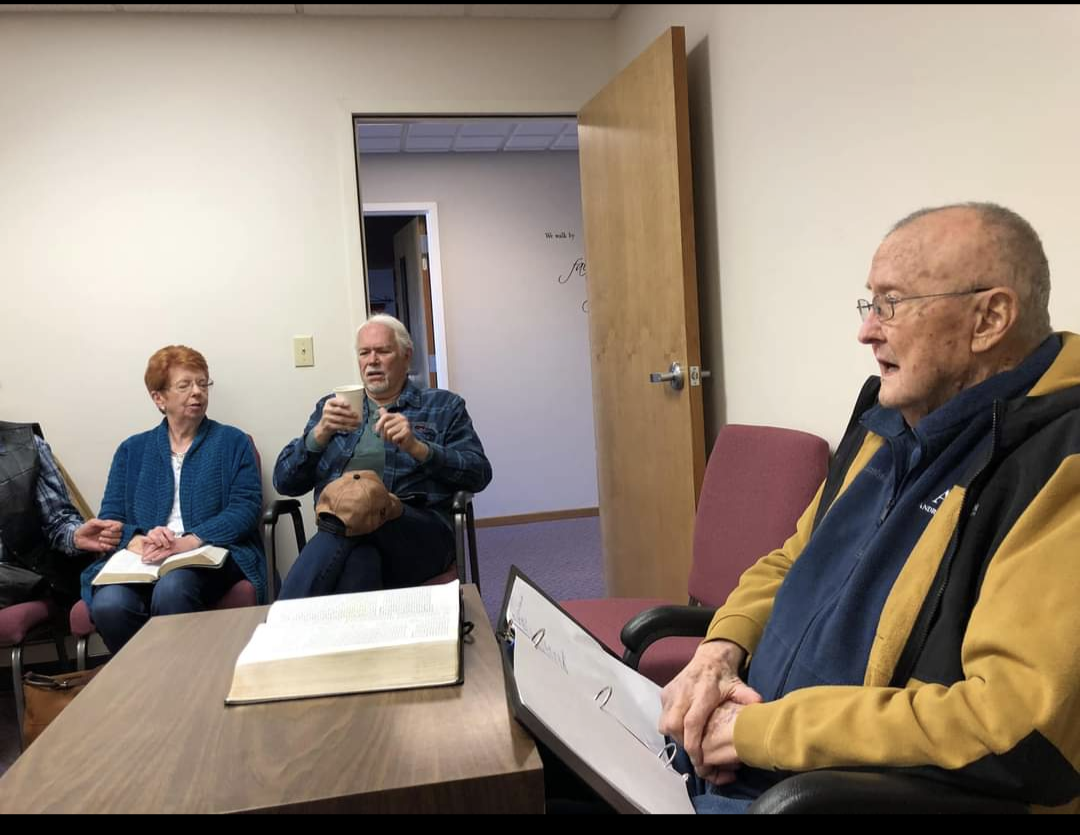
Jerry Thornhill teaching Sunday School the Sunday before he died on Wednesday
Let your steadfast love, O Lord, be upon me, even as I hope in you. My son has gone into the far country, and I can’t see his face. I am confused, furious, and in despair that despite my deep love for you—you let him go. Bring him home, Lord, before he forgets his way.
My son has gone into the far country, and I can’t see his face. Lord, he has run too fast over false ground. Bring him home, Lord, and restore the joy of my son. The ground beneath us is quivering and we need a place to stand.
Lord, he has run too fast over false ground. I am confused, furious, and in despair that despite my deep love for you—you let him go. The ground beneath us is quivering and we need a place to stand. Let your steadfast love, O Lord, be upon me, even as I hope in you.
Keep me as the apple of Your eye; Hide me under the shadow of Your wings. Psalm 17:8
Most of us believe that to mark this world, we need to do something big. We need to pastor a large church, get published, or establish an orphanage in a third-world country. We are so grandiose in our sense of what counts as significant. That is not the Jesus way.
What usually happens when you smile at a friend? They smile back.
Recently I read a fascinating book about spiritual formation and neurobiology called, Renovated, by Jim Wilder. In it, he talks about how a neuroscientist named Dr. Allan Schore from UCLA defined joy relationally as “someone who is glad to be with me” and “being the sparkle in someone’s eye.”
What could that mean for us? Do I dare believe that God would look at me as if He were glad to be with me and be the sparkle in His eye? Do I dare believe that He would smile at the mere thought of me?
If I could rest in the thought of being the sparkle in God’s eye, I wonder if it would be possible to transmit that sparkle to others when I look at them. When we see them. Speak to them. Listen to them. Are fully present to them.
I believe that God wrote this truth into the Bible long before Dr. Schore discovered it. Perhaps he would have known about “The Look” which causes joy had he gone to church all of his life and read his Bible.
God told Moses to tell his brother Aaron that the priests should say some very specific words to the people of God Numbers 6:24-26,
The Lord bless you and keep you; the Lord make his face to shine upon you and be gracious to you; the Lord lift up his countenance upon you and give you peace.
Do you see those words make his face to shine upon you and lift up his countenance upon you? I believe that is the smile of God. I believe that is the look on God’s face when he looks at me and you. Moses knew that the people of God needed a steady reminder of what God felt about them. That is also the reason I say it every Sunday at the close of our worship at my church.
What if those of us who have a covenant relationship with Jesus could be used by God as a conduit of his smile? What if God wants us to use our eyes and our smile to send the message to everyone made in the image of God that they matter to him? What if we started passing on Aaron’s blessing with our countenance and our actions in our everyday life?
When we really absorb Jesus into our core, we will be people who are marked by humility and hospitality. I’ve had more than a few saints you will never meet that have impacted my life because of their giving lifestyle. One of those men died seven days ago in my little town. He was on the search committee that brought me to my current church and a deacon in our church. His passing has left a huge hole in my heart.
But let me tell you about another deacon that changed the entire trajectory of my life some forty-six years ago.
When I moved out of my parent’s house and into my first apartment, I was assigned to his deacon family. He took that seriously. He was a strange and wonderful man. The term “geek” was not used back in the mid-seventies, but if it had it would be how I would have described my deacon. He had a pock-marked face and a bulbous nose. He was a large overweight man with narrow and sloping shoulders. When he smiled, which he did a lot, he had a gap between his front teeth.
In those days, I was in my rebellion. The only reason I attended church was that my mother said I could come to the house for Sunday dinner if I came to church. And every week it seemed she made a pot roast, rolls, and peach cobbler.
My deacon knew I was troubled. He would write me notes and tell me he prayed for me. He would seek me out when I came to church. He found out that I loved sports, so he took me to Denver Nuggets and Denver Broncos games—many times. That cost him time and money to do that. All the while I lived a prodigal life. I was living in complete defiance of Jesus. But my deacon didn’t give up on me. He kept praying and showing up in my life in any way he could think of.
Finally, through a series of God-ordained circumstances, in 1978 I rededicated my life to Jesus. Back in those days, that was a big deal. My dad always offered an altar call in the church he pastored and so I walked forward to make my decision public. The first person to grab me and hug me that Sunday was my deacon.
You will never meet him. I don’t even know if he is still alive. But that goofy, geeky, awkward deacon marked my life. He showed me the smile of God. He was the smile of God.
His name was Clinton Spearman. We named our second son Clinton.
Our culture, country, and town will be changed not through legislation, rules, and winning the culture wars. Up there will not come down here by returning to the values and lifestyles of the 40s and 50s. The Kingdom will come on earth as it is in heaven when we see people the way God sees them. I mean show up and really look at them.
You must be logged in to post a comment.