I Am Not What I Do

All Jesus did that day was tell stories—a long storytelling afternoon. Matt. 13:34 (MSG)

A few years ago my brother and I were having a conversation and he told me about a crisis time in his life.  He was struggling with a sense of identity and so he went on a retreat in the mountains.  After fasting and praying, he felt as if God in all but an audible voice:  “You are my artist.”  I was impressed by that.  I wanted that kind of term of endearment from God.

I didn’t go to a mountain cabin and fast, but I prayed and prayed.  I wanted to hear from God a word that was so intimate and so unique.  I got nothing. That hurt.  I felt as if I didn’t measure up and that somehow I was inadequate; maybe even damaged goods.  I became obsessed with who I was.  I began to define myself by what I did.  I was a minister.  I was a business consultant.  I was a father.  I was a husband.  I was a survey equipment salesman.  All of that, while nice and wholesome, never scratched that deeper itch.

Then one evening we were entertaining friends and, after a wonderful meal, we began to swap stories. We laughed a lot and cried a little.

Suddenly my wife started to tell a story and then turned to me and said, “You tell it.  You are the storyteller.”  Later that night I asked God if that was who I was.  Was I his storyteller? I got a deep sensation that seemed to say, “No.” My heart sank. Then he said, “You are the story. From time-to-time tell about the journey.”

God is writing a story out of my life and I get to tell you about it.  How amazing is that?  Sometimes it is a tragedy and sometimes it is a comedy.  But ultimately it is His story and I get to be in it.  As someone once said, “When God enters your story; your story is no longer your story, it is God’s story and he can call for the telling of that story anytime he chooses.”

So, now…

I love to tell the story of unseen things above,

Of Jesus and His glory, of Jesus and His love.

I love to tell the story, because I know ’tis true;

It satisfies my longings as nothing else can do.

I love to tell the story, ’twill be my theme in glory,

To tell the old, old story of Jesus and His love.

I was put here to live a story.  That is my vocation.  Telling the story is my avocation.

Royal Basin Trail

Royal Basin Trail

Not long ago I was listening to a lecture about identity. As the presenter spoke I found my mind leaving the room and imagining going for a walk in the New Heaven and the New Earth—with Jesus.

We were in dark timber; the squirrels were chattering at our approach. There was a musty smell of forest floor leaves in the air. Dappled light was scattered on the trail in front of us as the sun seemed to try to peek through the evergreen bows to watch us walk, Jesus and me.

We walked for about a mile, talking about the beauty and wonder of this sacred place God had made when Jesus stopped and sat down on a gray log.

He looked up at me, smiled, and said, “Tell me a story, Joe.”

I gulped and stammered, “What story do you want to hear?”

“You choose,” He said.

Posted in Uncategorized | Tagged , , , , , , | 4 Comments

Salty Saints

It is an everlasting covenant of salt before the Lord for both you and your offspring.  Numbers 18:19

In the ancient world, there was no refrigeration. Decay and rot were the great enemies of life, and salt was the only force that could arrest decay. It could preserve flesh, so it had a power in the ancient world. It was almost like magic.

In many ways salt was the beginning of trade in the ancient world. Civilizations fought wars over it. Romans would pay their soldiers, their salary, often in salt. In fact, we get the word “salary” from the Latin word for salt, which was sal. We get the word salad from the Roman practice of salting leafy vegetables.

The Bible talks a lot about salt. Some of you know, there was a family of a guy by the name of Lot. They’re fleeing Sodom and Gomorrah. Lot’s wife was disobedient to God, and she was turned into a—pillar of salt. And they took her with them on the journey, and that was the beginning of the salt lick.

So, salt is like this magic thing in the ancient world. God says, I want to make with you a covenant of salt.

Why?

God says, “Because in my world there’s rot, there’s decay, there’s sin, there’s deceit, there’s corruption, there’s selfishness. Everything’s spoiled. I’m going to start a new people, and I’m going to have a covenant of salt, so that through my people I can begin the process of saving my world from corruption, and decay, and rot. As you meet with people, you’re Saltfreshness, you’re hope, you’re joy. You are a covenant of salt. Blessed, to be a blessing.”

This is the divine conspiracy of subversive spirituality.

My father told me recently that a guy in their neighborhood came to him and asked him if he could borrow some money.  My dad told him that he would pray about it and talk to his wife.  Next day my dad gave him $1,000 cash and said, “Pay me if you can when you can, so I can help someone else.”

The guys said, “You’re the only person who has agreed to help me.”

Salt of the earth.

Effie Peyton was an 89 year old saint in a church I pastored.  I would go to visit her in the hospital and always leave feeling blessed by her. As I walked into the room with the buzzing machines, the harsh florescent lights and when she would see me she’d always reached over and grabbed her teeth and put them in her mouth and smile a huge smile, this 80 pound woman.

“Pastor, how’s that beautiful wife of yours?” she’d ask. “And what about those boys?  They are getting so big!”

We’d visit a while and then I could tell she was getting tired and I would make a move to leave and she’s say, “Pastor, can I pray for you?”  Then she’d spend the next ten Pentecostal minutes lifting her spindly arms up to her heavenly Father, and pray for me, Lynette, Cole, Clinton and Caleb.

A nurse came in one time while she was praying and Effie new she was in the room so she started praying for the nurse, by name. I smiled.

I left and lingered just outside her room for a moment and heard her say to the nurse, “Honey, that’s my pastor.  He’s a good man.  He loves Jesus.  Honey, do you love Jesus?”

She was the salt of the earth.

In your work, when you are shopping, and you bring joy, or when you challenge somebody, when you listen, when you touch, when you hug, when you laugh, when you say “You matter.” When you give a gift, when you write a note, when you make a call, when you volunteer, when you say to somebody…

Honey, Jesus loves you, He would love to be your friend.

That’s when you are the salt of the earth. And a little of the Kingdom of Heaven falls to this rotten earth.

Posted in Uncategorized | Tagged , , | Leave a comment

Life with God is an Inside Job

For I say to you, that unless your righteousness exceeds the righteousness of the scribes and Pharisees, you will by no means enter the kingdom of heaven. ~ Jesus

Is Jesus being meaner than Moses? No, he is saying that the kind of life-change that matters is when God is birthed deep down inside of you—down where the knobs are— and begins to control the operating-center of your life.

Virginia Stem Owens wrote an article called God and Man at Texas A&M. Owens wrote about how she had assigned her freshman English class “The Sermon on the Mount,” a selection in their rhetoric textbook. Having grown up in church, and being in Texas, a very religious state, she expected them to have some familiarity with it, but as she read the papers, she was shocked at how none of her students were familiar with it. In her words:

The first paper I picked up began, “In my opinion religion is one big hoax. There is an old saying that ‘you shouldn’t believe everything you read’ and it applies in this case.”

“The stuff the churches preach is extremely strict and allows for almost no fun without thinking if it is a sin or not.”

“I did not like the essay ‘Sermon on the Mount.’ It was hard to read and made me feel like I had to be perfect and no one is.”

“The things asked in this sermon are absurd. To look at a woman lustfully is adultery? That is the most extreme, stupid, un-human statement that I have ever heard.”

Owens writes, “At this point I began to be encouraged. There is something exquisitely innocent about not realizing you shouldn’t call Jesus stupid. This was not exactly intellectual agnosticism talking here, usually the perceived foe of the faith. It was just down-home hedonism. This was the real thing, a pristine response to the gospel, unfiltered through a two-millennia cultural haze.”

The common myth in our culture about Christianity is that it is all about rule-keeping.

But the fact is religion is rule-keeping, but the Gospel of Jesus is not rule-keeping. Religion is an outside in strategy. Religion tends to work on behavior modification, but the good news of Jesus is an inside out transformation.

So, when Jesus says that unless your righteousness exceeds the scribes and Pharisees He’s not saying that he wants them to have better rule-keeping skills. He’s saying that a follower of Jesus will have a kind of righteousness, a wholeness, an integrity about their lives that is more profound than the religious professionals of that day because they are being transformed in the depths of their lives.

There is a soul-change, not just a behavioral change. The Jesus Life re-calibrates us at the deepest levels of who we are. And Jesus can do this because he personified the beatitudes. Jesus, the living God among us, becomes poor. Jesus, the living God among us, morns buckets of tears for a broken world. Finally, he is crucified and God shines the light of His forgiveness and truth into the inky darkness of a broken world; into dark lives like yours and mine.

When we taste of God’s grace, life, and love that we have in Jesus—it transforms us, not just at the level of our hands, but at the deeper level of our hearts. Jesus transforms us in our depths.

His promise is that if you are a follower of His  he will so profoundly rearrange your life not just so that you can avoid adultery, but that adultery doesn’t have any attraction to your heart in the first place.

His promise is not that He will give you sufficient will power to not kill the irritating coworker, but that your heart will be filled with so much mercy from God that it will be a natural grace for you to extend that mercy to the most irritating person in your world.

He will change your soul to the point that sin no longer looks good to you.

My favorite story of grace outside of the Bible is Victor Hugo’s Les Miserable.

Jean Valjean, the main character of the story, is an ex-convict, released from prison after serving nineteen years: five for stealing a loaf of bread to feed his family, and fourteen more for attempting four escapes. Once he’s finally free he receives no welcome anywhere.

Innkeepers turn him away; even a dog drives him out of a kennel where he tries to sleep. Finally, Valjean knocks on the door of the local bishop, who welcomes him as if he were Christ himself. The bishop prepares a meal for Valjean, sets the table with silver, dines with him, and then provides him with his first real bed in nineteen years.

Despite the bishop’s kindness, Valjean awakes in the wee hours, steals all the silver he can carry, and flees into the night. He remains a fugitive for but a few hours. The long arm of the law reaches out and brings him back to the bishop, just as the household staff is discovering the theft. Upon seeing Valjean hauled into his house with the police, the old bishop instantly sizes up the situation and declares, “So here you are! I’m delighted to see you. Had you forgotten that I gave you the candlesticks as well? They’re silver like the rest, and worth as good as two-hundred francs. Did you forget to take them?”

For Jean Valjean, the bishop’s unexpected and extraordinary grace is almost more than he can comprehend. It changes the course of his life. That act of mercy so changes him that he Jean Valjeanspends the rest of his life saving and serving those who crossed his life. At the very end of the novel, the two candlesticks provide the last light that Jean Valjean sees before he dies.

That is what grace does to people; it changes them from the inside out.

Posted in Uncategorized | Tagged , , , , , | 2 Comments

The Palace of the King


ROOMS

By jay chambers

Silhouette pines bush the night’s hair,

her dark wondering locks tossed down around my shoes.

Tall, slender rhododendrons wear their bridal gowns to bed

whispering soon…soon.

And tonight the star-map above my head

could guide you to the palace of God.

My thumping heart is one room in that great residence,

this silver clearing is another.

I need space in my life in order to speak low and tender with my Lord as the above poem written by my brother describes so beautifully. This space is best fostered when I practicing silence, solitude, and Sabbath. They are a part of the rhythm of my life—like favorite rooms. And after all these years of resting in these rooms, I have something new to share about my time in solitude and silence. For me these go together like matching socks.

The discipline of silence is interesting to attend to with the changing seasons here in the Winter Treemountains. The wind through the pines and the swooshing feathered flight of birds overhead; the bark and chatter of squirrels in the woods.

In the winter, the air is cold and silent.  No birds are singing. The squirrels are less active. Thus the silence is quite loud. Only the crunch of snow under my boots.  I would have thought the whisper of God would have been more noticeable, but it wasn’t. Perhaps He is cuddling with the squirrels—keeping them warm.

This quote resonated with me about the current egocentric approach to Christianity:

I’m increasingly uncomfortable with current images of God found in books and workshops that mix popular psychology with a theology wholly devoted to self-realization. They seem to reverse the first question of the catechism I studied as a child, declaring that “the chief end of God is to glorify men and women, and to enjoy them forever.” I really don’t want a God who is solicitous of my every need, fawning for my attention, eager for nothing in the world so much as the fulfillment of my self-potential. One of the scourges of our age is that all our deities are house-broken and eminently companionable. Far from demanding anything, they ask only how they can more meaningfully enhance the lives of those they serve. ~ Fierce Landscapes, by Belden Lane

Of course this is why I enjoy walking in the wild and living in the mountains. It is hard to think of oneself as uber significant while living at the base of a fourteen-thousand-foot mountain. I bask in the thought of being “The Beloved” of the Father and I know that mankind is the crown of God’s creation, but the wilderness reminds me of how transcendent He is. My innate narcissism needs that constant reminder. I feel small in the wild and at the same time I feel as if the Creator-God is closer than my breath.

But in spite of my closeness with the one who calls me “Beloved”, there are those times when my demons come a callin’.

I found a process I have that has helped me when I feel an unwanted emotion.  It is called “Welcoming Prayer.” I found it in as book called Centering Prayer and Inner Awakening, by Cynthia Bourgeault

The three-step process is as follows:

  1. Focus and Sink In
  2. Welcome
  3. Let Go

Here is how I used in in my life: I am unusually sensitive to the approval and disapproval of men and yet I became a pastor. Go figure. I have found over the decades of serving God in the Church that I am either the hero or the goat. I don’t mind being the hero, but I loathe being the goat. I want to be liked. I want, nay, crave the approval of my congregants. It is my drug of choice. They don’t always cooperate.

A man shared with me a minor criticism from someone in the fellowship. It surprised me how much the criticism hurt my heart. I would have thought after all these years I would have grown past that. My head knew better—consider the source—, but my heart was wounded. I felt the desolation of God. Then I remembered this process, Welcoming Prayer.

The only way I could, in good conscience, practice this prayer was to try to obey Christ’s admonition to “love your enemies.” Enemies not being the criticizer, but the accompanying emotions of failure or inadequacy.

I thought, “How would I love my enemy?” The same way I would love my friend—invite them into my home for a meal. So, I invited the scary emotion of ‘fear of failure’ into a deep place in my heart, I focused on it. I smiled at it. I imagined opening my arms wide and asking it into my living room and to sit down on my couch while I finished preparing a meal of Apple cider glazed chicken, wild rice, and asparagus.

We didn’t speak. We just looked at each other. Me with a benign gaze, it with a menacing smirk. The more I cooked the less menacing the look. I offered the meal to it. It wouldn’t eat. It was time to go. I opened the door and bid farewell.

I’d like to believe that it will never return, but I am not that naive. Funny thing is when I began to clear the table of the meal I had prepared for my enemy, I found myself smiling and feeling another warm presence in the room—faint smell of a Carpenter that had worked hard all day in his shop.

And suddenly the painful room was changed into a palace.

Posted in Uncategorized | Tagged , , , , , , , | 3 Comments

The Wilderness

…Jesus was led up by the Spirit into the wilderness… Matthew 4:1

Our image of the wilderness is one of landscapes, beauty, and well-marked trails. In a sense, I live in a kind of wilderness right here in the upper Arkansas River Valley, surrounded by mountains that touch the sky.

In the ancient world wilderness was not thought of in the same way. It was a place of isolation, lostness, and death. This image of the wilderness is actually where we get our word “bewildered” from. To be turned around, to be upside down, and to not know where you are going—bewildered.

Three Sisters Wilderness Area, Oregon

Three Sisters Wilderness Area, Oregon

In the Bible the wilderness becomes a kind of visual short-hand for the dark and painful side of life with the living God. Experiences of disorientation, trouble, heartache, depression, and distress—this is the wilderness.

The times when you pray, read, and listen for God—and hear nothing.  That is wilderness.

The writer Thomas Merton said, “God, who is everywhere, never leaves us, yet sometimes He seems to be present and sometimes absent, and if we do not know Him well, we do not realize that He may be more present to us when He’s absent than when He’s present.” Or to put it another way, God may be most powerfully present when he seems most conspicuously absent.

Everyone who follows Jesus, follows Him into the wilderness. You either have been, are in one now, or are headed for a dry, empty, heartbreaking time where your prayers go unanswered and you feel utterly alone.

But here is the truth: God is in the wilderness. Jesus didn’t go out into the wilderness because God forgot about Him or He forgot about God. He’s in the wilderness because the Spirit led Him there.

There might be more than a few of you who feel as God might not care about you because you are spiritually thirsty, spiritually lonely, and spiritually hungry—you are as parched as any time in your life at a soul-level. And it is easy to mutter to yourself that God doesn’t care about you and your plight.

It is good to be between a ruined house of bondage and a holy promised land.  ~Leonard Cohen

That is the wilderness. That land of in between. We are not in the bondage of Egypt, and we are not yet in the land flowing with milk and honey. The wilderness is an important place because in Webster and in life, wilderness always comes before wisdom.

Jesus traces all of mankind’s wandering steps away from God—to lead us back home to God.

In the very opening moments of the drama of scripture Adam and Eve were cast out of paradise for turning their backs on God and driven out into the wilderness—east of Eden— and then several millennia later Jesus goes into the wilderness to bring us back home to God.

In the story of God’s people in the book of Exodus, they chose once again to not listen to God’s voice and turned an eleven day journey into a forty year exodus in the wilderness, Jesus spends forty days in the wilderness faithfully listening to the voice of the Father to bring us back home to God.

In Genesis 3 the human family disobeyed God by eating the fruit of a tree and the world is plunged into death. Around Jesus’ 33rd birthday, Jesus was nailed to the hard wood of a tree to deal with our disobedience and death and to give us life with God.

Jesus joins us in our wildernesses. Here is a story of one of my wilderness experiences:

Jesus knows the way,

Posted in Uncategorized | Tagged , , , , | Leave a comment

No Perfect People Allowed

 Go ye therefore, and teach all nations, baptizing them in the name of the Father, and of the Son, and of the Holy Ghost…  ~ Jesus

One of the striking things about Jesus is that He didn’t work real hard to make sure He put together a small group of people who were naturally compatible with each other.

One of them was a man named Simon the Zealot. Zealots were an extremist nationalist political party, committed to the overthrow of the Roman government by any means possible, violence if necessary, and sometimes assassinations. They hated the Romans.

The only people they hated more than the Romans were the people who collaborated with the Romans, like tax collectors who were Jewish people willing to collaborate with the Romans for corrupt financial gain. Zealots were freedom fighters or terrorists, depending upon your political point of view.

Jesus is forming a small group, and He says, Simon, you’re a Zealot. You despise Romans and collaborators like tax collectors. I’ll take you.

And then He says, Matthew, you’re a collaborator and a despised tax collector. I’ll take you. You room with Simon. You guys should have some interesting talks with each other.

Can you imagine what it was like?

When Jesus called his disciples, He comes to Peter and Andrew and they’re casting their nets from the shore, which typically would have meant that they couldn’t afford a boat. They would have been quite poor.

And then He comes to James and John. We are told they have a boat. In fact, He leaves them with their father who is with his other hired men. In other words, he has employees. This is a much higher operation. These are a couple of sets of brothers who are in quite different financial spheres.

Have you ever heard of anybody dealing with envy issues over who has what possessions, or over who lands where vocationally or financially? Jesus puts people in a small community; they have a lot of problems with each other. James and John come back to Jesus later on with their mommy and they have her say for them,

You know, after it’s all over, we’d like to be the ones that sit next to you in Heaven on your right or your left.

Jesus was always teaching about servanthood—die to yourself—and this was what they had their mommy come and ask Him to do? The other ten hear about this, and they are really mad with James and John. This is not a real easy Community.

Jesus did not come to create a Community for perfect people who all have natural chemistry with each other. What made His Community explode was this implacable, Spirit-empowered determination of those within the Community to lavish love on anybody who could possibly stand it!

You will never go wrong by underestimating the hunger of a human being just to be loved. We are bound together by grace.

The Church is a family where water runs thicker than blood.

Listen, it doesn’t matter what your past is like. You are welcome in the family of Jesus of Nazareth. If you have checkered past, you are welcome here. If you have no money, you are welcome here. If you have lots of money, you are welcome here. If you are a political conservative, you are welcome here. If you are a political liberal, you are welcome here.

We are bound together by grace and nothing else.


Posted in Uncategorized | Tagged , , , , | 1 Comment

The Beloved

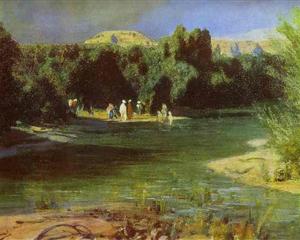
…As he came up from the water, suddenly the heavens were opened to him and he saw the Spirit of God descending like a dove and alighting on him. And a voice from heaven said, “This is my Son, the Beloved, with whom I am well pleased.” Matthew 3:16-17

When we immerse ourselves into the water at our baptism, it signifies that our lives are attached to Jesus’ life. We are, as the Apostle Paul so often said, ‘in Christ.’ Jesus’ story becomes our story. So, if you belong to Jesus, God the Father looks at you the way He looks at Jesus at this moment in the Jordan River when the Heavens are parted and God’s presence descends and a warm fatherly voice speaks such wonderful words of affirmation.

As one New Testament scholar put it…

baptism-1896.jpg!xlMediumAll the kindness heard in the Father’s Voice for his only true Son is conveyed to us in baptism. ~ Dale Bruner

It certainly is not always easy to hear that voice in a world filled with voices that shout: “You are no good, you are ugly; you are worthless; you are despicable, you are nobody—unless you demonstrate the opposite.

Let me be so bold as to say that my sin-battles in this life that I have lost have always been because I have forgotten who I am.

As soon as we become spiritually deaf to the voice that calls us the beloved, we are going to look someplace else to make us the beloved. ~Henri Nouwen

I am the beloved of God. Say that out loud. “I am the Beloved of God.”  It is true, why else would He have allowed you to be born?

You are the beloved and you are becoming the beloved. Think of it this way, over three decades ago I said some vows, and entered a covenant relationship with my wife and became a husband.  Was I a husband?  Technically, yes.  But over three decades of effort, mistakes, defeat and victories I am becoming a husband.

When the triune God of the Universe thought us up, we became the beloved of God, but we must now be active in becoming the beloved of God.

If you belong to Jesus, your baptism is God’s promise that as He looks at your life, He looks at you and says, “This is my son, my daughter—my beloved. And with you I am well pleased.”

If you are a Christian this is what is most true about your life. Honestly, this identity is what all of us need to build our lives on. But most of us build our lives on wherever we think we can find that kind of affirmation.

A few years ago I hiked the Pacific Crest Trail and one of the nights I stayed at a log cabin shelter called Brown’s Cabin. Inside it was a large note book for hikers to sign and leave a message or two. I leafed through the notebook and there was one page that had at the top these words, “Before I die___________.” There were many answers scribbled below than spanned from the profound to the profane. But the one that caught my eye was printed in such small font that I had to bend close to read it. It said, “Before I die I want to be loved.”

This is what all of us cannot live without and will go to extraordinary lengths to find. Why do so many folks that you know exhaust themselves looking for the affirmation of a boss they don’t even like? Why do so many lurch from one unhealthy relationship after another? Because none of us can live without someone saying, “You are my beloved. I approve of you. I am proud of you.”

A journey into becoming a deep, wise, and mature follower of Jesus is learning to build our entire lives around the truth of the words we hear spoken on the banks of the Jordan River: “You are my son, my daughter, the Beloved, with whom I am well pleased.”

When Martin Luther was hold up in a castle translating the Greek Bible into German so that for the very first time somewhat regular folks could read the Word of God for themselves and while he was doing this he struggled mightily with doubt and discouragement from what he understood to be the devil. And he was known to not only throw the occasional ink pots at whatever was tormenting him and causing him to doubt God’s promises, but while doing so he could be heard throughout the castle grounds shouting “I am baptized! I am baptized!”

Luther was hanging for dear life to what God says was true about who he was—that he was God’s beloved.

Listen to a story about a fragmented man who remembered who he was…

Posted in Uncategorized | Tagged , , , , , | 2 Comments

Bears in the Wilderness

Posted in Uncategorized | Tagged , , , , , , , , | 7 Comments

The Christmas Story

Posted in Uncategorized | Leave a comment

My Top Reads of 2015

A person who won’t read has no advantage over one who can’t read.~ Mark Twain

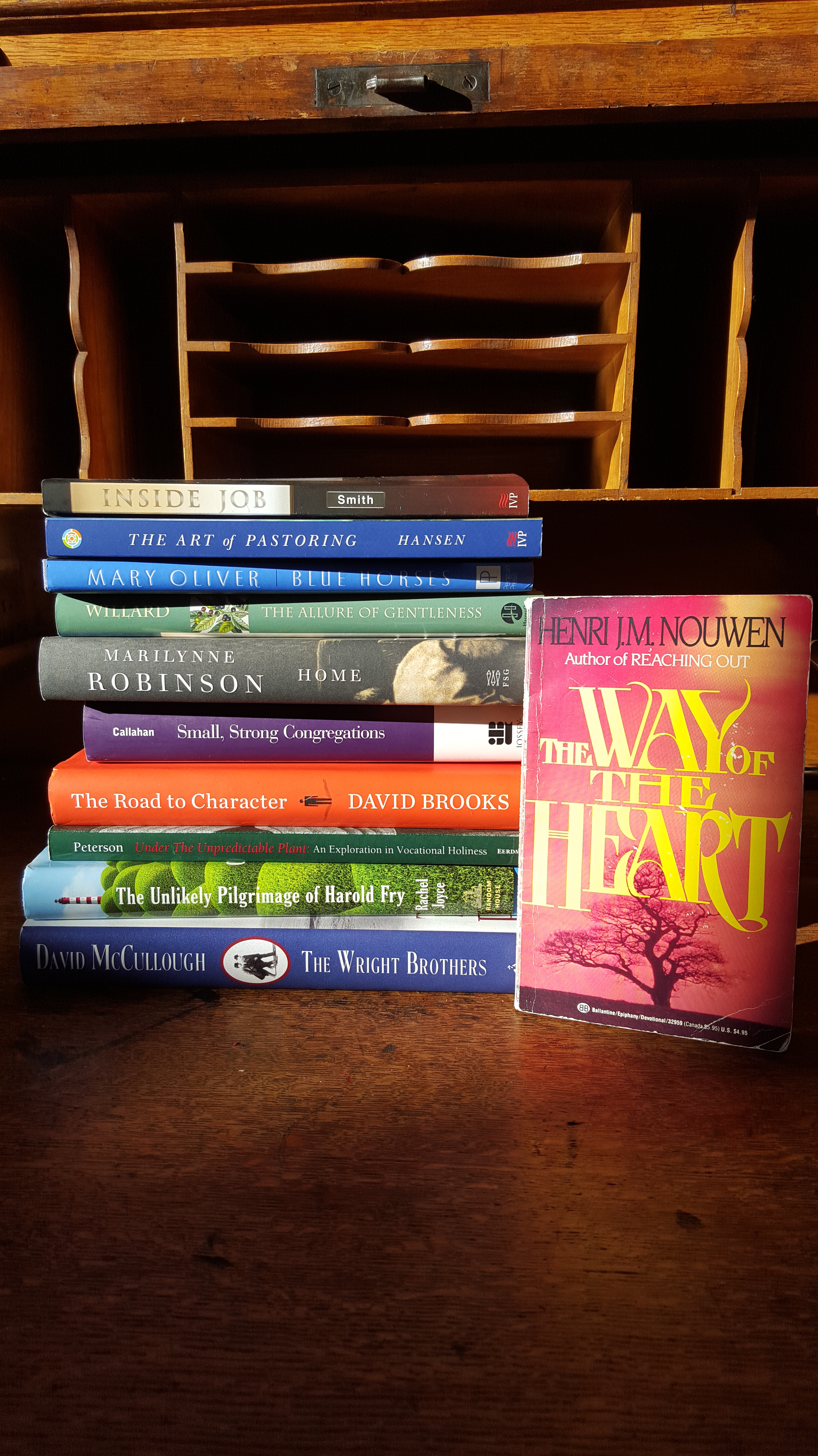
My books

Every year’s end I post a list and summary of my top ten reads for the previous year.  In doing this I have to be selective in what I post because I read significantly more than ten books in a year. (Sorry if that sounded arrogant. No, I’m not sorry.) I will list the title, the publisher’s summary and a comment or two. So here goes my top reads for 2015 in no particular order:

The Way of the Heart, by Henri J.M. Nouwen

One of my top five favorite authors of all time. Henri Nouwen brings some of the most important truths a Christ-follower needs live out in such a very accessible way. While we couldn’t be more different in our faith traditions, me a Southern Baptist and he a Roman Catholic, I have read few writers that push the truth of the Gospel as deeply into my soul as does Mr. Nouwen.

One of the greatest of all spiritual writers, invites us to search deeply for the well-springs that nourish true ministry in his classic The Way of the Heart. Interweaving the solitude, silence, and prayer of the fifth-century Egyptian Desert Fathers and Mothers with our contemporary search for an authentic spirituality, The Way of the Heart not only leads us to a fuller encounter with God, but to a more creative ministry with our fellow human beings. Here is one of the most profound works from a writer known for his fresh and perceptive insights—and who stands alongside C.S. Lewis and Thomas Merton as an essential Christian scholar and thinker.

Inside Job, by Stephen W. Smith

I wish I had read and assimilated this book 20 years ago; lots of life-pain might have been avoided. What I love about this book is the honesty by which the author discusses the interior issues of a leader’s heart. He pulls no punches and sugar-coats nothing. He can’t afford to. Too many lives are at risk.

The discussion in chapter 5 about the four quadrants of the heart was especially insightful. I want to be a leader that leads from all four quadrants: the part people see, the part that I reveal to a certain few, the part I show to my boon companions, and the part that I don’t know, but want to learn about—the deeper heart.

Another part that I found helpful was the chapter 9 on Leader Transitions. Because I have recently moved my wife across country to lead an organization that is culturally different than what I am used to, this looks to be a daunting challenge, but with the tools of transition the author outlines in this chapter, I feel better equipped to find contentment, resiliency and satisfaction in the latter years of my vocational life.

I highly recommend this book. Very little attention is paid to what is going on the inside of a heart and soul in popular writing about leadership. This book goes deep and stays there. The metrics are mostly external in our culture. But external metrics are of little good if the life I am living is only as deep as a bird bath. If read, processed and assimilated, this book will deepen your soul—preparing you to live the life you’ve always wanted and the one God as offered: Shalom. I purchased ten copies and gave them away to many of my pastor friends.

Effective leaders work very hard to succeed, but often at the cost of their own souls. They are challenged to keep themselves emotionally and spiritually healthy in order to survive success―to keep their humanity intact. This is the work within the work. Stephen W. Smith helps leaders in the marketplace and in ministry set aside the life-draining values of power, fame, fortune and position and instead explore the life-giving qualities of building character.

There is a better way to live than the craziness we experience in our driven world. Inside Job is your invitation to journey inside and do the work within your work.

The Art of Pastoring, by David Hansen

This is not a church growth book. This is a soul growth book. The idea of a pastor as a living parable of Jesus was one of the most humbling and empowering concepts of this book. I found myself cheering the author on at every turn of the page.  I would recommend this book as required reading for any young pastor.

Every pastor has encountered those who struggle to hear God’s voice in a hospital room, who reach for Jesus in the sacraments. No systematic answers can meet their deep, eternal needs. What can touch them, Hansen contends, is a life itself, a life lived as a parable of Jesus. “As a parable of Jesus Christ,” Hansen writes, “I deliver something to the parishioner that I am not, and in the process I deliver the parishioner into the hands of God.”

It is this knack for getting to the heart of things that makes The Art of Pastoring valuable for pastors in any setting–rural, suburban or urban. Parachurch workers, missionaries, church leaders and ministry volunteers will also find inspiration here.

In this significantly revised new edition, Hansen includes new insights into his view of pastorate as parable and adds a new postlude in which he comes clean on his “constant attempts to leave the ministry.”

The Allure of Gentleness, by Dallas Willard

Few authors have influenced me as deeply and as profoundly and the late Dallas Willard. I can’t get enough of his wisdom. I have read and re-read his works several times.  Mostly I re-read them because I didn’t understand them the first time through. But I also read them because they are so rich I have to savor the nuance of the wisdom so that it will seep deeply into my soul. This is one of his most accessible books and it is about such an important topic in our times.  The art of expressing our faith to an increasingly secular world and to do it in such a way that we win them with kindness.

When called upon to explain their faith, Christians do not always feel equipped to do so—particularly when some of the most difficult questions arise. In The Allure of Gentleness, esteemed teacher and author Dallas Willard not only assures us of the truth and reasonableness of the Christian faith, but also explores why reason and logic are not enough: to explain Jesus’s message, we must also be like Jesus, characterized by love, humility, and gentleness.

Based on a series of talks and lectures on apologetics given by the late author and edited by his daughter, Becky Heatley, this book constitutes Dallas Willard’s most thorough presentation on how to defend the Christian faith for the twenty-first century. This beautiful model of life, this allure of gentleness, Willard tells us, is the foundation for making the most compelling argument for Christ, one that will assure others that the Christian faith is not only true but the answer to our deepest desires and hopes.

Home, by Marilynne Robinson

One of the most thoughtful writers of our times. A deeply committed Christian and yet she doesn’t write the shallow-as-a-birdbath that dominates Christian fiction. In fact, I hate that term “Christian Fiction.” When I hear it I immediately move quickly away. It has become synonymous with bad writing. If you go to a book store today you won’t find Ms. Robinson in the Christian Fiction section. You will find it in the award winning literature section.

Home is an entirely independent, deeply affecting novel that takes place concurrently in the same locale, this time in the household of Reverend Robert Boughton, Ames’s closest friend.

Glory Boughton, aged thirty-eight, has returned to Gilead to care for her dying father. Soon her brother, Jack—the prodigal son of the family, gone for twenty years—comes home too, looking for refuge and trying to make peace with a past littered with tormenting trouble and pain.

Jack is one of the great characters in recent literature. A bad boy from childhood, an alcoholic who cannot hold a job, he is perpetually at odds with his surroundings and with his traditionalist father, though he remains Boughton’s most beloved child. Brilliant, lovable, and wayward, Jack forges an intense bond with Glory and engages painfully with Ames, his godfather and namesake.

Home is a moving and healing book about families, family secrets, and the passing of the generations, about love and death and faith. It is Robinson’s greatest work, an unforgettable embodiment of the deepest and most universal emotions.

Home is a 2008 National Book Award Finalist for Fiction.

Blue Horses, Mary Oliver

The older I get the more I value poetry. Poets tell us the best stories in the shortest space. They play a note that makes me think of a chord on either side of the note that harmonize. At least the good ones do. I go back the ones I like time and again. And when you combine great language with the scenes of the natural world, you get this wonderful volume of poetry.

Mary Oliver returns to the imagery that has defined her life’s work, describing with wonder both the everyday and the unaffected beauty of nature.

Herons, sparrows, owls, and kingfishers flit across the page in meditations on love, artistry, and impermanence. Whether considering a bird’s nest, the seeming patience of oak trees, or the artworks of Franz Marc, Oliver reminds us of the transformative power of attention and how much can be contained within the smallest moments.

At its heart, Blue Horses asks what it means to truly belong to this world, to live in it attuned to all its changes. Humorous, gentle, and always honest, Oliver is a visionary of the natural world.

Small, Strong, Congregations, by Kennon L. Callahan

I used to want to pastor a huge congregation. I have come to realize that several things about that dream. One, is that it is not God’s desire for me; second, I don’t’ have the talent for it; and third, a strong and healthy congregation is better for the Kingdom than a large sick one.

Create a small, strong congregation that is dedicated to advancing God’s mission “The twenty-first century is the century of small, strong congregations. More people will be drawn to small, strong congregations than any other kind of congregation. Yes, there are mega-congregations; Their number is increasing greatly. Nevertheless, across the planet, the vast majority of congregations will be small and strong, and the vast majority of people will be in these congregations.”

With uncommon wisdom Kennon L. Callahan-today’s most noted church consultant-moves ahead of conventional thinking and in Small, Strong Congregations offers his unique vision of the church of the future. This important book chronicles the emergence of a vast number of congregations that are questioning the bigger-is-better notion in church membership. These congregations are deliberately small, active, and happy in their dedication to creating strong church communities that advance God’s mission.

The Grasshopper Myth, by Karl Vaters

This book. My goodness.

The validation that I am Okay as a Small Church pastor was so liberating. I found myself highlighting passage after passage. The best and most liberating thing about this book is that it is NOT bashing megachurches. I find myself doing that from time to time and feel convicted about it now. I have known for years that I am a Small Church Pastor, but never felt very proud of that.

Eugene Peterson’s memoir, The Pastor made me proud of my vocation. Karl Vaters’ book made me proud of being a Small Church Pastor. Best line from the book, “Joel Osteen couldn’t do my job.” Loved this book and wish I had read it many years ago before I nearly killed my sheep and my family. I will be giving this book away to many mountain pastors here in Colorado.

90% of the churches in the world have less than 200 people.

What if that’s not a bad thing? What if smallness is an advantage God wants us to use, not a problem to fix?

Vaters takes on some of the unbiblical beliefs we’ve held about church growth and church size for the last several decades. Then he offers a game plan for a New Small Church.

The title comes from the story in Numbers 13. When the Hebrews were at the edge of the Promised Land, ten of the twelve spies come back with this report: “All the people we saw there are of great size. …We seemed like grasshoppers in our own eyes, and we looked the same to them.” – Numbers 13:32-33

The grasshopper myth is the false impression that our Small Church ministry is less than what God says it is because we compare ourselves with others.

The solution is for Small Churches to see themselves the way God sees them. A church of innovation, not stagnation. A church that leads instead of following. A church that thinks small, but never engages in small thinking.

If big churches are the cruise ships on the church ocean, small churches can be the speedboats. They can move faster, maneuver more deftly, squeeze into tighter spaces and have a ton of fun doing it. They just have to see themselves that way.

The Road to Character, by David Brooks

David Brooks is becoming one of my favorite pundits and authors. I like the way he thinks. This book is as close to a book about Christian ethics and character as one can get without being a bona fide Christian. To my knowledge Brooks in not a believer, but he is very very close.

Looking to some of the world’s greatest thinkers and inspiring leaders, Brooks explores how, through internal struggle and a sense of their own limitations, they have built a strong inner character. Labor activist Frances Perkins understood the need to suppress parts of herself so that she could be an instrument in a larger cause. Dwight Eisenhower organized his life not around impulsive self-expression but considered self-restraint. Dorothy Day, a devout Catholic convert and champion of the poor, learned as a young woman the vocabulary of simplicity and surrender. Civil rights pioneers A. Philip Randolph and Bayard Rustin learned reticence and the logic of self-discipline, the need to distrust oneself even while waging a noble crusade.

Blending psychology, politics, spirituality, and confessional, The Road to Character provides an opportunity for us to rethink our priorities, and strive to build rich inner lives marked by humility and moral depth.

Under the Unpredictable Plant, by Eugene Peterson

Last summer I preached for messages on the Old Testament book of Jonah. I picked up this old copy of Peterson’s treatment of Jonah and couldn’t put it down. I underlined and scrawled all through it. What a delightful book about the pastoral call and vocation.

He clarifies the pastoral vocation by using the book of Jonah where he points out how subversive this ancient book is to restoring our sense of calling and “vocational holiness.” He probes  the spiritual dimensions of the pastoral calling and seeks to reclaim the ground taken over by those who are trying to enlist pastors in religious careers.

The Unlikely Pilgrimage of Harold Fry, by Rachel Joyce

Lynette and I read this together. It is one of the most moving books either of us have read in years. Simply a captivating story.

Harold Fry, recently retired. He lives in a small English village with his wife, Maureen, who seems irritated by almost everything he does, even down to how he butters his toast. Little differentiates one day from the next. Then one morning the mail arrives, and within the stack of quotidian minutiae is a letter addressed to Harold in a shaky scrawl from a woman he hasn’t seen or heard from in twenty years. Queenie Hennessy is in hospice and is writing to say goodbye.

Harold pens a quick reply and, leaving Maureen to her chores, heads to the corner mailbox. But then, as happens in the very best works of fiction, Harold has a chance encounter, one that convinces him that he absolutely must deliver his message to Queenie in person. And thus begins the unlikely pilgrimage at the heart of Rachel Joyce’s remarkable debut. Harold Fry is determined to walk six hundred miles from Kingsbridge to the hospice in Berwick-upon-Tweed because, he believes, as long as he walks, Queenie Hennessey will live.

Still in his yachting shoes and light coat, Harold embarks on his urgent quest across the countryside. Along the way he meets one fascinating character after another, each of whom unlocks his long-dormant spirit and sense of promise. Memories of his first dance with Maureen, his wedding day, his joy in fatherhood, come rushing back to him—allowing him to also reconcile the losses and the regrets. As for Maureen, she finds herself missing Harold for the first time in years.
The Wright Brothers, by David McCullough

I am not certain, but I think I have read everything McCullough has written. In this latest book I was surprised to learn that the brother’s father was a devout Christian minister. Such a wonderful story of the carefulness in which they went about their task of inventing the first self-propelled flying machine.

On a winter day in 1903, in the Outer Banks of North Carolina, two unknown brothers from Ohio changed history. But it would take the world some time to believe what had happened: the age of flight had begun, with the first heavier-than-air, powered machine carrying a pilot.

Who were these men and how was it that they achieved what they did?

Far more than a couple of unschooled Dayton bicycle mechanics who happened to hit on success, they were men of exceptional courage and determination, and of far-ranging intellectual interests and ceaseless curiosity, much of which they attributed to their upbringing. The house they lived in had no electricity or indoor plumbing, but there were books aplenty, supplied mainly by their preacher father, and they never stopped reading.

When they worked together, no problem seemed to be insurmountable. Wilbur was unquestionably a genius. Orville had such mechanical ingenuity as few had ever seen. That they had no more than a public high school education, little money and no contacts in high places, never stopped them in their “mission” to take to the air. Nothing did, not even the self-evident reality that every time they took off in one of their contrivances, they risked being killed.

“If you are too busy to read, you are too busy.”~ Richard Foster

“If you are too busy to read, you are too busy.”~ Richard Foster

McCullough draws on the immense riches of the Wright Papers, including private diaries, notebooks, scrapbooks, and more than a thousand letters from private family correspondence to tell the human side of the Wright Brothers’ story, including the little-known contributions of their sister, Katharine, without whom things might well have gone differently for them.

There were so many others that I could have mentioned, but this is already longer than most of you will have read. I hope you will go to a library, or your favorite bookstore and get your hands on these books.

You will be the better for it.



Posted in Uncategorized | Tagged , , , , , , , , , , , , | Leave a comment