Getting out of God’s Chair

 Do not take revenge, my friends, but leave room for God’s wrath, for it is written: “It is mine to avenge; I will repay,” says the Lord. ~ Saint Paul

My oldest son, Cole, was UNinvited to preach at a church because the previous week he had quoted from Eugene Peterson’s version of the Bible—The Message. He didn’t use it as his main Bible, he just quoted from it to add color and nuance to a familiar verse of Scripture.

It hurt his feelings. He told me about the dis-invitation and it didn’t hurt my feelings, it made me flame-throwing mad. I wanted to call up the church and give them a piece of my mind that I can’t afford to lose. I wanted to spray paint on their front door, “Legalists!” I would have done it but I couldn’t find my black spray paint and the Broncos were playing.

Another time a business partner and I got into a disagreement in his office and then he tried to physically block me from leaving his office until we had settled the issue. (Which meant that I capitulated to his will.) I was dumbfounded that a man would try to physically keep me from leaving a room. I’m a big guy and I don’t suffer fools who try to impose their wills on me physically. My anger meter began to rise to a dangerous place.

He eventually moved and I walked out and drove away. On the drive home I processed the incident and began to replay it in my mind—over and over again. Bitter bile began to rise in my throat and leached over into my soul. I began to imagine things I would like to do to him with black spray paint.

Jesus told a story about a king, and he had a servant. The servant owed the king 10,000 talents. Commentators always freak out over that number, because it really meant billions and trillions of dollars. It was a ridiculous sum. It could not have meant, therefore, a loan. No king could’ve possibly given any servant 10,000 talents.

It must mean the servant was a high official in the kingdom and through mismanagement and malfeasance he had lost an enormous amount of money, so the very economy and very kingdom was in jeopardy. So the king comes to the servant and says, “Where’s my money? Pay me.” The servant says, “I can’t. Forgive me.” The king, though he had every right to sit in judgment, forgives him and has mercy on him.

So then that servant walks along and sees a second servant. That second servant owes the first servant (the forgiven servant) a few dollars. The first servant says, “Pay me.” The second servant says, “I don’t have it. Forgive me.” The first servant says, “No,” and throws him into prison.

When the king hears this, he grabs the first servant, and he says, “Shouldn’t you have had mercy on your fellow servant as I had mercy on you? Didn’t you have an experience of my mercy? How can anyone who has experienced my mercy have a grudge and hold their fellow servant liable?”

At the end of the parable, he throws the first servant into prison. Jesus ends with this chilling line:

“So also my heavenly Father will do to every one of you, if you do not forgive your brother from your heart.”

What is Jesus saying? “If you hold a grudge, if you retaliate against somebody else, then even though you say you believe you’re a sinner saved by grace, you don’t functionally believe it. You’re denying it, no matter what you say.”

When a servant acts like a king or a judge, it’s incongruous. That’s why we’re angry with each other. That’s why we’re paying each other back. That’s why we’re sitting in judgment. We’re servants acting like kings and judges.

What will change our hearts? The only thing that will change a servant from acting like a king is by getting a view of the amazing love of the King who became a Servant.

We should be in the dock; we put ourselves on the judgment seat. But the Lord, who was on the judgment seat, came down, put himself on trial, and he went to the cross. The Judge of all the earth was judged. He was punished for us. He took the punishment we deserve for all the ways we harm each other.

The gospel humbles us. We can’t stay angry at somebody unless we feel superior to them. It humbles us out of our bitterness. Then we can forgive.

When Jesus Christ was dying on the cross because he was being executed unjustly, do you remember what He said?

“Father, forgive them, for they do not know what they are doing.” Luke 23:24

Do you see the balance? He says, “Father, what they’re doing is wrong. They need to be forgiven. They are guilty, and I’m dying for their guilt.” And instead of screaming at his enemies, “You’ll get yours,” what does he say?

“Father, they really don’t understand the magnitude of what they’re doing.”

Eugene Peterson's version of Romans 12:17-19

Eugene Peterson’s version of Romans 12:17-19

Jesus has something good to say about his executioners.

If he treats his executioners like that, how dare you and I be cold and withdrawing to people or sarcastic, insulting, slashing, and burning people? How dare we talk like that?

He wouldn’t even talk like that at the very end.

Much less scrawl graffiti on their doors with black spray paint.

Posted in Uncategorized | Tagged , , , , , | 3 Comments

The Disciplines of Peace

Do not be anxious about anything, but in every situation, by prayer and petition, with thanksgiving, present your requests to God. And the peace of God, which transcends all understanding,will guard your hearts and your minds in Christ Jesus.

….whatever is true, whatever is noble, whatever is right, whatever is pure, whatever is lovely, whatever is admirable—if anything is excellent or praiseworthy—think about such things.    Philippians 4:6-8

I don’t know if you ever have anxiety or not.  I don’t know if you worry.  I don’t know if you ever get restless and struggle with feelings of discontentment. Sometimes I do.

With our world spinning out of control, seemingly we may need to ground ourselves in some of the ancient wisdom of Saint Paul where he taught about a peace that surpasses all understanding.

Do you need some peace? Then implement these three disciplines in your life this frenetic season.

Thinking

Thinking about what? He’s not talking about reading Hallmark Cards or watching Joel Osteen. He’s talking about Kingdom thinking.

Modern day self-help books will never ask you hard and transcendent questions. None of these books will ever say, “So you’re stressed. You’re unhappy. You’re anxious. Let’s start by asking the big questions.

  • What is the meaning of life?
  • What are you really here for?
  • What’s your life all about?
  • Where have you come from, and where are you going?
  • What should human beings spend their time doing?”

They never ask you to think, but they have a ton of techniques to alleviate symptoms of restlessness, stress and anxiety.

They want to discuss your work/life balance.  They want you to minimize your external stressors.  They want you to think “happy thoughts.”

Did you know there is a stupid peace, and there’s a smart peace? Stupid peace says, “Distract yourself with the trivialities of this world. Put all of your effort on increasing the external tranquility of your life. The challenge is that we can’t control one single bit or our externals.

Smart Peace says, “Think big, big picture. Think and ponder the epic Kingdom narrative arc. Everything is going to be okay.

If my grandgingers lost their puppy they would be devastated. They might even believe life was not really worth living.  But from an adult perspective is that remotely true? No. In fact there might even come a day when they will struggle to remember the name of that puppy. We know that in the larger narrative-arc of their life’s story they will be fine.

Isn’t it safe to assume that something infinitely more true than that is what God might think in regards to our current trials?

Think Kingdom thoughts.  Large, Biblical thoughts.

Thanking

It’s a little counter-intuitive, isn’t it? What we would say is you make your requests to God, and if you get your requests, you thank. That’s not what it says. It says you thank him as you make the request.

God did not make the world to be a world filled with sorrow and death and violence and suffering, but he has a plan. He has a plan to restore it. He has a plan to get it back.

Thorpe Cross

Cross on Thorpe Mt. Washington

On the day Jesus Christ was crucified, all of his friends might have looked up at him and said, “I can’t believe God could bring anything good out of this.” And yet had you actually been there, you were looking straight at the greatest thing God has ever done toward the redemption of the world.

God is saying, “That is the prime example of what I’m doing in everybody’s life. Even the terrible things that are happening to you, I’m working out for good.”

When I was in my early twenties, I asked God to let me marry a girl named Lisa. I begged Him. We got engaged and I just knew God had answered my prayers. Then I went on a Wilderness Leadership Training trip in Colorado for eleven days—when I returned I got all of her letters and arranged them by post mark in chronological order, smelled them, and opened them one by one. The last one said that she was breaking up with me. I was devastated. She had betrayed me and, it felt like God had betrayed me by not answer my prayer the way I wanted. I yelled at God and He was silent, until He wasn’t.

Today, some three sons and four grandgingers later I am more than a little thankful He answered my prayers differently.

I look back at it, and God in His deafening silence was saying, “My son, when a child of mine makes a request, I always give that person what he or she would have asked for if they knew everything I know.”

Do you believe that? To the degree you believe that, you’re going to have peace. If you don’t believe it, you don’t have peace. Whose fault is that? Is it God’s? Make your requests known with thanksgiving.

Loving

 “… whatever is lovely, whatever is admirable, [whatever is] excellent …” Vs. 8

He says it’s not enough just to think on the right things. It’s also important to love the right thing.

Children grow up. They change from darling little babies to difficult teens and independent adults. Jobs come and go. So do money, fame, looks, health, and every other facet of our reality. But God can be depended upon to be the same loving savior today, tomorrow and into eternity. We can let go of the rest, because we will always have him. Augustine famously said of God, “Our hearts are restless until they find their rest in thee.” As one writer paraphrased it, “only love of the immutable can yield tranquility.”

Now, find a nice quiet place, sit down, and try to love the immutable. You’ll say, “I’m not feeling anything yet.” God is just an abstraction. But Paul reminds us of a very powerful truth.

The Lord is near…. And the peace of God, which transcends all understanding, will guard your hearts and your minds in Christ Jesus.  Vs.5, 7

Paul says, “I want you to find Jesus Christ lovely. That’s the only way you’re ever going to love the immutable and find that tranquility.”

On the cross, Jesus lost all of his peace so that we could have His presence. And when we have His presence, we have His peace. Remember? It was on the cross that Jesus cried, “My God, my God, why hast thou forsaken me?”

Jesus died with a cry. He died screaming.

Jesus lost all of his peace so you could have eternal peace. Looking at that is what will get you through. That’s what will make him lovely.

Listen to this clip and find some peace…

My sin, oh the bliss of this glorious thought!

My sin, not in part, but the whole,

Is nailed to the cross, and I bear it no more.

Praise the Lord, praise the Lord, O my soul!

What does that have to do with his four little girls who died? Everything.

When things go wrong, one of the ways we lose our peace is we say, “Maybe I’m being punished.” But no! Look at the cross. All the punishment fell on him.

Another thing we say is, “Maybe God doesn’t care.” No! Look what he did for us! Look what he bore for us! The Bible gives you a God who says, “I’ve lost a child too, but not involuntarily. Voluntarily, for your sake.”

You sing that hymn, and you watch a man thinking, thanking, and loving himself into the peace of God. It worked for him under those circumstances. It worked for Paul under his circumstances. It will work for you.

Shalom!


Posted in Uncategorized | Tagged , , , | 2 Comments

Ugly Trees

I grew up nine miles from town, three miles from our nearest neighbor, at an elevation of 9,000 feet in Colorado.  One year my dad, brother, sister, and I went to the woods half a mile away to find our Christmas tree. We post-holed through the crusted snow from tree to tree.  “How about this one, Dad?” Again and again, he said no. “But it’s perfectly shaped,” we would respond.  “Let’s leave the pretty ones in the forest.”  “Why, Dad?” “So God can enjoy them in his forest,” my dad replied.

Finally, we heard, “Here it is.”  We groaned at the first sight of it. It was medium height, sparsely branched, and one side was almost bereft of branches.  The crown drooped.  The color was pale green.  The trunk was crooked as a dog’s hind leg.  “Perfect,” Dad said.  “Your mom can make it beautiful once we get it into the house.” Down on his knees in the crunchy snow, he placed the bow saw against its bark and began to cut down the tree.

ugly-treejpg-7ab70e7001f78853

I remember looking at my brother and sister with raised eyebrows.  I think one of them said, “Mom’s not going to like this.”

I don’t remember how my mom felt about the perfectly imperfect tree, but she and we threw every ornament in the house on it. We turned the bareness towards the wall.  We threw silver streaming icicles on the branches; we shredded cotton balls and threw them on the desperate needles for snow.  Large baseball-sized globe ornaments went on the bottom and incrementally smaller ones towards the top.  Egg-sized lights were strung all around.  A star was placed at the bent crown.   With an adjustment here and there, a final turn of the tree for the best angle in the family room, and we were finished.

“See? I told you,” Dad said with a smile. “Beautiful.”

I don’t remember ever doing it that way again. My mom probably drew a line in the snow about bringing weeds into the house and passing them off as Christmas trees in a private conversation with Dad. I was associated with about 20 Christmas trees in my family as a boy growing up.  I don’t remember a single one but this one.

The ordinary became extraordinary.

The ugly became beautiful.

The unwanted became wanted.

The obscure became remembered.

That can happen again this year in your home around your tree.  The reason we celebrate gifts under a tree is because of another tree; a rough-sawn, blood-soaked tree.  One no one wanted but is now treasured.  Not because of its own intrinsic beauty, but because by dying on that ugly tree, Jesus made it beautiful.

On a hill far away stood an old rugged cross,

The emblem of suff’ring and shame;

And I love that old cross where the dearest and best

For a world of lost sinners was slain.

Linger at that ugly, ancient tree and receive your gift of acceptance, love, and hope.

Posted in Uncategorized | 1 Comment

Deep Change

“Blessed are you, Simon son of Jonah! For flesh and blood has not revealed this to you, but my Father in heaven.  And I tell you, you are Peter…” Matthew 16: 17-18a

I was on a long flight one time and the only in flight entertainment was the movie Talladega Nights. This is a exceedingly silly film, but there is one scene in the movie that does help me to set up the theme for this post.

Ricky Bobby, the NASCAR racing sensation played by Will Ferrill, sits down with his wife, Carly, and his family to say grace before enjoying a fine meal of Domino’s, KFC, and, in Ricky Bobby’s words, the always delicious Taco Bell.  Ricky Bobby begins to pray…

“Dear Lord baby Jesus, I just want to say thank you for my family, my two beautiful Will Ferrellhandsome, striking sons, Walker and Texas Ranger, and of course my red hot smokin’ wife Carly.  Dear Lord baby Jesus, we also thank you for my wife’s father, Chip.  We hope that you can use your baby Jesus powers to heal him and his horrible leg. Dear tiny infant Jesus….

Carly interrupts… “Hey, um, Ricky, ya’ know—Jesus did grow up.  You don’t always have to call him baby.  It’s a bit odd and off-putting to pray to a baby.”

Ricky Bobby responds, “Well I like the Christmas Jesus best and I’m saying grace.  When you say grace you can say it to grown up Jesus, or teenage Jesus, or bearded Jesus, or whoever you want.”

Carly sighs and Ricky Bobby begins again. “Dear 8 pound 6 ounce newborn infant Jesus, don’t even know a word yet, just a little infant and so cuddly…but still omnipotent.  Dear tiny Jesus with your golden fleece diapers and tiny little fat balled up fists we just thank you for all the races I’ve won and the 21.2 million dollars that I have accrued (Whoot!) over this season.  Thank you for all your power and your grace, dear baby God.  Amen.”

Who is Jesus? I’ve heard from countless people down through the years, “My idea of Jesus is____________________.”

Is He an enlightened Guru, a wise philosopher, a social revolutionary, a master teacher, or a savvy leadership maven? Who is Jesus?

Folks dream up what they want Jesus to be and create a persona of their own personal Jesus. But what is fascinating is that this isn’t how we approach getting to know any other human being. Think about going down to the local coffee house to meet a new friend and they tell you that their name is Tom and they just opened up the new House Rock restaurant, they just moved here from Colorado Springs and they are 47 years old. And you say in response, “That is all well and good, but I like to think of you as a yoga instructor from Northern California, who’s been here for 3-4 months, loves sunrises and long walks by the Ocean.

You would never do that. Because you and I have to relate to other people as they are, not as we want them to be. It only makes sense that we take the world’s most important citizen on His own terms.

Jesus has gathered here some of his very closest friends and follower and he has taken Who do men saythem on a bit of a road trip to a city called Cesarea Phillipi where many of his followers are from and where he does much of his teaching. While there Jesus asked his famous question. Peter clears his throat, steps forward and says, “You are the King. We think you are the One.”

Peter is saying that they believe that Jesus is the long awaited One who will come to set the world right; that Jesus is the One that the ancient prophecies hinted at and whetted our appetites for. A human being was coming who would somehow share God’s authority and life and God would work through him to rescue and restore his world once and for all.

Peter says, “I think you are that guy.” Peter recognizes who He is and Jesus changes his name—and who he is.

In the ancient world, and in many traditional cultures today, names defined and described identity. Someone’s name said something about who they were. Jesus is saying to Peter, “Because you are my follower and you understand who I am, this is going to deeply transform who you are. You used to be called Simon, now you will be called Rocky.”

This teaches us that following Jesus will change you. Because Jesus will always be moving to the center of our lives and transforming us at our very depths—down deep, where the knobs are. Jesus refuses to be an accessory to our lives.  He refuses to be window dressing to our careers, all the while we are still calling the shots in our lives.

Knowing and following the real Jesus will transform the very depths of who you are.

And by doing this deep transformation, he is not making you less of you—he is actually making you more of who you were intended to be all along before sin began to disfigure and devalue you. He will strip away all the dark, twisted and gnarled parts of you and restore you to what you might have been had you stayed in Eden.

The question I ask myself this morning is this: If my character is not being transformed, why not? Maybe I have a relationship with an imaginary Jesus.

After all, Jesus did grow up.  Perhaps it is time I did too.

Posted in Uncategorized | Tagged , , , , , | 4 Comments

What is Your Temple?

“Destroy this temple, and in three days I will raise it up.” ~ Jesus

“Are we not all of us fanatics?…Choose your attachments carefully. Choose your temple of fanaticism with great care. You are what you love….Who teaches your USA children how to choose their temple? What to love enough not to think two times? For this choice determines all else, no? All other of, what you say, are free choices follow from this. What is your temple?                                               ~ David Foster Wallace, Infinite Jest, pgs 151

This character, Marathe, notices something about us. It is not only true of those of us who make a regular habit of gathering here to worship on Sundays. All of us worship at a temple. Whatever it is that we place at the center of our lives, whatever we are most deeply attached to, whatever it is that we love enough not to think two times—that is our temple of fanaticism.

cleansingthetemple02This scene in John chapter two is not what many of us associate with Jesus of Nazareth.  We tend to think of Jesus as a blond hared, blue-eyed, forty-year-old-white guy; a little on the effeminate side. We dial up the lyrics of the old him, “Gentle Jesus, meek and mild.” It is difficult for us to see Jesus here worked up to a lather, veins swelling on the side of his neck, brow furrowed and jaw muscles pulsing as he knocks tables over and uses a hastily made whip to drive livestock out of Church.

For ancient man a temple was a place where heaven and earth overlapped and interlocked. It was the place where broken people could bridge the infinite gulf between them and the divine. It was the place where the visible and in the invisible would meet each other.

But during the Enlightenment there were a group of intellectuals who said in various ways that all that is is what we can see, taste, touch and measure—scientifically. The implication of that is that there is nothing that can’t be explained or solved by scientific progress.

In the several hundred years after that, we have made all kinds of progress in understanding who we are, where we’ve come from and how to solve many of the problems of the world. And yet with all of the progress that flowed out of the Enlightenment, we have not solved our problems. We have found cures for many of the diseases that plagued those very men in the age of Enlightenment and at the same time we have invented catastrophic ways in which to destroy humanity. And post-modern man is left with this gnawing question: There has to be something more.

Like grass that slowly sprouts through cracks in concrete; spiritual desire, desire for a temple keeps sprouting up in our world.

In the Jewish tradition, the Temple wasn’t a retreat from reality, rather it was a beach head of reality into the world. It was a living sign that the one true God, the Living Creator, had not abandoned His world or the people who lived in it. Instead, was actively at work to renew and restore it.

When you look at the tapestry of scripture from the beginning of this book we love, all of God’s creation is “Temple.” This shows up when you read carefully the Old Testament description of the Tabernacle, which was the precursor to the Temple that Solomon built. Both of them are designed to echo back to the primal days of creation.

In the earliest days of life people communed with God face-to-face. And even after humanity turned their backs on God, He made arrangements in the tabernacle and then in the temple for broken people like you and me to be in his perfect presence.

And then down through the centuries, the Hebrew prophets over and over again would lean forward, squint their eyes to look ahead into the future for a day when God would act decisively to put what was wrong in the world right again and welcome people back into his living presence—when all of the world would be a Temple again.

By the time of Jesus’ day this theology and expectation had developed to such a point that most everyone believed that God would work through a singular individual — a Messiah. And one of the things the Messiah would do would be to reform or restore the Jerusalem Temple. It had become quite corrupt by Jesus’ day. This is why as He whipped that goat, and drove out that lamb and let loose that cage of turtle doves the officials stood wide-eyed and asked, “Who do you think you are, anyway?”

Jesus answered their question with a riddle that has a staggering claim lurking behind its door. The shocking claim is this: That He is a walking, living, breathing Temple. That His flesh and blood are where heaven and earth overlap and interlock. Where the visible and the invisible meet each other.

And through this mysterious figure, we actually see God’s glory as if we were standing in the Temple ourselves. And in a short three years Jesus would die—zeal for His Father’s house would literally consume him—but three days later God would raise Him from the dead so that people like you and I can connect with God, not by going to a place, but by going through a person.

Can you see why this is one of the most shocking things that Jesus ever said? No one else has ever had the audacity to claim this. When your family or friends tell you that all religions are the same, you can confidently assure them that only Jesus of Nazareth has ever claimed what he claimed.  All sorts of other religions, cults and groups have built temples, but Jesus says, “I am the Temple.”

This turns the tables on our whole lives


Posted in Uncategorized | Tagged , , , , | Leave a comment

How I Met Jesus

Mennonite Hospital and Sanitarium, La Junta, Colorado

Mennonite Hospital and Sanitarium, La Junta, Colorado

I was born in the Mennonite Hospital and Sanitarium, La Junta, Colorado December 18, 1957. The hospital is no longer in existence.  It was originally built by Christians to serve those who had been afflicted by tuberculosis so that they might be fully restored to health.  It ceased being a TB Sanitarium in 1955 and became a full-time hospital.

My parents were young.  Dad was 20 years old and my mom was 19 when she had me.  I am grateful that they were both followers of Jesus when I was brought into this world.  I am certain I would not be a Christian without their influence.

My father was a Southern Baptist pastor and my mother was first class pastor’s wife.  I am the oldest of four children.  I use to “play Church” with my little brother.  I would preach and he would direct the music. We had an idyllic early childhood in Southeastern Colorado and central Texas while Dad was going to college and seminary.

Being the oldest I thought I was supposed to do everything first.  I walked first, talked first, and was potty trained first. (I hope)  I was to “look after” my little brother and sisters. That might mean keeping them out of the street or protecting them from the local bullies.  It felt important being that important.  I loved having the role of older brother and first born.

When I was seven years old while living in Eastland, Texas my little brother Jay walked forward in an altar call at our father’s church and prayed to receive Jesus as his Lord and Savior.  He became a Christian and was baptized.  He did this before me!  I don’t remember the emotions I felt as a seven year old, but I can tell you it hurt.  How did this happen?  I was supposed to be first!

I don’t remember watching him be baptized.  I am certain I was present, but I don’t have a memory of it. I’ve blocked the memory.

Mom

My mother, Earlene Chambers, in the spring of 1958.

A few months later, in one of my many surly moods, I had  in a quarrel with my brother, sister and some neighborhood kids about what game we should play and they wouldn’t comply with my wishes so I stomped home in a huff.  My mother wondered if the reason I was having a difficult time getting along with others is because deep down I was still very selfish.  That maybe my relationships would be smoother if I learned to live more for others like Jesus did rather than just for me.  Would I like to have my sins forgiven and receive Christ as my Savior?  I allowed that I would like that.

So, we left the front porch of the parsonage and walked across the gravel parking lot into Morton Valley Baptist Church and found my father in his study.  He went over the “plan of salvation” with me.  I had heard it before in his sermons, but this was the first time I heard him explain it in terms that might make sense to a seven year old.

He asked me if I wanted to pray and invite Jesus into my heart and let Him forgive me of my sins.  I said that I did.  All three of us got out of our chairs and knelt and I repeated a prayer my father spoke aloud.  I remember seeing tears fall onto the carpet of the floor and disappearing into the fabric.  It was like my sins were falling away and disappearing as we prayed just like those tears.  We said, “In Jesus name, amen.”

I lifted up my head and saw my mother’s eyes wet with tears and a soft smile on my father’s face.  I asked if I could go tell my brother and sister what had happened.  They said yes.

Robbie, Jay and Joe at Morton Valley Baptist Church, Eastland, Texas

Robbie, Jay and Joe at Morton Valley Baptist Church, Eastland, Texas

I burst out of that study and into the woods behind the country church screaming at the top of my voice, “Jay!  Robbie! I am saved!  I am saved!”

My brother says that he and my sister said “Hallelujah” like a couple of little Pentecostals when they heard the good news that maybe now there would be some peace among the children.

The baptistery in our church was not working so I was baptized in a nearby church.  I remember looking into the deep pool and seeing a cinder block in the bottom my Dad said was for me to stand on; lots of pieces of debris floating on the surface and a wooden paddle floating with a blue and white cord tying it to the wall.

Freckle Face

Freckle Face

My Dad stirred the water with the paddle explaining to me it was to mix the cold and hot water together so that the water was warm for us. But I remember it being very cold and the floaties swirling in circles.  The baptism meant a lot to my father.  He got choked up when he said the words you say when someone is baptized.  It was strange to me that my father was getting emotional about me standing on a concrete block in a tub of dirty, cold water.

I have walked with Jesus a long time now.  I drifted from him in high school, repented and became a pastor.  I drifted from him as a pastor and had to rebuild relationships that my sin nearly destroyed. I have wept gallons of tears on my way back to the heavenly Father where I found mercy and grace in the face of my mother, father, wife, brother, sisters, sons and many friends.

Joe PicToday I spend a goodly part of each day trying to communicate to sin-infected people that there is a cure and a hope if they turn to Jesus.  Spiritual healing can be found not in a hospital or sanatorium, but on bent knee at the throne of the Great Physician.

Never fear repentance.

Posted in Uncategorized | Tagged , , , , , | 3 Comments

The Confluence of Love

If two lie down together, they will keep warm;
But how can one be warm alone?

                                                                ~ The Preacher

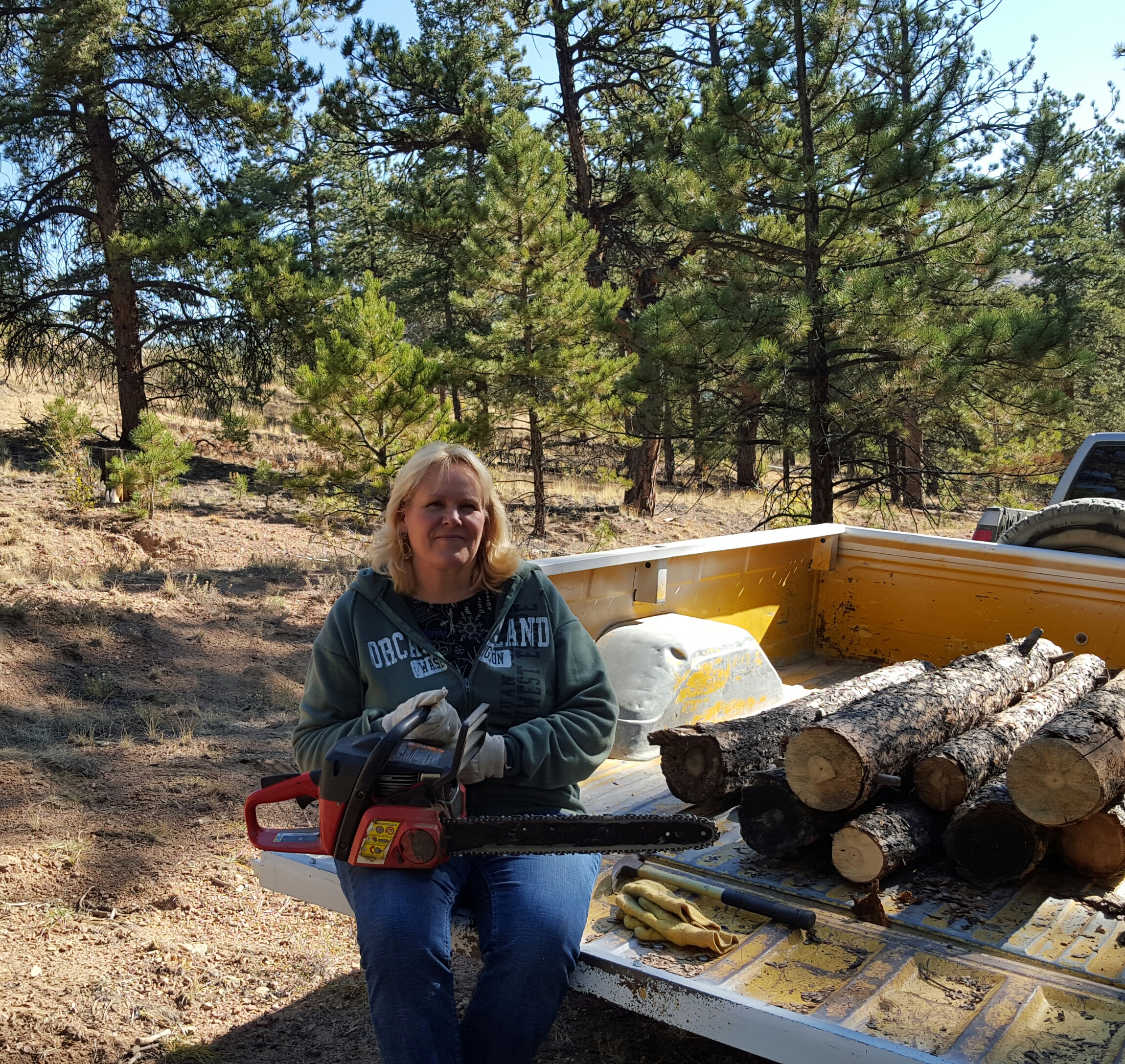
“I’m going to go out and cut some wood.”

There's something sexy about a woman in the woods with a chainsaw.

There’s something sexy about a woman in the woods with a chainsaw.

“Want me to go with you?” she asked.

“That would be great.”

Living in the mountains is something I have dreamed about for over forty years—and now that dream has come true at the foot of Mt. Princeton.  I am in heaven. I step out on my deck at night and can see a million pin-pricks of light in the night sky. Like so many tiny holes to heaven. I can go for a walk and dodge prickly pairs, see antelope, and smell the gentle decay of fallen leaves in the river bottom.

I am living my dream.

My wife is living my dream—not hers.

She is a city girl. She likes the close proximity of Hobby Lobby, Dollar Tree and Costco. She likes the security of people she loves very close to her or within easy driving distance. She likes well-kept lawns, paved streets and stop lights.

So what is she doing volunteering to step outside and hold logs while I cut them with a chainsaw? She isn’t living her life. She is living life. A life she didn’t choose. A life that is happening before us as we follow the calling of the Lord.

Nearly 34 years ago we entered a covenant together for better or worse and she is anything if not loyal to a promise. When we watch the Lord of the Rings trilogy the character she most closely identifies with is Samwise Gamgee. If Frodo, the ring-bearer, must go into Mordor then Sam will follow. It is who he is.

It is who she is.

Last night my hand was hung loosely over the arm of my chair as we were mindlessly watching one of our favorite shows and she slipped her hand inside of mine. We are living in the confluence or our lives—now that kids are grown and gone and grandkids are a thousand miles away. Our souls are knitting together. We are becoming one—our hearts are beating together.

Did you hear about the couple who had been married for 72 years and loved each other to the very end? The couple was hospitalized after a car accident just outside of Marshalltown, Iowa. They were given a shared room in the ICU where they held hands in adjacent beds.

At 3:38 pm on a Wednesday, Gordon’s breathing stopped. Though he was no longer alive, his heart monitor continued to register a beat.

The nurse told Gordon and Norma’s son, Dennis Yeager, that the monitor was beeping “because they’re holding hands, and Norma’s heart beat is going through him.”

Norma died at 4:38 pm, exactly one hour later.

Even when we are cutting wood together or praying together over a meal, we are living in the confluence of our lives.

Together.

Posted in Uncategorized | Tagged , , , , , | 8 Comments

Value above all Values

Now the word of the Lord came to Jonah…

Bible Series Jonah sepiaWhen the Word of the Lord comes to anything, it is never the same.  In Genesis when the earth was a dark, soupy mess, the word of God came to that mess and formed this spinning blue planet we call Earth. When God decided to make mankind, He spoke and mankind was formed from the dust of the ground and placed on this beautiful  blue planet. And in the fullness of time, God comes to us in person and speaks our language in the person of His son, Jesus.

Most scholars agree that this four chapter book was actually penned sometime after Jonah lived and died and several hundred years before Jesus came on the scene. And it is helpful to imagine Jonah as a ‘stand in’ for the people of God.  What God is saying to Jonah, He is really saying to Israel and all of God’s people. That’s why I can hear this as a word for me.  Whatever God is saying to Jonah, He is saying to Joe.

This was written to a group of people who had turned in on themselves and had forgotten who they were and why they were placed in that strategic part of the world. They mistakenly believed that because they were God’s chosen people that meant that they were His only people.  But God loved the Ninivites enough to warn them to change their wicked ways.  He needed a mouth-piece named Jonah.

That very first line in this little story tells us that we were created to find our purpose, meaning and our center in the living God and what He says to us.  God wants His voice to define and shape our lives. This story teaches us that the only secure foundation for us to build our lives on is God and what He says.

All of us are on a search for a word that defines and validates our existence. There will be one WORD that is like a hub in the spoke of our lives.  This “word” defines our values, which drive our behaviors and our passions.  This word will give our lives definition. It will be the foundation that we build the structure of our lives upon.

Tim Keller quotes entertainer Madonna in one of his books:

I have an iron will, and all of my will has always been to conquer some horrible feeling of inadequacy. . . I push past one spell of it and discover myself as a special human being, and then I get to another stage and think I’m mediocre and uninteresting. . . . Again and again. My drive in life is from this horrible fear of being mediocre. And that’s always pushing me, pushing me. Because even though I’ve become Somebody, I still have to prove I’m Somebody. My struggle has never ended and it probably never will.

That is more honest than you or I are often willing to be. Her value above all values is for people to think of her as interesting and special.

What is the ‘word’ for your life?

We are all driven for someone or something to define our existence: to say that you are worthwhile. What is that for you?  Some people believe if they get the right initials behind their name that they will finally be someone.  Others just know that if they achieve certain accomplishments in their career that they will fill that void deep inside.  Others rely on their physical attractiveness to feel special and noticed by someone significant.  Still others are aching for a significant person in their life to finally say, “Well done!”

None of these things are bad, the problem is that they are unstable. All of us are looking for a word to build our lives on and ultimately the only stable word to center your life upon is Word of the living God. The One who created you and formed you for Himself.

As God speaks to the preacher man named Jonah it quickly becomes clear that he has built his life on something other lastman-pieter-jonah-and-the-whalethan God and what God says about him, and so he runs…

God has a word for you.

Slow down and listen, that word is probably behind you and if you won’t listen to the whisper, just keep running and you might find a storm.

Posted in Uncategorized | Tagged , , , | Leave a comment

Misfits at the King’s Table

One Sabbath, when Jesus went to eat in the house of a prominent Pharisee, he was being carefully watched.   Luke 14:1

Meals say things about us. Throughout history meals have been used to show off and dramatize the power of the host.  But Jesus shows in this meal that God is saying something about how He feels about broken people.

This meal takes place on a Sabbath day and Jesus is going to dinner with a leader among the Pharisees.  Now, imagine this scene:  Perhaps Jesus and this man had just returned from Synagogue where they read Torah and worshipped Yahweh and now they are on their way to share a meal together.

The host of this meal is an important person.  He is a member of the powerful sect called Pharisees.  He not only was a member of this powerful group he was a leader.  This was no Storm Trooper Pharisee; this was a Sith Lord Pharisee.

And this dinner invitation is not as innocent as it might first appear. A person who is ill just happens to be present.  These religious leaders know that Jesus has a penchant for healing sick people and here one is placed right in front of him, tempting him to break a Sabbath rule.

Jesus looks at the crippled man and back to his host and says, “On this day when we worship a loving, compassionate God who creates, redeems and restores—would be Okay with you if I heal this person who is in pain?”

Silence.

Jesus takes their silence as permission and heals the man.

Then he asked them, “If one of you has a child or an ox that falls into a well on the Sabbath day, will you not immediately pull it out?” And they had nothing to say. Vs. 4-6

Apparently they had a rule against answering questions on the Sabbath.

And because everyone in this story is so prone to miss and misunderstand what God is doing in the world through Jesus, He tells a story and makes a parable out of the dinner itself.

Then Jesus said to his host, “When you give a luncheon or dinner, do not invite your friends, your brothers or relatives, or your rich neighbors; if you do, they may invite you back and so you will be repaid. 13 But when you give a banquet, invite the poor, the crippled, the lame, the blind, 14 and you will be blessed. Although they cannot repay you, you will be repaid at the resurrection of the righteous.” Vs. 12-14

Thus Jesus clearly teaches that you should not have your relatives over for dinner. Some of you have been searching for this verse your whole life long! You’re going to go call up the relatives and say, “Sorry, Jesus says you can’t come to my house for Thanksgiving Dinner—Luke 14:12.”

Is Jesus really saying here that it’s a sin to fix a meal for your relatives? No! Of course He’s not doing that! He’s contrasting conventional human wisdom with life in the Kingdom of God. Conventional wisdom says, if you’re going to do something nice for someone, make sure that they can do something nice back for you. Quid pro quo. You scratch my back, I’ll scratch yours.

But Jesus is saying that in the Kingdom, people sometimes do nice things for other folks who cannot do anything back for them at all.

Those of us seated at the King’s table ought to be marked by radical hospitality. There is a specific sequence to the people listed here.  It is a sequence that Jesus mentions several times in the Gospels.  The conventional and popular wisdom of the day among the religious elite is that those specific groups had apparently done something to sin away their spiritual standing.  Therefore they were going to be excluded when God set up his Kingdom.

So Jesus is telling this religious Sith Lord Pharisee, “The banquet God is throwing is for all the wrong people.” This means for those of us already seated at the table, that we are never to be selective about who we bring with us to the meal.  I am the wrong kind of person, who better than a person like me to bring others like me to the table?

Most other species forage alone, so that feeding is a solitary business, but human beings seem to love eating together. Even when we are stuck alone with a frozen dinner, most of us will open a magazine or turn on the television just for company. It is, at any rate, one of the clues to his presence. There is always the chance, when we are eating together, that we will discover the risen Lord in our midst. ~ Barbara Brown Taylor, “The Gospel Medicine”, page 95

Who around you needs to be welcomed into your life and into your home? This might mean you need to clear some time on your schedule for those outside your circle. I believe Christians ought to throw the best parties!

Who do you need to welcome to your Spiritual home? Most of you were invited by someone to attend a family of faith. Someone in your world right now would go to a gathering of believers if you invited them.  And there they will hear the Gospel of Grace and find a place they are welcomed and loved—you did.

Who do you need to make space for that is strange to you? Who is your Extra Grace Required (EGR) person?  In every gaggle of believers there is someone who is an extra grace required person.  If you look in your group and don’t see one, that means you areThe King's Table the EGR person. Who in your world do you think is too far from God’s grace or secretly hope they are too far?  Who is too dirty, rude, obnoxious or strange to sit at God’s table?

Who are the poor, the crippled, the lame, and the blind in your world that need to know that there is a chair waiting for them at the King’s Table?  Are they on your mind and heart?  They are on someone’s heart…they are on the King’s heart.

When we really absorb Jesus into our core we all will be people who are marked by hospitality.  It is a gospel for the misfits, a banquet for the broken.

Posted in Uncategorized | Leave a comment

Bread for Your Soul

Now the Passover, a feast of the Jews, was near. Then Jesus lifted up His eyes, and seeing a great multitude coming toward Him, He said to Philip, “Where shall we buy bread, that these may eat?”   John 6:4-5

As we look at the bread in the rugged hand of this carpenter turned rabbi from Nazareth, John wants us to make the connection that the one holding the bread is more than a miracle-worker.  He wants us to see that what bread is to the body, Jesus is to the soul.  When you are starving and you eat simple carbohydrates you are on your way to a restored life.

John is saying that is true about believing in Jesus. He drops a bread crumb clue that The Jewish Passover Feast was near.   That isn’t just a time-stamp reference; that is John’s way of pointing to the meaning of the miracle.  These meals are connected and the bread and Jesus are connected.

The Passover Meal was the central event in the life of the people of Israel.  They marked their calendars by it.  When Israel was in bondage in Egypt and Charlton Heston came to liberate them, they sprinkled the blood of an unblemished lamb on the doorpost of the home so the Angel of Death would “pass over” that home.  That act forever burned into their memory that they could be rescued by the death of an innocent third party sacrifice.

Also, tied to this Passover Meal was the bread God provided for them as they wandered in the barren wilderness.  It was called manna, literally meaning “What is it?”  It lay on the ground each morning for them to gather.  It was the first Wonder Bread.

Jesus said to them, “I tell you the truth, it is not Moses who has given you the bread from heaven, but it is my Father who gives you the true bread from heaven. For the bread of God is he who comes down from heaven and gives life to the world.”

“Sir,” they said, “from now on give us this bread.”

Then Jesus declared, “I am the bread of life. He who comes to me will never go hungry …vs. 32-35

Jesus is speaking to thousands of impoverished people who consume half of their caloric intake per day on barley bread—poor people food.  Quite literally most of these people on breadthe hillside went to bed each night with stomachs rumbling.  And Jesus has the audacity to say to perpetually hungry people, “I will feed you in a way that you will never be hungry again.”

How can he say that?

Jesus knows there is a hunger that is deeper in and further down than all of our physical hungers, thirsts, and social cravings, that is why he declares, “I am the bread of life.”

Maybe a great magnet pulls
All souls towards truth
Or maybe it is life itself
That feeds wisdom
To its youth

Constant craving
Has always been ~ K.D. Lang

There are two common words for life found in Scripture:  “bios” and “zoe.”  Bio refers to that which is physically alive, whereas zoe refers to a quality of life.  Vines Bible Dictionary describes the difference this way, “Bios is life extensive…while zoe is life intensive.”

Jesus is saying that behind every biological hunger is a spiritual hunger and that is what I have come to satisfy.  Behind every physical and social craving is a spiritual longing that only Jesus can provide.

What are you hungry for?  Your constant cravings are clues to the kind of zoe/life God has designed for you.

A popular commercial these days has Larry the Cable Guy pitching a new kind of acid reducer.  In this commercial he asks this question, “Why make a flavored heartburn pill? Because this is America, and we make things you want and things you didn’t know you wanted.  Like a spoon made into a fork, spray cans of cheese, and jeans made from sweat pants!”

Jesus stood on that hillside and made a meal they wanted that pointed to a meal they didn’t know they wanted.  All of our cravings and longings are aches for God:  His love, mercy, grace and presence in our innermost being.

As a pastor, I can tell you many people have full stomachs and emaciated souls.  Because you are what you eat. Listen to your hungers, to the rumblings in your own life right now.  Go to Jesus to satisfy your deepest longings.

I have trained for and completed three marathons.  As I stood at the starting line of my first marathon with my best friend, I was nervous.  Did I have what it takes to run 26.2 miles?  My friend saw worry etched on my face and leaned over to me saying, “Two things, big guy:  1. Trust your training. 2. I will be on your left shoulder every step of the way.  Together we can do this.”

At some point you have to discipline yourself to trust Jesus and believe that He is going to be with you every step of the way.

There are some verbs in verse 11 that are important:  Jesus “takes” the bread, gives “thanks” for the bread and “gives” the bread away. Takes—thanks—gives

At the last supper, same pattern…

And he took bread, gave thanks and broke it, and gave it to them, saying, “This is my body given for you; do this in remembrance of me.” Luke 22:19

Something mysterious happens when I come to the Lord’s Table with a broken heart over my efforts to satisfy longings apart from Jesus, and with an open heart full of gratitude and willingness to love God, love others and serve the world.

I saw a white apron one time with bold and black letters that said:  “Life is too short to eat bad food!”

May I change that to say, “Life is too short to eat good food thinking it is going to satisfy your constant cravings?” You are what you eat…so come to the table, take—give thanks—and give your life away to Jesus and to the world.

Posted in Uncategorized | Tagged , , , , , , | 3 Comments