The Coming Joy-mageddon

“And from Jesus Christ…the ruler of the kings of the earth.”               Revelation 1:5

When we hear “kings,” we think about the sphere of government or politics because in our day power tends to be divided up into different spheres — government, education, media, and the arts.

In those days the king ruled over everything. So when he says Jesus, the one who returns, is the ruler of the kings of the earth, he is saying Jesus’ lordship extends to every area. Jesus is Lord over all powers — media, the arts, business, everything.

Jesus is Lord over Barak Obama, Hillary Clinton and Donald Trump. Jesus is also Lord over Bill O’Reilly and Anderson Cooper. He is Lord over Jon Stewart and Dr. Phil.  He is Lord over Sponge Bob Square Pants and Big Bird. He is Lord over Afghanistan, Iran, Israel, Germany, France and Oakland Raider Fans.

He really is, whether or not people recognize it.

He is Lord over Lady Gaga and Taylor Swift and The Rolling Stones. He is Lord over Brad Pit, George Clooney and John Elway. He’s Lord over Toney Bennett, Bill Gaither and Chis Tomlin.  He’s Lord over CNN, TBN, MSNBC, and FOX News.

He’s Lord over John Hagee, Bill Hybels, Rick Warren, David Jeremiah, and Joe Chambers.

He is Lord over Main Street and Wall Street and State Street. He’s Lord over 1600 Pennsylvania Avenue and over Constitution Avenue and over Madison Avenue and Park Avenue and , Lord over Hollywood Boulevard, Lord over Times Square and Lord over 28390 County Road, Buena Vista, Colorado.

He’s just Lord over it all. You go home and look at your address, and he’s Lord there too.

But does the Christ-follower haven anything to fear at the second coming of the Lord?

No.

I am so weary of the fear mongers on T.V. and the internet. I get asked weekly if I am ready for the coming revolution, collapse of our country or the second coming judgement of the Lord. Who are these folks listening to? I’ll tell you.  They are listening to carpet-bagger preachers and talking ideologues in the media.  They certainly aren’t listening to Jesus.

Listen, we Christ-followers have nothing to fear about the future.

Marriage“I saw the Holy City, the new Jerusalem, coming down out of heaven from God, prepared as a bride beautifully dressed for her husband.” Revelation 21:2

It’s going to be like a lover and his beloved. It’s kind of like this:  My youngest son, Caleb is looking into the future.  He is starting to dream dreams.  Dreams of life and love.  He talks about it some, but I can see it in his thousand-yard-stare.  He is filled with questions.  Will I find my way?  Is she the right one?  What will it all look like?

But there will come a day when Caleb will stand at the front of a church in a formal suite, swallow a smile and wait for his bride.  There will be such outrageous hope in his eyes.  He will smile from ear to ear.  His mother will weep.  I will be composed.  And he will be filled with such anticipation and outrageous hope for a life of unspeakable joy.  And he will find it.  And he will know it.

One day the trumpet will sound and the eastern skies will split wide and our beloved will call us to his side.  And I can’t wait for that day.  If you see me with a far off look in my eyes just know I am straining to see the arrival of my beloved, Jesus.  And when that happens life will begin and joy will be abundant.

Because when He is Lord, there is nothing to fear.

“The gospel of the kingdom steadies us against believing anything bad about God. This world is a perfectly safe place to be as long as you’re in the Kingdom of God.” —Dallas Willard

Posted in Uncategorized | Tagged , , , , , | 4 Comments

Bread for the World

Even Through the darkest phase
Be it thick or thin
Always someone marches brave
Here beneath my skin

Constant craving
Has always been   K.D. Lang

And Jesus took the loaves, and when He had given thanks He distributed them to the disciples, and the disciples to those sitting down; and likewise of the fish, as much as they wanted. John 6:11

In 1863 a German philosopher named Ludwig Feuerbach wrote an essay entitled, Concerning Spiritualism and Materialism in which he poked fun at spirituality.  He basically said that mankind is simply a co-location of molecules and it is an accident of nature that we rose to the top of the food chain. He pointed to the food that we eat and said that we are nothing more and nothing less than the food on our plate.  He is the one who coined the term, “You are what you eat.”

The philosopher didn’t mean to, but I think he accidently agreed with Jesus even though he would be horrified at that assertion. Jesus taught that we hunger for a kind of life that only He can give.  That we are created for a flourishing life and that what you take into your soul will affect whether your life will flourish or flounder.  You really are what you eat.

image

Jesus offers bread for the world and bread for our souls.

This is the only miracle recorded in all four of the Gospels and John calls this miracle as “sign.”  By using that word John is saying this miracle points to a higher and holier truth than simply the multiplication of bread and fish.  This miracle points beyond itself to something much more significant.

What I love about the Gospel of John is that if we step back and look at it panoramically, you see John echoing the first book of the Bible. Genesis 1:1 begins by saying, “In the beginning God created the Heavens and the Earth.  John 1:1 begins by saying, “In the beginning was the Word and the Word was with God and the Word was God.”

In Genesis there is a poetic rhythm to the way the author describes how God created the cosmos out of the soupy darkness and nothingness in seven segments or days.  Throughout the Gospel of John there are scattered seven “signs” in which Jesus reveals who He is and what kind of Kingdom He has come to this earth to establish. John is saying that Jesus of Nazareth is the Creator-God of the cosmos and is now among us restoring the creation that has come unraveled due to our sin.

So, Jesus feeds this large, hungry, and rowdy crowd in a miraculous way.  And, surprisingly, the crowd misreads the sign.  They let the meaning of this miracle skip right by them like a stone on the Sea of Galilee.

If the miracles were simply power-displays, then I am confused as to why Jesus chose to showcase his supernatural abilities in this way.  If it had been me, I would have levitated and then flown around the lake like those wingsuit base jumpers and buzzed the crowd; but Jesus feeds a crowd of hungry people.

If this miracle is simply the disruption of natural laws, we miss the point of what is happening here. The miracles are a glimpse of the restoration of the natural order; it is God putting His creation back to the original design.  All of Jesus’ miracles are assaults on hunger, illness, poverty, decay, and death.  They are never simply power-displays to attract a crowd.

I sometimes get asked why there is pain and suffering in the world and I can never provide an adequate answer. What I can say with a high degree of certainty is that hunger, illness, poverty, decay and death were never part of God’s original design.  Those things were not God’s idea and he is working on setting things to rights through Jesus.

Jesus’ healings are not supernatural miracles in a natural world. They are the only truly ‘natural’ thing in a world that is unnatural, demonized and wounded.” —Jürgen Moltmann, The Way of Jesus Christ: Christology in Messianic Dimensions

Jesus was restoring the world! As we pattern our lives after Him, then serving the real-time, real-pain of this world is part of the expectation of what it means to follow Jesus. It is at the very center of what it means to be a church.

One time Jesus said, I tell you the truth, anyone who has faith in me will do what I have been doing. He will do even greater things than these… John 14:12

I used to think that meant if Jesus walked on water, I could fly if had I enough faith.  If Jesus could raise Lazarus, I could empty the graveyard…if I had enough faith.  But that is childish.  I think Jesus is speaking to ALL of his disciples down through the ages.  And if we were to add up all the acts of service done by Christ-followers for the last 2,000 years, it would far outweigh what Jesus was able to do in 3 ½ years of public ministry.

When we serve the deep needs of our community that is not just window-dressing and marketing for Jesus and our church. When we serve the City for the sake of the City, we are fulfilling this prophetic verse.  We are contributing to the RESTORATION Jesus started 2,000 years ago.

Maybe you don’t think what you have to offer is adequate.  You don’t have the time, the energy, the creativity, the talent, or the resources that Jesus could use to make any real difference in our community. Well, what did Jesus have to work with in this story?  They aren’t bringing very much to the potluck.  All they could find was a boy’s couple slices of Spam and a handful of saltines.  He takes their little and uses it to re-weave, rescue, and restore this world.

Maybe you don’t have much to give, but that’s all the little boy had, and that’s all Andrew could find, AND THAT’S ALL THE LORD NEEDED. That is the way of Jesus.  Little becomes much when placed in the hand of Jesus.

No one has an empty lunchbox; what’s in yours? 

Posted in Uncategorized | Leave a comment

Be Decent

I want always to able a little boy and to have fun, grins Peter Pan.  Then with one grand leap, he stretches out his arms and flies into the night toward the brightest star and Never Never Land.

As children, millions of us followed Peter’s pixie-dust trail to his land of rollicking adventures and returned with hearts full of fantasies. As grown-ups, we never lose our admiration of Peter—the boy eternal. With magical whirl, he always manage to evade the hook of adulthood. Nothing, not even the ever-ticking, clock-swallowing crocodile, spoils his fun or his freedom.

A little bit of Peter Pan resides in all of us. He’s our spirit of youth who likes to crow from time to time. Problems arise, however, when we always want to live like Peter Pan. The late psychologist and author Dan Kiley in his book The Peter Pan Syndrome, describes people with this attitude:

They don’t want anything to do with school, work, or anything else that smacks of adulthood. Their desire is to do whatever they must to remain just what they are: little children who won’t grow up.

Kiley actually sees Peter Pan as in illustration of a confused adolescent.

For all his gaiety, he was a deeply troubled boy…caught in the abyss between the man he didn’t want to become and the boy he could no longer be.

Spiritually, we can get stuck in that same abyss, becoming adolescence in adult bodies. Our playful desire to never grow up can backfire, affecting not just us but those we love.

Although Diotrephes is mentioned only once in the Bible, the brief reference speaks buckets about this type of person.

Diotrephes, who loves being in charge, denigrates my counsel. If I come, you can be sure I’ll hold him to account for spreading vicious rumors about us.

 As if that weren’t bad enough, he not only refuses hospitality to traveling Christians but tries to stop others from welcoming them. Worse yet, instead of inviting them in he throws them out.

 Friend, don’t go along with evil. Model the good. (The Message, 3rd John 9-11a)

This is a Church Bully. He is not the appointed leader, he is the self-appointed leader.  He is not the anointed leader, he is the self-anointed leader.  He wants his way and he is going to get it…at all costs.  Diotrephes lives on with no sense of decency.

A recent statistical study conducted by Southern Seminary discovered that 116 pastors are fired every month in the Southern Baptist Convention.  Another study I read found that it only takes five (5) people to get rid of the pastor.

When my friends and I get together and share our hearts, unfortunately a great deal of our time is spent encouraging each other and giving counsel on how to deal with the “Church Bullies” in our churches.  Because before long you begin to feel like the Lord is leading you somewhere else.

The only problem is there is a Diotrephes waiting there…anxious to have you come.

Now, I don’t mean that every disagreeable person is a Diotrephes.  That is not my point.  But I am saying that it is easy if you are frequently negative, and have a steady bad attitude regarding the leadership of the church—it is easy to fall into a Diotrephes syndrome.  That is part of adolescence–not wanting to grow up.

Well-Intentioned Dragons, Marshall Shelley:

Dragons, of course, are fictional beasts–monstrous reptiles with lion’s claws, a serpent’s tail, bat wings, and scaly skin.  They exist only in the imagination.

But there are dragons of a different sort, decidedly real.  In most cases, though not always, they do not intend to be sinister; in fact, they’re usually quite friendly.  But their charm belies their power to destroy.

Within the church, they are often sincere, well-meaning saints, but they leave ulcers, strained relationships, and hard feelings in their wake.  They don’t consider themselves difficult people.  They don’t sit up nights thinking of ways to be nasty.  Often they are pillars of the community–talented, strong personalities, deservingly respected–but for some reason, they undermine the ministry of the church.  They are not naturally rebellious or pathological; they are loyal church members, convinced they’re serving God, but they wind up doing more harm than good.

They can drive pastors crazy…or out of the church.

Some dragons are openly critical.  They are the ones who accuse you of being (pick one) too spiritual, not spiritual enough, too dominant, too laid back, too narrow, too loose, too structured, too disorganized, or ulterior in your motives.

These criticisms are painful because they are largely unanswerable.  How can you defend yourself and maintain a spirit of peace?  How can you possibly prove the purity of your motives?  Dragons make it hard to disagree without being disagreeable.

I am sure Diotrephes never set out to tear up a church.  But he just had to have his way. I am convinced that if a Diotrephes is still reading this article they are blind to their bullyness.  They will not be able to tell they are the problem. In addition to prayer, it usually takes someone or several someones to stand up to the bully and challenge them to live by a different set of standards.

When you are tempted to manipulate and dominate, remember the lordship of Jesus. Who is ultimately in charge? We don’t have to push our way if we’re willing to trust our true Master.

Posted in Uncategorized | Tagged , , , , | Leave a comment

The Last Meal

“With fervent desire I have desired to eat this Passover with you before I suffer; for I say to you, I will no longer eat of it until it is fulfilled in the kingdom of God.”  Luke 22:15-16

And in many ways, meals tell our stories.

I can still remember the soft, yet granular texture of my grandmother’s cornbread stuffing at Thanksgiving in Colorado Springs in 1971.  And the smell the chili powder and cheese burning in the oven when I cooked a pan of enchiladas for Lynette in a single-wide trailer behind the skating rink in Shawnee, Oklahoma in 1981.  I can also still taste the cloyingly sweetness of that white wedding cake in Slidell, LA at the reception after I pledged vows to my wife. Then there is the soft, yet bold aroma of Verona coffee shared with my friends after Lynette’s handpicked and homemade blackberry cobbler in Seattle.

Meals mark our moments and tell our stories.

communion-200x300It is striking that at the very heart of our faith and what it means to be a Christ-follower centers around a feast—a meal.  Some call it Communion. Others call it the Eucharist. We Baptist call it The Lord’s Supper.

This Supper is loaded with layers of meaning. It points back to the exodus of the Jewish people out of the bondage of Egypt. It also points to the moment just hours before our Lord was crucified on a cross. And it points to a future feast when the Kingdom of God is brought into its fullest reality at the end of the age.

In the meantime, aren’t you hungry for something?

The scriptures often use hunger and thirst as a metaphor for spiritual reality. We have our hungers and thirsts for a reason. They are meant to lead us to the God who intends to share His table of love.

One of my favorite movies is Chocolat, about a little French village in 1959. In this town, you knew what was expected of you and where your place was. If you happened to forget, someone would remind you. They trusted in the wisdom of ages past, including tradition, family, and morality.

The Mayor is the self-appointed guardian of the town. He writes the preacher’s sermons, guides the townspeople in their moral decisions, and overall, tries to maintain the status quo at all costs.

Into this town sweeps a vibrant, young woman named Vianne who is anything but traditional.  She does nothing by the book. She does not go to church, has a daughter Chocolat _redhoodedcapeViannewithout a father present, and has the gall to open a chocolate shop in the middle of Lent.

Her chocolate shop and her grace unexpectedly transform the town and its people. A wounded woman finds the courage to escape her abusive husband. A grandmother renews a broken relationship with her family members. Even the Comte de Reynaud (mayor), after an intense Easter Saturday conversion experience, is described as “strangely released”.

If a young woman selling chocolate can make that much of a difference (albeit in a fictional town)- mending family relationships, breaking free from abusive situations, opening their hearts for love – Just think what a difference can be made by the life of a man named Jesus.

I think this is a picture of what God does for us when Jesus comes into our lives and sets us free from our oppression, no matter how well-intended, with his sweet grace of love and acceptance.

A friend of mine told me about a missionary who had a collection of communion chalices. There were some that were ornate, some that were gold, some were bejeweled and some were silver. My friend said he was very impressed with the collection and asked about each of them and then finally asked the owner which of the many was his favorite. The missionary reached up on the shelf and picked up a rather ugly one sitting on the end of the shelf.  It was a small orange/brown rough-metaled chalice.

He pulled it from the shelf and then told my friend that it had been given to him by a church community in Japan.  The metal in the chalice was repurposed from a decommissioned bomb found in Japan after WWII. The very instrument that was designed and used to inflict death and destruction had been transformed into a vessel to hold life, restoration, and hope.

I hope you hear the longing in Jesus’ voice when, with crumbs on his beard and wine on His breath, He says to His friends and followers, do this in remembrance of Me. 

Next time you celebrate the Lord’s Supper, linger over the bread and the wine and whisper to the Lord, “I remember.”

That’s a meal that tells a story.

Posted in Uncategorized | Tagged , , , , , | Leave a comment

Faith to Finish

Since we are surrounded by so great a cloud of witnesses …let us run with endurance the race that is set before us.  Hebrews 12:1

I’ve finished three full marathons (26.2 miles) and almost 20 Half Marathons. At the start

Boulder Backroads Whidbey Island Seattle Rock and Roll

Boulder Backroads
Whidbey Island
Seattle Rock and Roll

of the race you might be singing songs like:

Summertime, and the livin’ is easy

Fish are jumpin’ and the cotton is high

Oh, your daddy’s rich and your ma is good-lookin’

But at the finish:

Oh Danny boy, the pipes, the pipes are calling
From glen to glen and down the mountain side
The summer’s gone and all the roses dying
‘Tis you, ’tis you must go and I must bye 

In the last marathon I ran I saw lots of signs on the pinned to the backs of runners, but two stood out to me. One said, “Expected finish Tuesday about noon.” The second one said, “Courage to Start, Faith to Finish.”

WHAT DOES IT TAKE TO FINISH WELL?

Persistence in Prayer

Jesus tells us a story in Luke 18 about a widow who needs justice. She goes to her local politician and he’s a pretty weak kneed — turns out he’s on the take, he’s thoroughly corrupt. It’s hard to believe there could be such a thing as a corrupt politician, but use your imagination.

This woman has no connections, no money. She’s on welfare herself, can’t bribe him, but she calls him, writes him, e-mails him, faxes him so often he finally says to his staff, “Just take care of what she needs. Get her out of my hair and off my back.”

In Luke 11 Jesus tells another story and asks us to imagine that we have friends who are Methodists come to visit—uninvited. They arrive at midnight and they haven’t eaten since noon. Your kitchen’s empty and the local Town Talk Cafe is closed, so you go to your neighbor. You pound on the door. “The Methodists are here,” you say. “Give me some beer and some potato chips so I can feed them! For it is written that Methodists only partake of Beer and Chips.” (It’s in Luke 11, you can look it up.)

The neighbor says, “It’s one in the morning and the kids are in bed and it’s the first good night’s sleep I’ve had in a week. Are you crazy?”

But if you keep pounding long enough, Jesus says, he’ll give you food just to shut you up. If you are willing to persist with corrupt politicians and cranky neighbors, how can you not persist with God who listens to his children with infinite patience, who longs to give good things?

Sometimes the gift God wants to give you is growth, the kind of growth that only comes when you persist again and again and again.

Many years ago ministry and my selfishness had almost destroyed my marriage. My first post-ministry job was tearing down a cat lady’s house for $10 per hour, then I worked in an oil refinery for a few months, then I got a job as a corporate trainer and traveled the country teaching companies courses like, “How to Supervise People,” “Conflict Management,” and “Communication Skills.”

I felt as lost and unattached as a refugee. I spent night after miserable night in strange hotel rooms from Seattle to New York City. But I developed a discipline in that dark time of journaling three pages every morning no matter what.

I would start my day out, “Dear Lord, …”

I kept going to the Lord.

Then one day in Flagstaff, Arizona I was reading through Psalm 51 in The Message translation and came across this passage…

God, make a fresh start in me, shape a Genesis week from the chaos of my life. 11 Don’t throw me out with the trash, or fail to breathe holiness in me. 12 Bring me back from gray exile, put a fresh wind in my sails! 13 Give me a job teaching rebels your ways so the lost can find their way home. Psalms 51:10-13 (MSG)

God was sending me a message through His Word that in spite of my present circumstances, He was not finished with me. I would have never dreamed in that Comfort Inn in Flagstaff, that one day I would be pastoring a beautiful church in the mountains of Colorado.

I’ve gotten a lot of things wrong in my life, but one thing I’ve kept doing is I’ve kept going to God.

FIND SOME ENCOURAGERS

We need to find a few people who say, “Don’t quit, just keep running, and just don’t give up.” We need to find a little cloud of witnesses.

Seattle RnRIn my last marathon, I saw lots of sleek and strong bodies. But there were others that were not so sleek. I saw a lady bent over with osteoporosis. There was a man who was pushing his son in a wheelchair. Some run fast, some run slow — it doesn’t matter. Just keep running. Everybody has a race to run and not one of them is easy.

When you run in a race there are people along the way that cheer you on. I remember in the first third of the race, I would run by a group in lawn chairs cheering me on and I would think, “You don’t know me. You’re just cheering to hear your own voice. Leave me alone.”

But in the last third of the race when a total stranger shouted, “You can do it, big fella!” I’d run over to them and say, “Really? You think I can? I hope so. Thanks for cheering me!”

Wouldn’t it be wonderful if every Sunday when folks gather in their places of worship, they would know that they had a little cloud of witnesses? That when they were down and discouraged they could look into the eyes of those encouragers and find strength to finish their race.

Derek Redmond was prepared for the 400-meter semifinal race at the Olympics in Barcelona in 1992. He felt he was in the best shape of his life. His father Jim, sitting in the stands. Jim and his son were very close and he made it to all of the championship races.

Derek gets off to a good start. Coming around the first bend in the track, tragedy struck as Derek’s hamstring went. His leg would not function.

He hopped on one leg for half a lap before his father came to his aid. Together they finished the race arm-in-arm to a standing ovation.


When we get to heaven, the Lord won’t care if we won our race and beat anyone down here. He’s going to look to see if we finished.

Courage to start; faith to finish.

One day there will be a great cloud of witnesses cheering as we enter the fully realized Kingdom of God and hear our Heavenly Father say, “Well done thou good and faithful servant. Well done. Enter into the joy of the Kingdom.”

Just keep running.

Posted in Uncategorized | Tagged , , , , , , | 4 Comments

Christians R Us

“When I was a child, I talked like a child, I thought like a child, I reasoned like a child. When I became a man, I put childish ways behind me.”  I Corinthians 13:11 (NIV)

A parent can expect their child to challenge their authority regularly from the time he is about 15 months of age, if not earlier. The toddler is the world’s most hard-nosed opponent of law and order, and he can make life miserable for his harassed parents. In his own innocent way, he is adorable AND vicious and selfish and demanding and cunning and destructive.

When it comes to rearing children, every society is only 20 years away from barbarism. Twenty years is all we have to accomplish the task of civilizing the infants who are born into our midst each year. These savages know nothing of our language, our culture, our religion, our customs of interpersonal relations…the barbarian must be tamed if civilization is to survive.~ Dr. Albert Siegel

Let me borrow on that analogy and say the barbarian must be tamed if the church is ever going to reach its full potential. How difficult it will be to soar, to do what we have been called to do, if all of us don’t grow up and become adults, no longer childish and immature.

Has the barbaric nature inside your soul been tamed? If not, you’re part of the problem. You are one of the reasons the church still struggles to stay on its feet and behave. I am not referring to being childlike. There is a difference between childishness and childlikeness.

Childlikeness

  1. Mentally they are teachable.

Childlike Christians are often anxious to learn about faith and ready to start exploring its many facets. We should never outgrow this insatiable desire to learn about God and the application of His truth

  1. Emotionally they are touchable.

Like children, young believers are generally willing to let down their guard, place their trust in others, and become involved in people’s lives. This level of transparency and vulnerability should always characterize a Christian’s life.

  1. Spiritually they are tender.

Christians who are childlike in their faith are usually open to God’s Word and respond positively to the Spirit. The Lord desires that all His people display that kind of sensitivity to the Spirit.

Children are so tender, and that is how God wants believers to be. Childlikeness is commended all through Scripture, but childishness is condemned severely. Especially when the childishness is in the life of an adult.

Childishness

  1. Willful Defiance

“Do not prophesy to us right things; speak to us smooth things…” Isaiah 30:10

In other words, “I want to hear what I want to hear. If you’re going to get cranky, if you’re going to get negative, if you’re going to come down on us about holiness when we are only toddler-screaming-nohuman, then go somewhere else and give your message.” That is a childish response.

He who cannot obey, cannot command.  –Benjamin Franklin

A basic requirement for being a good leader is submitting to authority, not only before, but while leading. When will we learn to submit? When will we learn to bow before the Father and in all sincerity say, “Have Thine own way”? What is true of a leader is true for an adult Christ-follower.

Or it should be.

  1. Superficial Commitment

Childish believers often desire to be entertained instead of transformed. They enjoy listening to great preachers and beautiful music. They may even serve in the church from time to time, but they have no genuine interest in applying the truth of God’s Word on a practical and daily level.

“When I was little we used to play church. We’d get the chairs into rows, fight over who’d be the preacher. Vigorously lead the hymn service and generally have a great carnal time. The aggressive kids naturally wanted to be up front directing and preaching; the quieter ones were content to sit and be entertained by the up-fronters.

Occasionally, we’d get mesmerized by a true sensationalistic crowd swayers. Like the girl who said, ‘Boo, I’m the Holy Ghost.’ But in general, if the up-fronters were pretty good, well, they’d hold their audience for quite a while. If they weren’t so good, eventually the kids would drift off to play something else like jump rope or jacks.

Now, that generation has grown up. But most of them haven’t changed too much. Every Sunday they still play church. They line up in rows for the entertainment, if it’s pretty good the church will grow. If it’s not too hot, eventually they drift off to play something else like yachting or wife-swapping.”~ Ann Ortlund

What game are you playing? Being willfully defiant is bad enough. But to add to it a superficial commitment is almost unbearable.

  1. Easily swayed.

The older I get the more I am convinced that the best way to keep me from being easily swayed is to immerse myself in the Psalms and the Gospels and at the same time be deeply connected to mature brothers in Christ that are more committed to my growth in Christ than I am.

Where are you?

The innocence of children may be more a matter of weakness of limb than purity of heart. –Augustine


Posted in Uncategorized | Tagged , , , , , | 2 Comments

I Surrender Almost

So he looked this way and that way, and when he saw no one, he killed the Egyptian and hid him in the sand. Exodus 2:12

The act of willing surrender is a choice of openness, a choice of abandonment of self-determination, a choice of cooperation with God. ~ David Benner, Desiring God’s Will

Surrendering to God sounds like such a nice thing, but is the never-ending battle of a Christ-follower. We never get to a place where we can relax and believe that we have settled the issue of willfulness.

We sing…

All to Jesus I surrender;
All to Him I freely give;
I will ever love and trust Him,
In His presence daily live.

The great danger is that when we sing songs like that in safe places of worship we come to think of ourselves as surrendered people. We confuse intention with action and desire with behavior. But the truth about surrender does not come on Sunday morning when the music is playing; the truth about surrender happens when you are tempted.

Will you take the pain that comes from saying, “yes” to God? When John the Baptizer said yes to God it cost him great discomfort. Each of the followers of Jesus in his lifetime paid a great price to saying yes to God. Jesus was not spared the ultimate pain of saying yes to God. What makes me think I can escape the pain of saying yes to God?

We have so anesthetized and Joel Osteenized our faith that we leave the impression that to follow Jesus ought to be all rainbows, puppy dogs and puffy clouds. It’s a lie from the pit of hell and it smells like smoke.

Our culture screams that we should assert our will in every area of our lives, but the Christian teaching says something different.

Take the age-old problem of judging. It is a vice for which we religious types are infamous. In spite of clear teaching from Jesus to not judge, we do so with much alacrity. We look at a person and assign that person a certain category. That person does not dress like me or manage their time or money like I do. They do not hold to my particular political views and I form value assessment of that person. Now that person is not an image-bearer like me, his identity has shifted to his behavior or his politics. She is other.

I segregate them in my mind.  Instead of looking at that tattoo-wearing, Obama-supporting, welfare-enrolled, abortion-supporting, anti-gun person as a man or a woman created in the image of God who is just as broken as I am—they are “those people.” And as long as they are “those people” the only way I will have a convivial relationship with them is if the relationship is on my terms.

I simply don’t look at those outside of my tribe and say, “Lord, how do you want me to love them right where they are and NEVER try to change them.”

I love what Frank Laubach wrote years ago about surrender:

Submission is the first and last duty of man. That is exactly what I have needed in my Christian life. Two years ago a profound dissatisfaction led me to begin trying to line up my actions with the will of God about every fifteen minutes or every half hour. Other people to whom I confessed this intention said it was impossible. I judge from what I have said that few people are trying even that. But this year I have started out trying to live all my waking moments in conscious listening to the inner voice, asking without ceasing, “What, Father, do you desire said? What, Father, do you desire done this minute?”

This is doable if I am willing to take the pain that comes with saying yes to God. Of course there will be failures and I will lean again and again on the grace of God and return to Him saying, “What, Father, do you desire said? What, Father, do you desire done this minute?”

whitteflagThis requires diligence on my part because my old ways are relentless. Will I surrender my will to His moment by moment? Now, you’ll excuse me, there is someone listening to Kenny G and packing a gun I need to befriend.

Posted in Uncategorized | Tagged , , , | 1 Comment

Be Ruthless with Your Idol

…For until those days the children of Israel burned incense to it, and called it Nehushtan. 2 Kings 18:4

The reformer John Calvin famously wrote that the human heart is an idol factory. Humans have a proclivity to take things, even good things, and turn them into objects of worship.

In Numbers 21:4–9 we have a story of God’s recently freed people (the Israelites) moses-serpent-polebecoming rebellious against God and complaining to Moses about being brought out of Egypt into the wilderness to die. They wanted to go back into slavery and sought a response from God about their request. In response to their complaints, God sends snakes which was probably not what they had in mind when they were complaining.

Some of them began to die from poisonous snakebites. This is when the people realized they needed God’s help. They repented and asked that the snakes be taken away from them. Moses took the request to God who told him to make a bronze snake and put it on a pole. Moses was then instructed to hold the pole up in the air, and if the people would look at the pole (or Nehushtan), they would not die from the snakebites.

All in all, this story points ahead to Jesus – the pole represents the cross and the snake (sin) represents Jesus on the cross. Jesus taught this interpretation Himself in John 3:14.

Fast-forward hundreds of years to Hezekiah and 2 Kings 18:4. Apparently, the Israelites had been making offerings to the bronze serpent that Moses had fashioned. Instead of worshipping the God who saved their ancestors, they were worshipping a thing that God used to save them.

This must have been extremely frustrating for God watching His chosen people worship a thing that was used instead of the one who used it. It would be like thanking the life-ring instead of the lifeguard for saving you from drowning. Or thanking the fire hydrant instead of the fireman from dousing the flames engulfing your home.

The bronze serpent was something God used, not God Himself. Instead, the Israelites took a good thing and turned it into an idol.

Idols can be things God used many years ago, but has since moved on.

The bronze serpent was something God used while the Israelites were wandering through the desert. That was roughly 750–780 years before Hezekiah was king. Even still, people were holding on to the relic of God’s work in the past and worshipping it in the present.

Don’t we do this as well? We being to idolize a movement, music, or minister who God used in the past. We look back at the glory days when God used someone or something and then we put them or it on a pedestal.

Like the Israelites, we need to be careful not to fixate (and even worship) something that God used many years ago, but has since moved on. The only thing worth looking back in time to worship is the life, death, and resurrection of Jesus. Anything else could become an idol.

Idols take the focus off the things God does and on to the things God uses.

Notice that the Israelites were making offerings to the bronze serpent and not for what God did through the bronze serpent. There’s a huge difference.

If the Israelites were making offerings for what God did through the bronze serpent (i.e., giving Him thanks for what He had done for their people all those many years ago) there wouldn’t have been a problem. But the Israelites were making offerings to the bronze serpent. In essence, they were thanking and worshiping the thing rather than the being who used the thing.

This happens to us all the time. We tend to gravitate towards things or people or methods that God uses, then eventually replace them for God altogether. For example, we may appreciate a particular style of preaching or music God is using. We gravitate towards that person and slowly begin to focus only on them. We only like that kind of preaching or music in worship services. Soon, they become the object of our affection rather than God.

Is there anything wrong with gravitating towards a person God is using? Of course not. The problem begins when we replace them with God. Like the bronze serpent, we forget that they are a tool being used by God and not actually God Himself.

Idols can be anything, anywhere, at any time.

The Israelites were worshipping a 780 year old bronze serpent that God once used for good. Sounds really weird, doesn’t it?

We tend to think of idols as something archaic. Backwards ancient people worshiped golden calves and sacrificed their children to giant statues, but we’re modern and evolved. We don’t worship idols and sacrifice children like those foolish people in the past.

Or do we?

We can worship our possessions, our reputations, our hobbies, families, styles of preaching or worship music. We can even worship our vocations: Preacher, Doctor, Physical Therapist. We can worship our politics, churches, and denominations.

How do we keep from ending up like the Israelites and worshipping a good thing that God used instead of worshipping God Himself?

I think the answer is in Hezekiah’s actions – he broke the bronze serpent into pieces.

If there is something in our lives that we can’t help but worship, then maybe it’s time to “break it” into pieces. We need to take it off the pedestal in our minds, break it, and replace it with God.

Sure, it could be painful. I’m not sure Hezekiah took pleasure in destroying a wonderfully important piece of his people’s history, but if it becomes an idol then it needs to go. The idol needs to be broken into pieces.

The good news is that there is liberation in breaking our idols into pieces. After Hezekiah destroyed Israel’s idols we read that “the Lord was with him.” This is not to say that God wasn’t always there and had just now shown up, but that Hezekiah (and Israel’s) relationship was restored with God. It was fuller, richer, and more complete.

When we destroy our idols, we begin to experience God’s joy in worshipping Him. After all, that’s what we were made to do.

Posted in Uncategorized | Leave a comment

When Your Shepherd Tries to Kill You

“Take your son, your only son Isaac, whom you love, and go to the land of Moriah, and offer him there as a burnt offering on one of the mountains that I shall show you.” On the third day Abraham looked up and saw the place far away. ~ Genesis 22:2,4

It is a dark road, this road to Moriah.  It’s dark because it means Abraham losing his son, whom he loves. But it’s not just that. It’s dark because it means losing his dream, for Isaac was the promise of God. Isaac was the promise that Abraham’s life would lead to a new community, and he was losing his dream. But it wasn’t just that.

It was dark because he wasn’t just going to lose Isaac. Abraham was to destroy his son at the command of God. So what do you do when you have to walk in the darkness, and God seems distant or remote or silent?

Abraham in this moment is stepping out into what could be called “the road of godforsakenness,” when it seems like God is contradicting himself, when it seems like God wants to stop the salvation that he’s begun.

This is a story about darkness, most of us at some point or another in our lives; understand what it is to walk in darkness. Faith is about hanging on in dark places.

Faith is not about doubt-free certainty. Faith is about tenacious obedience at all costs.

He’s heard this voice before. This voice told him to leave his home and everything familiar. This voice told him that he and God were in covenant together. And this voice told him that he and his wife would have a son although they had the combined ages of 190 years old, and he laughed and his wife laughed. But apparently he responded in obedience once again because, in fact, she did have a son.

Now the voice comes to him once more; and as far as we know, it’s for the last time. Once this episode is over, we hear little about Abraham in Genesis. This time he’s asked one final thing.

To this point he’s been asked to give up everything in his life — his home, his family, everything — for the sake of the promise.  Now the voice is going to ask him to give up one more thing: Give up the promise.

Can you let go of what you love the most? Is God alone enough for you?

We all have dark times. When it looks like the God whom we serve is not cooperating with the script we have written for our lives.

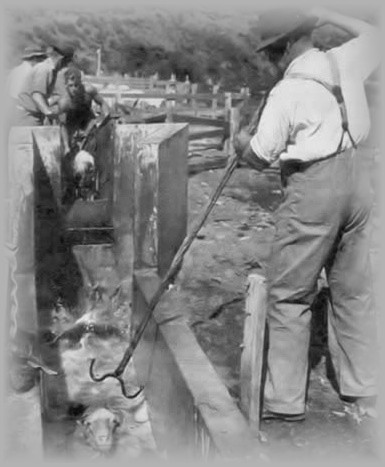
The late Elisabeth Elliot, one of the godliest women of our generation, told about a time Sheep_dippingyears ago while visiting friends who owned a sheep ranch in Northern Wales. One day she saw a shepherd pick up a sheep and take it to a sheep dip which is a large vat of liquid insecticide and fungicide, and put the sheep into the vat, and the sheep frantically fought for air. Then the shepherd pushed the head down, but the sheep kept coming up, and the shepherd kept pushing it down, because all of the surface of the sheep had to be coated with the solution to keep it from getting ill.

She said, “I wondered what it’s like to feel like your shepherd is trying to kill you? Then she remembered the death of her missionary husband at the hands of the very people he served and said, “Oh, I remember.”

If this story of Abraham tells us anything it tells us that sometimes your shepherd, who is trying to save you, will feel to you like he is trying to kill you. And that is a dark time, indeed. I don’t know what it looks like for you, but I know this: Every human being that ever lived has walked in darkness sometime. But one day, one day the “third day” will come. It came for Abraham.

It came in the life of another one who also stepped out on the “road to godforsakenness” who, like Isaac, had to carry on his back the wood on which he would be killed. Who cried out in his darkest hour, “My God, my God, why have you forsaken me?”

Only when it was time for his sacrifice, no voice cried out to stop the Father, and Jesus was killed. But the third day came for him, too. And the third day will come for you and for me, someday, friends.

Faith is about tenacious obedience and we live with this promise: The third day will come.

Posted in Uncategorized | Tagged , , , , , , , | 6 Comments

Hattie’s Song

“The kingdom of heaven is like leaven, which a woman took and hid in three measures of meal till it was all leavened.”~ Jesus

The bedraggled man sat in my office and tried to wet his lips, but his tongue was too dry. His shoulders were rounded and stooped as if he carried the world. His eyes kept flitting around from one window to the next, glancing at me furtively. Finally, he’d gathered enough spit to speak.

“Pastor Joe, your sermon yesterday on hope and leaven made me think of something that happened to me when I was a little boy. I don’t know why, but I feel as if I’m supposed to tell you this story.

“I was eight years old when my grandmother remarried a man named Bob. During the summers my mother would take us up to their ranch in northern Texas for a visit. Grandpa Bob sat me on his knee, tussled my hair; told me stories.  I liked Grandpa Bob. He let me drive the tractor and feed the chickens.

“They had a maid that worked for them, cleaning, cooking and generally taking care of the house.  Her name was Hattie. She was a beautiful, large black woman. She made the best biscuits in the world but she barely spoke. When I was in the sitting room with my mom and grandparents, I could hear Hattie in the kitchen as she slammed cabinet doors and banged pots and pans.

“Don’t break all the dishes, Hattie.” Grandpa Bob would yell out to her with a grin.  Then he turned to me and said, “Hattie can’t hear a lick. She doesn’t realize how hard she’s banging stuff.”

“My mother had me stay with them at the ranch for the summer with Grandpa Bob and my Grandma. Grandpa took me everywhere with him. We went to town to the feed store. He took me to the Town Talk Café for breakfast. He took me to the courthouse and we sat on some benches with other old men and they told stories and laughed.

“One Friday evening we went to a large meeting in a farmer’s field. There were lots of men there and they had their cars and trucks all in a circle with their headlights pointing to the center. In the middle of the circle of headlights was a large oak tree.

“Grandpa Bob had a wooden box that he put in front of his truck and he stood up on it and began to speak. Everyone listened to him. It was like he was their boss or something. I couldn’t understand everything he said but it sounded as if he was angry. I’d never heard him speak in anger before that night. He was yelling at the black man who was being held by the arms under the tree. I was sitting in the front seat of the car and grandpa Bob’s back was to me and I couldn’t make out everything he said, but then they put a rope around the black man’s neck and pulled him up in the air from a rope they had tossed over the limb of the tree. The man kicked and kicked and kicked and kicked until he didn’t kick anymore.

The man stopped, wet his lips, and wiped a tear from his eye.

“Pastor Joe, it was the most horrible thing I’ve seen in my life. I was only a boy. Who takes their grandson to something like that?” he asked.

All I could do was shake my head in sadness.

He continued, “On the way home Grandpa Bob told me over and over again about how we needed to remind those people of their place and that if they ever started getting ideas like that black-no-good-son-of-a-bitch-preacher, King—then all of society would come unraveled.

“While he talked I kept seeing that black man’s feet kicking and kicking and then going still.

“Later that night I was in my bed and couldn’t keep from crying so I sobbed in my pillow. Directly, I heard the door to my room open. I turned my head towards the door thinking it might be Grandpa Bob coming to tell me to stop crying, but silhouetted against the hallway light was the round figure of Hattie. She sat on the edge of the bed and stroked my face. Her hands smelled of cinnamon and honey. She patted my chest with her thick black hand, and the more she was tender with me the more I could see that man’s feet hanging from the tree, and I cried all the more.black hands

Then I heard her softly begin to sing:

Precious Lord, take my hand
Lead me on, let me stand
I’m tired, I’m weak, I’m lone
Through the storm, through the night
Lead me on to the light
Take my hand precious Lord, lead me home

“When she was finished she patted me on the head and quietly stepped out of the room.

“The next day I heard a man preaching on the radio from the kitchen. When I went in and sat down at the table I saw Hattie washing dishes and she was listening carefully to the preacher man. She saw me come in and asked me if I wanted pancakes for breakfast.

“I must have had a shocked look on my face thinking about the song she sang to me the night before and now her listening to the radio because Hattie looked at me sternly and yet with a hint of kindness and said, “You can keep a secret can’t you?” I nodded my head. She said, “I’m only pretending to be deaf so’s I can hear what Mr. Bob is planning and warn my people when I hear something’s coming that’ll bring them harm. I’m like leaven in the loaf that the Bible talks about. He don’t know I can hear, so let’s keep it that way, Okay? One day, judgment run down as waters, and righteousness as a mighty stream like Dr. King say.”

“I nodded.

“Aren’t you scared, Miss Hattie?” I asked.

“Yes, boy, I’m scared. But God knows what He’s doing. I do my part and he do His part and all will be well one day.”

“From that day on my step grandfather did his best to fill my head with hate and Hattie would fill it with love every night.

“In time my grandparents died and I lost track of Hattie but in the early nineties I went back to that community to look for her. I went to the only cemetery in town and had the hardest time finding her.  Eventually I found her in the “colored section.” The only marker on her grave was a small metal plate with a number twenty-seven. I vowed that when I could get the money I’d get her a nice stone.

“I’ve never had enough money, but no one has marked my life like Hattie. She never spoke an ill word about my grandma or grandpa Bob. She just filled me with love whenever they weren’t around. Told me stories, smiled at me and sang. And, Pastor Joe, she could sing like an angel and that always gave me hope.”

He took a sip of water from the Styrofoam cup and thanked me for my time and excused himself.

I sat in my chair—slack-jawed. But I kept humming that tune all day. I couldn’t get it out of my head.

The leaven of the gospel of the Kingdom hid its way into her life and was kneaded into Hattie’s soul and there lay–until a little boy needed a song—and today I’m telling you their story. That’s how the Kingdom spreads.

So, get your hopes up and sing.

Somebody might be listening.

Posted in Uncategorized | Tagged , , , , , | 2 Comments