A Symbol Divided Should Fall

I’ve asked my good friend Jamie Greening to write a guest blog for me this week. Jamie is a writer, thinker, and a man who is walking a long obedience in the same direction—with Jesus. He wrote a very good book last year which I bought and gave away several copies called The Little Girl Waits. You can click here and learn more about it. He also writes a blog you can find here and I encourage you to check it out.


Is the flag of the Confederate States of America a racist symbol?

I bring this up, because racism is the headline that will not go away.  It seemed like things might gently calm down again, but suddenly frat boys were filmed singing a hateful, violent, racist song with great glee and gusto.  Then Ferguson erupted again, and another Racistyoung black man was shot in Wisconsin.  Then my friend sent me a screenshot of the Confederate flag offered at Amazon, along with some of the comments.

Jesus said the poor you will have with you always (Mark 14:7).  I am beginning to wonder if there is some alternate reading of that text that says, ‘the racist you will have with you always.’

The question I ask is not whether or not racism is real, I think that is a given.  The question I ask is whether or not the Confederate flag is an inherently racist, therefore evil, symbol?

Is it the American equivalent to the swastika of Nazi German? 20070728-confederateswastika

It seems to me there are three different views of what the Confederate flag means.  Let’s put them into groups A, B, and C.

For Group A the Confederate flag means Southern culture.  It is a stand in for sweet tea, grits, college football and conservative politics.  As such, it is a viewed as a beloved icon of all that is right in the world.  People who see the Confederate flag in this way do not connect it at all to the past, but to the present.  If they connect it to the past at all, it is to their own personal past, their own experiences of Southern living, of nostalgia.  It is to the South what the Space Needle is to the Northwest or cactus is to the Southwest.

For Group B, which includes many black Americans, the Confederate flag means slavery.  It is a stand in for that evil peculiar institution that eventually drove the grand experiment in democracy to the bloodiest of all political actions:  Civil war.  It is a reminder that once upon a time, not so long ago, in a very near land, their ancestors were denied life, liberty, and the pursuit of happiness.  People of their ethnicity were bought, sold, abused, and murdered at the whims of white people.  For these individuals, the Confederate flag is a racial epithet that is intended to remind people of color what their ‘place’ is.

For Group C the Confederate flag is a symbol of rebellion, foolishness, and backwardness.  People who fly it or promote it are telling the world around them they are not serious people, that they are morons, and are the fringe of the fringe.

As a child of the west, and a native resident of a proud state that loves its own flag, I understand the sympathies of Group A.  However, as a follower of Christ, and as a human being who believes that we are all created in the image of God, I firmly stand in solidarity with Group B.  The Confederate flag does not represent Southern culture, it represents the devilish ideology of slavery and oppression.  For that reason, I believe it has no place in modern American discourse.  Civilized people, from Savannah to Sacramento should abolish it and urge others to do so.

I know that it feels a little odd to put so much attention on a symbol when we have such contentious issues as police shootings, inequality in the application of justice, rampant black poverty, and incredible numbers of black-on-black violence.  I also realize that as a white male, I will never fully appreciate everything about this issue.  However, we must start somewhere, and sometimes the easiest stuff is the best first step.  Racism is a sin against God and man.

Celebrating a racist symbol is too.

Posted in Uncategorized | Tagged , , , , , , | 2 Comments

Confession is Good for the Soul

…and golden bowls full of incense, which are the prayers of the saints. Revelation 5:8

The Cat in the Hat is a children’s book written and illustrated by Theodor Geisel under the pen name Dr. Seuss and first published in 1957. The story centers on a tall anthropomorphic cat, who wears a red and white-striped hat and a red bow tie. The Cat shows up at the house of Sally and her brother one rainy day when their mother is away. Ignoring repeated objections from the children’s fish, the Cat shows the children a few of his tricks in an attempt to entertain them. In the process, he and his companions, Thing One and Thing Two wreck the house.

As the mother returns and is seen about to enter the house the fish says these words.

This mess is so big

And so deep and so tall,

We can not pick it up.

There is no way at all!

That is the truth of truths when it comes to my life.  I consistently make a mess of my life that I can’t deal with. All you have to do is glance at the headlines to realize that something is dreadfully wrong with this world.

When a newspaper posed the question, ‘What’s Wrong with the World?’ the Catholic thinker G. K. Chesterton reputedly wrote a brief letter in response:

Dear Sirs:

I am.

Sincerely Yours,

G.K. Chesterton

That is the attitude of someone who has grasped the message of Jesus. And the discipline of confession is the process that helps us all understand that the change the world needs begins in our own souls. And that bothers us.

What Sin Does To Our Souls

When we live in patterns that are estranged from God it withers us, it exhausts us, and it parches our souls. The reason we are so spiritually thirsty is that we are drinking from man-made wells. The Bible tells us about a Creator-God that uses his wisdom and intelligence to make a creation that is bursting with beauty, delight, possibility, harmony, goodness, and justice—in a word: Shalom.

As the Jewish people introduced God to the world they told us that God is anti-sin, not because He doesn’t want us to have fun, but because God is for shalom.

God is against greed, for example, not because He makes a world full of beautiful things then decides that He doesn’t want me to enjoy any of them. God is against greed because he has made a world of staggering beauty and placed me in it and wants me to be grateful and appreciative of the beauty of it.  And God is wise enough to know that greed is an addiction and hunger that will eat me alive like a malignancy.

God is anti-greed because God is pro shalom.

Leo Tolstoy tells the story of a greedy man named, Pahom, who was obsessed with amassing more and more land. One day he learned of a wonderful and unusual opportunity to get more land. For only 1,000 rubles he could have the entire area that he could walk around in a day, but he had to make it back to the starting point by the sunset or he would lose everything that he invested.

He arose early and set out. He walked on and on thinking that he could get just a little more land if he kept straining forward for the prize he sought, but he went so far that he realized he must walk very fast if he was going to get back to the starting point and claim the land. As the sun set lower in the sky, he quickened his pace. He began to run. He came within sight of the finishing goal and exerted his last energies plunging over the finish line, falling to the ground, dead.

His servant took a spade and dug a grave. He made it just long enough and just wide enough to match Pahom’s body and buried him. Here’s the title Tolstoy gave his story: “How Much Land Does a Man Need?” He ends this short story with this line: “Six feet from his head to his heels was all that man needed”.

Sin wears us out and does us in every time.

What Grace Does to Our Souls

Confession may be good for the soul, but we don’t like it. We will let malevolent voices convince us there is no need to play that game. We limp towards honest and open confession to God, but He runs to embrace us, heal us, love us and restore us like a father waiting for a returning son. We stutter, stammer, and falter to name what is wrong with our souls, but God trumpets his mercy to us, shouts in celebration about his forgiveness like the widow who has found her last lost penny.

God captures our prayers of confession as if precious drops of libation and then in the Garden of Gethsemane where Jesus prayed “Father…take this cup away from Me; nevertheless not My will, but Yours, be done” Jesus drank the cup to the dark dregs. And with the bile of our sin and brokenness on his parched tongue, he cried out the next day on the cross ‘It is finished!

He did that so God can embrace, heal and restore us. Jesus felt the scorn of men and the wrath of God so that we can hear a heavenly voice say, “‘Well done, good and faithful servant…Enter into the joy of your lord.’”

Ancient Practices of Christian Confession:

  • Confess regularly

I’ve found the consistent practice of confessing my sin in private prayer and before I partake of communion to help me create repetitive soul-memory.

  • Confess particularly

I don’t sin in generalities.  I sin in specifics. It is easy to hide the textures, colors, and nastiness of my sin in a general and bland declaration that I am a sinner. I confess as particular as my infraction.

  • Confess joyfully

The joy comes in the restoration of a right relationship with the Father who ran to embrace me even with the stench of my pig-sty-sin all over my clothes. Joy comes from anticipating all of heaven rejoices when one sinner is restored of all sins large and small. Restoration on earth always means a party in heaven.

Of course, there is a hateful voice who has much invested in keeping my sin to myself. He knows the longer I keep silent about the mess piling up in my life the harder it is to come clean before the God who loves me.

There is a painting in which Faust is playing chess with the Devil. Faust has only a few pieces left on the board and seems to be check-mated.  The expression on his face foretells Fausthis doom.  The Devil, who seems to be very much in control, has a sneer of glee.

Through the years people would come to the gallery where the picture was displayed and gaze and ponder the hopelessness of the situation.  As they would leave, most left with the sense that the artist had captured the essence of their own situation.

Then one day, a great chess master came into the gallery.  He stood for hours focused on the painting and specifically the chessboard.  Day after day, he would return to study the portrait.  Finally, with a shout that disturbed everyone in the gallery, “It’s a lie!  You still have a move.”

Tell God what is bothering you. That’s your best move.

Posted in Uncategorized | Tagged , , , , , , , , | 3 Comments

The Jesus Way

In My Father’s house are many mansions; if it were not so, I would have told you. I go to prepare a place for you … I am the way, the truth, and the life. No one comes to the Father except through Me.~ Jesus   (John 14:1-2, 6)

Blessed are the sat upon, Spat upon, Ratted on. ~ Paul Simon

After the unexpected death of Michael Jackson in the summer of 2009, the whole world tuned into the Staple Center in Los Angeles to watch his funeral. Towards the end of the service celebrities began to sing the iconic song Michael Jackson wrote entitled We Are the World.

There comes a time when we heed a certain call

When the world must come together as one

There are people dying

And it’s time to lend a hand to life

The greatest gift of all

As those words were being sung, behind the stage on a huge screen, various iconic images Jackson Memorialof the world’s religions were being flashed onto the screen. As the song progressed those images began to spin and dissolved into one image.

That is a snapshot of a lot of popular sentiment present in pop culture.  But, truth be known, that is also the feelings of many who are armchair church goers. There are more than a few church folks that believe deep down inside that belief in a particular God as the only way to life after life is divisive and dangerous. There is doubt that the exclusivity of Jesus’ claims as THE way is healthy at all.

Wouldn’t it be wiser to say something like all religions are the same?  Stephen Prothero is a professor in the Department of Religion at Boston University and the author of numerous books on religion in America who is not a Christian says, “that what all religions hold in common is that something is wrong with the world, but they are radically different in how they diagnose what’s wrong, and in the cure that they prescribe.”

Everyone has definite beliefs. Even if those definite beliefs are no one should have definite beliefs. That’s pretty definite. The question isn’t “Will we or will we not have exclusive beliefs about God. The question is whose exclusive beliefs about life and God will lead you into the most humility in the way that you approach yourself and the most loving and sacrificial service in the way that you approach other people?

Back in the 90’s the Christian Music group Audio Adrenaline had a song that was popular when my boys were small that said:

Come and go with me

To my Father’s house

Come and go with me

To my Father’s house

It’s a big big house

With lots and lots a room

A big big table

With lots and lots of food

A big big yard

Where we can play football

A big big house

Its my Father’s house

Jesus shows us that the Jesus Way is the most inclusive of all the exclusive approaches to God available in the world. How can Jesus make this exclusive claim, “I am THE way to God AND there’s plenty of room?”

Here’s how: The Jesus Way allows not only the strong but the weak access to God; not only the enlightened but the unenlightened.

Most people inside and outside the church believe, at the end of the day, that good people get into heaven and bad people go to hell. But what if I am not that good? Who sets the standard? What if I don’t make that cut?

The good news that our faith holds out to us is that, through Jesus, God accepts the weak, the immoral, the down and out, the losers, the incompetent, the lousy, the lame-brain, and the messes—the hot messes.

I am so bad that Jesus had to die for me to reconcile me to God and at the same time I am so loved by Jesus that He is glad to die for me so that I can be reconciled with God. That is good news that you will not find anywhere else on the earth.

This should cause us to live differently.

Humility

 Wait, what? Maybe you’re thinking of Christians and the last thing you might imagine is a humble person. They often behave as the most judgmental and arrogant and narrow-minded people on the planet. I get that. But that is a perversion of our faith. It is one of the signs that the Gospel hasn’t gone down deep enough in the soul. Because the truth is that the Jesus Way says that acceptance by God does not depend on how wise, strong, or capable I am.  What matters is not my record, but Jesus’ record. Being a Christian is admitting that I need help.  That I need someone from outside my reality to rescue me.

Arrogant, narrow-minded, and judgmental Christians are either not true Christ-followers or they have forgotten that no one performs their way to God. True Christians always look at themselves humbly and look at others highly.

What that means for me is that when I am tempted to compare my ethics, politics, morality, and way of life with those people I disagree with or who I think are beneath me—I remember that I am the worst sinner I know. I suffer from a humility drift. It is so easy for me to forget that God has a relationship with me not because I am quite the catch for God, I have a relationship with God because Jesus took me in.

Flannery O’Connor wrote a short story entitled ‘Revelation’, which is found in her collection Everything That Rises Must Converge. Toward the end of the tale the main character, Mrs. Turpin, a religious person in the Pharisaical sense, is caught up in the whirlwind of emotion as she has a dream or vision of countless hordes of undesirables that are streaming into heaven and God’s presence. Turpin has been cut to the quick by the unsettling realization that, quite unlike herself, God cherishes the weak and foolish things of the world.

Then like a monumental statue coming to life, she bent her head slowly and gazed, as if through the very heart of mystery, down into the pig parlor at the hogs. They had settled all in one corner around the old sow who was grunting softly. A red glow suffused them. They appeared to pant with a secret life.

Until the sun slipped finally behind the tree line, Mrs. Turpin remained there with her gaze bent to them as if she were absorbing some abysmal life-giving knowledge. At last she lifted her head. There was only a purple streak in the sky, cutting through a field of crimson and leading, like an extension of the highway, into the descending dusk. She raised her hands from the side of the pen in a gesture hieratic and profound. A visionary light settled in her eyes.

She saw the streak as a vast swinging bridge extending upward from the earth through a field of living fire. Upon it a vast horde of souls were tumbling toward heaven. There were whole companies of white trash, clean for the first time in their lives…and battalions of freaks and lunatics shouting and clapping and leaping like frogs. And bringing up the end of the procession was a tribe of people whom she recognized at once as those who, like herself and Claude, had always had a little of everything and the God-given wit to use it right.

She leaned forward to observe them closer. They were marching behind the others with great dignity, accountable as they had always been for good order and common sense and respectable behavior. They, alone were on key. Yet she could see by their shocked and altered faces even their virtues were being burned away.

An arrogant Christian is a contradiction in terms.

Am I moving towards becoming a person of humility and recognizing that the person in the mirror is more of a mess than he thinks and the people I meet on the street and sit across from at the breakfast table are more loved by God than I can possibly imagine?

For me, this shows up most prominently in my need to be right all the time.  I find myself inwardly sneering at people I think I am better than. Sometimes I think I deserve God’s favor, certainly more than Joel Osteen, Sara Palin, or Barak Obama. I’ve got a long way to go.

Living the Jesus Way is a journey into humility.

Confidence

When a child is first born what can it do for you? Nothing. The essence of the interactions is feeding it and changing its diaper. And yet that little bundle of joy can open up a space inside of you that wasn’t there before.

That child can audition for American Idol and sound like a pig stuck under a gate, but you will think she sings like an angel. It can be an ugly child—as ugly as E.T. on meth— and yet we take thousands of pictures and inflict them on all of our Facebook friends. Why? Because she is your child or grandchild. You love a creature that can do nothing for you but make a mess.

If your employee bursts into your room at 2:30 in the morning crying because they are scared of a monster in their closet—what would you do? Call 911. But when your son or grandson comes into your room crying because they are scared, what do you do? You pull him to your chest, stroke his hair, whisper words of comfort to him and carry him back to his bed and sit with him until he falls back to sleep.  Why? Because you love him.

Jesus says that if you belong to him God is not your boss—- he’s your Father. And for some that means He is the Father they never had.

Ernest Hemingway wrote a short story called The Capital of the World. Published in 1936, it is the story of a young waiter named Paco and his aspiration to be a matador.

In the story, it was clear that Paco’s relationship with his father had broken down. Paco ran away from home to pursue his dreams. In an effort to rebuild their relationship, his father searched all of Spain hoping to reconnect with his son.

After a long and unsuccessful journey to find his son, Paco’s father tried one last time. The father placed an ad in a Madrid newspaper. The ad read:

Dear Paco,

Meet me in the front of the newspaper office tomorrow at noon.

All is forgiven.

I love you

At noon the next day, hundreds of men named Paco arrived at the newspaper office, each looking to rebuild a relationship that had gone bad.

I think there is a Father-hunger and a Father-wound in many souls today.  Souls are longing for a Father.

Is yours?

Come and go with me

To my Father’s housewelcome-mat_210

It’s a big big house

With lots and lots a room

Posted in Uncategorized | Tagged , , , , , , | 3 Comments

Averted Vision

“Can you bind the chains of the Pleiades, or loose the cords of Orion? Job 38:31

For I will show mercy to anyone I choose, and I will show compassion to anyone I choose. But you may not look directly at my face…” Exodus 33:19-20 (NLT)

After a quarrel with my wife, I draped my hand over the steering wheel, let out a long sigh and pouted all the way to the mall. She sat as far from me as she could get and stared out of the truck window at telephone poles that blurred by. It was a dark time in our marriage. After nineteen years of busy, career-building and child-rearing—we sat as strangers in our own life.

That was fifteen years ago.

In the ebb and flow of life since—all of our children moving out, birth of four grandchildren, pastoring a church again, building a successful career as a third grade teacher—we have found our way together. Our dance of love is gentle, steady, and constant.  Sometimes we slow dance in the kitchen now while supper is simmering on the stove.

Gradually, God has given us an intermittent ministry of helping couples in crisis. We have sat with couples in our living room and listened to heart breaking stories of betrayal, pain, neglect and anger. Sometimes they are on the verge of breaking up, sometimes they are just weary in well doing.  We have ministered to single moms in our home and try to speak words of hope into lives where there is nothing but midnight. We sit with hurting couples.  I am the one that talks the most.  I’ve made a life answering questions that no one is asking. I talk, she listens.

Almost inevitably during one of those times someone will ask her a question and she always seems shocked that anyone wants to know what she thinks, but she flits a look at me and then she speaks words of wisdom that can only come from a combat veteran. Her words are few but they carry profound weight.  But more important than the words is her presence sitting there on the couch.  She is fully present and beams love and concern. She reminds me of the shy member of the Trinity—the Holy Spirit.  Not drawing attention to herself, not so much speaking words of comfort, or words of wise counsel—even though words fall from her lips like petals from a rose—but her calming presence in the room is palpable.

I marvel at the quiet, deep and provocative ministry God does through my wife. I’m not sure those sitting on our couches or feel her hugs, realize what she is doing for them.  Sometimes when you are hurting so badly you don’t remember the tender way a nurse or doctor touched your shoulder when you were pain until later, then their face flashes across your mind’s eye and warmth fills your soul.

When I look at how she is with people in our home, I see what the shy member of the Trinity is doing in the lives my wife touches.

When I was a boy living at nine thousand feet in the mountains of Colorado I liked to star gaze. I got a telescope for Christmas one year and a little book that described the constellations.  The stars at nine thousand feet are like holes in the floor of heaven.

I loved picking out the Big Dipper, the Little Dipper and the North Star.  I found Mars and the evening star, Venus. There was Orion, Ursa Major, and Leo.

PleadiesBut my personal favorite was the Pleiades or sometimes referred to as the Seven Sisters. As a boy they reminded me a kite with a long tale.  But what was interesting about this open star cluster is that if I looked at them directly the individual stars would blur and dissolve before my eyes. But if I looked to the side just a little, and not look at them directly, I could see and count all seven sisters. The only way to see them with clarity was in my peripheral vision. The technical term for this phenomenon is averted vision in order to pick out a very faint star, you have to let your gaze drift casually to the space just next to it; if you look directly at it, it vanishes. At night, when you look directly at an object, you are using the center part of your eye, or the iris. This part of your eye is packed with cone cells (which see best in bright, strong light). When you look slightly to one side of the star, the starlight strikes that off-the-center part of your eye that has more rod cells (which see better in the dark).

I found that to be true about the inner workings of the soul of the bride of my youth. To gaze at it directly it blurs and vanishes—for it is shy.  But if I listen to how she prays for our sons, daughter-in-law and grandchildren and how she prays for the children in her class; if I watch how she reads stories to our grandchildren, if I watch how she smiles and leans forward while listening to a hurting person’s story, if I look at the faces of brothers and sisters at church when she hugs them—I see more than I can take in.

How did I merit such shining star in my life?

God knew who I needed. He knew of my loud and blustery ways, he knew I needed someone to be the shy, steady and constant constellation in my night sky.

If you look away a little, you can see you need her too.

But I seen her first.

Posted in Uncategorized | Tagged , , , , , , , | 3 Comments

Mercy Me

Then Jesus asked him, “What is your name?” He replied, “My name is Legion; for we are many.” Mark 5:9

Ever have an enemy?

When I was in high school I dated the town bully’s ex-girlfriend. How smart was that? She began attending our church and was really cute, so we began dating after she assured me that her relationship with Charlie was over. He had a reputation of dealing drugs, and fighting with knives and clubs. He was a weight-lifter and his muscles had muscles. He struck fear in to the heart of everyone.

One day, on my way out of the high school, my brother met me in the hallway and told me that Charlie N. was outside in the parking lot looking for me. Said he was high and wanted to kill me.  I did something that I had never done in my high school career—I went to the library. I waited there until my father came to pick me up.

1964 Ford Falcon

1964 Ford Falcon

Over the next several weeks and months, as my new girlfriend and I would drive around town or go to school functions, there would always be a fear that Charlie was never very far away. There were several occasions that as we “cruised North Avenue” on a Friday or Saturday night, I could see the ’64 Ford Falcon following us. My mouth would get dry and my palms would get sweaty, but we never had a physical confrontation. He would just follow us and stare at me.

I did my best to look as big as I could, but I was a beanpole at 6’ 4” and a buck eighty. He was 6’ and 210 pounds.  Think of a white and long-haired Mike Tyson. I had nightmares about Charlie.

On the eastern shores of Galilee Jesus encounters a man who had an enemy that was much stronger than he was.

He is a creature you would probably meet only in your worst nightmares, if even there.  He is a man possessed with demons.  They drive him to violence.  They drive him to cry out like a wild dog howling in the night.  They drive him to the solitary places—in the hills, among the tombs.

There he acts like a rabid animal, living on the ragged, outer fringe of humanity.  Luke tells us that it has been a long time since he’s worn clothes or lived in a house.

There are no houses in Palestine for men like him.  No hospitals.  No asylums.  He has no place to go…his only refuge are the holes dug in the hillside, used to bury the dead.

His hair is a matted tangle of filth.  His body is scarred white around his wrists and ankles where manacles once tried to restrain him.  He is covered with scares from self-inflicted wounds.  He barely resembles a human.

How did the image of God become so marred and defaced?  How did he get to where he is now?  How did he end up here—his only home, a tomb; his only companions, demons?

We don’t know…but now his body is a beachhead for Satan.  And it is onto this beachhead that Jesus now lands.

Jesus is so much stronger than our strongest enemy.  He had just calmed the angry sea.  He is about to deal with the evil forces in this man’s soul.  The Scriptures want us to see that nothing in this world is a match for the power of Jesus.

(The community) came to Jesus and saw the demoniac sitting there, clothed and in his right mind, the very man who had had the legion; and they were afraid.  Mark 5:15

Legion

Legion

The mercy of Jesus is more powerful than all the evil and brokenness in this world. Often it surprises us who receives the mercy of God and who is afraid of it. Why would you be afraid of mercy? Because to embrace it will change you.

Much in my life has changed over the past forty years since I last saw my old nemesis, Charlie. And, as God would have it, as I grew to be a very large man physically (I added a hundred pounds to that buck eighty), I also grew into a man who would be far more interested in the soul of my enemy than having a physical encounter with him. That can only be attributed to the transformative power of mercy in the wild places of my life.

About twenty years ago I visited my old hometown and had a coffee with my first girlfriend’s mother and she told me that Charlie was involved in a drug deal that went bad and cut a man’s throat in a knife fight.  Seeing blood shoot out of his neck, he put his hand over the wound, called 911 and held his hand on the wound until the ambulance got there.

He cut his throat—then saved his life—then went to prison.

While Charlie was in prison for living out of his brokenness, I served those years learning to live a life of brokenness.  People matter to me now in ways that I could not imagine fifteen years ago.

Living a life out of brokenness versus living a life of brokenness. It is a not-so-subtle difference. When we live out of our brokenness we allow our wounds to drive us to behave in self-protective ways. And inevitably those ways of self-protection end up hurting others because they are narcissistic.

But when I live a life of brokenness, I embrace my wounds as magnets for God’s mercy to drive me to depend on Him for operational grace. And with that grace flowing into my life I am able to love and give away that mercy to others that he has put in my path. I am broken in all the right places. I become a wounded healer.

I’ve wondered about Charlie over the years.  On my birthday this year another high school friend sent me birthday wishes on social media.  Below is our conversation:

Mike: Happy Birthday hopefully you are over the trauma I provided in the old neighborhood!! There’s always counselling!!!

Joe: Danny M. was my nemesis. Along with Charlie N. But I’ll send you the bill, Mike Z.

Mike: Billing and getting are two different things my friend!  Enjoy your Birthday and my best to you and your family—Danny M. is a drunk and Charlie N. is a born again Christian!! Who saw that coming?

Enemy? What enemy?

Mercy, me.

He’s my brother.

Posted in Uncategorized | Tagged , , , , , , , , , | 2 Comments

Born Again, Really?

Jesus answered and said to him, “Most assuredly, I say to you, unless one is born again, he cannot see the kingdom of God.” Nicodemus said to Him, “How can a man be born when he is old? Can he enter a second time into his mother’s womb and be born?”  John 3:3-4

A friend told me about a frightening experience he had in college. Seems he took one of those throw away courses that you sometimes need to take to fill up electives and he chose what he thought would be an easy class.  It was called, “Human Growth and Development.” It was a general health course about hygiene, reproduction, birth, adolescence, adulthood and old age.

One day they had a film called “The Miracle of Life” and it was during the days when all films were on the old school technology called VHS. The teacher was rather awkward when it came to machines and technology but fumbled her way through showing the videotape of a birth.  And it was a graphic and full-frontal video of a birth.  You saw everything as the baby came out into the midwife’s hands, cleaned up and handed it to its mother.

That is when the fumbling teacher turned to discuss the scene with the class of red-faced college students. As she turned she thought she hit the stop button on the VHS machine but she hit rewind and to the horror of the class, with her back to the screen explaining what had just occurred, the class sat mouths agape as the tape ran backward and they saw in slow motion the midwife take the newborn baby out of the mothers arms and shove it back where it came from.

You know those students are in therapy to this day.

That shocking image is some of what Nicodemus is going through in this nighttime conversation with Jesus when he says, Do not marvel that I said to you, ‘You must be born again. (vs. 7)

This image startled Nicodemus. And I think the statement “born again” might startle us as well. For many in our culture when they hear those words “Born Again” inner alarm bells start going off.  It is a great way to get an extra seat on a bus or airplane just start talking about being born again.

What does the phrase born-again Christian mean to the average person in Seattle? What does it mean when it’s used in the media? It means someone who has had an emotional religious experience, usually, something fairly cathartic, maybe a crisis. It also refers to a narrow, dogmatic, and conservative brand of Christianity— cultic, fringe kind of people.

 Why do born-again people so often make you wish they’d never been born the first time? ~ Katharine Whitehorn (British journalist, writer, and columnist)

That is how most people feel in our culture when they hear that metaphor to describe an individual today.

But, in this night-time conversation with Nicodemus when Jesus says to Nicodemus, “You must be born again,” he is not commending to him a particular view of immigration reform legislation or gun control laws. Jesus is using a central image for the transformation that God births in us through Jesus.

 We All Need a New Birth

Jesus is saying that if we want to actually taste life with God; his kingdom, his rescue, presence, mercy, and restoration we will need a transformation that is comprehensive not unlike new birth.

People who belong to Jesus are birthed into a new way of being in which they share in the life of God.  When I was conceived and born into this world some 58 years ago, I passed from a way of life for 9 months that is similar and yet quite different the moment I drew my first breath.  And having been born I carry with me forever the genetic properties of Robert and Earlene Chambers. I have their chromosomes, blood, genes in me as a very part of me.

It is similar when a person is born from above.  They share in the very life of God.

By the phrase born again is expressed not the correction of one part, but the renovation of the whole nature. ~ John Calvin

Jesus does not intend to merely tweak our lives or offer us minor course correction. Jesus intends to completely renovate and restore us to who He intended mankind to be when he dreamed us up before time. He intends to birth us into a new kind of life.  A life from outside this reality. Birth from above where we actually share and are connected to God’s life.

And I believe that it is this that all of us most deeply desire.

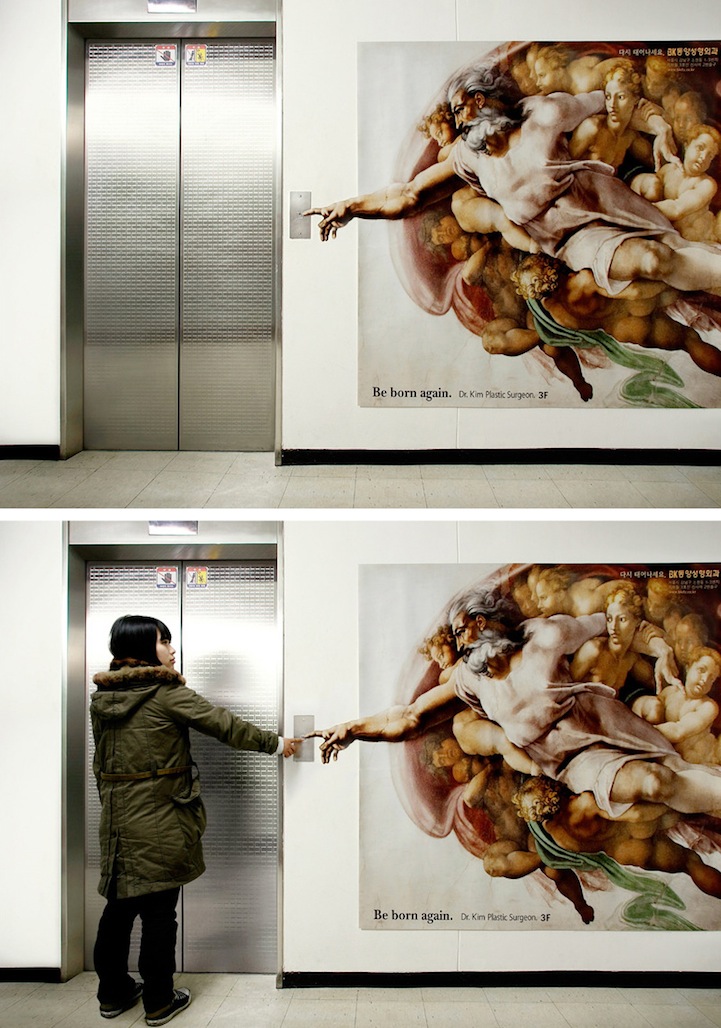
There is a photo advertising plastic surgery of Michelangelo’s depiction of God on the Be Born AgainSistine Chapel touching a button to an elevator to his office. The caption at the bottom of the picture is “Be Born Again.”

What is it that you and I are really after?  With our plastic surgery, our resume padding, our fad dieting, our football deflations, and our frantic chasing after more success after more success? What we are after? We want to be born again. We want a new life. We are not convinced that the life we are living is a life worth living.

I wish that I could sit down over coffee, let two minutes of complete silence hang between us so that our spirits are settled, and then ask each of you this question: What’s bothering you?

And as we pull that thread on the sweater surrounding your soul, I wonder what might come unraveled? I think we would see exactly where you would love to have a new birth.

Jesus says that kind of soul-renovation comes, not from a tweak on the outside, but from a restoration of the whole of you that begins on the inside. What you and I need is not a minor alteration, but a new birth.

I wonder where you and I might be looking for a new life right now.  Where is our elevator button? Am I seeking it in the externals of life, or am I seeking it where it can actually be found—from birth that comes from God?

 The New Birth Is a Gift

All of us know, intuitively, that birth is something that happens to us and that we had nothing to do with it in any way. Not a single one of us did anything to bring about our own natural birth.  And Jesus’ point here is that it is the same with birth that comes from above. We can’t grab, earn, or conjure up life with God.  The fact that we have a life with God is not due to any of our doing.

It’s all about that grace, that grace, that grace.

Like the old hymn writer Augustus Toplady said over two hundred years ago:

 Not the labor of my hands

Can fulfill Thy law’s demands;

Could my zeal no respite know,

Could my tears forever flow,

All for sin could not atone;

Thou must save, and Thou alone.

We can’t do anything to merit God’s grace, we can only receive it as a gift.  Because if anyone could have merited favor with God based on achievement it would have been Nicodemus.

The resume is impressive:

A Pharisee—one of the intellectual guardians of the Law.

Member of the Sanhedrin—the esteemed ruling council.

Israel’s teacher—the authority, the one whose opinion could sway the vote, the one whose words were most quoted.

Most impressive. Nicodemus is at the top of the religious ladder, looking down.

But the view from the top is, at best, disappointing. And now, he steps down from that ladder to walk the streets. Searching.

And it is this successful, powerful, at-the-top-of-his-game-guy Jesus says, “You need another birth.”

This is what is hard and beautiful about the Christian faith.  Because our faith, unique from all other religions, says “Nobody is disqualified on the one hand and nobody is good enough on the other.”

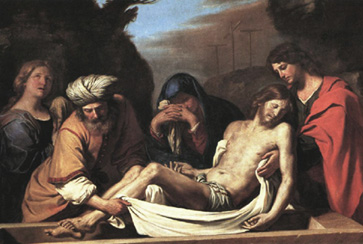
Good Friday Gueranger 15Grace is why pimps and prostitutes flocked to Jesus because they understood that their past didn’t keep them from life with God.  But this is also why many of the priests, professors and the pious had a hard time with Jesus because their past didn’t get them any special favors with God. Nobody is disqualified and nobody is good enough for life with God. A new birth can only be given to you.

Nicodemus accepted the gift and moved in the direction of the new birth, I think I will too.

Posted in Uncategorized | Tagged , , , , , , | 2 Comments

My Top Reads of 2014

A person who won’t read has no advantage over one who can’t read.~ Mark Twain

Every year’s end I post a list and summary of my top ten reads for the previous year.  In doing this I have to be selective in what I post because I read significantly more than ten books in a year. (Sorry if that sounded arrogant. No, I’m not sorry.) I will list the title, the publisher’s summary and a comment or two. So here goes my top reads for 2014 in no particular order:

Jayber Crow, by Wendell Berry

Jayber Crow, born in Goforth, Kentucky, orphaned at age ten, began his search as a “pre-ministerial student” at Pigeonville College. There, freedom met with new burdens and a young man needed more than a mirror to find himself. But the beginning of that finding was a short conversation with “Old Grit,” his profound professor of New Testament Greek. “You have been given questions to which you cannot be given answers. You will have to live them out—perhaps a little at a time.”

“And how long is that going to take?”

“I don’t know. As long as you live, perhaps.”

“That could be a long time.”

“I will tell you a further mystery,” he said. “It may take longer.”

Eventually, after the flood of 1937, Jayber becomes the barber of the small community of Port William, Kentucky. From behind that barber chair he lives out the questions that drove him from seminary and begins to accept the gifts of community that enclose his answers. The chair gives him a perfect perch from which to listen, to talk, and to see, as life spends itself all around. In this novel full of remarkable characters, he tells his story that becomes the story of his town and its transcendent membership.

This is the most profound and moving novel I have read since Gilead, by Marilynne Robinson.  The character, Jayber Crow, has stayed with me weeks after I finished the book. I found myself wondering what Jayber might think about a certain situation I encountered.  I suppose that is a sign of good writing when a fictional character gets in your head. I really loved this novel.

Mere Christianity, by C.S. Lewis

In the classic Mere Christianity, C.S. Lewis, the most important writer of the 20th century, explores the common ground upon which all of those of Christian faith stand together. Bringing together Lewis’ legendary broadcast talks during World War Two from his three previous books The Case for Christianity, Christian Behavior, and Beyond Personality, Mere Christianity provides an unequaled opportunity for believers and nonbelievers alike to hear this powerful apologetic for the Christian faith.

I don’t know how many times I’ve read Mere Christianity, but a few months ago I decided to read it again and am always amazed at how profound and yet accessible this book is.  Lewis is simply brilliant at putting the Christian faith in terms that and intelligent stranger would understand. I won’t suffer a person who rejects the Christian faith and then tells me they have never read this book.  I would say to them they are making an ignorant (uninformed) decision. Go read the book.

A Conversation in Spiritual Theology, by Eugene Peterson

Eugene Peterson is well known for The Message, his gutsy and faithful paraphrase of the Bible. He is also known by many for his series of books on Pastoral Theology, books which are enlivened by pithy one-liners, for Peterson has a way with words – a way which leads to stimulated thought and deep reflection. Now he has added to these volumes a set of five books on Spiritual Theology.

The five volumes are:

Christ Plays in Ten Thousand Places: A Conversation in Spiritual Theology (2005)

Eat This Book: A Conversation in the Art of Spiritual Reading (2006)

The Jesus Way: A Conversation on the Ways that Jesus is the Way (2007)

Tell It Slant: A Conversation on the Language of Jesus in His Stories and Prayers (2008)

Practice Resurrection: A Conversation on Growing Up in Christ (2010)

Eugene Peterson is on my Mt. Rushmore of authors who have influenced my life. I read and re-read his works. I read these five volumes consecutively and will do it again, perhaps yearly.  They are that good.

The Little Girl Waits, by Jamie Greening

There are evil people in the world, and they do evil things to innocent children. Pastor Butch Gregory is on a fatal collision course with such evil people. Pastor Butch’s life is a happy one, filled with church meetings, sermon preparation, and leading a congregation he loves. His life is forever changed when unimaginable tragedy comes to a little girl from his church named Tamara. Pastor Butch feels a supernatural call from God to do something about it, so he sets out on a sprawling adventure to find and rescue her before it is too late.

I loved this book for a couple of reasons, one is that it is a really good story set in the Pacific Northwest which is where I live and two it was written by a very dear friend of mine.  I have given my copy away and bought another and gave it away as well.  The subject of human trafficking is the tragedy of our times in this country. Jamie does a great job of burning this into our imaginations with this book. He does it in a gritty and respectful way.  This is a good book.

Strengthening the Soul of Your Leadership: Seeking God in the Crucible of Ministry, by Ruth Haley Barton

“I’m tired of helping others enjoy God. I just want to enjoy God for myself.” With this painful admission, Ruth Haley Barton invites us to an honest exploration of what happens when spiritual leaders lose track of their souls. Weaving together contemporary illustrations with penetrating insight from the life of Moses, Strengthening the Soul of Your Leadership explores topics such as, responding to the dynamics of calling, facing the loneliness of leadership, leading from your authentic self, cultivating spiritual community, reenvisioning the promised land, and discerning God’s will together.

Her chapter on intercessory prayer alone is worth the price of the book.  This is a very helpful and practical guide for anyone in Christian leadership who may not have the tools to adequately care for the hidden part of their lives.  If you lead, then read…this book.

Soul Keeping, by John Ortberg

The soul is NOT “a theological and abstract subject.” The soul is the coolest, eeriest, most mysterious, evocative, crucial, sacred, eternal, life-directing, fragile, indestructible, controversial, expensive dimension of your existence. Jesus said it’s worth more than the world. You’d be an idiot not to prize it above all else. Shouldn’t you get pretty clear on exactly what it is? Shouldn’t you know what it runs on? Wouldn’t it be worth knowing how to care for it? Two things are for sure. One is: you have a soul. The other is: if you don’t look after this one you won’t be issued a replacement.

Not only does the author give helpful council about the most important and hidden part of our lives, he weaves in anecdotal narratives about his mentor, Dallas Willard, in such a touching way that it makes you want to hear more about Ortberg’s relationship with Willard. Such a good book.

Slow Church: Cultivating Community in the Patient Way of Jesus, by Christopher Smith and John Pattison

Fast food. Fast cars. Fast and furious. Fast forward. Fast . . . church?

The church is often idealized (or demonized) as the last bastion of a bygone era, dragging our feet as we’re pulled into new moralities and new spiritualities. We guard our doctrine and our piety with great vigilance. But we often fail to notice how quickly we’re capitulating, in the structures and practices of our churches, to a culture of unreflective speed, dehumanizing efficiency and dis-integrating isolationism.

In the beginning, the church ate together, traveled together and shared in all facets of life. Centered as they were on Jesus, these seemingly mundane activities took on their own significance in the mission of God. In Slow Church, Chris Smith and John Pattison invite us to leave franchise faith behind and enter into the ecology, economy and ethics of the kingdom of God, where people know each other well and love one another as Christ loved the church.

One of the more profound books I’ve read in a long time concerning the nature of the church.  In our efforts as purveyors of churchology, pastors have worked hard at creating church franchises like the ubiquitous golden arches in almost every town in America.  What happened to the local church that is birthed out of its own context instead of trying to mimic someone else? I will say this again about another book in a moment, but I would that all pastors and especially church planters would read this book.

An Altar in the World: A Geography of Faith, by Barbara Brown Taylor

In the New York Times bestseller An Altar in the World, acclaimed author Barbara Brown Taylor continues her spiritual journey by building upon where she left off in Leaving Church.  With the honesty of Elizabeth Gilbert (Eat, Pray, Love) and the spiritual depth of Anne Lamott (Grace, Eventually), Taylor shares how she learned to find God beyond the church walls by embracing the sacred as a natural part of everyday life. In An Altar in the World, Taylor shows us how to discover altars everywhere we go and in nearly everything we do as we learn to live with purpose, pay attention, slow down, and revere the world we live in.

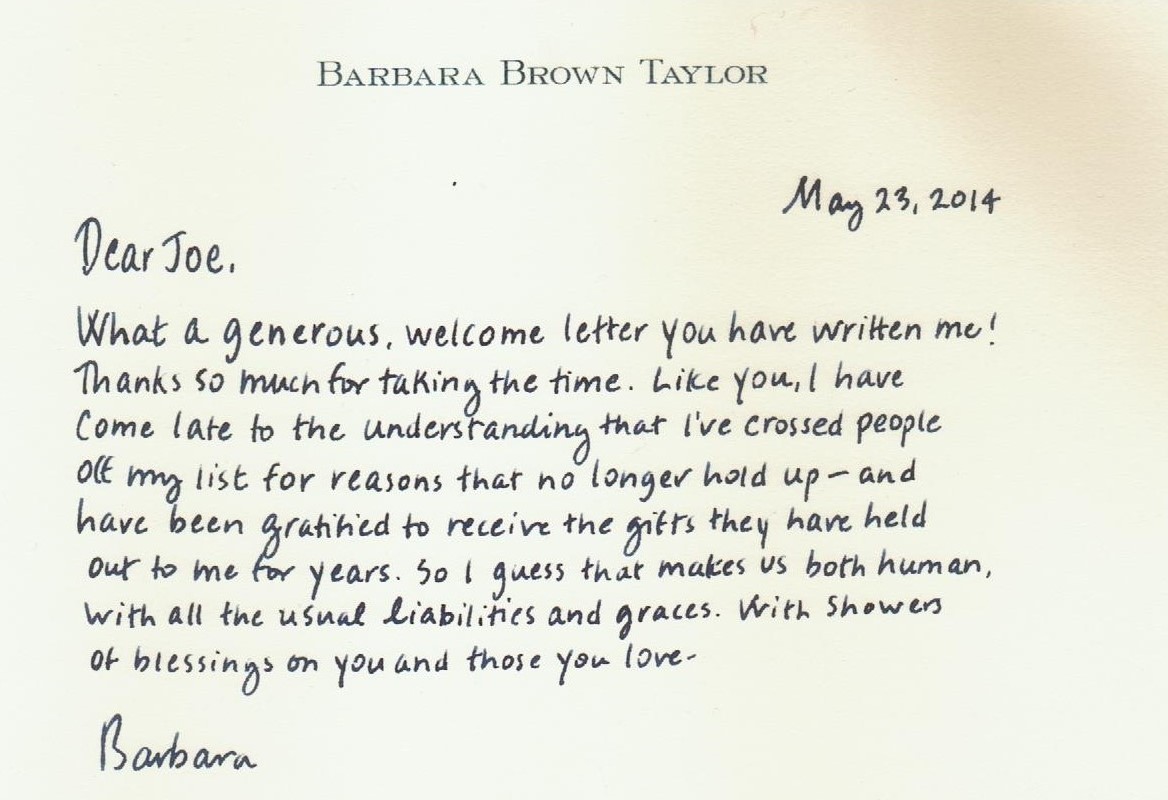
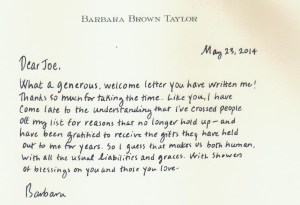
What can I say about this author and this book?  I fell in love with them both. I am confessing to you that I have a literary crush on Mrs. Taylor.001  (Much like I do with Annie Dillard.)  I was so impressed with the prose and spiritual depth of her writings that I wrote her a note asking her to forgive me for ignoring her years due to her reputation as a liberal. Understand that a “Liberal” in the Southern Baptist community means “you are not a fundamentalist and tea party Republican.” In the classical sense of theological liberalism, she is not a liberal.
Blue Highways: A Journey into America, by William Least Heat-Moon

Hailed as a masterpiece of American travel writing, Blue Highways is an unforgettable journey along our nation’s backroads. William Least Heat-Moon set out with little more than the need to put home behind him and a sense of curiosity about “those little towns that get on the map-if they get on at all-only because some cartographer has a blank space to fill: Remote, Oregon; Simplicity, Virginia; New Freedom, Pennsylvania; New Hope, Tennessee; Why, Arizona; Whynot, Mississippi.” His adventures, his discoveries, and his recollections of the extraordinary people he encountered along the way amount to a revelation of the true American experience.

Some of the best prose you will ever read. I learned about people and places I could not envision would live in the imagination of our best writers, but here they are scattered here and there across this land of ours.  The eye for detail, nuance and sense of place is uncanny by the author as he travels to the backwater towns and communities of our country. Reminds me of the Tolkien quote, “Not all who wander are lost.”  Great book.

Shrink: Faithful Ministry in a Church-Growth Culture, by Tim Suttle

Among followers of Jesus, great is often the enemy of good.

The drive to be great—to be a success by the standards of the world—often crowds out the qualities of goodness, virtue, and faithfulness that should define the central focus of Christian leadership. In the culture of today’s church, successful leadership is often judged by what works, while persistent faithfulness takes a back seat. If a ministry doesn’t produce results, it is dropped. If people don’t respond, we move on. This pursuit of “greatness” exerts a crushing pressure on the local church and creates a consuming anxiety in its leaders. In their pursuit of this warped vision of greatness, church leaders end up embracing a leadership narrative that runs counter to the sacrificial call of the gospel story.

When church leaders focus on faithfulness to God and the gospel, however, it’s always a kingdom-win—regardless of the visible results of their ministry. John the Baptist modeled this kind of leadership. As John’s disciples crossed the Jordan River to follow after Jesus, John freely released them to a greater calling than following him. Speaking of Jesus, John said: “He must increase, but I must decrease.” Joyfully satisfied to have been faithful to his calling, John knew that the size and scope of his ministry would be determined by the will of the Father, not his own will. Following the example of John the Baptist and with a careful look at the teaching of Scripture, Tim Suttle dares church leaders to risk failure by chasing the vision God has given them—no matter how small it might seem—instead of pursuing the broad path of pragmatism that leads to fame and numerical success.

This book encouraged me and frustrated the hell out of me. It encouraged me because it gives me hope that there is a remnant of pastors/shepherds that really get what it means to be a pastor.  They have not drunk the Kool-Aid about bigger and faster is better. It frustrates me in that it so clearly points out how seductive the Church Growth Movement was and how susceptible I was to make a Faustian deal with the American value of accomplishment is equal to validation. What a crock! I am valued by what Jesus did on my behalf, not how big my church gets. This book is REQUIRERED reading for young pastors, in my humble and yet very accurate opinion.

BooksThere were so many others that I could have mentioned, but this is already longer than most of you will have read.

I hope you will go to a library, or your favorite bookstore and get your hands on these books.

You will be the better for it.

Posted in Uncategorized | Tagged , , , , , , , , , | Leave a comment

Finding Rest

Slow down, you move too fast
You got to make the morning last
Just kicking down the cobble stones
Looking for fun and feelin’ groovy~ Paul Simon

“We stay busy so that the truth of our lives can’t catch up.”~ Brene Brown

Many live at a high-speed pace. A recent article indicated that assuming a middle-class worker working 50 weeks a year, worked over 428 more hours in one calendar year than the same person in that demographic in 1979. The website Techcrunch did a survey of those who visited their site and found that 80% of their users continued to work “virtually” after they went home from the office, 38% checked email while they were eating dinner, and 69% said they couldn’t go to sleep without checking their email one last time.

And yet the ancient wisdom of Scriptures reminds us,

…The seventh day is the Sabbath of the Lord your God. In it you shall do no work…For in six days the Lord made the heavens and the earth, the sea, and all that is in them, and rested the seventh day.  Exodus 20:9, 11

Maybe you are thinking, “Why does a God who is powerful enough to speak galaxies, suns, and field mice into existence need to take a rest? Is he tuckered out?  What kind of all-powerful God is that?” Sabbath rest is not for God so much as it is for us. God wasn’t an old man who just worked in the yard and needed to come in, get some iced tea, sit in his big easy chair, and take a break.  He rested to show us how to rest.

When I was a younger father and it was time for my boys to take a nap I would send them to their rooms, maybe read a quick story to them, and leave them in their room. If they didn’t go to sleep right away would speak firmly to them. If that didn’t work I would give them some Benadryl. (Kidding)

Now I have young grandchildren and do you know how I get them to take a nap?  I lay down on the bed, tell them a story and we both take a nap together. You might call that old age, I’ll call it wisdom.  I’m showing them how to rest.  I show them what they need when they are unaware that they need it. That is exactly what God does for us.  God shows us how to rest because he is a wise creator and a gracious Father who knows what we need.

What we see as we look at this garden picture, is that when we burn the candle at both ends we are not nearly as bright as we think we are. And when we work our fingers to the bone, we are not being overachievers, we are being self-destructive—we are being inhuman. To refuse rest is to try to live against the grain of the Cosmos.

Chinese word BusyMaybe you don’t know that the character for “busyness” in Chinese is a combination of the character for “tearing” and the character for “heart.” When our busyness gets the better of us it does violence to our souls. One friend even told me that it can mean heart-death.

How are you at keeping this commandment?  You do recognize that these are not called the “Ten Suggestions?”  What kind of society would we have if everyone reading this article approached the other nine with the same energy that we approach this one about rest?

Imagine someone saying, “I’m really trying to take some incremental steps at not murdering people.  I see some progress, but this is a “cra cra” time of the year for me.” We don’t give each other a pass when it comes to breaking the commandment about adultery or stealing or murder, but we do with the commandment to simply rest. Why do we feel completely justified and even validated in burning the midnight oil?

The classic movie Chariots of Fire is about runners in the 1924 Olympic Games and one of the runners named Harold Abrahams said just before a race—in a moment of angst, “And now in one hour’s time, I will be out there again. I will raise my eyes and look down that corridor; 4 feet wide, with 10 lonely seconds to justify my existence. But will I?”

I think many of us can’t stomach any stoppage in our work because we are our work. We use what we do to justify our existence. We bet our identity, our sense of ourselves, on what we do in our Monday through Saturday world. We have 40, 70, 90, 100 lonely hours a week to justify our existence. But will we?

What has this done to our souls? I suspect we are not the better for it. As a curator of souls, I’m concerned about our drift away from ancient soul practices. In the Jewish tradition, it is common to speak of the Sabbath as a Queen that a family might welcome into the home as a guest on a week-by-week basis.

So, how can we welcome Queen Sabbath into our “crazy busy” lives?

Rest

The word Sabbath is a Hebrew word that has a pretty simple non-religious meaning. It means, “Stop” “Cease” or “Quit.”  Sabbath simply means that one day a week you stop all of your earning, producing, and accomplishing.  Here is how we might say Sabbath in our context: “Unplug.”

Go for a walk.  Notice the veins in the leaves that process the energy from the sun.  Feel the breeze on your face. Go for a walk in the rain.

Cook from scratch your family’s favorite meal and have a race to see who can finish eating their meal—last. Sit at the table and listen to the stories of your children. Listen to the tone of voice of your spouse. Maybe even listen to the silence between you and your spouse.

Have a meandering conversation with someone. There is no purpose to the discussion.  Let silence linger between you if need be.

Re-Enter

When I was in high school I worked on a cattle ranch every summer and we cooked on a wood-burning stove.  My girlfriend and I exchanged letters and in one letter she said, “I love the smell of your letters.  They smell like wood smoke.” When we enter into a rhythm of practicing Sabbath we take that aroma into our work world so that others might say, “I love your life. It smells like rest.”

What would your regular Monday-Friday work life look like if it was shaped by Sabbath, shaped by deliberate rest?

Practice mini Sabbaths during the day. Set an alarm on your phone to remind you to unplug for five minutes at the beginning, middle, and end of the day.  Someone shaped by the Sabbath might change the expectations of those who work for them.  Perhaps they make it a practice to NOT email employees after hours and encourage their employees to unplug after dinner. Perhaps a person shaped by the Sabbath would approach each day at work with less anxiety about outcomes.

 Worship

Sabbath isn’t “me” time.  It is not time to get a mani-pedi, do some maintenance on you, or go shopping.  Sabbath is first and foremost about God. Sabbath grounds us in what God does for us in Jesus. And that means that the weekly rhythm of worship is the centerpiece of the Sabbath.

That is why we gather weekly at a place of faith and sing the songs, pray the prayers, take communion, and listen to the reading and teaching of the Word of God. Worship incrementally shapes and forms our Sabbath souls over a lifetime.

Grunge benchOf course, as a Christ-follower, I believe Jesus said it best, “Are you tired? Worn out? Burned out on religion? Come to me. Get away with me and you’ll recover your life. I’ll show you how to take a real rest. Walk with me and work with me—watch how I do it. Learn the unforced rhythms of grace. I won’t lay anything heavy or ill-fitting on you. Keep company with me and you’ll learn to live freely and lightly.” (Matthew 11:28-30 The Message)

Pace yourself.

Posted in Uncategorized | Tagged , , , , , , , , , | 2 Comments

The Savior is Present

“Look, the virgin shall conceive and bear a son,  and they shall name him Emmanuel,” which means, “God is with us.”  Matthew 1:23

“Attention is the rarest and purest form of generosity.” ~ Simone Weil

If you are like me, you don’t often stare at people in public or cry in public. It is an unofficial code of our culture. And yet for a few months in the spring of 2010, both of those things happened in abundance at the Museum of Modern Art in New York City.

The artist Marina Abramovic sat, six days a week, seven hours a day in a plain chair, under bright klieg lights, in MoMA’s towering atrium. She clocked 700 hours of sitting. During that time her routine seldom varied. Every day she took her place just before the museum doors opened and left it after they closed. Her wardrobe was consistent: a sort of concert gown with a long train, in one of three colors (red, black, and white).untitled (3)

Always her hair, in a braided plait, was pulled forward over her left shoulder. Always her skin was an odd pasty white as if the blood had drained away. Her pose rarely changed: her body slightly bent forward, she stared silently and intently straight ahead.

There was one variable, a big one: her audience.

Visitors to the museum were invited, first come first served, to sit in a chair facing her and silently return her gaze. The chair was rarely, if ever, empty. Close to 1,400 people occupied it, some for only a minute or two, a few for an entire day.

A collection of photos by Marco Anelli is stunning. People from all the diversity that you might expect living in New York sat in that chair. Their facial expressions ran the gamut from enrapt joy, confusion to weeping.

When I read about that, I wondered what is it that causes such deep emotion to well up out of someone over a few minutes of uninterrupted eye contact with a total stranger. I think it is genuine presence. The artist offered to total strangers what you and I rarely receive: Uninterrupted connection. No distractions, no technology, and no agenda. And many of those people found that profoundly moving.

The good news we hear from Scripture is that, in Jesus, God is present—with us.

If you have been around the faith for very long you are aware that we barely get three chapters into our story in the book of Genesis and you find that mankind lost interest in God.

They had enjoyed unfettered access to each other and to the Creator-God who made them. But then they do the one thing that God asked them to not do and they find themselves looking for bushes in which they might hide. God walks through the garden asking, “Where are you?” Then, after a sad conversation with God, they find themselves leaving the garden and heading east of Eden—away from God.

We aren’t with God, but God wants to be with us. And from that point on the story is God on a journey to find us, asking us, “Where are you?” Wanting to be with us even when we don’t want to be with Him.

Fast forward to nine months before the first Christmas, around 4 B.C. in Nazareth, and an angel announced to the town handyman, whose fiancé is mysteriously pregnant: God will finally be with us.

Just like there used to be long garden walks in the cool of the day with the Creator-God, those days are here again! And the world would never be the same. If we would sit with this truth it can only stagger us.

“The Word is born a child. It is only right that we should be astounded.”                                      ~Bernard of Clairvaux

The creator of the cosmos, comes to a planet which is only a floating dust mote in the Milky Way galaxy, and that galaxy is a tiny swirl of flecks in the universe, and that Universe is barely a jot or a tittle in the cosmos. And God doesn’t come as a king or an emperor, he comes as dimpled handed and chubby-cheeked little baby boy. Born of two of the poorest of the poor in the smallest of villages in the tiniest of nations. God is born a child. It is only right that we should be astounded.

I wonder if we could turn down the schmaltzy muzak, clear away the tinsel, and be astounded at the entrance of God into this dark world.

God Saves

“Jesus” literally means “the Lord Saves’ and thus Jesus’ vocation and his name are one. The little squirming bundle of joy that Mary and Joseph would hold that night in Bethlehem would speak words of wonder, touch diseased bodies, walk on water, confound and disturb the religious establishment, be beaten at a post, hung on a cross, stabbed in the side, put in a grave, and on the third day rise from the dead—is God with us.

The modern secular way of approaching life says that there is nothing that needs saving in the world. That all that we think is right or wrong or evil about the world is merely a product of sociology and biology. And as we progress in our scientific discoveries, we will eventually rid the world of all that is wrong.

That sounds good, but it doesn’t match what we see in the news every night or what shows up in your social media feed. Or even what we see when we look into the mirror. We know there are things that happen in the world that are bad and it is not getting any better; it seems to be getting worse.

Then there’s the religious approach and when you boil down the religious approaches to God they all more or less say: Save yourself. You get your life in order and God or the divine will accept you, approve of you, and welcome you into his/its presence.

Our faith doesn’t say we can do anything to save ourselves. It says God rescues us, liberates us, and restores us through Jesus. We simply have to embrace that fact.

God Knows

God feels the pain of your life and mine, is compassionate about the deep pains of the world, and actually comes all the way in and all the way down into our insecurities, loneliness, and betrayal. God actually tastes the salty tears of heartbreak and the coppery tang of blood on his lips. God came and lived in this brutal world.

The birth of Jesus among us means that God actually knows our world from the inside.

Lauren Winner is an Assistant Professor of Christian Spirituality at Duke Divinity School. Winner was born to a Jewish father and a Southern Baptist mother and was raised Jewish. She converted to Christianity while doing her Master’s degree at Cambridge University. She completed her doctoral work at Columbia University in 2006. Listen to what she writes in her book Girl Meets God,

The very first thing I liked about Christianity, long before it ever occurred to me to go to church or say the creed or call myself a Christian, was the Incarnation, the idea that God lowered himself and became a man so that we could relate to him better. In Christianity, God got to be both a distant and transcendent Father god, and a present and immanent Son god who walked among us. Christians, unlike Jews, spent their time talking to a God who knew from experience what it was like to get hungry, to go swimming, to miss a best friend.

The incarnation means that God comes to us in our moments of deepest insecurity, our moments when life has gut-punched us so that we can’t breathe and then chews us up and spits us out like a piece of used up chewing gum and says, “I know.”

This Christmas perhaps we won’t sit in the presence of an artist, but we can stand amazed in the presence of Jesus…

                 …the Nazarene,

                and wonder how he could love me,

                a sinner, condemned, unclean.

                How marvelous! How wonderful!

                And my song shall ever be:

                How marvelous! How wonderful

                is my Savior’s love for me!

Jesus was wearing a red robe of sacrifice on the cross, was wrapped in the black robe of death and placed in a cold grave, but three days later He walked out that grave wearing the white robe of glory.

The Savior is present and He wants to sit with you this Christmas.

Posted in Uncategorized | Tagged , , , , | 1 Comment

Ask Me About My Soul

Come and hear, all you who fear God, and I will declare what He has done for my soul. Psalm 66:16

I walked down a busy street in the rain to a coffee house to warm my body and settle my soul into a deeper place of peace. The faces I passed on the street were deeply lined; not from weather, but from the hardness of street-life.

The sidewalk is strewn with trash, and cryptic pathways veer into the underbrush by the Walmart that made me wonder if folks might live in those gnarled briars and thorny blackberry bushes. I didn’t go down the path to see. I walked on, in the rain.

There is a layer of my soul inside that feels like the weather outside. Gray.

I was hoe-axed with some challenging personal news today that is making my head spin. Add to that the fact that this has been a tough news cycle and you have the makings of a heavy heart.

People that are important to me are hurting as I sit in this coffee shop and warm up from my soggy walk. I feel weight in my heart for her, him and them. They killed 145 children in Pakistan. They killed 2 in Sydney. They killed 6 in Pennsylvania. They tortured our enemies at CIA “dark sites.”

Pastors I care about are struggling to establish a ecclesiastical beachhead in hostile territory. A godly man of God, who loves Jesus and His kingdom, is scrambling and scuffling to make ends meet—even cleaning toilets in a middle school.

I looked into the pale face of my friend who is struggling with his health and feel my own frailty creeping around.

Nothing is sharp and crisp today. Everything is dull, opaque. The words of one of an old poem by Joseph Bayly plucks just the right cord,

A Psalm In a Hotel Room

I’m alone, Lord,
alone,
a thousand miles from home.
There’s no one here who knows my name
except the clerk,
and he spelled it wrong,
no one to eat dinner with,
laugh at my jokes,
listen to my gripes,
be happy with me about what happened today
and say that’s great.
No one cares.
There’s just this lousy bed
and slush in the street outside
between the buildings.
I feel sorry for myself
and I’ve plenty of reason to.
Maybe I ought to say
I’m on top of it,
praise the Lord,
things are great;
but they’re not.
Tonight
it’s all
gray slush.

But deeper than this slate-surface on my soul is a deeper in and further down place of joy. A place of surety that no street-side trash, sad world news, gray rain or opaque skies can reach. I am loved by the One who created me.

I am His beloved.

And that is just enough for this gray day.

Posted in Uncategorized | Tagged , , , , , , , , , | 2 Comments