My Top Reads of 2014

A person who won’t read has no advantage over one who can’t read.~ Mark Twain

Every year’s end I post a list and summary of my top ten reads for the previous year.  In doing this I have to be selective in what I post because I read significantly more than ten books in a year. (Sorry if that sounded arrogant. No, I’m not sorry.) I will list the title, the publisher’s summary and a comment or two. So here goes my top reads for 2014 in no particular order:

Jayber Crow, by Wendell Berry

Jayber Crow, born in Goforth, Kentucky, orphaned at age ten, began his search as a “pre-ministerial student” at Pigeonville College. There, freedom met with new burdens and a young man needed more than a mirror to find himself. But the beginning of that finding was a short conversation with “Old Grit,” his profound professor of New Testament Greek. “You have been given questions to which you cannot be given answers. You will have to live them out—perhaps a little at a time.”

“And how long is that going to take?”

“I don’t know. As long as you live, perhaps.”

“That could be a long time.”

“I will tell you a further mystery,” he said. “It may take longer.”

Eventually, after the flood of 1937, Jayber becomes the barber of the small community of Port William, Kentucky. From behind that barber chair he lives out the questions that drove him from seminary and begins to accept the gifts of community that enclose his answers. The chair gives him a perfect perch from which to listen, to talk, and to see, as life spends itself all around. In this novel full of remarkable characters, he tells his story that becomes the story of his town and its transcendent membership.

This is the most profound and moving novel I have read since Gilead, by Marilynne Robinson.  The character, Jayber Crow, has stayed with me weeks after I finished the book. I found myself wondering what Jayber might think about a certain situation I encountered.  I suppose that is a sign of good writing when a fictional character gets in your head. I really loved this novel.

Mere Christianity, by C.S. Lewis

In the classic Mere Christianity, C.S. Lewis, the most important writer of the 20th century, explores the common ground upon which all of those of Christian faith stand together. Bringing together Lewis’ legendary broadcast talks during World War Two from his three previous books The Case for Christianity, Christian Behavior, and Beyond Personality, Mere Christianity provides an unequaled opportunity for believers and nonbelievers alike to hear this powerful apologetic for the Christian faith.

I don’t know how many times I’ve read Mere Christianity, but a few months ago I decided to read it again and am always amazed at how profound and yet accessible this book is.  Lewis is simply brilliant at putting the Christian faith in terms that and intelligent stranger would understand. I won’t suffer a person who rejects the Christian faith and then tells me they have never read this book.  I would say to them they are making an ignorant (uninformed) decision. Go read the book.

A Conversation in Spiritual Theology, by Eugene Peterson

Eugene Peterson is well known for The Message, his gutsy and faithful paraphrase of the Bible. He is also known by many for his series of books on Pastoral Theology, books which are enlivened by pithy one-liners, for Peterson has a way with words – a way which leads to stimulated thought and deep reflection. Now he has added to these volumes a set of five books on Spiritual Theology.

The five volumes are:

Christ Plays in Ten Thousand Places: A Conversation in Spiritual Theology (2005)

Eat This Book: A Conversation in the Art of Spiritual Reading (2006)

The Jesus Way: A Conversation on the Ways that Jesus is the Way (2007)

Tell It Slant: A Conversation on the Language of Jesus in His Stories and Prayers (2008)

Practice Resurrection: A Conversation on Growing Up in Christ (2010)

Eugene Peterson is on my Mt. Rushmore of authors who have influenced my life. I read and re-read his works. I read these five volumes consecutively and will do it again, perhaps yearly.  They are that good.

The Little Girl Waits, by Jamie Greening

There are evil people in the world, and they do evil things to innocent children. Pastor Butch Gregory is on a fatal collision course with such evil people. Pastor Butch’s life is a happy one, filled with church meetings, sermon preparation, and leading a congregation he loves. His life is forever changed when unimaginable tragedy comes to a little girl from his church named Tamara. Pastor Butch feels a supernatural call from God to do something about it, so he sets out on a sprawling adventure to find and rescue her before it is too late.

I loved this book for a couple of reasons, one is that it is a really good story set in the Pacific Northwest which is where I live and two it was written by a very dear friend of mine.  I have given my copy away and bought another and gave it away as well.  The subject of human trafficking is the tragedy of our times in this country. Jamie does a great job of burning this into our imaginations with this book. He does it in a gritty and respectful way.  This is a good book.

Strengthening the Soul of Your Leadership: Seeking God in the Crucible of Ministry, by Ruth Haley Barton

“I’m tired of helping others enjoy God. I just want to enjoy God for myself.” With this painful admission, Ruth Haley Barton invites us to an honest exploration of what happens when spiritual leaders lose track of their souls. Weaving together contemporary illustrations with penetrating insight from the life of Moses, Strengthening the Soul of Your Leadership explores topics such as, responding to the dynamics of calling, facing the loneliness of leadership, leading from your authentic self, cultivating spiritual community, reenvisioning the promised land, and discerning God’s will together.

Her chapter on intercessory prayer alone is worth the price of the book.  This is a very helpful and practical guide for anyone in Christian leadership who may not have the tools to adequately care for the hidden part of their lives.  If you lead, then read…this book.

Soul Keeping, by John Ortberg

The soul is NOT “a theological and abstract subject.” The soul is the coolest, eeriest, most mysterious, evocative, crucial, sacred, eternal, life-directing, fragile, indestructible, controversial, expensive dimension of your existence. Jesus said it’s worth more than the world. You’d be an idiot not to prize it above all else. Shouldn’t you get pretty clear on exactly what it is? Shouldn’t you know what it runs on? Wouldn’t it be worth knowing how to care for it? Two things are for sure. One is: you have a soul. The other is: if you don’t look after this one you won’t be issued a replacement.

Not only does the author give helpful council about the most important and hidden part of our lives, he weaves in anecdotal narratives about his mentor, Dallas Willard, in such a touching way that it makes you want to hear more about Ortberg’s relationship with Willard. Such a good book.

Slow Church: Cultivating Community in the Patient Way of Jesus, by Christopher Smith and John Pattison

Fast food. Fast cars. Fast and furious. Fast forward. Fast . . . church?

The church is often idealized (or demonized) as the last bastion of a bygone era, dragging our feet as we’re pulled into new moralities and new spiritualities. We guard our doctrine and our piety with great vigilance. But we often fail to notice how quickly we’re capitulating, in the structures and practices of our churches, to a culture of unreflective speed, dehumanizing efficiency and dis-integrating isolationism.

In the beginning, the church ate together, traveled together and shared in all facets of life. Centered as they were on Jesus, these seemingly mundane activities took on their own significance in the mission of God. In Slow Church, Chris Smith and John Pattison invite us to leave franchise faith behind and enter into the ecology, economy and ethics of the kingdom of God, where people know each other well and love one another as Christ loved the church.

One of the more profound books I’ve read in a long time concerning the nature of the church.  In our efforts as purveyors of churchology, pastors have worked hard at creating church franchises like the ubiquitous golden arches in almost every town in America.  What happened to the local church that is birthed out of its own context instead of trying to mimic someone else? I will say this again about another book in a moment, but I would that all pastors and especially church planters would read this book.

An Altar in the World: A Geography of Faith, by Barbara Brown Taylor

In the New York Times bestseller An Altar in the World, acclaimed author Barbara Brown Taylor continues her spiritual journey by building upon where she left off in Leaving Church.  With the honesty of Elizabeth Gilbert (Eat, Pray, Love) and the spiritual depth of Anne Lamott (Grace, Eventually), Taylor shares how she learned to find God beyond the church walls by embracing the sacred as a natural part of everyday life. In An Altar in the World, Taylor shows us how to discover altars everywhere we go and in nearly everything we do as we learn to live with purpose, pay attention, slow down, and revere the world we live in.

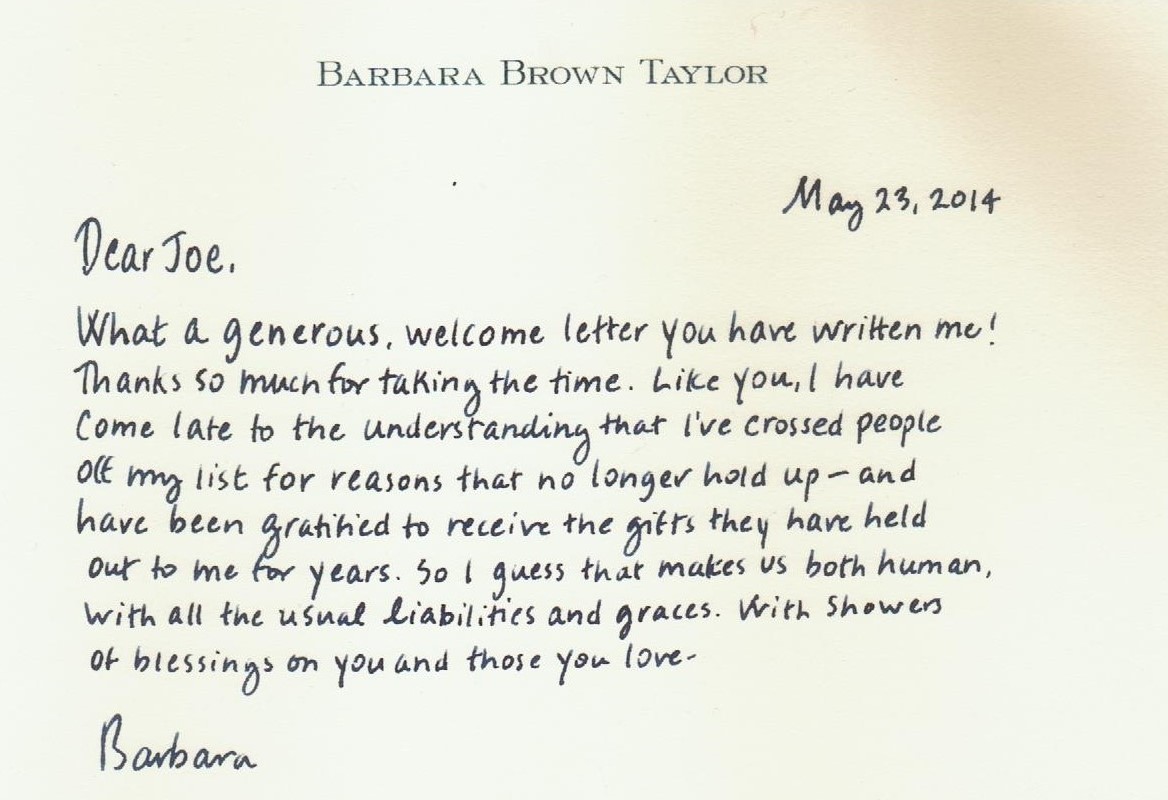
What can I say about this author and this book?  I fell in love with them both. I am confessing to you that I have a literary crush on Mrs. Taylor.001  (Much like I do with Annie Dillard.)  I was so impressed with the prose and spiritual depth of her writings that I wrote her a note asking her to forgive me for ignoring her years due to her reputation as a liberal. Understand that a “Liberal” in the Southern Baptist community means “you are not a fundamentalist and tea party Republican.” In the classical sense of theological liberalism, she is not a liberal.
Blue Highways: A Journey into America, by William Least Heat-Moon

Hailed as a masterpiece of American travel writing, Blue Highways is an unforgettable journey along our nation’s backroads. William Least Heat-Moon set out with little more than the need to put home behind him and a sense of curiosity about “those little towns that get on the map-if they get on at all-only because some cartographer has a blank space to fill: Remote, Oregon; Simplicity, Virginia; New Freedom, Pennsylvania; New Hope, Tennessee; Why, Arizona; Whynot, Mississippi.” His adventures, his discoveries, and his recollections of the extraordinary people he encountered along the way amount to a revelation of the true American experience.

Some of the best prose you will ever read. I learned about people and places I could not envision would live in the imagination of our best writers, but here they are scattered here and there across this land of ours.  The eye for detail, nuance and sense of place is uncanny by the author as he travels to the backwater towns and communities of our country. Reminds me of the Tolkien quote, “Not all who wander are lost.”  Great book.

Shrink: Faithful Ministry in a Church-Growth Culture, by Tim Suttle

Among followers of Jesus, great is often the enemy of good.

The drive to be great—to be a success by the standards of the world—often crowds out the qualities of goodness, virtue, and faithfulness that should define the central focus of Christian leadership. In the culture of today’s church, successful leadership is often judged by what works, while persistent faithfulness takes a back seat. If a ministry doesn’t produce results, it is dropped. If people don’t respond, we move on. This pursuit of “greatness” exerts a crushing pressure on the local church and creates a consuming anxiety in its leaders. In their pursuit of this warped vision of greatness, church leaders end up embracing a leadership narrative that runs counter to the sacrificial call of the gospel story.

When church leaders focus on faithfulness to God and the gospel, however, it’s always a kingdom-win—regardless of the visible results of their ministry. John the Baptist modeled this kind of leadership. As John’s disciples crossed the Jordan River to follow after Jesus, John freely released them to a greater calling than following him. Speaking of Jesus, John said: “He must increase, but I must decrease.” Joyfully satisfied to have been faithful to his calling, John knew that the size and scope of his ministry would be determined by the will of the Father, not his own will. Following the example of John the Baptist and with a careful look at the teaching of Scripture, Tim Suttle dares church leaders to risk failure by chasing the vision God has given them—no matter how small it might seem—instead of pursuing the broad path of pragmatism that leads to fame and numerical success.

This book encouraged me and frustrated the hell out of me. It encouraged me because it gives me hope that there is a remnant of pastors/shepherds that really get what it means to be a pastor.  They have not drunk the Kool-Aid about bigger and faster is better. It frustrates me in that it so clearly points out how seductive the Church Growth Movement was and how susceptible I was to make a Faustian deal with the American value of accomplishment is equal to validation. What a crock! I am valued by what Jesus did on my behalf, not how big my church gets. This book is REQUIRERED reading for young pastors, in my humble and yet very accurate opinion.

BooksThere were so many others that I could have mentioned, but this is already longer than most of you will have read.

I hope you will go to a library, or your favorite bookstore and get your hands on these books.

You will be the better for it.

Posted in Uncategorized | Tagged , , , , , , , , , | Leave a comment

Finding Rest

Slow down, you move too fast
You got to make the morning last
Just kicking down the cobble stones
Looking for fun and feelin’ groovy~ Paul Simon

“We stay busy so that the truth of our lives can’t catch up.”~ Brene Brown

Many live at a high-speed pace. A recent article indicated that assuming a middle-class worker working 50 weeks a year, worked over 428 more hours in one calendar year than the same person in that demographic in 1979. The website Techcrunch did a survey of those who visited their site and found that 80% of their users continued to work “virtually” after they went home from the office, 38% checked email while they were eating dinner, and 69% said they couldn’t go to sleep without checking their email one last time.

And yet the ancient wisdom of Scriptures reminds us,

…The seventh day is the Sabbath of the Lord your God. In it you shall do no work…For in six days the Lord made the heavens and the earth, the sea, and all that is in them, and rested the seventh day.  Exodus 20:9, 11

Maybe you are thinking, “Why does a God who is powerful enough to speak galaxies, suns, and field mice into existence need to take a rest? Is he tuckered out?  What kind of all-powerful God is that?” Sabbath rest is not for God so much as it is for us. God wasn’t an old man who just worked in the yard and needed to come in, get some iced tea, sit in his big easy chair, and take a break.  He rested to show us how to rest.

When I was a younger father and it was time for my boys to take a nap I would send them to their rooms, maybe read a quick story to them, and leave them in their room. If they didn’t go to sleep right away would speak firmly to them. If that didn’t work I would give them some Benadryl. (Kidding)

Now I have young grandchildren and do you know how I get them to take a nap?  I lay down on the bed, tell them a story and we both take a nap together. You might call that old age, I’ll call it wisdom.  I’m showing them how to rest.  I show them what they need when they are unaware that they need it. That is exactly what God does for us.  God shows us how to rest because he is a wise creator and a gracious Father who knows what we need.

What we see as we look at this garden picture, is that when we burn the candle at both ends we are not nearly as bright as we think we are. And when we work our fingers to the bone, we are not being overachievers, we are being self-destructive—we are being inhuman. To refuse rest is to try to live against the grain of the Cosmos.

Chinese word BusyMaybe you don’t know that the character for “busyness” in Chinese is a combination of the character for “tearing” and the character for “heart.” When our busyness gets the better of us it does violence to our souls. One friend even told me that it can mean heart-death.

How are you at keeping this commandment?  You do recognize that these are not called the “Ten Suggestions?”  What kind of society would we have if everyone reading this article approached the other nine with the same energy that we approach this one about rest?

Imagine someone saying, “I’m really trying to take some incremental steps at not murdering people.  I see some progress, but this is a “cra cra” time of the year for me.” We don’t give each other a pass when it comes to breaking the commandment about adultery or stealing or murder, but we do with the commandment to simply rest. Why do we feel completely justified and even validated in burning the midnight oil?

The classic movie Chariots of Fire is about runners in the 1924 Olympic Games and one of the runners named Harold Abrahams said just before a race—in a moment of angst, “And now in one hour’s time, I will be out there again. I will raise my eyes and look down that corridor; 4 feet wide, with 10 lonely seconds to justify my existence. But will I?”

I think many of us can’t stomach any stoppage in our work because we are our work. We use what we do to justify our existence. We bet our identity, our sense of ourselves, on what we do in our Monday through Saturday world. We have 40, 70, 90, 100 lonely hours a week to justify our existence. But will we?

What has this done to our souls? I suspect we are not the better for it. As a curator of souls, I’m concerned about our drift away from ancient soul practices. In the Jewish tradition, it is common to speak of the Sabbath as a Queen that a family might welcome into the home as a guest on a week-by-week basis.

So, how can we welcome Queen Sabbath into our “crazy busy” lives?

Rest

The word Sabbath is a Hebrew word that has a pretty simple non-religious meaning. It means, “Stop” “Cease” or “Quit.”  Sabbath simply means that one day a week you stop all of your earning, producing, and accomplishing.  Here is how we might say Sabbath in our context: “Unplug.”

Go for a walk.  Notice the veins in the leaves that process the energy from the sun.  Feel the breeze on your face. Go for a walk in the rain.

Cook from scratch your family’s favorite meal and have a race to see who can finish eating their meal—last. Sit at the table and listen to the stories of your children. Listen to the tone of voice of your spouse. Maybe even listen to the silence between you and your spouse.

Have a meandering conversation with someone. There is no purpose to the discussion.  Let silence linger between you if need be.

Re-Enter

When I was in high school I worked on a cattle ranch every summer and we cooked on a wood-burning stove.  My girlfriend and I exchanged letters and in one letter she said, “I love the smell of your letters.  They smell like wood smoke.” When we enter into a rhythm of practicing Sabbath we take that aroma into our work world so that others might say, “I love your life. It smells like rest.”

What would your regular Monday-Friday work life look like if it was shaped by Sabbath, shaped by deliberate rest?

Practice mini Sabbaths during the day. Set an alarm on your phone to remind you to unplug for five minutes at the beginning, middle, and end of the day.  Someone shaped by the Sabbath might change the expectations of those who work for them.  Perhaps they make it a practice to NOT email employees after hours and encourage their employees to unplug after dinner. Perhaps a person shaped by the Sabbath would approach each day at work with less anxiety about outcomes.

 Worship

Sabbath isn’t “me” time.  It is not time to get a mani-pedi, do some maintenance on you, or go shopping.  Sabbath is first and foremost about God. Sabbath grounds us in what God does for us in Jesus. And that means that the weekly rhythm of worship is the centerpiece of the Sabbath.

That is why we gather weekly at a place of faith and sing the songs, pray the prayers, take communion, and listen to the reading and teaching of the Word of God. Worship incrementally shapes and forms our Sabbath souls over a lifetime.

Grunge benchOf course, as a Christ-follower, I believe Jesus said it best, “Are you tired? Worn out? Burned out on religion? Come to me. Get away with me and you’ll recover your life. I’ll show you how to take a real rest. Walk with me and work with me—watch how I do it. Learn the unforced rhythms of grace. I won’t lay anything heavy or ill-fitting on you. Keep company with me and you’ll learn to live freely and lightly.” (Matthew 11:28-30 The Message)

Pace yourself.

Posted in Uncategorized | Tagged , , , , , , , , , | 2 Comments

The Savior is Present

“Look, the virgin shall conceive and bear a son,  and they shall name him Emmanuel,” which means, “God is with us.”  Matthew 1:23

“Attention is the rarest and purest form of generosity.” ~ Simone Weil

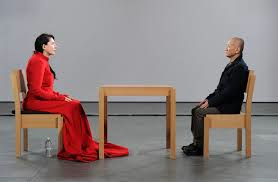
If you are like me, you don’t often stare at people in public or cry in public. It is an unofficial code of our culture. And yet for a few months in the spring of 2010, both of those things happened in abundance at the Museum of Modern Art in New York City.

The artist Marina Abramovic sat, six days a week, seven hours a day in a plain chair, under bright klieg lights, in MoMA’s towering atrium. She clocked 700 hours of sitting. During that time her routine seldom varied. Every day she took her place just before the museum doors opened and left it after they closed. Her wardrobe was consistent: a sort of concert gown with a long train, in one of three colors (red, black, and white).untitled (3)

Always her hair, in a braided plait, was pulled forward over her left shoulder. Always her skin was an odd pasty white as if the blood had drained away. Her pose rarely changed: her body slightly bent forward, she stared silently and intently straight ahead.

There was one variable, a big one: her audience.

Visitors to the museum were invited, first come first served, to sit in a chair facing her and silently return her gaze. The chair was rarely, if ever, empty. Close to 1,400 people occupied it, some for only a minute or two, a few for an entire day.

A collection of photos by Marco Anelli is stunning. People from all the diversity that you might expect living in New York sat in that chair. Their facial expressions ran the gamut from enrapt joy, confusion to weeping.

When I read about that, I wondered what is it that causes such deep emotion to well up out of someone over a few minutes of uninterrupted eye contact with a total stranger. I think it is genuine presence. The artist offered to total strangers what you and I rarely receive: Uninterrupted connection. No distractions, no technology, and no agenda. And many of those people found that profoundly moving.

The good news we hear from Scripture is that, in Jesus, God is present—with us.

If you have been around the faith for very long you are aware that we barely get three chapters into our story in the book of Genesis and you find that mankind lost interest in God.

They had enjoyed unfettered access to each other and to the Creator-God who made them. But then they do the one thing that God asked them to not do and they find themselves looking for bushes in which they might hide. God walks through the garden asking, “Where are you?” Then, after a sad conversation with God, they find themselves leaving the garden and heading east of Eden—away from God.

We aren’t with God, but God wants to be with us. And from that point on the story is God on a journey to find us, asking us, “Where are you?” Wanting to be with us even when we don’t want to be with Him.

Fast forward to nine months before the first Christmas, around 4 B.C. in Nazareth, and an angel announced to the town handyman, whose fiancé is mysteriously pregnant: God will finally be with us.

Just like there used to be long garden walks in the cool of the day with the Creator-God, those days are here again! And the world would never be the same. If we would sit with this truth it can only stagger us.

“The Word is born a child. It is only right that we should be astounded.”                                      ~Bernard of Clairvaux

The creator of the cosmos, comes to a planet which is only a floating dust mote in the Milky Way galaxy, and that galaxy is a tiny swirl of flecks in the universe, and that Universe is barely a jot or a tittle in the cosmos. And God doesn’t come as a king or an emperor, he comes as dimpled handed and chubby-cheeked little baby boy. Born of two of the poorest of the poor in the smallest of villages in the tiniest of nations. God is born a child. It is only right that we should be astounded.

I wonder if we could turn down the schmaltzy muzak, clear away the tinsel, and be astounded at the entrance of God into this dark world.

God Saves

“Jesus” literally means “the Lord Saves’ and thus Jesus’ vocation and his name are one. The little squirming bundle of joy that Mary and Joseph would hold that night in Bethlehem would speak words of wonder, touch diseased bodies, walk on water, confound and disturb the religious establishment, be beaten at a post, hung on a cross, stabbed in the side, put in a grave, and on the third day rise from the dead—is God with us.

The modern secular way of approaching life says that there is nothing that needs saving in the world. That all that we think is right or wrong or evil about the world is merely a product of sociology and biology. And as we progress in our scientific discoveries, we will eventually rid the world of all that is wrong.

That sounds good, but it doesn’t match what we see in the news every night or what shows up in your social media feed. Or even what we see when we look into the mirror. We know there are things that happen in the world that are bad and it is not getting any better; it seems to be getting worse.

Then there’s the religious approach and when you boil down the religious approaches to God they all more or less say: Save yourself. You get your life in order and God or the divine will accept you, approve of you, and welcome you into his/its presence.

Our faith doesn’t say we can do anything to save ourselves. It says God rescues us, liberates us, and restores us through Jesus. We simply have to embrace that fact.

God Knows

God feels the pain of your life and mine, is compassionate about the deep pains of the world, and actually comes all the way in and all the way down into our insecurities, loneliness, and betrayal. God actually tastes the salty tears of heartbreak and the coppery tang of blood on his lips. God came and lived in this brutal world.

The birth of Jesus among us means that God actually knows our world from the inside.

Lauren Winner is an Assistant Professor of Christian Spirituality at Duke Divinity School. Winner was born to a Jewish father and a Southern Baptist mother and was raised Jewish. She converted to Christianity while doing her Master’s degree at Cambridge University. She completed her doctoral work at Columbia University in 2006. Listen to what she writes in her book Girl Meets God,

The very first thing I liked about Christianity, long before it ever occurred to me to go to church or say the creed or call myself a Christian, was the Incarnation, the idea that God lowered himself and became a man so that we could relate to him better. In Christianity, God got to be both a distant and transcendent Father god, and a present and immanent Son god who walked among us. Christians, unlike Jews, spent their time talking to a God who knew from experience what it was like to get hungry, to go swimming, to miss a best friend.

The incarnation means that God comes to us in our moments of deepest insecurity, our moments when life has gut-punched us so that we can’t breathe and then chews us up and spits us out like a piece of used up chewing gum and says, “I know.”

This Christmas perhaps we won’t sit in the presence of an artist, but we can stand amazed in the presence of Jesus…

                 …the Nazarene,

                and wonder how he could love me,

                a sinner, condemned, unclean.

                How marvelous! How wonderful!

                And my song shall ever be:

                How marvelous! How wonderful

                is my Savior’s love for me!

Jesus was wearing a red robe of sacrifice on the cross, was wrapped in the black robe of death and placed in a cold grave, but three days later He walked out that grave wearing the white robe of glory.

The Savior is present and He wants to sit with you this Christmas.

Posted in Uncategorized | Tagged , , , , | 1 Comment

Ask Me About My Soul

Come and hear, all you who fear God, and I will declare what He has done for my soul. Psalm 66:16

I walked down a busy street in the rain to a coffee house to warm my body and settle my soul into a deeper place of peace. The faces I passed on the street were deeply lined; not from weather, but from the hardness of street-life.

The sidewalk is strewn with trash, and cryptic pathways veer into the underbrush by the Walmart that made me wonder if folks might live in those gnarled briars and thorny blackberry bushes. I didn’t go down the path to see. I walked on, in the rain.

There is a layer of my soul inside that feels like the weather outside. Gray.

I was hoe-axed with some challenging personal news today that is making my head spin. Add to that the fact that this has been a tough news cycle and you have the makings of a heavy heart.

People that are important to me are hurting as I sit in this coffee shop and warm up from my soggy walk. I feel weight in my heart for her, him and them. They killed 145 children in Pakistan. They killed 2 in Sydney. They killed 6 in Pennsylvania. They tortured our enemies at CIA “dark sites.”

Pastors I care about are struggling to establish a ecclesiastical beachhead in hostile territory. A godly man of God, who loves Jesus and His kingdom, is scrambling and scuffling to make ends meet—even cleaning toilets in a middle school.

I looked into the pale face of my friend who is struggling with his health and feel my own frailty creeping around.

Nothing is sharp and crisp today. Everything is dull, opaque. The words of one of an old poem by Joseph Bayly plucks just the right cord,

A Psalm In a Hotel Room

I’m alone, Lord,
alone,
a thousand miles from home.
There’s no one here who knows my name
except the clerk,
and he spelled it wrong,
no one to eat dinner with,
laugh at my jokes,
listen to my gripes,
be happy with me about what happened today
and say that’s great.
No one cares.
There’s just this lousy bed
and slush in the street outside
between the buildings.
I feel sorry for myself
and I’ve plenty of reason to.
Maybe I ought to say
I’m on top of it,
praise the Lord,
things are great;
but they’re not.
Tonight
it’s all
gray slush.

But deeper than this slate-surface on my soul is a deeper in and further down place of joy. A place of surety that no street-side trash, sad world news, gray rain or opaque skies can reach. I am loved by the One who created me.

I am His beloved.

And that is just enough for this gray day.

Posted in Uncategorized | Tagged , , , , , , , , , | 2 Comments

Spiritual Formation

 I went down to the potter’s house, and, behold, he wrought a work on the wheel.  Jeremiah 18:3

Dad,

I am concerned about my spiritual formation. The desire is there, the plan and execution is lacking. What would you suggest to address this? I just don’t seem to be able to get into the rhythm of prayer and time in Scripture. It may be in part that I have so many options and so much time in the day that I fail to narrow my focus. Anyway – I know this is not healthy and not sustainable, I want to live differently but I just can’t seem to find the way forward. Any input you could provide would be very helpful.

Thanks,

Cole

Hi son,

I think you are at a critical season in your journey with Jesus and your spiritual formation.  If you are not careful the urgent will impinge upon the important and crowd it out.  In the name of urgent things like, making a living, going to church, playing with kids, loving your wife, going to functions with your children, socializing with your friends, and a myriad of other very important things it is easy to kick the “Soul Formation/Care” can down the road and say to yourself that you will get to it with things settle down a little.

The fact that you are even self-aware enough to ask me the question encourages me that you might not make the mistake(s) that plagued me when I was trying to build my church kingdom, and raise you and your brothers.

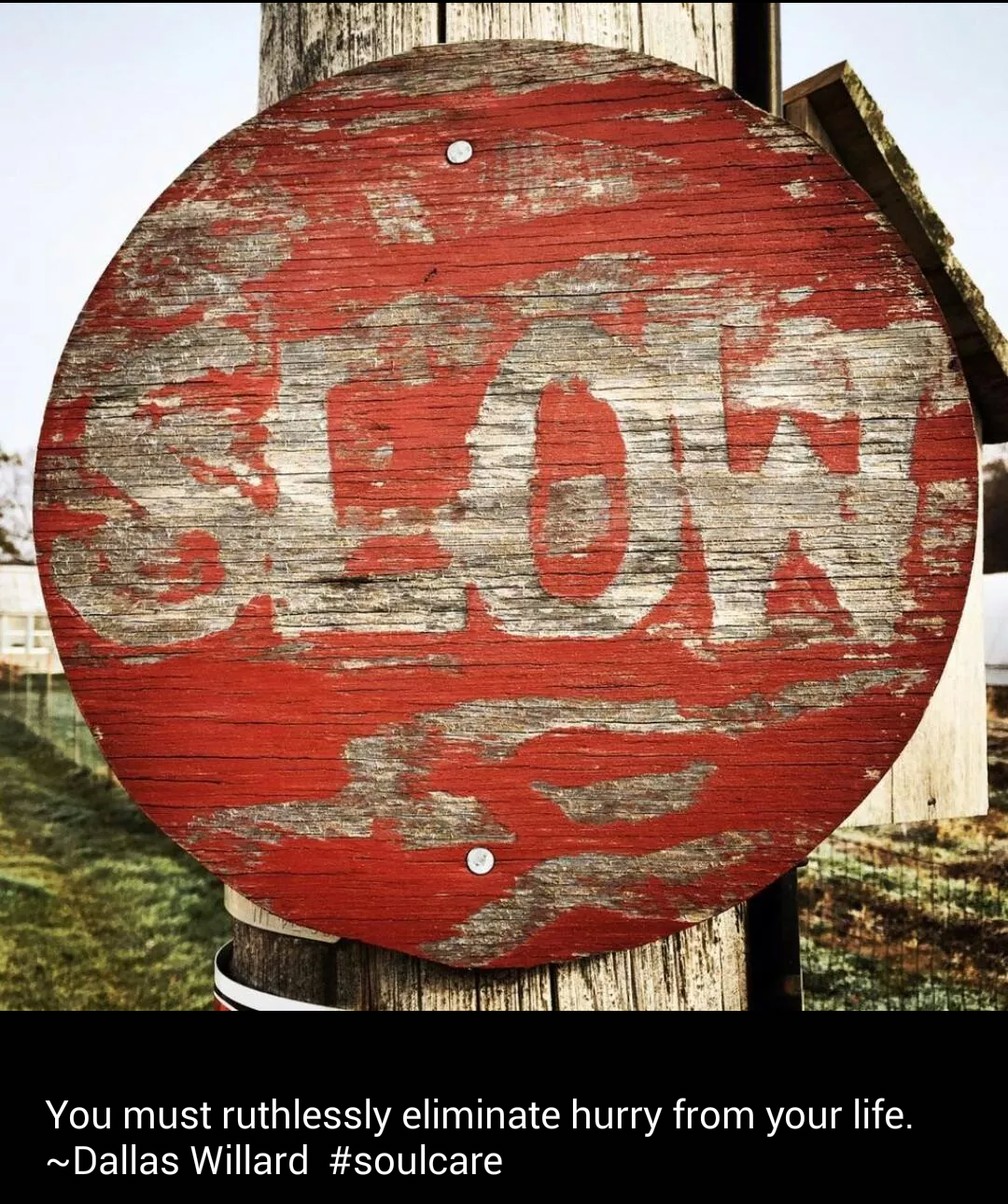
Remember what Dallas Willard told John Ortberg when Ortberg asked him for advice as he took the position as Teaching Pastor the largest Church in the country at that time, Willow Creek Community Church in Chicago, “John, you much ruthlessly eliminate hurry from your life.” At that time Ortberg was in his 30’s with three young children in his home with huge professional responsibilities. I say that to you to say if he can do it, you can do it.

The details of how you and Ashley do that are going to be peculiar to your family culture, rhythms and dynamics, but when you and Ash elevate the value of Soul Formation/Care to the highest level—you will find a way to make the details happen without sacrificing the well-being of your family.

My friend John K., who has young kids, told me that when his kids got old enough to be in sports that he and his wife decided that they would steer their kids in the athletic direction that would virtually ensure that the kids wouldn’t have to be in a “game” on a Sunday.  That meant that they were in “Dance” or “Fencing” or “Tennis” or “Wrestling”—a non-team sport.  His kids got the athletic experience, but they didn’t have to battle the practice and games on Sunday conflict. That is just an example of the parental choices some have made to protect what is of most important.

This is a team effort you and Ash need to embark upon.  You are good at this, but you might need to tag-team some solitude time so that you can go deep with the Lord. Start out slowly and incrementally like you would train for a marathon.  Take 15 minutes of protected alone time with you and the Holy Spirit. Do the basics in that time space: Lectio Divina, Listening Prayer, and Journaling. Then, as you become more comfortable, up the time incrementally. Make sure you work out a way so that Ashley can do the same thing.  This will be much more effective if you do this as co-leaders in the family. If both aren’t’ committed to this you won’t be able to sustain this value. Be aware that your wife’s might look different than yours.

Together you and Ash might try something your mother and I often do: Consolation and Desolation. Click on this link to my blog entitled The Beauty and the Brutal where I describe what that is.  It is a good way to jointly connect with each other about what is going on in your souls.

I also recommend something that I think you guys could do remarkably well.  Develop some family practices like Sabbath keeping.  Study how orthodox Jewish families practice Shabbat. I know you could make this work as a family tradition that would be so helpful for your souls and your family.

  • Light a Sabbath candle
  • Observe a Sabbath communion
  • As father, you could touch and pray a Sabbath blessing on each child.
  • As mother, Ashley might light the candle and with hand gestures, pantomime pulling the light of the candle to her face in a waving motion as she prays Sabbath blessing on the family.
  • Sing a Sabbath song together as a family
  • Pray a Sabbath prayer together as a family.

Hope that helps a little.  I am very encouraged that you even asked the question, son.  I don’t remember thinking this way when I was twenty nine.  You are giving me hope that the sins of the father are not going to be passed down to the third and the fourth generation.

Blessings,

dad

clay-potterP.S. Remember: Your soul is being formed 24/7 by something. The more you bring Jesus into your operational awareness the more He has opportunity to put his fingerprints on your life.

Posted in Uncategorized | Tagged , , , , , , , | Leave a comment

The Gift of Perspective

One of the great sorrows which came to human beings when Adam and Eve left the Garden was the loss of memory, memory of all that God’s children are meant to be. ~Madeleine L’Engle

When we lived in the Pacific Northwest there was a gulch with fir trees down in the draw along with maple and cypress. The bottom by the creek is virtually impenetrable with English ivy and pesky blackberry bushes. In the summer and fall, the green foliage covers to the extent that you can’t see the forest floor, the creek, or the rotting rowboat that leans against the giant maple.

However, when autumn came around and the trees started to lose their summer clothes, the ivy and vines begin to retreat to wherever they go in the winter. From my elevated back deck, I could see deeper into the wooded bottom, almost to the creek that flows year-round in the draw. The rowboat still wasn’t visible because the bank is too steep and the angle isn’t right from the deck, but a few feet away I could see the faint outline of a metallic and skeletal structure.

The Ancient Joy Machine

The leaves fell like small kites landing gently on the ground revealing what’s left of a child’s ancient swing set. Once upon a time, the wooded backyard was ruled by laughter and joy. Children squealed with glee on that equipment, but no child has touched it in years. However, the equipment stood tall and erect amongst the firs, ivy, and blackberry bushes. I suppose the metal will eventually rust away and the elements will leach into the loamy soil; maybe the relentless blackberry bushes will pull it down like prey to be devoured by moisture and oxidation into the brown leaves. But for now, the metal, paint, bolts, and nuts stood in defiance of the inevitable. But make no mistake, death and decay will overtake the old joy-making machine.

As I stood on my deck with a cup of hot coffee in my hand looking at that partially obscured swing set dusted with a confection of snow, I thought it an apt parable of my soul. There are some harsh realities, always present in my character, and they are being revealed during the darker days of melancholy. I could see the scaffolding of accomplishment, upon which I depended for so many years to bring me joy and a sense of well-being, here symbolically revealed in all of its decrepit glory right before my eyes in that creek bottom. To paraphrase Shakespeare, “Now is the winter of our discontent, made glorious summer by this sun of my youth.”

I wrapped the fleece closer to my sagging shoulders, I stared at the playset. In it, I saw meaning, deep meaning. Sociologists suggest that people have a difficult time describing or even identifying something for which they have no vocabulary. Some even suggest that you can have a hard time experiencing something for which you have no corresponding word. The Greeks had a word for the feeling you have when you are happy: Makarios. It is a feeling of contentment when you know your place in the world and is satisfied with that place. If your life has been fortunate, you should feel Makarios.

Those tubes and chains of metal in the bottom of the gulch reminded me of wasted years building my life on false sources of what I longed for—joy unspeakable and full of glory. A scaffolding of career success, peer approval, solid reputation, and a sense of accomplishment. And yet they were all mere child’s play when viewed from the elevated platform of late middle life. They were illusory. They would not withstand the relentless ravages of time and the toxicity of sin.

We used to sing a song in the church I grew up in that makes much sense to me these days:

When darkness veils His lovely face,

I rest on His unchanging grace;

In every high and stormy gale

My anchor holds within the veil.

On Christ, the solid Rock, I stand;

All other ground is sinking sand.

I wonder if we would put our weight on something altogether different at an earlier age than the external structures this world prizes so highly if we might feel content with our place in the world. What if we stood firmly on the bedrock certainty that we are loved by our heavenly Father? Unshakably loved. If we began earlier in our pilgrimage to rest in that safe knowledge of unconditional acceptance founded on grace, the structure hidden in the undergrowth of our soul might remain hidden, for joy is shy that way. But the day is coming when what is hidden will be revealed. If not in this life, in the life to come—for eternity waits for no one. Often what is most shy and obscure about our souls is what matters most.

Give care upon that which you play in this life. Soon enough we will skip and play in the company of the Joy-Giver in an eternal garden.

And laughter will once again rule the day.

Posted in Uncategorized | Tagged , , , , , , , , , | 1 Comment

Psalm 51

Posted in Uncategorized | Tagged , , , , | Leave a comment

Change is Slow

To everything there is a season…He has made everything beautiful in its time. Ecclesiastes 3:1,11

I get frustrated at long stop lights. I drum my fingers on the kitchen counter waiting for my soup to warm up in the microwave. I sent a package to a friend last week and he hasn’t said anything about yet, and it’s been four days!

When my sons were infants, I couldn’t wait until they were out of diapers. Then I couldn’t wait until they could get themselves out of their own car seat. Then I couldn’t wait for them to walk so that I wouldn’t have to carry them everywhere. Then I couldn’t’ wait for them to get their driver’s license so that I didn’t have to drive them everywhere. Then I couldn’t wait for them to move out of the house.

Now I am grateful when they call.

Patience has never been a virtueScreenshot_2014-11-19-15-17-47-1 (1)e of mine. I want to see immediate results. I am hell-bent in my desire to see the effect of my cause. I step on the bathroom scales and see that I need to lose weight so I go for a long walk and eat a light lunch and get back on the scales that evening and see no measurable change—I want to see results!

God has always dealt with me on His schedule, not mine. He works on me at His pace: S.l.o.w.l.y.

I want to have wisdom—quickly.

I want character—now.

I want integrity—at the end of this prayer.

I want virtue to govern my leadership—yesterday.

And yet it is true that God rarely gets in a hurry about anything.

Wendell Berry in an essay called A Country of Edges writes,

How the river works as a maker of the landscape, sculptor, and arm of creation will always remain to some degree unknown, for it works with immeasurable leisure and patience, and often it works in turmoil.

By what complex interaction of flowing water, of weather, of growth and decay was that cliff given its shape? Where did this house-sized boulder fall from, what manner of sledging and breaking did it do coming down, what effect has it had on the course of the stream? What is happening now in all the swirling rapids and falls and eddies and pools of the river in flood? We know the results. But because we have not a thousand years to sit and watch, because our perspective is not that of birds or fish or of the lichens on the cliff face but only of men, because the life of the Gorge has larger boundaries than the life of man, we know little of the process.

grandcanyonWhat a wonderful parable of how the topography of our lives might change. Imagine the river as the Holy Spirit, cutting, gouging, smoothing and bringing nutrients to our hidden parts. Imagine the rhythm of freezing/thawing and frost cracking open fissures of our character so that more Holy Water might seep and effect more erosion. Imagine the wind blowing the sand of—say a long traffic light or an incalcitrant child—across our lives to change us, to etch us, to deepen us.

What caused this house-sized tribulation to fall down the side-walls of my life? It has altered my life so that I am flowing a different way altogether.  From my vantage I see no change, but I have only the point of view of the moment, for I lack the geological arc of my story. That is the gift of perspective.

I think I know what is needed to change the topography of my soul:

A Stubborn Sculptor

I have an Artist that is relentless in His creative pursuits of my soul. He chips away at my arrogance, hones down my pride and infuses my sloth with divine energy. He is fierce in His determination to create something out of my life.

When I was a boy I offered him a kaleidoscope of colors and designs He might use to add depth, hue and tone to my heart, but the older I got the more monochromatic and flat my soul became. Narcissim and sin have a way of reducing life to gray scale. Nothing is as boring as a sinner bent on ignoring the Artist.

For we are His workmanship…”  Ephesians 2:10a

We have the fingerprints of God all over us. We not only have a stubborn artist we can offer a willing heart.

A semi-Soft Soul

The reason I say “semi” is because it has been my experience that His stubbornness is greater than mine. If I have just a little humility to offer Him and open my mind, emotions and will to His creativity, I have the opportunity to participate in the artistry of my life. His will is going to be done in my life with or without my cooperation. And every irritation, every conflict, every moment of joy or sadness are His invitation to join Him in the artistry of deep transformation.

In the Older Testament God spoke through his prophet to remind us of His commitment to us.

Look, as the clay is in the potter’s hand, so are you in My hand…  Jeremiah 18:6b

You have heard folks say about a person who might be young, innocent or naive that they are impressionable. I would say that as a follower of Jesus we are all impressionable to one degree or another. To the extent I offer my “impressionability” up the Artist the more profound the art of my soul.

That being said I must also say that if God is as relentless as I suspect He is, then even my stiff soul is being formed by Him—for He is stubborn that way.

What can I influence in this change process? Not much, actually.  God is God and He has never needed or asked for my artistic input, thank you very much. He will fashion me to resemble His Son starting in this life and ending in eternity.  (It’s a full-time job)  So, I can’t influence God but I can cooperate with him and trust the process.  And that is as far as I can go.

For grace is like water, it always follows the path of least resistance. And it is that flow of grace that changes me into a something of splendor. Slow change. Imperceptibly so, but change none-the-less.

But do not ignore this one fact, beloved, that with the Lord one day is like a thousand years, and a thousand years are like one day.  The Lord is not slow about his promise, as some think of slowness, but is patient with you.  2 Peter 3:8-9 (NRSV)

Time is on His side. It is His ally in my transformation.  So, bring on the long traffic lights and slow microwaves; let’s see how God will use them to make me into something wonderful.  Because more important that the deepening lines around my eyes and the graying of my beard is the transformation of my soul.

He is heaven-bent on that.

Posted in Uncategorized | Leave a comment

Cutting Corners

Do you remember Humphrey Bogart’s line in Casablanca? “Of all the gin joints, in all the towns, in all the world, she walks into mine.” I wonder if he stole that line from David in this story.

“Of all the caves, in all of En Gedi, in all of the Judean Desert, Saul walks into mine!”

What are the odds that Saul would pick the one cave in all of the Judean desert where David and his band are hiding out? Not very good. Unless, of course, God orchestrated this awkward reunion.

Eugene Peterson describes the scene:

On the run from King Saul, David and a few of his men hide in one of the caves overlooking the Dead Sea. The day is hot and the cave is cool. They are deep in the cave, resting. Then there is a shadow across the mouth of the cave. They are astonished to see that it is King Saul. They didn’t know that he was that close in his pursuit. Saul enters the cave but doesn’t see them: fresh from the hard glare of desert sun, his eyes haven’t adjusted to the darkness and don’t pick out the shadowy figures in the recesses of the cave. Besides, he isn’t looking for them at that moment; he has entered the cave to respond to a call of nature. He turns his back on them.

When David and his men see what is going on, they know that Saul, oblivious to their presence, is as good as dead. The men are ready to pounce, but David silently forbids them to kill him. Instead, he moves along the wall of the cave to where the king’s garment has been tossed, cuts off a piece of it, and then slips back with his men. In a short while King Saul pulls on his garment, straps on his sword, and leaves.

images (2)As Saul was outlined from the opening of the cave against the cobalt blue of the Dead Sea, with the red cliffs of Moab beyond, David saw something his companions didn’t see: David saw not an enemy but the magnificent, albeit flawed, king anointed by God. (adapted from A Leap Over the Wall)

Now, let’s listen to the rest of the story:

Afterward David was stricken to the heart because he had cut off a corner of Saul’s cloak. He said … See, my father, see the corner of your cloak in my hand…

Saul said, “Is this your voice, my son David?” Saul lifted up his voice and wept. He said to David, “You are more righteous than I…Now I know that you shall surely be king, and that the kingdom of Israel shall be established in your hand.

Swear to me therefore by the Lord that you will not cut off my descendants after me, and that you will not wipe out my name from my father’s house.” So David swore this to Saul. Then Saul went home; but David and his men went up to the stronghold.                                                          (1 Samuel 24:5ff)

Did you hear what David called Saul? “My father!” Do you hear the tenderness? “My father…I could have killed you. But I did not! I am guilty of no wrongdoing; no rebellion. God knows this is true. I am nothing for you to worry about!

And did you notice Saul’s response? “Is that your voice, David my son?” The voice I have known so well? The voice that offered to fight Goliath when no one else would? The voice that comforted me with songs in my times of depression? The voice that counseled me? The voice that spoke words of love to my daughter and words of friendship to my son? Is it that the voice I am hearing?”

We read this passionate exchange and say, “Wow, what a wonderful end to the story. David is merciful. Saul is sorry. They shake hands and leave as friends. The end.” Right? Not quite.

Two chapters later virtually the same thing occurs. Saul repents of his repentance. He’s chasing David again. Trying to kill him, again. And during the night, David sneaks into Saul’s camp and steals his spear. Perhaps the spear that Saul kept trying to use to turn David into shish kebab? David steals that spear, sneaks across the valley to the hill on the other side…and calls out to Saul. Again! He holds up Saul’s spear, mocks his bodyguards and repeats himself. “I could have killed you. Again! Look…here’s the proof. Your spear from right beside your bed. But I didn’t do it. Again! Because I am your loyal servant. So, please Saul, back off! Stop trying to kill me.”

And, again, Saul repents. Again, Saul is sorry. Again. But David never believes Saul. He never feels safe. And despite Saul’s words about David being the real king, until Saul dies by his own hand.

Troubled, twisted Saul.

Have you ever known someone who did bad stuff, said he was sorry, went out and did the same bad stuff again?

The husband who strikes his wife, apologizes tearfully, but does it again and …again. The woman who promises to stop drinking…and keeps drinking herself right into destruction. The child who promises to stop lying to her parents…but keeps right on lying. The dad who promises not to work so much…promises to make time for his wife and kids …and keeps right on working. The guy who promises God that he will stop looking at porn…and keeps looking.

Call it the “Saul Cycle.” Sin, sorrow, sin, sorrow…

If you love someone who is stuck in a Saul-cycle, sooner or later, you reach a broken-hearted point where you don’t believe them anymore. You don’t believe they will ever stop; that they will ever be better. Even if they promise to.

I don’t know what was going on with Saul. Perhaps he was mentally ill. The Bible says that God took HIS Spirit away from him…and sent an evil spirit upon him. That is a very troubling passage but the clear teaching is this: Saul reached a point of supreme, habitual wickedness where the Lord finally said, “Fine… you want to be that kind of person. I will let you be that kind of person. In fact, I will confirm it in you!”

I’ve known people locked in the Saul Cycle: Sin—Sorry, Sin—Sorry, Sin—Sorry. But, then one day it is: Sin—Sorry, Sin—sin, Sin—sin, Sin—sin…and they stopped being sorry.

Humble, merciful David.

I wonder if David considered doing what his men had urged him to do. Cut off more than a piece of cloth! I think David was tempted to really cut corners… not the corner of a robe… but to cut the corner on his journey to the throne.

When David cut the corner of the robe, it was a sign that he refused to cut the corners that mattered. There are a lot of things about David that are disturbing in these stories…lies, doubt, fear… but one of the places he shines through is right here: he will not, will not, will not lift his hand against the Lord’s anointed. He will not kill Saul so that he can hurry up what he believes even God wants to get done. If God wants to make him king, God will have to deal with the king who presently occupies the throne. Because David isn’t going to do it.

I preached my first sermon in 1978 and it was horrible. I was 22 years old. But I felt God had called me to preach and I have always struggled with impulse control issues and the discipline of delayed gratification. People were kind to me after hearing my first sermon, but I knew it was horrible. So, what did I do? I found a cassette tape of a preacher I admired and transcribed his sermon word for word, listened to it over and over and not only did I steal his words, stories, research, but even his delivery; plagiarized the tone and tenor of his voice, his rate of speech and volume. When he got loud, I got loud, when he whispered for effect, I whispered for effect.

When I preached that sermon the response was mind-boggling. There was no polite but stayed affirmations. I received full-throated accolades about me being the next Billy Graham. And then I became addicted to that affirmation that came my way about preaching. Iit was quite a while before I felt confident enough in my own abilities to write my own sermons. I rationalized what I was doing. I was advancing the Kingdom, people were coming to faith and the Church was growing. But it was all based on a lie.

I had cut corners.

Many years ago I made a promise to the Lord that I would wrestle with the Scripture and write my own sermons even if it meant that they were bad and my Church wouldn’t grow and folks stopped asking me to speak. I would not cut corners anymore. If lives were going to be changed or influenced, He would have to do it through the gifts I offered up on Sundays that came from my own hands.

Ready, willing you.

Can you think of one area in your life where you are tempted to cut corners? To speed things along? Maybe to cheat or fib or fudge a little bit to get what you want? To get what might even be good?

I wonder what David did with the corner of Saul’s robe. I’ll bet he kept it for the rest of his life…as a reminder that he was not going to cut corners to get to what God wanted.

Posted in Uncategorized | 2 Comments

Pretty little packages tied up with string…..

chamberschaos's avatarthe chambers chaos

I’m just a little angry about it this week. My window in my room is broken, like its so old that the frame rotted so when we closed it when it got to cold the glass completely came out. The wash machine has been broken for almost a month and is a custom order because the old house has odd staircase measurements for modern wash machines. And then, my refrigerator broke, so we’re essentially “camping” in civilization. Fun, oh so very fun. And then we can’t even be excited about crazy awesome really good news because we also get stupid news in the same fell swoop.

None of these physical things are my families fault. None. We currently live in a hundred year old house, we got a steal of a deal on rent because the owners couldn’t afford to fix some of these issues and went low cost on…

View original post 971 more words

Posted in Uncategorized | Leave a comment