The Cleft

Then Peter answered and said to Jesus, “Lord, it is good for us to be here…” Matthew 17:4

Rock of Ages, cleft for me, let me hide myself in thee. ~Augustus Toplady

We took a break from the teaching session on our ‘Silence’ at Potter’s Inn in Divide, Colorado and had some time to disengage, reflect and pray in any way that seemed helpful for us.  I was going to go for a walk and Nette went to our room.  Before I left for the walk in the mountains, I went in to our room to get a jacket. Lynette was lying across the bed, propped up on an elbow, reading something from our binder.

She sighed.

I glanced at her and asked, “What’s wrong?”

“I don’t know” she said. “I guess I don’t like doing this silence and solitude stuff.  I feel uncomfortable being alone with nothing to do or distract me.”

“Why is that?”

“I guess it’s because I don’t feel like there is much down in my soul to keep me company, and it has always been difficult for me to feel like I was the ‘beloved’ of God like they are talking about.”

We laid on the bed in silence; I heard her sniffle and knew she was crying. I let a few moments pass and then asked, “If I lost my arms, legs, and voice in an accident would you still love me?”

“Yes,” she said.

“Even if I couldn’t do a single thing for you, not even thank you for loving me?”

“Of course I would love you” she said.

“Could you allow that if you would love me when there was nothing I could do to earn your love, that the infinite God of all things would love you for just the way you are?”

Sniffles and silence.

“But I don’t feel loved like that from God,” she said.

“Want to try to go for a walk?” I asked.  “I know your knee is hurting but it might be good to walk the prayer trail together.”

“Okay”

We went slowly and talked deeply. We continued to let silence linger between us as we walked the trail—holding hands.

“I want to go to ‘The Cleft’” she said.

On the side of a wooded hill, in the shade of some Ponderosa Pines is an outcropping of rocks with one larger granite rock about the size of small car that a portion had split off in such a smooth and sloping way that it forms a seat. When you sit in it and lean back you are surrounded by stone.

The Cleft

The Cleft

We climbed the hill, passing a small sign that said, “Ascent.”   The trail wound up the slope and was in no hurry.  In the nine thousand foot thin mountain air we were in no hurry either, stopping several times to catch our breath and take in the heavy pine scent of the woods.

“Wouldn’t that smell be wonderful to try to capture and breathe for ending our Sabbaths each week?” Nette asked.

We arrived at ‘The Cleft’ and stood before the pink gray stone, noticing Cairns placed here and there; serving as make shift markers of epiphanal moments from pilgrims past.

20140517_164315

I walked up to the wooden bench and sat facing downhill some twenty feet away from ‘The Cleft’ while Nette studied the Cairns and the cleft. Presently, she stepped towards the rock and sat in the chair-like split of stone.  She stroked both sides with her palms and fingers as if she were rubbing the armchair of her grandpa’s favorite chair.

“It feels like God is hugging me.  I want to sing.” She thought for a moment and then began to sing,

I love you, Lord

And I lift my voice

To worship You

Oh, my soul, rejoice!


Take joy my King

In what You hear

Let it be a sweet, sweet sound

In Your ear

From a distance I watched my wife transfigured. I witnessed intimacy with the Almighty and glanced about for material to erect a tabernacle—but settled for this memory instead. A breeze sighed through the pine boughs as if a choir of supplicants praised the Creator and joined in the worship with this golden angel who felt beloved in the arms of God.


Posted in Uncategorized | 5 Comments

Living in Rhythm

If you keep the Sabbath, you start to see creation not as somewhere to get away from your ordinary life but a place to frame an attentiveness to your life. ~ Eugene Peterson

Most of the things we need to be most fully alive never come in busyness. They grow in rest. ~ Mark Buchanan

He looked like the actor that played the Marlboro man in those old cigarette commercials: Good looking, squared jawed, and salt and pepper hair. He had the physique of a man who knew his way around manual labor. His face was weathered with crow’s feet lines around his eyes. He had an easy smile—a very likable man.

“What do you do for a living?” he asked.

“I’m a pastor.”

“Really! My best friend is a pastor” he said.

We talked a little about our families, our churches, and our communities. He was interested in my trip last summer on Pacific Crest Trail so I told him about some of those adventures. He said his friend the pastor was easily discouraged and asked if I struggled with discouragement very much. I said that I did from time-to-time.

“I think of Church members as adopted children, but most of them think of me as a foster parent. I expect them to stay in the family, but they are only thinking about staying until they find their true home” I said.

“Wow, I never thought of it like that. I can see why it might discourage my friend so much when folks leave the flock. Makes me glad I’m a farmer” he said as he drummed his fingers on the arm of the chair.

farmer_field_092713

We talked some more about his life, wife, kids and what he wants to do for the Kingdom.

We spent each evening over the next four nights talking about our souls and what God was teaching us about how to care for that part of us that is hidden. Each night we would ask each other what was beautiful about our day and what was brutal about our day. Our conversations ranged from trivial to the profound. We were at this retreat to learn to care for our souls. He confessed that it was hard for him to sit still. Said he was wound pretty tight. A driven man. Type A.

He seemed proud of this temperament.

That wasn’t hard to discern. We were assigned Benedictine work on the retreat and he took the most labor intensive assignment and soon was tracking how much work he got done each day. All the while we were trying to learn how to operate in rhythm like Jesus lived.

Engage—disengage.

Engage— disengage.

One evening he came to our evening discussion and said he didn’t get the ‘live in rhythm’ thing. Said it was very hard for him to accept. We talked about living that way would allow us to be present in the moment and not so distracted about what might happen in the future.

“That all sounds good but I’m not so sure it is as necessary as everyone is making it seem” he said. “I’ve done pretty well in life. I only came here for a little tweaking.”

On the last morning we were together we took the Lord’s Supper. We were instructed to break off a larger portion of the bread than we might need for ourselves and then, as the Lord prompted, go to someone in the group and give them a piece of the communion bread along with a thought, blessings or a prayer.

I went to the Marlboro Man, gave him a piece of bread, and said, “You already know how to care for your soul because you know how to care for the land that you farm. I believe God is telling you to listen to the dirt and learn how to care for the private part of your world. He wants to meet you in the dirt that you love so much. Care for your soul like you care for your soil.”

While I spoke to him these words his eyes flitted around the room when someone walked by with bread in their hands. I said a prayer for him and made to move away to someone else and he said,

“Thanks, Dana.”

“You’re welcome. I wish you peace.”

Being present is very hard for some people. They can’t seem to turn their minds off. I wonder how much they are missing from the shy member of the Trinity. It seems that the only member of the Godhead that is able to command their attention long enough to etch something on to their soul is the thunder God of Sinai. There is so much more to walking with God than the shouts from a mountain. There is the whisper of the still small voice. There is the shepherd’s voice leading me beside still waters. There’s the Father’s voice declaring that I am the beloved.  But I have to slow down and turn down the noise in my life to feel his arms around me.

“Lord, make me to lay down in green pastures, lead me beside still waters and restore my soul. Sustain in me a willing spirit.  Fill my cup, Lord. I am so easily distracted with what I didn’t get done yesterday and what I have yet to accomplish tomorrow that it is hard for me to sit still and enjoy your company.

And bless Dana—whoever he is.”


Posted in Uncategorized | 4 Comments

A Gallilean Whisper

Beware the barrenness of a busy life.~ Socretes

For what profit is it to a man if he gains the whole world, and loses his own soul? Or what will a man give in exchange for his soul?~ Jesus

Selling your soul in exchange for something is a plot trope older than the story of Johann Faust. In pop culture it’s primarily conceived of in Christian terms—sell your soul to the devil, and you’ll never get to heaven but you’ll have something you want on earth, whether that’s fame, talent, love, money, or some other fifth option.

I drink coffee with folks every week who would never admit that they have sold their soul to the devil. Because they imagine the devil as a cartoon character or comic book villain. In truth he is much more beautiful and seductive than any of that. Don’t believe the lie. He is a wily one, ole Slewfoot.

running-cartoon-devil

One of his favorite tactics is seduction. And part of what it means to be seduced is that the perpetrator knows our weaknesses and exploits them. Do you feel unloved? Let me adore you. Do you feel insignificant? Let me worship you. Do you feel insecure? Let me take care of you. And when we listen to the silver tongued soul-whisperer, we find our deepest thirst quenched—for the moment. We are like the frog who feels safe in the water because it is in the nature of an amphibian to find comfort there—all the while Mestophilises is gradually turning up the heat on the pot and before we know it he has made a soup of our lives.

Eugene Peterson paraphrased Jesus’ words, “What kind of deal is it to get everything you want but lose yourself? What could you ever trade your soul for?” What are you willing to wager to get what you want out of life? Are you satisfied with the life you are living? What deal have you struck?

I read recently that the soul has no external gauge so we can’t tell how full or empty or in what condition it is in. Don’t you wish it did? But there are some ways we can check the condition of our souls if we can quiet the siren song of the evil one long enough to listen to what our bodies and our souls are saying. Here are a few marks on the soul-gauge:

  • Are you easily irritated these days?
  • Are you excessively defensive when criticized?
  • Are you increasingly indecisive about relatively simple decisions?
  • Do you find yourself drawn to the refrigerator or cupboard when you aren’t even hungry?
  • Are you thinking about shortcut to success that on your better days you would not consider?
  • Can’t turn your brain off?
  • Have you made a series of bad judgments?
  • Is fear, anxiety, and worry your constant companion?
  • Do long sighs leak out of your lips like a giant balloon is being deflated? Does this happen several times a day?
  • Trouble sleeping?
  • When you relax do you feel guilty?

busy-bodies-need-massage

There is a shy part of you that if you ignore it you will suffer tragic long-term effects. It is called your soul. Many folks I know are wagering that because the soul is hidden that it is unimportant. But the valves of your heart are hidden too, and yet if they get clogged, you are a walking time bomb.

The good news is that Jesus is very concerned with state of your soul. I want to give you two verses to ruminate upon.

Read them slowly and let the Galilean whisper become an earworm.

Listen! I am standing at the door, knocking; if you hear my voice and open the door, I will come in to you and eat with you, and you with me. Revelation 3:20 (NRSV)

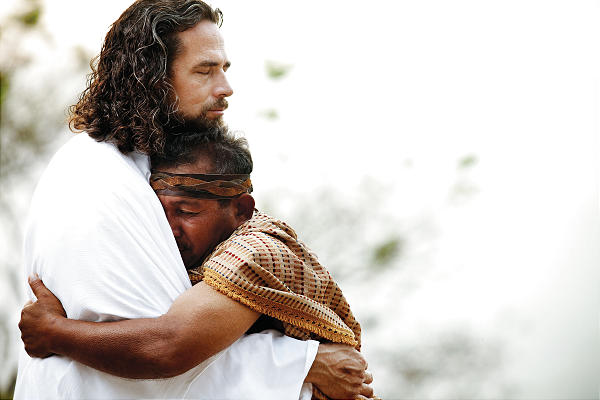
hugging-jesus

“Are you tired? Worn out? Burned out on religion? Come to me. Get away with me and you’ll recover your life. I’ll show you how to take a real rest. Walk with me and work with me—watch how I do it. Learn the unforced rhythms of grace. I won’t lay anything heavy or ill-fitting on you. Keep company with me and you’ll learn to live freely and lightly.” Matthew 11:28-30 (MSG)

My mother was born in Texas and has a little bit of a Texas accent when she talks even though she has lived away from that foreign country for decades. When I was a boy I remember noticing that when in the company of my aunt that my mother’s Texas accent grew more pronounced and affected. It was like the more these two sisters who love each other were in one another’s presence they spoke with the same inflections, rhythms, and tones. In fact, if you weren’t in the room with them it was hard to tell who was speaking.

You and I have a choice about whose voice we will fill our ears. It will impact your life for the good or the not-so-good. You don’t have to worry about changing your life-patterns to hear the devil. His voice is the white noise that is all around us, for he is the god of this world. Ignore him at your peril. I promise you he is not ignoring you. But will you arrange your life in such a way that your can hear the voice from Galilee?

The Faustian plot is indeed quite old, but so is the hope of the Kingdom of God…but you must listen for a still and small voice—a whisper—and you have to go to him.

Jesus says, “Are your ears awake? Listen.” Rev.3:22(MSG)

Posted in Uncategorized | Tagged | Leave a comment

Consumer Christianity

Most Christian ‘believers’ tend to echo the cultural prejudices and worldviews of the dominant group in their country, with only a minority revealing any real transformation of attitudes or consciousness. It has been true of slavery and racism, classism and consumerism and issues of immigration and health care for the poor.~ Richard Rohr

It is better not to make a vow than to make one and not fulfill it. Ecclesiastes 5:5

Ever heard of commodification?  It is a sociological term that is defined as the process by which social relationships are reduced to economic exchange relationships.  You probably have a commodified relationship with your coffee shop.  You say “Hi” to the baristas and the management.  You are comfortable with the shop.  But the relationship is based on the fact that they are giving you a good product at a fair price.  But if you find another store, a little closer to home that a gives you a better product and a better price its “Goodbye old coffee shop and hello new shop!”

coffee shop

Why?  Because your relationship with that store is not as important as your personal needs.    That is a commodified relationship.  Nothing wrong with that.

But Christ-followers also have covenant relationships.  These are radically different in nature.  We have covenant relationships with our children, marriages, friendships and churches.  In these we are far more concerned with the relationship than we are with our own personal needs.  Much to my discomfort, my wife would often feed our children before she fed me or even herself.  When she and I got married we exchanged rings, said some vows, signed a document.  We entered a life-long covenant.

But an amazing phenomenon has occurred in my generation where we have commodified our covenant relationships.  That means we approach our social relationships and say something like “I will be the spouse I am supposed to be as long as you are the spouse you are supposed to be.  I will be the friend I am supposed to be as long as you are the friend you are supposed to be.  I will be the church member I am supposed to be as long as you are the church you are supposed to be…I will meet your needs as long as your are meeting my needs.”

In a covenant relationship each person meets the needs of the other person even if their own needs are not being met.  In a covenant relationship I say “I will be the spouse I am supposed to be even if you are never the spouse you are supposed to be.  I will be the friend I am supposed to be even if you are never the friend you are supposed to be.  I will be the pastor I am supposed to be even if you are never the church you are supposed to be.”

How many friendships are torn asunder because we have commodified them?  How many marriages are fragmented beyond repair because we choose to relate to each other like we do a grocery store?  And churches are hindered from establishing a beachhead on enemy shores because of an “exchange relationship.”

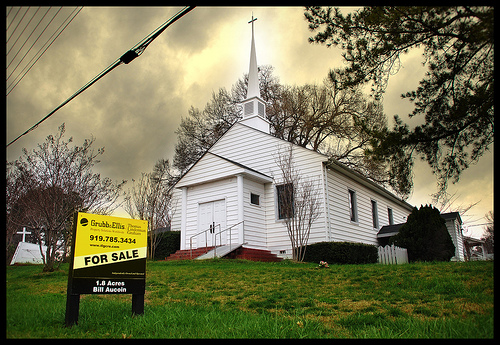
church-for-sale

I am saddened when I hear someone say they are going to separate from their spouse because they have to start taking care of their needs.  I am heartbroken when I see people leave a church because the church is no longer meeting their needs.  I am infuriated when I see a pastor leave a church because there is a prettier, wealthier and more prestigious church that will help his long-term career.  Churches are reduced to mistresses when that happens.  And it happens all the time.

I am so glad Jesus didn’t commodify His relationship with me.  “Joe, I will be the savior I am supposed to be as long as you are the Christian you are supposed to be.”  Or “I can’t go to the cross right now, because after three years of pouring myself out with these slow-witted disciples I need to start taking care of me and my relationship with the Father.”

May there be a clear line between my covenant and my commodified relationships.

Christ loved the church and gave himself up for her to make her holy, cleansing her by the washing with water through the word, and to present her to himself as a radiant church, without stain or wrinkle or any other blemish, but holy and blameless. Ephesians 5:25-27

Posted in Uncategorized | 14 Comments

Was Jesus an Irritating Preacher?

“Honey, I don’t think you irritated anyone at Church today. I’m proud of you.” Lynette Chambers

He left that place and came to his hometown, and his disciples followed him. On the sabbath he began to teach in the synagogue, and many who heard him were astounded. Mark 6:1-2

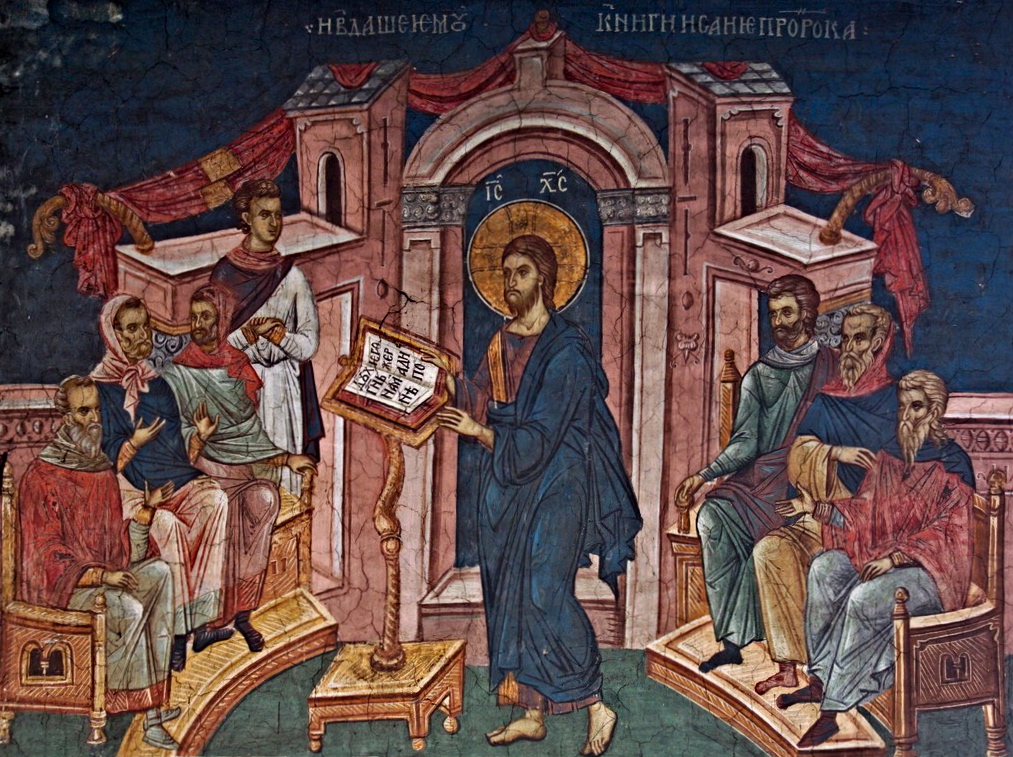
It must have been quite an impressive sermon. The people were amazed at his authority and eloquence. And yet the more they talked about it the angrier they got. The story actually says, “They took offense at him.” Why? What was it about his sermon that so irritating?

christ-preaching-in-the-synagogue-at-nazareth-14th-c-fresco-visoki-decani-monastery-kosovo

In Luke’s version he tells us, “All spoke well of him and were amazed at the gracious words that came from his mouth.” How can you be irritated at “gracious words?” Because the fine folks in Nazareth are like me in that I would like to choose who God is going to be gracious to and who he is going to be wrathful towards. And yet Jesus was announcing that God wants to be merciful to all peoples of all nations, even the sworn enemies of Israel. And this is where the hometown folks of Nazareth failed to resemble Jesus the most.

God will love whom He will love and we don’t get to advise Him on this issue. But the good people of Nazareth thought they might. They had an idea of who God should show mercy towards and who He shouldn’t. And when Jesus planed against that grain, he was rejected as a legitimate prophet; labeled a handyman-washout and rabbi want-to-be, and finally rejected in his own home town.

There is a level of contempt in this exchange that is palpable. In fact, it amazed Jesus. I could only find two places in the New Testament where we are told that Jesus is amazed. One is when a Gentile exercised a staggering amount of faith in Jesus, and here where his hometown treated Him with such scorn.

It seems He wanted to do “deeds of power” but could only cure a few sick folk so he moved on. Apparently, Jesus only lingers where He is welcome. If you lean forward and listen carefully you can hear contempt in the voice of the village elders as they make observations about Jesus when he finished his sermon.

“Is not this the carpenter, the son of Mary?”

Notice three things about this not-so-innocent question: One, it was not a question. Two, the phrase “son of Mary” means they are questioning his parentage. This was a first century euphemism for ‘bastard.’ In that society you always named the son by naming the father, not the mother. Three, by calling Jesus “the carpenter” they were calling him the equivalent of a handy man, a jack-of-all-trades.

Need your door fixed? Need your gate re-hung? Need your sink unplugged? Call Jesus. He was the ultimate “Hubbies Helper.”

I imagine the tone of voice to be one of derision and contempt. Contempt is an ugly word. Maybe it’s those hard consonants that thump when you say the word. More likely its baggage comes from usage in our common tongue.

You’ve heard the phrase “familiarity breeds contempt?” Ever wonder where that came from? The maxim dates back to the second century B.C. Aesop wrote a fable to illustrate it. A fox had never before seen a lion and when he first met the king of the beasts, the fox was nearly frightened to death. At their second meeting, the fox was not frightened as much and the third time he met the lion, the fox went up and started talking with him. And the moral of the story? Familiarity makes even the most frightening things seem quite harmless.

My problem is that I’ve known Jesus longer than the folks in Nazareth. They knew him for thirty years, but I have known him for fifty. I’ve studied him, talked to him, argued with him and explained him to anyone who would listen and more than a few who wouldn’t.

I wonder if Jesus, the Lion of Judah, has become harmless to me.

Along with this sense of familiarity, I wonder if Jesus actually feels welcomed in my life. Does he sense contempt behind my patronizing prayers and woodened worship? Two quick scenes just flashed in my mind from Scripture that are hauntingly convicting.

One is a post resurrection sighting of Jesus towards the end of Luke where Jesus is walking along the road with two discouraged disciples.

“As they came near the village to which they were going, he walked ahead as if he were going on. 29 But they urged him strongly, saying, “Stay with us, because it is almost evening and the day is now nearly over.” So he went in to stay with them. 30 When he was at the table with them, he took bread, blessed and broke it, and gave it to them. 31 Then their eyes were opened, and they recognized him…” Luke 24:28-31a

They wanted this stranger, who sounded strangely familiar, to share a meal with them. No contempt here.

The other scene is in the last book of the Bible where John the Revelator records Jesus words to a Church called Laodicea and confronts them about their apathy. Jesus admonishes them to be either hot or cold but not lukewarm. And what is the remedy to this apathetic attitude towards Jesus?

Listen! I am standing at the door, knocking; if you hear my voice and open the door, I will come in to you and eat with you, and you with me. Revelation 3:20

It seems that the solution to apathy, discouragement and even the lack of faith is more quiet intimacy with him.

Sometimes my wife and I can sit for long stretches of time in wordless intimacy. We have gained this over three decades of loving, serving and living together. We enjoy each other’s company. We don’t have to do anything fun to have a lovely day. Walks around the block, sitting in the sun on the deck watching the Puget Sound, and driving around town running errands are all wonderful experiences of love. You just can’t rush love. It comes in the faithful daily-ness of a life lived for the well-being of another.

What frightens my wife and encourages me is the truism that the longer a couple lives and loves together the more they will resemble one another physically and in character. Something the village elders of Jesus’ hometown never took the time to learn.

Take time to be holy, the world rushes on;

Spend much time in secret, with Jesus alone.

By looking to Jesus, like Him thou shalt be;

Thy friends in thy conduct His likeness shall see.

I have learned that intimacy transcends familiarity. And while Jesus is far from safe, he is, as C.S. Lewis has said, “good.” And the daily-ness of that goodness in my life, over time, will bring about a holy resemblance.

At least that is my wife’s prayer.


Posted in Uncategorized | Leave a comment

People, Get Ready.

Then Jesus was led up by the Spirit into the wilderness to be tempted by the devil. Matthew 4:1

The best way to battle temptation is to give into it.~ Oscar Wilde

I received a phone call from a person that was distraught. I listened and empathized with them in their sorrow. About that time a show came on the television that was somewhat racy. Not horrible, but certainly not appropriate. I had muted the sound so that I could listen to the quivering voice on the line. I began to pray for the person, all the while the fleshly images were being flashed on the screen in front of me. I closed my eyes to talk to God on behalf of a hurting friend but kept opening one eye to see the flashing images.

It is extremely difficult to pray to God and ogle images on television. I had to either hurry the prayer or turn off the T.V.

So I prayed, “DearLordJesushelpMrs.SoandSoblah,blah,blah.InJesusname,Amen.”

Jesus had a clear vision of who he was. He was God’s beloved son and the Voice spoken at his baptism was still ringing in his ear all the way out into the wilderness. He knew who He was and Whose He was.

It is not enough to have a plan about what you are not going to do in life. You must develop a vision for who you are and what you are going to become. To be fully human is not just the absence of evil, it is the relentless pursuit of good. And that is what Jesus did in the wilderness when he did battle with the devil. All of the years of reading Torah, internalizing the Scriptures and praying the Psalms came to bear on those dry and dusty 40 days out east of Zion.

It is not enough to get married and not have plans to be unfaithful, you must make plans to be faithful. It’s not enough to have plans to not become addicted to alcohol, you have to have a vision, intention and a method to be moving towards God. No one plans to be unfaithful to God. No one I have ever met has signed on to be a Christian and secretly made plans to bow their knee to the devil at the same time.

Dallas Willard has said, “We must arrange our lives so that sin no longer looks good to us.” I need to build into my life behaviors, friends, and habits that make loving Jesus more attractive than loving my own desires.

Jesus said to him, “Away with you, Satan! for it is written,

‘Worship the Lord your God,

and serve only him.’”

Then the devil left him… Matthew 4:10-11a

What I worship really matters. One night at a weight loss clinic the instructor held up an apple and then a candy bar.

images

“What is the nutritional value of this apple,” she asked, “and how would it relate to your diet?”

“Low in calories”, “natural” and “lots of fiber” were among the answers.

She then went on to explain what was wrong with eating candy, and concluded with, “Apples are not only more healthful but also less expensive. You can buy this apple for about thirty cents. Do you know I paid eighty-five cents for this candy bar?”

Everyone just stared at the forbidden treat, and from the back of the room someone blurted out:

“I’ll give you two dollars for it.”

What I ascribe worth to really matters. I love how author Tim Keller puts it when he says, “The things you daydream about in your spare time are ultimately the things you serve.” It doesn’t require vision and inner strength to choose the apple over the Snickers at a weight loss clinic. It gets a lot harder at 10:00 at night and your spouse has already gone to bed and will never know anyway. The immediate gratification of the candy bar versus the fiber-rich benefits of the apple are at odds and the candy bar usually wins. Unless I have matured to the point where I can live with delayed gratification long enough to remember the vision of a healthy and dynamic body that gives presence to the soul that lives inside—I will have peanut breath when I go to bed.

It’s easy to make the right choice in squishy moments at 11:00 on Sunday mornings at the sin-loss clinic called Church. It’s a lot harder to make soul-enhancing choices in the wilderness of Monday through Saturday.

Jesus didn’t start his preparation during His temptation. He envisioned the kind of God-fearing pilgrim He would be long before he was taken into the wilderness. Since before He was twelve He had built into His lifestyle soul-shaping exercises for all of his life. Things like scripture mediation and memorization. Things like prayer and worship. Things like service and solitude. He learned obedience from the things he suffered, scripture says. He learned to be comfortable with obscurity. In fact, we could say that all of his life had prepared him for this battle in with wilderness and all the battles that dogged his steps to the cross.

imagesTEOLORNB

We must be prepared for the battle before the battle begins.

So, turn the T.V. off. Spend time reading, praying, and listening.

The phone could ring at any moment.

Posted in Uncategorized | 1 Comment

Jars of Clay

7 But we have this treasure in clay jars, so that it may be made clear that this extraordinary power belongs to God and does not come from us. 8 We are afflicted in every way, but not crushed; perplexed, but not driven to despair; 9 persecuted, but not forsaken; struck down, but not destroyed; 10 always carrying in the body the death of Jesus, so that the life of Jesus may also be made visible in our bodies. 11 For while we live, we are always being given up to death for Jesus’ sake, so that the life of Jesus may be made visible in our mortal flesh. 12 So death is at work in us, but life in you.  2 Corinthians 4:7-12 (NRVS)

Power does not consist of size, great ministry programs, or eloquent preachers.  I am convinced that God let you to invite me to be your pastor almost six years ago.  I don’t think you or I got that wrong.  I am further convinced that God led us to reimagine ourselves from a “church for the unchurched” to a “restoring church” when we changed our vision, values and name about 3 years ago.

All we really want to do is be obedient to what God has called us to do.  And last we checked with God on this it was to “restore His world one heart at a time.”

Henry Blackaby has famously said that “when you are uncertain what God’s specific will for you to do is, do the last thing He told you to do until God tells you to do something different.”  So, as your elder brother and pastor I am here to declare to you that as best as I can discern, God has not changed His mind in what we should be doing.

Power is not found in anything external to us.  True power exists in paradox, the most significant of which happened 2,000 years ago when God in the flesh died. When omnipotence surrendered to impotence.

Jesus, who had the power to call angels down from heaven to destroy His enemies, didn’t. Instead, He endured the shame of the cross, “and while being reviled, He did not revile in return; while suffering, He uttered no threats.” (1 Peter 2:23)

This passage is about power.  But not the kind of power we normally think about.

Power to minister effectively and impact others comes from God. But His power is not displayed as humans would display it. There are no parades of military might. No bold headlines. No press conferences. No flexed muscles, or clenched fists, or angry threats. So how does God display His power?

But we have this treasure in clay jars…  Vs. 7

Earthen vessels. Simple clay pots.  Fragile and flawed. You and me. What a paradox. Power in pots…life in death.

Why would God p[lace His priceless treasure in such pottery?

…so that it may be made clear that this extraordinary power belongs to God and does not come from us. Vs 7b

Like Mary’s expensive perfume in John 12, the aroma of Jesus inside our hearts cannot be experienced by other until it is poured out.  And often, God’s way of pouring out that fragrance is to break the earthen vessel that holds it.

We are afflicted in every way, but not crushed; perplexed, but not driven to despair; persecuted, but not forsaken; struck down, but not destroyed…  Vs. 8-9

But that is not we want in life, is it? We want to be big, beautiful and displayed on some safe shelf.  God, however, wants us to be a fragrant aroma of Jesus.  And that means we have to be taken off the shelf, poured out, and even broken.

The spiritual battle is real, but we don’t want real battles. We want to watch battles in movies or play them in video games.  Things blow up, be we are safe on this side of the video screen.  We don’t want a real battle, we just want a safe thrill.

Life, however, isn’t a movie. It is a war zone with real battles, real bullets, and real blood.  Sickness, disease, heartache, disappointment, crippling accidents, crushing experiences, tears, and death touch each one of us.

Life is not a movie.

But does God put us through all this just to watch us squirm…to make us miserable…to prove that He’s in charge?

No.  Instead, this all points back to the cross.

We come now to another paradox: Experiencing the life of Jesus requires an acceptance of death.

… always carrying in the body the death of Jesus, so that the life of Jesus may also be made visible in our bodies. Vs.10

There is not abundant life without first an abasing death. And this reality should be displayed in our lives not only clearly but continually.

 For while we live, we are always being given up to death for Jesus’ sake, so that the life of Jesus may be made visible in our mortal flesh.  Vs.11

What does Paul mean by “death” here? It includes acceptance of those four painful experiences mentioned before in vs.8-9.

Afflicted…perplexed…persecuted…struck down.

When we accept those struggles as part of the process of releasing our fragrance, we’re not destroyed.  Rather, His power is perfected in our weakness. For when we die, He lives. When we lose, He wins. When we’re weak, He is strong. When we are dependent, He is powerful.  That is the beauty of the paradox. That is the power in clay pots.

“Given up to death.” Doesn’t sound like a Hallmark movie, does it? But there is divine wisdom in the paradox. We are constantly being delivered to the point of death so that God’s message will leak out. Then people who watch us will realize there isn’t anything significant about the vessel—it’s what’s inside that counts.

When other people see this death in us, it changes them…

 So death is at work in us, but life in you.  Vs.12

When others see God’s power perfected in our weakness, it dawns on them that maybe God could use them too.

Do you want to make an impact where you work?

Do you want to touch your neighborhood?

Then merely live out the dying message of Jesus. Let it out. Don’t hide the cracks. Let your humanity show.  It’s the cracks in the clay that allow people to see through and focus on the Lord.  You’ll be amazed how often God honors a weak, broken piece of pottery—how seldom He uses fine china.

I want to share with you six practices that will position us so that the best light possible can shine through our cracked pots.  I am going to call you to join me in living a life of brokenness so that Jesus can shine through.

earthenvesselphoto

If the clay pot had feelings, how do you think it is feeling right now?  A lot of pain? A little fragmented? Confused? Demoralized?

This month is the 30th year of me being a pastor and here is an observation based on that experience that I would like to share with you.  Church for many has become something you go to, like you might go to a gym, a sporting event, a gallery, or a show.  Church has become a destination.  But the truth is, while we never want what happens on Sunday’s to be tortuous, it is never to be the destination.  What happens when the body of Christ reassembles on Sunday’s is supposed to do is be a celebration.  A celebration of how the Light of Christ has escaped from the cracked pots that gather here.

You know the old adage that if you want something to change you have to do something different.  Or as Einstein said was the definition of insanity was to do the same things over and over again and each time hoping and that this time it would turn out different.

I am calling you who call this place your church home to go on a journey with me this year.  James says do not be hears only but be doers of the Word.  I am going to call you all to a deeper walk with Jesus and His bride, the Church.

This is going to be an arduous journey.  You might be tired of hearing about the PCT that I went on last year, but here is one more truth that applies to us.  I have been backpacking for 50 years.  I know how to backpack.  But I had never hiked 15 miles a day for 30 days. I did lots of reading.  Watched lots of Youtube videos.  I went as light as I have ever gone in my life.  And yet, ten days in at the first opportunity I started discarding things that at the beginning I thought were necessary for survival.  I had to adjust my plan.

I am going to outline a journey towards being vessels that shine the light of Christ, but that will certainly mean we will have to adjust our plan along the way.

So, with that in mind I want to suggest to you that we, as a bunch of crack pots, covenant together to do something different.  I am calling to you join me in a grand experiment.  I wonder what it would look like if this Church of broken vessels left this building each week to live a life marked by the following:

1 Work it Out 

Every follower of Christ is in fulltime ministry. Our work life is therefore also part of our ministry. The symbol of a clock reminds us that we have the opportunity to ‘work out’ our salvation at our place of work/career.  Our work life is a major part of our spiritual formation. Some of us have become workaholics and we’re invited to rediscover a healthy work rhythm, others are in the wrong career and they can realign themselves with their gifting – calling.

Practical examples of this include:

– Not exceeding 50 hours a week at work (making exceptions for busy seasons)

– Developing a Sabbath rhythm (keeping Sabbath at least once a week)

– Develop a life outside of work.

– Evaluating whether my job is ethically honoring God and is in line with how God created me.

– Be approachable at work.

– Take lunch breaks and spend the time with people at work.

– Use my calendar to book my hours.

– If I have employees under me, negotiate good working conditions for them (hours/pay/environment)

– Start a prayer group at work

– Set reminders to remember God (phone/email/screensaver)

– Evaluate work every 6 months and ask if it’s still honoring God.

– Email my accountability friend on Monday to ask for prayer/thank for aspects in work.

2 Downward Mobility

We live in a culture obsessed with ‘going up’ or ‘climbing the ladder’. In contrast, the Jesus way is one of servanthood and emptying oneself. An orientation towards downward mobility. This is symbolized by someone walking down the ladder. For us this is the decision not to ‘keep up with the Joneses’ but to join the movement in an opposite direction. This involves whole-life stewardship. It was a huge shock to us when we realized that we were the rich Jesus talked about; and we’ve been on a journey of figuring out what the implications of this are. Giving of ‘our’ time, resources and skills is the implied journey of this invitation – it’s a developing of a servanthood-mentality.

Practical examples of this include:

– Being honest about your finances by disclosing it to one other person or family (in detail)

– Determining with your family what a sustainable lifestyle is and commit to keep it (giving room for inflation) then giving the rest away; work out a budget.

– Start with a rhythm of giving 10% away.

– Redistribute educational skills and life experiences.

– Make a habit of comparing downward instead of upwards (check out http://www.globalrichlist.com)

– Make resources available for use in the community chest (exercise your sharing capability).

– Making friends with people lower on the organizational chart.

– Not always accepting promotions.

– – Stop being obsessed with name-brands.

– Give extras away (to a person you know) – (clothes/cutlery/electronics etc.);

– Fasting from restaurants/luxuries/expensive foods and give money away (or tip 100% or whatever percentage would stretch you)

– When buying something new, give something else away

– Get out of debt

3 Incarnation

God became man through the life of Jesus. The technical phrase for this is incarnation – literally meaning ‘in the flesh’. We are also called to live like Jesus in the context where we find ourselves. This is symbolized by two shoes. We ask, ‘how would it be to walk in your shoes’? In a post culture wars that are going on in our country and the way many socially progressives feel about the evangelical church lets be creative to show equal parts grace and truth.  (John 1:14) All they are hearing now is TRUTH shouted at them and it sounds like hate.  Jesus wants to liberate both groups. For us this has evolved into developing friendships between the rich and the poor. I found this quote but have lost who said it, “The rich and the poor need each other to rediscover their humanity … The rich need to realize that they’re not God and the poor that they are also made in the image of God and has something to contribute”.

Practical examples in our community:

– Developing a friendship with someone who is other – gay/black/white/poor/rich/famous/atheist/agnostic/other religion etc.

– Commit to a monthly cross-cultural experience (Walk or support an AIDS awareness walkathon or race, find something else that forces to deal with strangers  and pray with them and then join them in the work they’re already doing).

– Learn people’s names and learn their stories (security guards / tellers / baristas / workers in garden / baggers).

– Walk into relationships of reconciliation where we confess past hurts and reconcile (one on one).

– Buy groceries in bulk to give away.

– Learn a new language.

– Visit someone in jail/hospital.

– Get involved with the homeless ministry.

4 Puzzle Piece

Every person is uniquely gifted. This is symbolized by a puzzle piece. A puzzle piece is nothing on its own, the puzzle cannot be completed without every piece.  Instead of discovering our spiritual gift and thry to find a place to serve, how about we think of each of us as a gift and offer ourselves to Christ and His body in what ways make the most sense for the gift? (charismata)/talents/personality/experiences and passions.  Ask the question ‘where do I fit?’ Or more pertinent – ‘how am I a gift’? instead of ‘what is your gift’? This may reduce the lay/clergy divide as far as ministry is concerned.

Practical examples of this include:

– Serve with what you are good at (the skills you use at your work is a good place to start).

– Participate in group activities (say what is on your mind) come to services with a servant attitude.

– Put your name on the chore list at church: (cleaning, landscape, nursery, serving, etc)

– Discover your gifts/talents/personality by doing an inventory and discussing it with people you know.

– Look the Everett Gospel mission and ask what the needs are and see which ones are within you capability to fulfill.

– Live out your passion within RCM; listen to needs and see how you can help with them.

– Be real / don’t think that your piece is not ‘spiritual’ enough – admin/using your hands/ making meals/ writing / locking and opening the facilities are as spiritual as teaching/ preaching / praying.

5 Re-Member

Loving others cannot happen in the abstract it happens during face-to-face encounters, we symbolize this invitation with bread/eating. Reclaiming hospitality and eating meals together have been a huge journey for us. Jesus constantly developed communities around eating and drinking in houses and continually diversified the people coming together. This diversity included different races, classes, and religions. Every member in our community commits to breaking bread with their neighbors.

Practical examples out of our community:

– Gather together on a Sunday.

– Pray with others at least once a week.

– Get together at least once a month with accountability partner.

– Meet at least once a week with other Christians in order to share life.

– Have at least a monthly meal with someone who is not a Christian.

– Combining events (movies, sport, shows, games nights) with fellowship. (Especially with people who are outside of your affinity).

– If REALLY busy, set aside at least one day for fellowship, and make that day count.

– Meeting others at work.

– Engage in hobbies together like running, hiking, sports, jazz shows, reading groups, etc.)

– Have at least a daily God conversation with someone (not the same person).

– Hang out with biological family.

– Make space for single people in married couples’ lives.

6 Plugged In Daily

As followers of Jesus we want to develop a rhythm of plugging in daily. This rhythm is symbolized by a plug. Just as all our gadgets (phones, laptops, toothbrushes) need charging – so do we. This rhythm links one with the classic spiritual disciplines (what traditionally has been called a quiet time). This is an invitation that keeps people in conversation with God. The classic disciplines as described by Richard Foster and Dallas Willard are of great help here. We encourage people to engage for at least 15 minutes a day with a formal discipline, and then some other informal plug-in’s for the rest of the day

Practical Ideas for this discipline:

– Bible reading (books/chapters/www.project345.com))

– Memorizing passages

– Prayer (Psalms, Praying the hours)

–  Develop a group of people in the church and designate a certain day— call it ‘Discipline Tuesday’ where someone chooses one of the classic disciplines (silence, meditation, solitude, fasting, celebration, confession) and everyone practices it and then give each other feedback).

– Reduce the time watching TV and spend that time in prayer and Bible study.

– Couples read books to one another . (Just before or after supper is a good time.)

– Listening to the Bible/radio/worship CDs in your car while you travel

– Coins in pockets (or anything for that matter) which serve as prayer/ any sort of reminders.

– Journal

– Read a dead guy/gals devotionals  (Oswald Chambers, Hannah Hurnard,)

– Read/pray through sacred space

– Read the lectionary readings for Sunday

– Use trips in the car as a retreat space

Conclusion:

I wonder if you will join me on this great experiment.  Join me in a covenant for one year. What would our church look like if over the next six months we took one of these rhythms and concentrated on learning about them, practiced them and came on Sunday and heard stories of victories and defeats about how living as Cracked Pots worked during the week?

My dream is that we happy few, we band of brothers and sisters, learn about these practices, then go out and practice the practices and come back on Sundays and celebrate what happened the week before, then learn some more on how to live the practices, and go and practice and come back and tell the story and celebrate victories and failures.

I wonder if you will join me in letting Jesus light so shine before men that they may see our good deeds and glorify our Father in Heaven?

If so I am asking you to come and take a shard of this broken clay and take it home.  Spend a week asking God if he wants you to go to this level of community and soul training commitment. Then take a Sharpie or pencil and write a prayer on your piece of broken clay, bring it back with you next week and we will reassemble the earthen vessel and glue it all back together.

We will put a candle inside it and light it to represent the light of Christ inside of us and let the beauty of diffused light shining through our brokenness remind us that this is about Jesus and not about us.

One more thing.  By doing this I am calling you to enter a covenant.  Covenants in the Bible were when an animal was sacrificed and separated in two sections and the two parties that entered the covenant walked between the two sections of the carcass.  I’m just asking you to come take a shard of broken pottery.  And while we are not sacrificing an animal; we don’t need to because Jesus died once and for all for our sins, I am calling you to enter into a covenant with me that you will practice to the best of your ability these rhythms for one year.  Then the week after Easter next year we will all enter into a month of prayer and discernment and ask God if He is leading us to stay together as Church for another year.  Each person will pray and ask God to reveal if they are to remain with His portion of His body called Restoration Church Mukilteo.  If God says, “Leave and start this, or leave and attend that.” Then you are released and go with blessings.

But during the year when it gets tough and you get discouraged, don’t leave.  You are entering a covenant.  You can leave but keep your promise to stay until the month of prayer and discerning and if God still says go, then go.

The Light is ready to shine.

Let’s shine.



Posted in Uncategorized | 1 Comment

The Question behind the Question

All theology, like all fiction, is at its heart autobiography.~~Fredrick Buechner

When I was a kid my parents told us a joke that was not funny. The point of the joke was to see if a person would join in the laughter if they didn’t really get the joke. Then one by one my parents would lean over and tell one of us confused kids that the joke is not supposed to be funny, but just laugh when you hear the punch line: “Radio.” The fun was watching to see who would start laughing just because everyone else laughed.

One day my six year old grandson Oren told me a joke.

Oren: Knock, knock

Me: Who’s there?

Oren: Iva.

Me: Iva who?

Oren: I’ve a sore hand from knocking!

After hearing his joke I said. That’s not very funny, Oren. He said, “Yeah huh. All jokes are funny.”

I said, “You think so?”

“Yes, Grandpa all jokes are funny. That’s why they are jokes, grandpa.”

“How about I tell you a joke my mom and dad told me when I was a kid you tell me if it is funny?” I asked.

“Okay.”

“Once there was a polar bear, a walrus, and a penguin all floating on an iceberg in the middle of the ocean and one of them yelled, “Radio.” And they all jumped off! Get it? They all jumped off!”

Oren

Long silence.

Finally Oren said, “I guess I was wrong about all jokes being funny.”

There are some jokes that are not funny. I find this story about Jonah like a joke that is not funny. I struggle with the ending.

Jonah was sent by God to warn Nineveh that because of its wickedness God was going to destroy it. And by God’s grace they listen to the eight word sermon and repented and God relented. The greatest response to a sermon in history so that the largest city in the world came to put their entire trust in the living God. You would think that the preacher, Jonah, would be elated, but he is not. He was angry and stomped out of the city and sat down on a hill to pout. Now, I’ve pouted after a sermon but not because it went so well that thousands were saved and hundreds were healed. What is going on with this strange preacher?

This was an unwanted and dangerous assignment. But Jonah reminded God that he didn’t desert his post because he thought the mission would fail or be dangerous. No, the reason Jonah fled to the other side of the world was because he was afraid the mission would succeed.

Better preachers than me have done it and a few lesser ones. You see this kind of argument in Robert Duvall’s movie, The Apostle. In one scene, Sonny, a preacher who has a hot temper and a criminal record, stomps around in an upstairs room kicking furniture and yelling. A neighbor calls to complain about the noise.

“Sounds like you have a madman over there.”

Sonny’s mom smiles and explains that’s just Sonny. “Ever since he’s been a little-bitty boy my son’s been talking to God. Sometimes he talks to the Lord and sometimes he yells at the Lord, and tonight he happens to be yelling at God.”

Jonah is quarreling with God about his mercy towards the sworn enemies of the nation of Israel. Frustrated, he stomped out of the city, sat on a hill, and waited at a safe distance for what he hoped was another opportunity for God to change his mind and nuke Nineveh. And while pouting out there east of the city, God decided to mess with Jonah a little and create a one person Play with Jonah both the central character and the audience of this little play.

Read how Eugene Peterson describes this one person play:

God arranged for a broad-leafed tree to spring up. It grew over Jonah to cool him off and get him out of his angry sulk. Jonah was pleased and enjoyed the shade. Life was looking up.

But then God sent a worm. By dawn of the next day, the worm had bored into the shade tree and it withered away. The sun came up and God sent a hot, blistering wind from the east. The sun beat down on Jonah’s head and he started to faint. He prayed to die: “I’m better off dead!”

jonah

Then God said to Jonah, “What right do you have to get angry about this shade tree?”

Jonah said, “Plenty of right. It’s made me angry enough to die!”

God said, “What’s this? How is it that you can change your feelings from pleasure to anger overnight about a mere shade tree that you did nothing to get? You neither planted nor watered it. It grew up one night and died the next night. So, why can’t I likewise change what I feel about Nineveh from anger to pleasure?

And so God showed Jonah the false narrative that drove his life. And if I don’t pay attention to my thinking it drives my life as well that God loves good people and God punishes the bad people.

In the Jonah story the pagan and awful Ninevites were too bad to get in God’s favor by moral performance. They were people outside of the love-range of God; the drug dealers, the war mongers, the strip club owners, the prostitutes, the Oakland Raider fans. But they weren’t the only ones in this story that are standing in need of God’s grace. Jonah, the Israelite, the member of the chosen people, the prophet, the bible scholar, and the church attender—-this preacher was in need of God’s grace as well.

The true narrative of God is that everyone is hot mess and everyone is loved by God. Everybody is broken and everybody is loved.

So why was Jonah so angry? Jonah was mad because he thought he deserved his mercy and Nineveh didn’t. But the funny thing about mercy is that you can never deserve it. The God of grace, the God who shows us his face in Jesus, never says, “Good people are in and bad people are out.” God says, “Humble people are in and proud people are out.”

There is not one way to run from God, there are two. Some of us run from God by breaking all the rules and some of us run from God by keeping all the rules.

In Flannery O’Connor’s novel Wiseblood she has a character named Hazel Motes who typifies this. Near the beginning of the novel she describes Hazel Mote’s this way, “’There was already a deep black wordless conviction in him that the way to avoid Jesus was to avoid sin.”

Jonah didn’t want a devotional relationship with God, he wanted to use God for his own purposes. He wanted the assurance that if he obeyed the rules and did the right things then God would to do what he thought God should do. In other words, Jonah wanted God to be a Jennie in Aladdin’s bottle; which, in effect, made Jonah God. He was blind to how much mercy he has been given and that is why it was really hard for him to show mercy. And what I am learning is that when I am running low on mercy for people it is because I have forgotten how much mercy I have received from God.

So, God asks, “Should I not be concerned about your community?” The more I think that question I wonder if God is asking me just how concerned I am about my Ninevites.

As it turns out, there is a Presbyterian, a Catholic, and a Baptist are sitting, not on an iceberg, but in Church on a quiet Sunday morning and God says “Mercy!”

And they all______________________.

The joke is on us.

Posted in Uncategorized | Leave a comment

Storms of Grace

But the Lord hurled a great wind upon the sea, and such a mighty storm came upon the sea that the ship threatened to break up.  Then the mariners were afraid, and each cried to his god. They threw the cargo that was in the ship into the sea, to lighten it for them. Jonah, meanwhile, had gone down into the hold of the ship and had lain down, and was fast asleep.  Jonah 1:4-5

L-RF-33

This storm is not a punishment but a grace. God is doing a nautical intervention in Jonah’s life. This story is compressed, high speed and hi-def depiction of what has happened in my life and, perhaps, yours.

Sometime God wakes us up with storms not because he doesn’t care for us, but precisely because he does care for us. God brings us storms for our sakes. This is a storm of love from God towards Jonah to woo him back.

About 15 years ago I was leading a group of adults on a backpacking trip in the mountains of Colorado and we decided to climb a 13, 500 foot peak called Broken Hand.  It was a beautiful day so we packed a light lunch and minimal clothing and set off to summit this peak.  There are rock-band cliffs along the face of the mountain and one little cut in the cliffs that requires you to use four points on the mountain. (Hands and feet on the ground.) But this section is only about 15 feet or so.  We made it up and on up the grassy tundra above the rock-face to the summit.  When we got to the summit we could see a storm had blown in from the southwest and would be on us before we could get down.  I knew this was a possible dangerous situation.

We ate our lunch on the move and started down.  The storm overtook us and enveloped us in a dense cloud and visibility was reduced to a few feet.  The wind picked up and the rain started pelting us.  There was no shelter.  We put what clothing we brought with us on and yet we all started to shiver.  This is dangerous when you are tired and wet because hypothermia is a real threat.  Our trouble was that we couldn’t see our route down.  Rather than have the group tire out and increase the risk of hypothermia, I had them huddle together and I started probing down the mountain searching for the 15 foot cut down the rock cliff.  I couldn’t find it. I fell several occasions, slipping on the wet grass and rock.  I tore fingernails out at the quick trying to cling to rock face like a cat.  I was panicking.  People were going to die on the mountain.

Broken Hand Mountain with escape route

Broken Hand Mountain with escape route

I prayed and begged God to show me a way down.  I decided to take the group down an unexplored gully on a snow ribbon.  One slip and there would be instant death.  We kicked steps down and finally descended beneath the cloud ceiling and could see we were going to make it.

That storm was a harbinger from God.  I was on an arrogant path of destruction that would lead to the loss of my integrity and my ministry. He was calling me back to Himself.  As I laid in my tent that night and wept that I had nearly lost everyone on the mountain in that storm, it was as if God were saying, “You haven’t seen anything yet. I have another storm I’m going to hurl at you if you don’t return to me.”

The Broken Hand storm was a breeze compared to the storm that was gathering just over the horizon of my life.  But that final storm was the best thing and the worst thing that has ever happened to me.

Could it be that the storms that are in your life right now are not a punishment, but a grace to help you run to God instead of away from Him?

Jonah falls into a deep sleep in the bottom of the boat, desperately hoping to not have to think about God and then he was pulled up out of the bottom of the boat and confronted with a storm that frightened the seasoned sailors. Those sailors are practicing an ancient pagan practice to figure out what the fates or gods want done and as they spin the bottle (so to speak) it points to Jonah.  Now Jonah comes face-to-face with God and His storm.

They ask him the questions that define his life.  Who are you? Who do you worship?

“I am a Hebrew,” he replied. “I worship the Lord, the God of heaven, who made the sea and the dry land.”   Then they said to him, “What shall we do to you that the sea may quiet down for us?” For the sea was growing more and more tempestuous.  12 He said to them, “Pick me up and throw me into the sea; then the sea will quiet down for you; for I know it is because of me that this great storm has come upon you.”  Vs.9, vs. 11-12

Jonah is thrown into the storm and the very thing he thought would kill him, saves him.  Jonah thought that underneath those angry waves was death, but it turns out that underneath those waves was love.

How can you and I be sure that when we are drowning in our storms that we know that God intends for those storms to bring about love? We have something Jonah did not have. For you see, the story of Jonah points to one greater than Jonah.

Hundreds of years after this story was written, Jesus would one day say that this story was a sign of what He came into the world to do.

In Jesus, God would throw himself into the storms of our darkness, dysfunction, and death.  And no one would save Jesus, he would go all the way down to death; for you and for me. We can know, in the moments of our storms, and the moments when we feel like we are drowning, that underneath all of those waves is a firm foundation called love.

 My Hope is Built on Nothing Less

by Edward Mote, 1797-1874

When darkness veils His lovely face,

I rest on His unchanging grace;

In every high and stormy gale

My anchor holds within the veil.

On Christ, the solid Rock, I stand;

All other ground is sinking sand.

Could it be that the storms that are in your life right now are not a punishment, but a grace to help you run to God instead of away from Him?

Posted in Uncategorized | 1 Comment

Identity Crisis

Now the word of the Lord came to Jonah…

When the Word of the Lord comes to anything, it is never the same.  In Genesis when the earth was a dark, soupy mess, the word of God came to that mess and formed this spinning blue planet we call Earth. When God decided to make mankind, He spoke and mankind was formed from the dust of the ground and placed on this beautiful  blue planet. And in the fullness of time, God comes to us in person and speaks our language in the person of His son, Jesus.

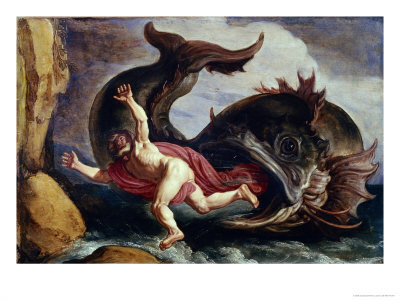
lastman-pieter-jonah-and-the-whaleMost scholars agree that this four chapter book was actually penned sometime after Jonah lived and died and several hundred years before Jesus came on the scene. And it is helpful to imagine Jonah as a ‘stand in’ for the people of God.  What God is saying to Jonah, He is really saying to Israel and all of God’s people. That’s why I can hear this as a word for me.  Whatever God is saying to Jonah, He is saying to Joe.

This was written to a group of people who had turned in on themselves and had forgotten who they were and why they were placed in such a strategic part of the world. They mistakenly believed that because they were God’s chosen people that meant that they were His only people.  But God loved the Ninivites enough to warn them to change their wicked ways.  He needed a mouth-piece named Jonah.

That very first line in this little story tells us that we were created to find our purpose, meaning and our center in the living God and what He says to us.  God wants His voice defines our lives, and shapes our lives. This story teaches us that the only secure foundation for us to build our lives on is God and what He says.

All of us are on a search for a word that defines and validates our existence. There will be one WORD that is like a hub in the spoke of our lives.  This “word” defines our values, which drive our behaviors and our passions.  This word will give our lives definition. It will be the foundation that I build the structure of my life upon. Tim Keller quotes entertainer Madonna in one of his books:

I have an iron will, and all of my will has always been to conquer some horrible feeling of inadequacy. . . I push past one spell of it and discover myself as a special human being, and then I get to another stage and think I’m mediocre and uninteresting. . . . Again and again. My drive in life is from this horrible fear of being mediocre. And that’s always pushing me, pushing me. Because even though I’ve become Somebody, I still have to prove I’m Somebody. My struggle has never ended and it probably never will.

That is more honest that you or I are willing to be. Her value above all values is for people to think of her as interesting and special.

What is the ‘word’ on your life? We are all driven for someone or something to define our existence: to say that you are worthwhile. What is that for you?  Some people believe if they get the right initials behind their name that they will finally be someone.  Others just know that if they achieve certain accomplishments in their career that they will fill that void deep inside.  Others rely on their physical attractiveness to feel special and noticed by someone significant.  Still others are aching for a significan person in their life to finally say, “Well done!”

None of these things are bad, the problem is that they are unstable. All of us are looking for a word to build our lives on and ultimately the only stable word to center your life upon is Word of the living God. The One who created you and formed you for Himself.

As God speaks to Jonah it demonstrates that Jonah has built his life on something other than God and what God says about him, and so he runs…

God has a word for you.  Slow down and listen, that word is  probably behind you and if you won’t listen to the whisper, just keep running and you might find a storm.

Posted in Uncategorized | Tagged , , , | 2 Comments