Tell Me A Story

When I was in college at Howard Payne University and feeling stressed about school work (which looks odd to type given my lack of success in school) I would often take a novel, usually Louis L’Amour, and read it over a weekend.  I would do it to escape. I didn’t want to deal with where I was so I would travel to some rugged place in the fictional west and vicariously be a hero.

In fifty years of being in a sentient relationship with my father, I have never known him to have ever read a novel.  He jokingly would list reading novels as sin when he preached—a sin for him.  But given the fact that I never saw or heard of him reading them, I suspect he actually believed that his preaching was accurate.  This is odd given the fact that as a young boy my earliest fiction was books called Mountain Pony,  Midnight,  Gumpy, son of Spunk—all with his name scrawled in the flyleaf indicating he had read them when he was a boy.

Gumpy

Somewhere along life’s path, Dad quit reading fiction.  I imagine he felt that it was a waste of time when there was so much other information that he could be processing that would help him know God better or understand people better. I should pull that thread with him and ask him about that.

I read fiction, without shame or guilt.  In fact, I will go so far as to say that if a person wants to really understand the human soul he or she must read fiction.  I used the word “must” intentionally. Something happens behind the veil of the analytical mind when you read a story.  You get under the protagonist skin.  You get inside their head.  You feel what they feel and understand their motives.

Also, when we analyze all information before it finds lodging in our souls we fail to savor it.  It’s like listening to a ballad sung by a throaty diva, a stand-up base, piano and brushes on a drum—it’s easy and safe to analyze technique instead of being swept away when the breathy saxophone comes into play a rift.

It’s like being a scientist who explains that the blood-red sunset is due to the fact that there is probably a forest fire somewhere that is causing the light to be diffused in the smoke particles.  It’s like a biologist explaining the act of reproduction between a man and a woman.  If non-fiction is only about information then why do we want to believe that there is more going on between a man and a woman that the desire for pleasure and reproduction when they make love?  Only the poets will adequately be able to tell us. And they don’t tell us so much as show us.

So, here’s my thing:  Read more fiction.  If you want to be a better teacher, read more fiction. If you want to be a better preacher, read more fiction. If you want to be a better sales person, read more fiction.  If you want to be a better father, mother, friend, husband, wife—read more fiction. If you wan to be a better person, read more fiction.  For we are a story-telling people.

Also, how can you tell good stories if you are not a reader of good stories?  It’s like trying to play better music and never listening to good music.  It’s like trying to be a better cook without tasting good food.  If you want to be a better communicator, then you must (there’s that word again) read and absorb good stories.

Good fiction is heart-language.  I believe you can gain knowledge from reading non-fiction, but if you want to acquire deeper wisdom you find it in good fiction. Notice I said read good fiction.  This would not include Louis L’Amour.  When I was a child read as a child, but now that I am a man I have put away childish things.

As a rule, popular literature is not good literature.  Much like popular music is not going to stand up to the test of time and be considered classic, popular fiction will not stand up over time.  I’m not saying it is a sin to read John Grisham or Dean Koontz or Nicholas Sparks (well maybe Nicholas Sparks). I am saying read fiction that will be revered two generations from now.

A good place to start:

The Old Man and The Sea

Grapes of Wrath

A Good Man is Hard to Find

To Kill a Mockingbird

Light in August

One final reason to read good fiction: If you abide by the rule that you will never read fiction, and you are faithful to your self-imposed moratorium, you must abstain from reading about 40% of the red-letter words in your New Testament.  In a word they are called parables. If Jesus used that much fiction to teach the most important aspects of the with-God life, then who am I to teach without it? Who am I to live without reading fiction?

It all started in a mountain home with books my father read as a boy. Those books were passed down to us kids and my brother and sisters devoured them—creating readers out of all of us.

When some folks have described my teaching style I’ve heard them say, “He’s not a preacher.  He’s just a storyteller.” They usually mean that in some pejorative sense, but I take it as the highest compliment.

“Storyteller”

I’d be in good company with that moniker.

With many stories like these, (Jesus) presented his message to them, fitting the stories to their experience and maturity. He was never without a story when he spoke. Mark 4:33 (MSG)

Posted in Uncategorized | 5 Comments

My Top Reads of 2013

I thought I would share with you my top reads for 2013 and why I liked them so much.  You will see that they fall into three basic categories, History, Novels and Church related.  I read other genres but these are the three streams that keep me energized throughout the year. I have included portions of the book descriptions from the publisher to give you a better idea of what the book is about.

oldbooks

1. Gilead, by Marilynne Robinson

In 1956, toward the end of Reverend John Ames’s life, he begins a letter to his young son, an account of himself and his forebears. Ames is the son of an Iowan preacher and the grandson of a minister who, as a young man in Maine, saw a vision of Christ bound in chains and came west to Kansas to fight for abolition: He “preached men into the Civil War,” then, at age fifty, became a chaplain in the Union Army, losing his right eye in battle. Reverend Ames writes to his son about the tension between his father–an ardent pacifist–and his grandfather, whose pistol and bloody shirts, concealed in an army blanket, may be relics from the fight between the abolitionists and those settlers who wanted to vote Kansas into the union as a slave state. And he tells a story of the sacred bonds between fathers and sons, which are tested in his tender and strained relationship with his namesake, John Ames Boughton, his best friend’s wayward son.

This is also the tale of another remarkable vision–not a corporeal vision of God but the vision of life as a wondrously strange creation. It tells how wisdom was forged in Ames’s soul during his solitary life, and how history lives through generations, pervasively present even when betrayed and forgotten.

Gilead is the long-hoped-for second novel by one of our finest writers, a hymn of praise and lamentation to the God-haunted existence that Reverend Ames loves passionately, and from which he will soon part.

It is rare to find such powerful prose, good enough to win the Pulitzer Prize, that puts faith in general and pastors in particular in such an honorable light.  I took my time reading and soaking in this novel.  I suspect, like I Heard the Owl Call My Name, I will make this an annual read for the rest of my life.  It is that good.

2. Let Your Life Speak: Listening for the Voice of Vocation, by Parker Palmer

With wisdom, compassion, and gentle humor, Parker J. Palmer invites us to listen to the inner teacher and follow its leadings toward a sense of meaning and purpose. Telling stories from his own life and the lives of others who have made a difference, he shares insights gained from darkness and depression as well as fulfillment and joy, illuminating a pathway toward vocation for all who seek the true calling of their lives.

My favorite section is when he describes discerning God’s will for his vocation and asks a wise and older Quaker woman about the “way opening” before him without success.  She responded, “I’ve never had way open before me.  But a lot of way has closed behind me, and that’s had the same guiding effect.”

3. Soul Custody: Choosing to Care for the One and Only You, by Stephen W. Smith

Every day, inner and outer violence ravages the soul, leaving us weak, fearful, and malnourished. In Soul Custody, Stephen W. Smith presents eight choices to help readers reclaim custody of their one and only life—choices about silence, community, vocation, honoring the body, finding one’s true self, and more. As Smith reminds readers, allowing God to shape the soul leads to the deep, full, and satisfying life that God had in mind all along.

This is not a self-help book. It is not a book of easy steps to a happy life. It is an invitation to the life God dreams for each of His children. It is a call to start living—to let the soul wake up to life as God intended.

I read this when I hiked the Pacific Crest Trail last summer and it so moved me that it made me want to shift the focus of my ministry to writing and soul care.  It was like all my life has been moving towards both of these new adventures.  I got to meet Steve and spend some time with him on a Soul Care retreat last fall and found him to be as real and wise as his book.

4. The Sparrow, by Mary Doria Russell

Emilio Sandoz is a remarkable man, a living saint and Jesuit priest who undergoes an experience so harrowing and profound that it makes him question the existence of God. This experience – the first contact between human beings and intelligent extraterrestrial life – begins with a small mistake and ends in a horrible catastrophe. Sandoz is a part of the crew sent to explore a new planet. What they find is a civilization so alien and incomprehensible that they feel compelled to wonder what it means to be human. The priest is the only surviving member of the crew and upon his return he is confronted by public inquisition and accusations of the most heinous crimes imaginable. His faith utterly destroyed, crippled and defenseless, his only hope is to tell his tale. Father John Candotti has been charged with discovering the truth, but the truth may be more than Earth is willing to accept.

What a remarkable book.  The theological discussions in this novel were wonderful.  I found myself thinking about this book long after I finished reading it.  It is filled with provocative questions about theology and how our faith works itself out in our lives.  Don’t think of this as Christian fiction.  It is not.  But it is a wonderful book about faith.

5. Mariette in Ecstasy, by Ron Hansen

In this quiet and forceful study of religious passion, Hansen ( The Assassination of Jesse James by the Coward Robert Ford ) places an extraordinary spiritual experience in the center of a deftly evoked natural world, namely, rural upstate New York just after the turn of the century. At summer’s end, when she is 17, Mariette Baptiste, educated daughter of the local doctor, enters the cloistered convent of Our Lady of the Afflictions as a postulant. Her religious fervor, understated but determined, makes an impact on the small community of nuns whose days and nights are measured in a round of prayer and farm work changing only with the seasons. Their ordered life is disrupted, however, as Mariette begins to fall into a series of trances from which she awakens with stigmata, which heal as spontaneously as they appear. The feelings of skepticism, jealousy and adoration evoked in the nuns, Mariette’s own response and that of the Mother Superior are delicately, indelibly drawn in Hansen’s authoritative prose.

I loved this book.  I couldn’t put it down.  As a lifelong Southern Baptist I am not very familiar with the culture of the Catholic tradition.  This was an exploration of that culture and also a provocative study about what the unusual or miraculous would do to a closed community.  How it would distract or disrupt the rhythms of daily life.  And I have not been as moved by and ending of a novel like this one since Grapes of Wrath.  Powerful.

6. Lincoln’s Battle with God: A President’s Struggle with Faith and What It Meant for America, by Stephen Mansfield

Abraham Lincoln is the most beloved of all U.S. presidents. He freed the slaves, gave the world some of its most beautiful phrases, and redefined the meaning of America. He did all of this with wisdom, compassion, and wit.

Yet, throughout his life, Lincoln fought with God. In his early years in Illinois, he rejected even the existence of God and became the village atheist. In time, this changed but still he wrestled with the truth of the Bible, preachers, doctrines, the will of God, the providence of God, and then, finally, God’s purposes in the Civil War. Still, on the day he was shot, Lincoln said he longed to go to Jerusalem to walk in the Savior’s steps.

So much myth has grown up around this president.  What I like about this book is that he doesn’t assert definitively that Lincoln was a Christ-follower.  But he does leave open the possibility and does a remarkable job showing the theological growth of this complicated man.

7. Longing for God: Seven Paths of Christian Devotion,  by Richard Foster

Think of the moment you last experienced God.  Do you know him that closely in this moment?

Truly experiencing the love of God gives us a taste of his goodness and his love for us, but often those moments are fleeting. We get distracted by life. Our awareness and understanding fade while our longing to experience him that way again increases.

In these pages you can begin to fill that longing by developing your capacity to receive and respond to God’s love. Spiritual formation is the process through which one’s inner self is opened to the work of the Holy Spirit, who forms us into the image of the Son. Here Richard Foster and Gayle Beebe, both experienced leaders in spiritual formation, introduce you to people from the past who have known God deeply. Each person helps you to grasp one of the seven primary paths to intimacy with God that have been developed throughout Christian history. Chapters are divided into sections, each segment surrounding a key figure and concluding with a reflection and prayer.

Richard Foster gives a tremendous sketch of the important traditions that have come down to us since the birth of the Church.  From John Calvin to John Wesley and many less known saints of God, this book was inspirational as well as informative for me.

8. The Dog Stars, by Peter Heller

I love dystopian stories.  Surviving a pandemic disease that has killed everyone he knows, a pilot establishes a shelter in an abandoned airport hangar before hearing a random radio transmission that compels him to risk his life to seek out other survivors.

This is set in my home state of Colorado and the prose are sparse as the eastern planes of that state.  A quick and entertaining read.

9. Jesus the Pastor: Leading Others in the Character and Power of Christ, by John Frye

For decades, Paul has been the model for today’s pastors. But Pastor John Frye says we must instead look to Jesus as our model. ‘While we may lift Christ up as Savior, as we bow down to him as Lord, as we marvel at his offices of Prophet, Priest, and King, as we walk with him as Friend, we seem to ignore him as the supreme Senior Pastor.’

Sharing thought-provoking, biblical insights and personal experiences, Frye calls other pastors to become apprentices to Jesus himself. He is the One who invites pastors to watch him in action and draw close so he can shape who they are and how they fulfill their ministry.

I’ve come to love my vocation late.  A couple of years ago I read Eugene Peterson’s memoir, The Pastor and fell in love with or remembered with affection my call; my calling to be a pastor.  This book is in that vein.  Yet it looks at the life and lifestyle of Jesus a the beta pastor for all of us to emulate.  I really liked this book.

10. West with the Night, by Beryl Markham

Beryl Markham’s life was a true epic, complete with shattered societal expectations, torrid love affairs, and desperate crash landings. A rebel from a young age, the British-born Markham was raised in Kenya’s unforgiving farmlands. She learned to be a bush pilot at a time when most Africans had never seen a plane. In 1936, she accepted the ultimate challenge: to fly solo across the Atlantic. Her successes and her failures—and her deep, lifelong love of the “soul of Africa”—are all chronicled here with wrenching honesty and agile wit. Hailed by National Geographic as one of the greatest adventure books of all time, West with the Night is the sweeping account of a fearless and dedicated woman.

Some of the best writing I’ve laid eyes on in years.

***********

Now, a word as to why I read so much fiction.  I believe that the deepest wisdom we learn is through stories.  We think in narratives.  We remember in narratives.  We speak in narratives.  We make meaning of our lives by telling stories.

To only read non-fiction is to feed the mind and yet  leave the soul without the proper nutrients that will make growth a possibility.  I think of the mind as seed and the heart/soul as soil.  What good is all the best seed planted in shallow and bland soil?  Fiction ploughs the soil of the soul and prepares it for the seed of non-fiction books.

The reading preacher will discover that great writers know the road to the human heart and, once at their destination, know how to move our hearts.~~Cornelius Plantinga, Jr., Reading for Preaching   

Besides, the greatest short story ever told was by none other than our own Lord and Savior, Jesus Christ.

It starts out like this: “A certain man had two sons…”

 

Posted in Uncategorized | 1 Comment

Listening with a Friend

“Attention is the rarest and purest form of generosity.” – Simone Weil

C.S. Lewis understood as well as many, that hearing God and living the With-God life requires community. He believed it so much that he wanted children to learn it from the beginning. Lucy, Edmund, Susan, and Peter go into Narnia…together.

Lewis’s good friend J.R.R. Tolkien embedded this idea of community in his great work as well. When Frodo starts on his epic journey, he begins relatively alone, then he is in a fellowship, and finally, it is winnowed down to two on the side of the mountain of Doom. But while he feels alone, he is never truly alone. He always has Sam. And they discover and fulfill their destiny—together.

The writer of Hebrews knew this truth as well:

“And let us consider one another in order to stir up love and good works, not forsaking the assembling of ourselves together, as is the manner of some, but exhorting one another, and so much the more as you see the Day approaching.” Heb. 10:24-25

The Quakers have what they call a “Clearness Committee” that they use to discern the will of God. A clearness committee is a group of Friends appointed to help a member of the meeting find clarity around a leading.

Recently I sat with a friend and, together, we leaned towards heaven to hear the voice of God. It was a sacred moment that lingered with me for hours after we parted company. The aroma of our conversation is present and pleasant even today. I have reflected and pondered our conversation, his questions, his insights, and, surprisingly, my own words that would not have been uttered without the presence of my friend.

Friendship-old-men-on-bench-300x216

“For where two or three are gathered together in my name, there am I in the midst of them.” Matthew 18:20

Meet Jesus in the midst of fellowship. For one does not simply walk into Mordor…with out a friend.

Posted in Uncategorized | 1 Comment

An Older Place than Eden

There is no place like home. ~~Frank Baum, “The Wizard of Oz”

 You can’t go home again. ~~Thomas C. Wolfe

Which is it?

For most of us, the idea of home has a powerful gravitational pull in our emotional life and our imagination.  Home evokes deep desire that all of us share for belonging—for security.

It calls out of us a deep desire for place.

Many feel like nomads.  They’ve moved so many times they don’t know where to call home.  This sense of “home” is absent in our lives.  I read recently that 43 million Americans move every year. That is about 16% of the population.  The average American will move 14 times in their lifetime.  I wonder what that transiency does to the soul.

People move, ostensibly, for work.  Their job takes them to different parts of the country.  Often those are choices that we make to further our careers.  And for many Americans career has usurped “place” in terms of the Summum bonum of life.  The ultimate value is my career. But I wonder if underneath our transience there is a deeper dynamic at work here.  I think for many the narrative they live by; that keeps them packing boxes and renting U-Haul’s again and again, is that after they get where they think they will find security and significance they discover that all the places are pretty much the same.

Being exiled is one of the primary images of the Bible to depict a life being lived in separation from God.  We have all been exiled east of Eden.  We are estranged from our Creator.  It is why we are profoundly restless.  We were created to be deeply at home in God’s presence, glory and love—and we have wandered away.

All we like sheep have gone astray; we have turned every one to his own way…  Isaiah 53:6

Sheep don’t get lost because they go on a dead run away from the Shepherd, they nibble from one clump of grass to the next until they raise their little nappy head, look around, and wonder, “Where is the Shepherd?  How can he be so cruel to abandon me?  Where is he?”

Away from the Shepherd, they find themselves in a far country either by their own nibbling or from the circumstances of life—and they feel displaced.

Most people assume that the Bible presents a world view that mankind is primarily a rule-breaker and that Christianity is basically a set of rules to be kept and as long as you keep the rules you are in good standing with an irritated God.  They think that Christianity is about a list of things that must be done and a longer list of things that must NOT be done.  Sin, therefore, is rule-breaking.

If the essence of sin is rule-breaking or rule-keeping then the best Christian in my home is Bella the Wonder Dog.  Because except for her pathological addiction to unguarded trash which she can’t seem to say no to, she keeps the rules better than anyone.

But the Bible teaches a much more profound and sophisticated picture of what is wrong with us in this world.  It tells a story that we all were originally created to be home with God, to walk with him in the cool of the afternoon, to have an intimate fellowship with Him—but we literally nibbled our way out of His presence and hid in the underbrush and we have been homeless and homesick ever since.

We are in exile east of Eden.

“Thou hast made us for thyself, and our hearts are restless until they find their rest in thee.”~~St. Augustine

Our main problem is not that we have broken a few ancient rules or modern-day social conventions, our main problem is that we were made to find our home in God and we are looking for a home in all the wrong places.

But there is good news; we could have a homecoming. 

A highway shall be there,

    and it shall be called the Holy Way;

the unclean shall not travel on it,

    but it shall be for God’s people;

    no traveler, not even fools, shall go astray.

And the ransomed of the Lord shall return,

and come to Zion with singing;

everlasting joy shall be upon their heads;

they shall obtain joy and gladness,

and sorrow and sighing shall flee away.  Isaiah 35:8, 10

Historically that actually happened. When the Babylonian empire fell the Israelites were allowed to return to their homeland.  But, of course, as caravan after caravan arrived on the banks of the Jordan River you know that the birds didn’t begin singing and the flowers suddenly begin to blossom again.  Creation didn’t begin to dance upon their return.

Why, then, does Isaiah say this is so in such picturesque language?  Because even though they had returned to their homeland—they aren’t home yet.   They were home but they weren’t all the way home.  They got what they wanted—but it wasn’t enough.  They were still exiled from their Creator-God.  That even though they were home with their land they were yet to be home with their Lord. God has something larger in mind than a change of geographic location.  God pictures a day in which He would act in the world in such a way that the Universe itself would break forth in song.

Paul said the earth groans for the day when the King would return; Jesus said that the rocks, the very stones are willing and ready to shout praises to the King of Kings.  Isaiah is promising that a day is coming when all that is wrong is going to be put to rights.

“Wrong will be right, when Aslan comes in sight,

At the sound of his roar, sorrows will be no more,

When he bares his teeth, winter meets its death,

And when he shakes his mane, we shall have spring again.”

― C.S. Lewis, The Lion, the Witch, and the Wardrobe

We are restless, homeless, and homesick because we are exiled from God.  But, in Jesus, God brings us home again.

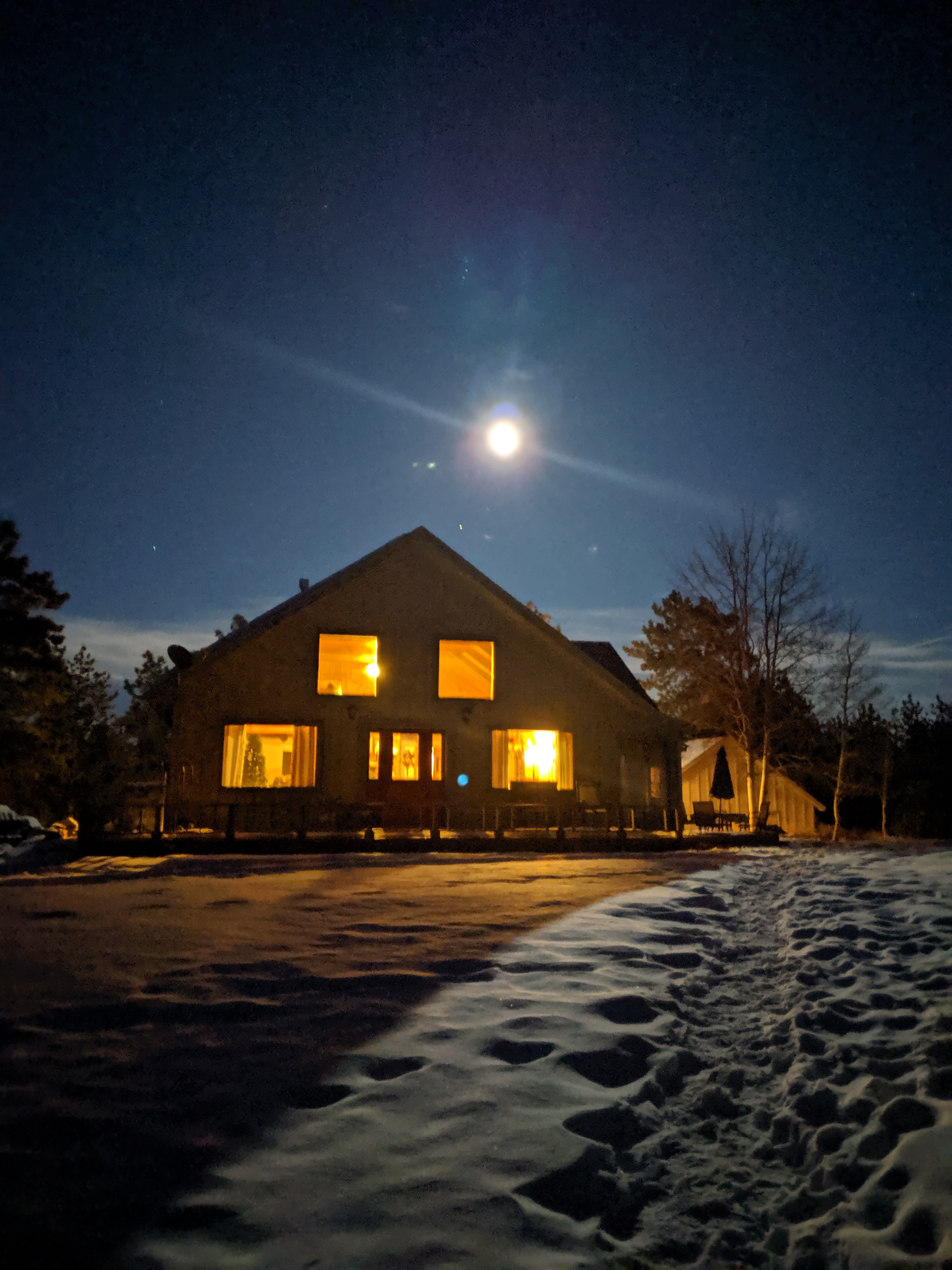
Chambers Cabin

In fact, in Jesus, God is willing to become homeless Himself in order to bring us home. Jesus is born homeless, in a rodent-infested, damp, low-ceilinged cave of a barn and placed in a common feed trough.  He was displaced.  And soon after His birth, the family fled to Egypt to escape the murderous Herod.  Jesus lived most of his ministry without a home.

Foxes have holes, and birds of the air have nests; but the Son of man hath no where to lay his head.          Luke 9:58

…Jesus also suffered outside the city gate…  Hebrews 13:12 (NRSV)

Jesus died outside of the city, away from hearth and home; away from family and friends. He died alone far away from Nazareth but even further away from Heaven.  God became homeless so we could come home.  Jesus became exiled so we could have a homecoming.

The House of Christmas

By G.K. Chesterton

A Child in a foul stable,

Where the beasts feed and foam;

Only where He was homeless

Are you and I at home;

We have hands that fashion and heads that know,

But our hearts we lost – how long ago!

In a place no chart nor ship can show

Under the sky’s dome.

To an open house in the evening

Home shall men come,

To an older place than Eden

And a taller town than Rome.

To the end of the way of the wandering star,

To the things that cannot be and that are,

To the place where God was homeless

And all men are at home.

We are all limping our way back home to God, you might consider joining us on the road and limp along with us.  We won’t always limp.  When we get home we will dance.  And the joy of the Lord will be our strength.

Posted in Uncategorized | 1 Comment

Ugly Trees*

I grew up nine miles from town, three miles from our nearest neighbor, at an elevation of 9,000 feet in Colorado.  One year my dad, brother, sister, and I went to the woods half a mile away to find our Christmas tree. We post-holed through the crusted snow from tree to tree.  “How about this one, Dad?”   Again and again he said no. “But it’s perfectly shaped,” we would respond.  “Let’s leave the pretty ones in the forest.”  “Why, Dad?” “So God can enjoy them in his forest,” my dad replied.

Finally, we heard, “Here it is.”  We groaned at the first sight of it. It was medium height, sparsely branched, and one side was almost bereft of branches.  The crown drooped.  The color was a pale green.  The trunk was crooked as a dog’s hind leg.  “Perfect,” Dad said.  “Your mom can make it beautiful once we get it into the house.” Down on his knees in the crunchy snow, he placed the bow saw against its bark and began to cut down the tree.

ugly-treejpg-7ab70e7001f78853

I remember looking at my brother and sister with raised eyebrows.  I think one of them said, “Mom’s not going to like this.”

I don’t remember how my mom felt about the perfectly imperfect tree, but she and we threw every ornament in the house on it. We turned the bareness towards the wall.  We threw silver streaming icicles on the branches; we shredded cotton balls and threw them on the desperate needles for snow.  Large baseball-sized globe ornaments went on the bottom and incrementally smaller ones towards the top.  Egg-sized lights were strung all around.  A star was placed at the bent crown.   With an adjustment here and there, a final turn of the tree for the best angle in the family room, and we were finished.

“See? I told you,” Dad said with a smile. “Beautiful.”

I don’t remember ever doing it that way again. My mom probably drew a line in the snow about bringing weeds into the house and passing them off as Christmas trees in a private conversation with Dad. I was associated with about 20 Christmas trees in my family as a boy growing up.  I don’t remember a single one but this one.

The ordinary became extraordinary.

The ugly became beautiful.

The unwanted became wanted.

The obscure became remembered.

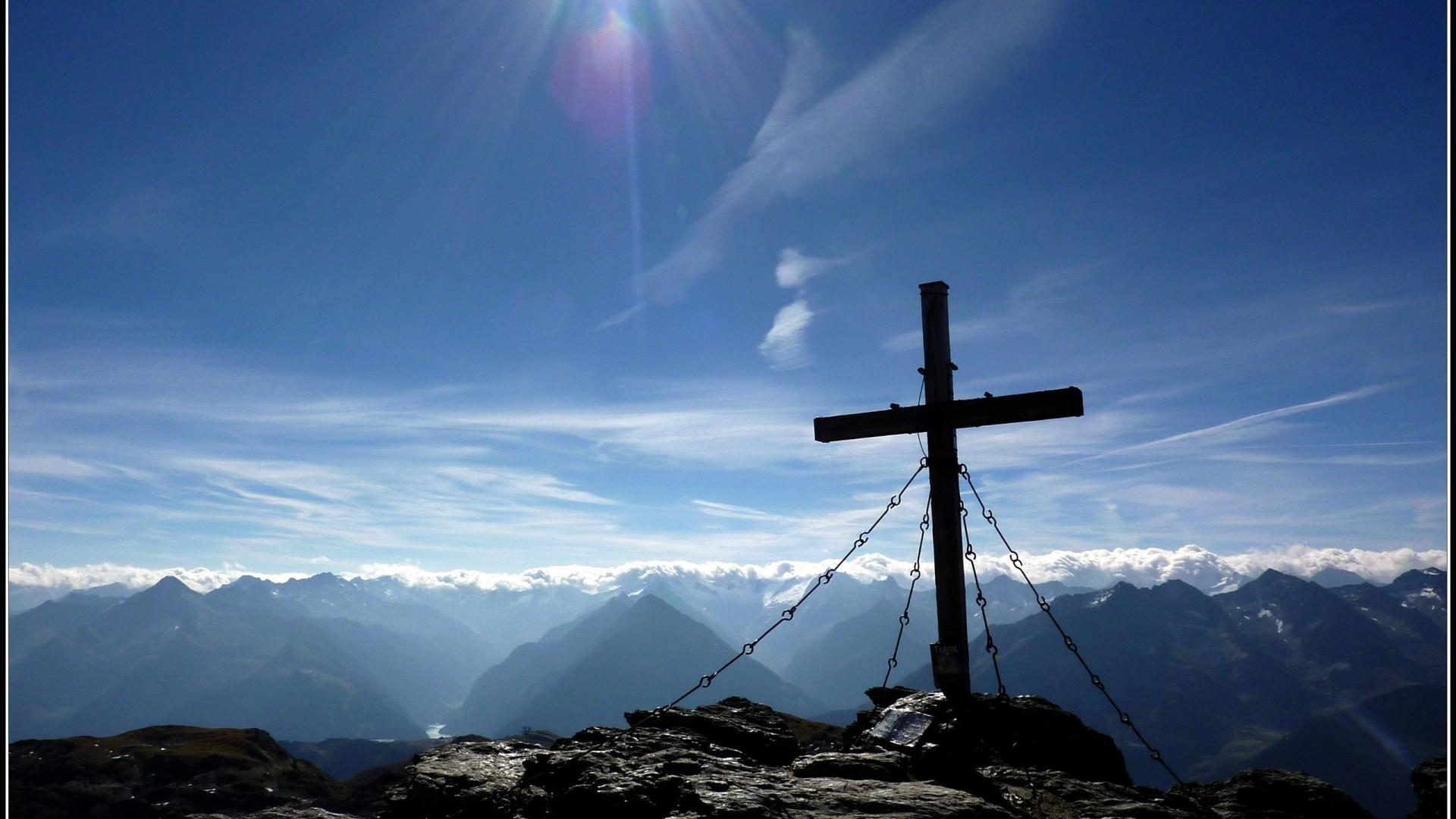
That can happen again this year in your home around your tree.  The reason we celebrate gifts under a tree is because of another tree; a rough-sawn, blood-soaked tree.  One no one wanted but is now treasured.  Not because of its own intrinsic beauty, but because by dying on that ugly tree, Jesus made it beautiful.

On a hill far away stood an old rugged cross,

The emblem of suff’ring and shame;

And I love that old cross where the dearest and best

For a world of lost sinners was slain.

cross-on-mount-rastkogel-austria-304415

Linger at that ugly, ancient tree and receive your gift of acceptance, love and hope.


*previously published

Posted in Uncategorized | 2 Comments

Christmas Love

When I was a boy there was a girl; her name was Mary Patterson.  She was tall, which was important to me, with dark brown hair to the middle of her back.  Her bright smile dazzled me.

When she laughed she had a way of throwing her head back as if to let the joy of her soul escape to the sky.  She mostly wore dresses to school and tall socks that came up to her knees.  Oh, those socks…man those were some fine socks.  She had the best knee-high socks in 8th grade. (if you know what I mean)

I loved her.  She was the only one for me.  When she walked by my desk, I caught the faint waft of Prell shampoo.  She made my knees weak, my mouth dry, and my palms sweat.  Words, phrases and whole sentences betrayed me.  I opened my mouth to speak and nothing but air would come out.  She would just smile, toss her hair over her shoulder, and walk on by.  All I had was the scent of Prell.

Sweetheart Banquet

My best friend, Tim Peggram, had a girlfriend at the time, Connie Schlosser, and we wanted to double date to the Valentine’s Day Sweetheart banquet.  Well, the only one for me to ask was Mary.  It took me a long time to get the courage to pass the note in class.  She was pretty good friends with Connie, so the three of us felt I had a chance at her agreeing to go with me. She could at least talk with Connie if my mouth went AWOL again.

I sent the note before lunch and got a response after lunch.  The note was folded so tightly you would have thought it held national secrets.  It was slipped to me with the slight of hand and secrecy that only happens in the CIA and junior high.  I was almost too afraid to open it.  Not knowing was better than being turned down.  Tim kept bugging me, “Open it, you big baby.”  Sure he had a girlfriend.  That was easy for him to say.  I needed this moment of suspense.  Finally, he threatened to ask her in front of the entire class what her answer was. That did it. I opened it, carefully unfolding the note as if it were some ancient treasure map.

There in black and white in her delicately flared handwriting, was her answer…YES! (Okay, I added the caps and exclamation point, but it’s my story, so leave me alone.)

You can’t imagine what that did to my 8th-grade self-esteem.  Walking down the hall after that, I had a walk.  It was the walk of a man who had the girl of his dreams.

We all went to the Sweetheart Banquet.  It went well.  My mouth did not fail me.  We all talked and laughed and laughed.  What a great time.  That was the happiest day of my short life.

The banquet was on Saturday night.  At school on Monday morning, I got another note from my future wife, Mary Patterson; she was breaking up with me.  I was devastated.  I wrote a terse little note back asking why.  She wrote back saying, “I want to go out with older boys.  Besides I don’t really get you…kind of goofy.”

That was my first experience with unrequited love.  Not the last…but certainly, the one that hurt the most.  Donnie Osmond had a song out at this time called Puppy Love.  My love may have only been puppy love, but it was real to this puppy.

What do you do with unrequited love?  Ever think that God’s love was unrequited? How do you get a date with someone who doesn’t even know you exist?

The best way is an introduction.  Like having a friend pass a note to see if the girl of your dreams is interested in going to a Sweetheart Banquet with you.   As far as God is concerned, the Old Testament prophets were the introducers.

“Therefore the Lord himself will give you a sign: The virgin will be with child and will give birth to a son and will call him Immanuel.”    Isaiah 7:14

“For a child is born to us, a son is given to us.  And the government will rest on his shoulders.  These will be his royal titles: Wonderful Counselor, Mighty God, Everlasting Father, Prince of Peace.”    Isaiah 9:6

“But you, O Bethlehem, are only a small village in Judah.  Yet a ruler of Israel will come from you, one whose origins are from the distant past.”      Micah 5:2

It’s an old movie plot.  The woman is a minor actress in a play or a dancer in a musical.  Her secret admirer sits in the audience every night.  Night after night she receives a dozen roses with no name attached, just a card that reads “From a secret admirer.”  She wonders who he could be, dreams of what he looks like; she thinks of him often.  And then finally he asks her to dinner, and they fall in love and live happily ever after.

Rose

That is what God has done.  We didn’t know Him, but He was watching us.  He knew us and loved us.   He sent roses.  Sometimes those roses were the prophets.  Sometimes He whispered His love in the trees and the sunsets and in the laughter of children.

And then at Christmas, God signed the card.

Posted in Uncategorized | Tagged , , , , , , | 1 Comment

Wilderness Wisdom

“And this, our life exempt from public haunt, finds tongues in trees, books in running brooks, sermons in stones, and good in everything.”~~William Shakespeare, As You Like It, Act II, scene i.

This may come as a surprise to you, but it was only an 11-day journey from Egypt to Canaan.  So why did it take the Israelites 40 years?  Did they take a wrong turn?  Did Moses get his map turned upside down?  Did they enjoy the extended camping trip?  No.  God kept His people in the wilderness because in the wilderness there were some lessons that they could learn in no other way.

There were two significant wilderness experiences in my life.  The first was as a young man.  I had a job pouring concrete for a living.  I built storm shelters in Oklahoma.  In the spring and summer I would often work 70 hours a week in the most labor intensive job I have ever known.  I remember being covered with dirt, cement, and sunburn thinking, “What am I doing here?  This is not where I belong.  I have a calling to preach God’s Word and build His church and I am building this old man’s storm shelter.”  I was miserable.  But my hunger for God’s Word was as intense as at any time in my life during those dry years.

The second wilderness wandering has lasted 7 years.  For many years I traveled the country conducting training seminars on supervision and management principles.  On the surface you might conclude that I might enjoy that work.  I used my speaking talent and got to see lots of places around the country.  And I enjoyed the satisfaction that comes from putting in a hard day’s work—like pouring concrete—I took comfort in the fact that I was able to find utility for my talent as a teacher.  But I can remember many occasions waiting for a delayed flight staring at my reflection in the terminal window and thinking, “What am I doing here?  This is not where I belong.  I have been called to preach and teach God’s Word and I am teaching these folks how to do a performance review.  This is not where I belong.”

For the last several years I have found a promised land.  I have found my voice as a Christ-follower and that is to care for the souls of a precious few that will trust me with their stories.  I am humbled to be building God’s church again and teaching His Word.  My desert-soul is blooming again.

If you find yourself in a spiritual wilderness remember that John the Baptist, Jesus, Paul, and the Apostle John, to name just a few, have spent time in the wilderness.

Some of you have a heart so broken that you don’t think you are ever going to get it back together again:  children that won’t respond to your love, or your family has disowned you, or you are tired of waking up in your bed alone, or financially you are on the edge of Chapter 7.

Wilderness.  No one likes being there.

As Pharaoh approached, the Israelites looked up, and there were the Egyptians, marching after them.  They were terrified and cried out to the LORD.  They said to Moses, “Was it because there were no graves in Egypt that you brought us to the desert to die?  What have you done to us by bringing us out of Egypt?  Didn’t we say to you in Egypt, ‘Leave us alone; let us serve the Egyptians’?  It would have been better for us to serve the Egyptians than to die in the desert!”    Exodus 14:10-12(NIV)

40 years later…

So Joshua ordered the officers of the people: “Go through the camp and tell the people, ‘Get your supplies ready. Three days from now you will cross the Jordan here to go in and take possession of the land the LORD your God is giving you for your own.’”… (The people say) “Whoever rebels against your word and does not obey your words, whatever you may command them, will be put to death.  Only be strong and courageous!” Joshua 1:10-11, 18 (NIV)

Many years passed between these two passages. What is the difference between Exodus 14 and Joshua 1?  In a word, discipline.

Discipline is very hard for me.  I seem to do better when I am under a deadline, when there is a sense of urgency in my life.  When things are placid I tend to stagnate.  When I have to be disciplined…I am.

Someone is reported to have asked a concert violinist in New York’s Carnegie Hall how she became so skilled.  She said that it was by “planned neglect.”  She planned to neglect everything that was not related to her goal.

These Israelites learned a very important lesson while they were in the wilderness, circumstances force you to the discipline necessary for the circumstances.  That is the way life is.  There are things you will never learn unless you learn them in the wilderness.

When the Spanish conqueror Cortez invaded Mexico, he found that his troops were dispirited and lethargic in battle.  So he went to the harbor and burned the Spanish galleons that would take them home to Spain.  He told them, “Either conquer or die.”

That’s a wilderness experience.  And when you get up against the wall like that, you begin to pray like never before.  My best prayers are when I am scared.  Do you know where I learned that?  In the wilderness.  I learned the discipline of Bible study, silence, solitude, fasting, and moral integrity in the wilderness.

In life and in Webster, wilderness always precedes wisdom.

Posted in Uncategorized | 3 Comments

Who Am I?

…an angel of the Lord appeared to him in a dream, saying, “…you shall call His name Jesus, for He will save His people from their sins.”  Matthew 1:20-21

Two vital questions: “Who names you?”  And “What is your highest priority in life?”  Until you can answer those questions aright, you’ll never know who you are.

imagesIOIXA25U

Whose are you?

What society tells you today is you have to find out who you are. You have to name yourself. Don’t let anybody else name you. Don’t let anybody else tell you who you are. You have to name yourself.

Through work…Here’s the problem with that: If you decide, “I’m going to name myself through my work, through my career, through my achievement, through the money I make,” problems show up because if you’re successful, you’ll find out you’ll lose your family and your health by and large.  If you’re not successful…then, who are you?

Follow your bliss…Find your inner poetic self. Drop out of the rat race. Find out what your own personal needs are … your sexual needs, your aesthetic needs, your deepest aspirations. Forget about work. Find out what you really want and go do that.  The real problem is when you drop out to find your poetic self you find out you need money in order to do that.

Through relationships…This is when your core sense of self comes from who you know.  Or who you are married to or who your parents are.  I am the son of Dub Chambers, I am the father of Caleb Chambers.  I am the pastor’s wife.  Or as James Taylor once said about his wife, “I’m Mr. Carly Simon.

But when your sense of self is determine by a role you play, like being a father, or a wife or friend…you are putting your entire identity in the hands of another human being who may not always have your best interests at heart.

The Bible says these are all cul de sacs—dead ends—because what happens is you think you’re naming yourself, but actually you’re not. Whatever you use to name you becomes your authority.

A man thinks, “I’m going to be a great father.” What happens when something goes wrong with the children? What if they rebel? What if they turn on you? You don’t even have a name anymore because your whole identity is wrapped up in that. All of your meaning goes out the door. You become a shriveled husk.

You do not belong to yourself. Whoever names you is the one to whom you belong. You either belong to God or else you belong to whatever you have turned to find your identity.

How do I know who or what is naming me?  It’s been my experience that it is often connected to that which I have the most emotional energy invested.  And if that naming agent is threatened in any way, I begin to get very desperate.  Check and see who or what triggers these primary emotions in your life:

Joy, Happiness, Satisfaction, Fulfillment, Contentment, Peace, Fear, Shame, Sadness, Hurt, Guilt, Frustration, Dissatisfaction, Disappointment

We all feel these emotions.  That’s why they are called primary emotions.  But the rub comes when they are threatened and are escalated to the point of desperation.  I will never know joy unless…  I will never know contentment unless…  I feel such sadness at the mere thought of…I will feel such shame if…  I will feel intense guilt if …

The irony is this is not a new way of getting an identity. It’s a very old way. Back in Genesis 11, we’re told about the Tower of Babel. How did that happen? A group of people, said, “Come, let us build ourselves a city, and a tower whose top is in the heavens; let us make a name for ourselves…”

The story says they are scattered because they sought to make a name for themselves.

What are you living for?

Jesus knew what he was living for. Your priorities and your commitments are what give you that identity.

Nested inside the English word “identical” is the origin of the word “identity.”  If you live for your own happiness, if you live for your own comfort, you’ll never know who you are because with one crowd you’ll be one way, with another crowd another way. With the church crowd, you’re one way; with the business crowd, you’re another way.

The only way you’re going to know who you are is when there is you’re committed to that is so strong that you’re committed to it in every situation so there is an inner core of sameness in any situation you’re in.

You have a last name. Your last name is God’s family name.

But as many as received Him, to them He gave the right to become children of God, to those who believe in His name. John 1:12

Who am I?  I am Joe Christian.  No, that doesn’t sound right.  “Christian” is a caricature in our culture.  But how about, “Joe Christ-Follower?”  I’ve always wanted a hyphenated name. Seriously, at a deeper level, we have to stop trying to name ourselves.

What it means to become a Christian is to say, “Jesus is my Savior, my Redeemer, my Restorer, and my King. He and he alone has satisfied all of the requirements so I’m acceptable before God.”  That is the ground, the base, the foundation for my new identity.

Many Christ-followers are filled with angst, pain and worry and insecurities.  Why?  Because they have forgotten Whose they are. And they have tried to have too many names.

Christian, let me remind  that you have a last name: “Beloved.”

Christians also have a first name. (Or as my cajun friend would say you have a front name.) The first name comes from finding your gifts and finding the kinds of people God wants you to help, finding the kind of ministry he wants you to do. The first name comes as time goes on.

God changed Sarai’s name to Sarah, Abram’s name to Abraham, Saul’s name to Paul, Simon’s name to Peter by saying, “This is the kind of ministry I’m going to give you. These are the kinds of gifts I’m giving you. This is the kind of service I want you to have.”

A friend of mine’s twenty-something daughter and son-in-law wrote an article and said something rather profound:

A few months before our wedding, we met with Andie’s Uncle Glenn who would be officiating the ceremony. While we were there, he spoke some wise, paradigm-shifting words that have become a personal mantra for us as we attempt to navigate this season of our life together.

In response to our anxiety over what we were supposed to be doing with our lives, Uncle Glenn gently reminded us that, “The twenties are for learning.”  ~~Team Gandie

How do you find your first name? How do you find your niche in the kingdom economy? It takes all of your life. Slowly, incrementally your first name is revealed to you. It’s only by obeying, it’s only by reaching out, it’s only by submitting to him completely and saying, “The most important thing is to serve you and know you,” do you find your first name, in increments.

Parker Palmer talks about the struggle to find his vocation at high noon of his life and I love this story:

But when I arrived and started sharing my vocational quandary, people responded with a traditional Quaker counsel that, despite their good intentions, left me even more discouraged. “Have faith,” they said, “and way will open.”

“I have faith,” I thought to myself. “What I don’t have is time to wait for `way’ to open. I’m approaching middle age at warp speed, and I have yet to find a vocational path that feels right. The only way that’s opened so far is the wrong way.”

After a few months of deepening frustration, I took my troubles to an older Quaker woman well known for her thoughtfulness and candor. “Ruth,” I said, “people keep telling me that `way will open.’ Well, I sit in the silence, I pray, I listen for my calling, but way is not opening. I’ve been trying to find my vocation for a long time, and I still don’t have the foggiest idea of what I’m meant to do. Way may open for other people, but it’s sure not opening for me.”

Ruth’s reply was a model of Quaker plain-speaking. “I’m a birthright Friend,” she said somberly, “and in sixty-plus years of living, way has never opened in front of me.” She paused, and I started sinking into despair. Was this wise woman telling me that the Quaker concept of God’s guidance was a hoax?

Then she spoke again, this time with a grin. “But a lot of way has closed behind me, and that’s had the same guiding effect.”

I laughed with her, laughed loud and long, the kind of laughter that comes when a simple truth exposes your heart for the needlessly neurotic mess it has become. Ruth’s honesty gave me a new way to look at my vocational journey, and my experience has long since confirmed the lesson she taught me that day: there is as much guidance in what does not and cannot happen in my life as there is in what can and does—maybe more.~~Parker Palmer, Let Your Life Speak

Whose are you? For what are you living? Unless you let Him name you, you’ll never find out who you are.

Let me remind you that for all of eternity Jesus and His father had known divine intimacy and oneness. Then ‘Way’ closed behind Him. In the Garden of Gethsemane, he agonized over what was coming on the cross. He cried out with every primary emotion on the spectrum, “Father, let this cup pass from me. Nevertheless not my will be done, but Thine be done.” Then on the cross, he cried out, “My God, My God why has Thou forsaken me?”

Jesus received his name at Christmas, but He lost it on Good Friday so you could receive your name on Easter.

There’s just something about that name.

Posted in Uncategorized | Tagged | Leave a comment

Do You Hear What I Hear?*

After spending an afternoon shopping for my grandson’s Christmas gifts and running various errands for a wife who had earlier given me a long list of must-do items…I was startled into an important lesson about life.  It came as a shock.  In fact it scared me very badly until I realized the truth.

In the back of my old rag top Jeep lay Oren’s gifts for the best three year old boy in the wide world and I was on my way home.  My mind was swirling with thoughts about the new direction that many of us feel God is leading our little church.  Thoughts of how physically out of shape I feel.  Thoughts of an appointment I was going to be late for.  Thoughts of at least five marriages that are about to bleed out.  Thoughts swirling in my mind like snowflakes in a winter wind around the corner of a house.

Busy…aimless…haphazard.

The radio was slapping out the music of Bruce Hornsby on the radio and I was trying to sing along to the lyrics:

Listen to the mandolin rain

Listen to the music on the lake

Listen to my heart break every time she runs away

I was singing loud to try to keep up with the popping rhythm of the cloth top of my Jeep.  The engine was whining as I cruised down the Boeing Highway towards Mukilteo.  Then I heard a siren from somewhere behind me and off in the distance a muted Public Address voice with all the authority that comes with someone who carries a badge and a gun, “Halt! Where do you think you are going?”

I squinted into all of my mirrors straining to get a glimpse of the flashing red and blue lights of the police officer that is yelling at me.  I looked ahead and to my right then to my left.  He was not ahead of me, not behind me, not beside me…yet the siren was still there and the voice from One Adam Twelve was still hollering at me.  I was getting more than a little frustrated and very confused, so I pulled over to the far right lane and wondered what I might have done to irritate the officer so much that he has to yell at me over the PA system and turn his siren on but without flashing emergency lights.

Did I run a red light?  Was I speeding?  Did I change lanes inappropriately?  Did he think I fit the description of a mass murder or terrorist?  Maybe he thought I was an Oakland Raider fan.  What could I have possible done to incur such wrath when the only thing I had been doing for the last hour was to successfully purchase—not contraband mind you— but toys for my grandson?

I started pulling over to make my way off the highway and be frisked by an irritated police officer who has an authority complex.  That badge and gun have gone to this guy’s head, I said to myself.  Then the siren went off again and the voice on the PA system from somewhere behind me says, “To infinity and beyond!”

The tumblers in my brain all click in recognition.  Buzz Lightyear had fallen over in the backseat and activated his button and he had been cycling through all of his lines from the movie Toy Story.

I started to laugh out loud.  It has been a very long time that I obeyed the voice of a toy no matter how authoritative sounding that voice might be.  I remember saying, “That is funny right there, Joe.  You crossed two lanes of traffic and were about to get out of your jeep, put your hands on the hood of your Jeep and get spread-eagle for a …toy.”  That would be a toy story indeed.

I was not expecting to hear from Buzz that afternoon, but I heard from him and adjusted my behavior accordingly.  Then I was hit with the thought, “Do you respond as quickly to the voice of Jesus as you did the voice of Buzz?”

*Originally published in 2010

Posted in Uncategorized | 3 Comments

Old Words of Thanksgiving

I love new things.  I have a new Surface RT, a Samsung Galaxy 4, a new ULA backpack, new Hoka One trail running shoes, a new Neo Air sleeping pad, a new Big Agnes ultra lite tent.  I buy new books weekly.

But sometimes old things are the best things.  Old bibles, old loves, old friends, old memories, old lessons, old ideas, old wisdom and old words…like these…read them aloud and savor the richness of each thought.

…from The Valley of Vision.

O My God,

Thou fairest, greatest, first of all objects, my heart admires, adores, loves thee, for my little vessel is as full as it can be, and I would pour out all that fullness before thee in ceaseless flow.

When I think upon and converse with thee ten thousand delightful thoughts spring up, ten thousand sources of pleasure are unsealed, ten thousand refreshing joys spread over my heart, crowding into every moment of happiness.

I bless thee for the soul thou hast created, for adorning it, for sanctifying it, though it is fixed in barren soil;

I bless thee for body thou hast given me, for preserving its strength and vigour, for providing senses to enjoy delights, for the ease and freedom of my limbs, for hands, eyes, ears that do thy bidding;

I bless thee for thy royal bounty providing my daily support, for a full table and overflowing cup, for appetite, taste, sweetness;

I bless thee for social joys of relatives and friends, for ability to serve others, for a heart that feels sorrows and necessities, for a mind to care for my fellow-men, for opportunities of spreading happiness around, for loved ones in the joys of heaven, for my own expectation of seeing thee clearly.

I love thee above the powers of language to express, for what thou art to thy creatures. Increase my love, O my God, through time and eternity.

Amen.

Posted in Uncategorized | 1 Comment