Why Do You Love Jesus?

Then Jesus said unto him, “Unless ye see signs and wonders, ye will not believe.” John 4:48

We want what God gives, but we don’t want God. We will take both, but if we have to choose, often if we were honest, we would choose God’s provisions over his presence.

A few years ago a man came to me and asked if I would be willing to meet with him for breakfast once a week to see if we could develop a relationship. He was a man I respected very much and jumped at the chance to begin the relationship.  So the journey began.  We met every week for deep conversation and a cup of coffee.

cup of coffee

From time to time he would ask me how I was doing and I would disclose a little of my struggles with him, but not very much.  At that time I had more private-life turmoil than you can imagine.  I was on a self-destructive path, but he never knew about it.  To be honest with you, it felt that the only reason he asked me how I was doing was to not appear too selfish.

I remember thinking to myself at the time I wish I felt like he loved me enough that I could tell him what is going on deep inside my heart, but I don’t think he really wants to know about me.

One day I was praying in my journal and came to the realization of how I had been treated.  This man did not want a friendship; he wanted a place to deposit his pain. I wonder if Jesus ever feels the same way?  I wonder if He feels as if people only want a relationship with Him for what He can give them rather than really want to know him?

I believe that all of us want to be known and loved for who we are—and so does Jesus.

As I reflected on that, I repented for all the times I ignored Jesus, when I was too busy with my little life to ask him a personal question.  I repented for all the times I did go to him because I was in trouble or I needed something.  I repented of all the times I chose to talk about me instead of exploring the depths of His personality. I repented of my self-involvement.

I want to know Jesus for who He is.  I want to explore the depths of his personality.  I want to open myself up to him and let him into the dark places.  I will trade the darkest places of my soul for the brightest places of his. Oh, I want to know him. I want to love and trust him even if he doesn’t heal my wounds.  I want to talk to him even if he doesn’t respond to my pleadings. I want to love him if my bills don’t get paid.  I want to follow him if I never am successful.  I want to love him even if get cancer and die. I want to love him even if this pain in my heart never goes away.

Someone has said, “When you can’t trace His hand, trust His heart.” Jesus wants me to trust Him even if I never see Him. That’s what I intend to do.  And while I trust in the dark, I pray The Jesus Prayer—

Lord Jesus Christ, Son of God, have mercy on me, a sinner.

Posted in Uncategorized | Leave a comment

Restoration Church(es)

Behind many of the front doors of the nice homes in our community are broken, torn and hurting people.  Many of them are so busy pursuing the American Dream that they are too pre-occupied to notice that they are not in love with their spouses anymore and their children don’t know them.  They are medicating the emptiness with all sorts of strategies.  They need us to show them the way to restoration.  We are a hospital for sinners, not a hotel for saints.

Muk

Restoring God’s world one heart at a time.

Why?  Because we have been uniquely equipped and called by God to do this.  We have the right experience as a congregation; we have the right passion as a people.  And we have shared values that we believe if all the people who live in our community would hold then restoration would begin.

Our Values…

Mending Brokenness

Bringing healing to the secret places of the soul where the facades of security, success, and significance we present to the world only succeed in imprisoning the person God intended us to be.

Deepening Faith

Presenting everyone mature in Christ, everybody complete, everybody whole, everybody just the way God designed them to be.   So that human lives can flourish as God intended them to flourish, so that the power of sin might lose its grip on humanity.

Strengthening Families

Preparing the next generation for the journey of life by understanding that life is not a series of random, arbitrary acts, but that we all are part of God’s epic story of conflict, victory, love, and restoration.

Pursuing Peace

Establishing (building, creating, developing, joining) God’s dream that all the people of the world are woven together into a beautiful, harmonious, interdependent, knitted and webbed relationship with each other and the physical world.

Going forward we will dig deep into these values.  We will protect these values.  We will filter everything we do in this church though those values.  If an activity does not move us closer to living out those values we will not do it.  We will live out those values as a church and as a individuals.

How Will We Know We Are Hitting the Mark?

We will know when Sunday after Sunday we will see…

Wounded Healers

Wounded healers leave here ready and willing to speak words of grace and truth into the hearts of fragmented lives. Sometimes just to listen, sometimes to just pray, but we will be agents of healing.

Mature Believers

We will see Christ followers falling deeper and deeper in love with Jesus and see their Biblical wisdom in a steady growth trajectory up and to the right.  They will want to learn more, give more, love more, serve more all bring glory to the God who has saved them.

Strong Families

We will see families building their foundations on the life of Jesus, his teachings, and his example; a legacy of faithful dependence on Jesus that will set them apart in this world.

Peace Makers

We will send out peace makers into the community that are committed to advancing the Kingdom God.  What upsets God will upset us.  What burdens the heart of God will burden our hearts.  We will leave every Sunday so affected by the love of Jesus and so filled by the presence of the Holy Spirit that we will infect our community with God’s Shalom.  It will be an Immaculate Infection.

What is Our Long-range Strategy for Restoration?

Our strategy won’t be easy, but it should be relatively simple. We will provide three safe environments.

Worship

Since worship is a human response to a divine revelation and every time we gather as a group in Jesus name we know God will say something, then we must respond.  God says something and we respond to it; God does something, and we respond to it.  Sometimes it means we laugh and shout to the Lord.  Sometimes it means we applaud.  Sometimes it means we weep for the joy of grace; sometimes we weep for the sorrow of sin.  Sometimes we are loud.  Sometimes we are quiet.  But worship always requires a response. And whenever we respond to God, we are changed.

Growth Groups

We will meet in one-on-one and in little groups in homes, coffee houses, and a various other venues for the purpose of encouraging each other to keep running the race, to learn more about who Jesus is, comfort each other when life kicks us in the teeth, and to hold each other accountable when we want to drift away from Him.

Serving Teams

We will serve each other, we will serve our community and we will serve the world.  There are countless little things that we can do that will teach us humility and bring civility to this hostile world.

There are people who need our hands and feet to do for them what they can’t do for themselves.

There are causes we will be involved in because there are voiceless people who need someone will lift them up and make things right.  We will bring the Kingdom of God to bear in this world.  There are water wells to be dug, vitamins to distribute, micro-financing to offer and human trafficking to end.

We will serve the city for the sake of the city. 

God will be pleased when we join Him in this restoration covenant that is as ancient as Noah and the Ark.  Nothing pleases the Father more than to see His children join Him in bringing ‘Up There Down Here.’  We will join with the Father to make His dream come alive on this earth.

There are hearts that need to be restored to right relationship with God through Jesus.  There are marriages that need to be restored through deep community with other brothers and sisters in Christ.  There are families that need to be restored through wise counsel and life-coaching centered in the Bible.  There are leaders that need to be called and equipped to pass on to the next generation this mission and these values. There are wrongs in this society that need to be righted, that can only be righted if we burn with a righteous anger and then get up and do something about those wrongs.

For if the Gospel is not good news for everybody it is not good news for anybody.

One day the leaders in our community will come to us and say, “It is better for us that you are here.”  They will be glad that there is a group of people so committed to personal and social restoration.

And the scripture will be true about us that says, “When the righteous prosper, the city rejoices…”  Proverbs 11:10

Posted in Uncategorized | Tagged , , , , , , | Leave a comment

Hearing Crickets

Be strong and of good courage; do not be afraid, nor be dismayed, for the LORD your God is with you wherever you go.”                      Josh 1:9 (NKJV)

Henry Kissenger, who was afraid of flying, used to say that he always felt better when Nixon was on the plane.  Do you know what makes me feel better?  Knowing that I belong to the God of this universe.  That I am one of His favored children.  That He lives inside of me.  When I fly, He flies.

Did you hear about the Baptist pastor who was flying and was asked if he wanted a drink?  He said, “No, I am too close to the home office.”  Even on an airplane, the presence of God is there and it makes a difference.  It makes a difference in our lives too.  But we are often too busy to listen.  We are hustling too much to know it.

A Native American and his friend were in downtown New York City, walking near Times Square in Manhattan. It was during the noon lunch hour and the streets were filled with people. Cars were honking their horns, taxicabs were squealing around corners, sirens were wailing, and the sounds of the city were almost deafening.

Suddenly, the Native American said, “I hear a cricket.”

His friend said, “What? You must be crazy. You couldn’t possible hear a cricket in all of this noise!”

“No, I’m sure of it,” the Native American said, “I heard a cricket.”

The Native American listened carefully for a moment, and then walked across the street to a big cement planter where some shrubs were growing. He looked into the bushes, beneath the branches, and sure enough, he located a small cricket.

His friend was utterly amazed. “That’s incredible,” said his friend. “You must have superhuman ears!”

“No, my ears are no different from yours.  It all depends on what you’re listening for.”

“But that can’t be!  I could never hear a cricket in this noise,” said the friend.

“Yes, it’s true.  It depends on what is really important to you. Here, let me show you.” He reached into his pocket, pulled out a few coins, and discreetly dropped them on the sidewalk. And then, with the noise of the crowded street still blaring in their ears, they noticed every head within twenty feet turn and look to see if the money that tinkled on the pavement was theirs.

“See what I mean?” asked the Native American. “It all depends on what’s important to you.”

Sometimes people say they can’t connect with God.  They say they can’t hear him.  Do you suppose that is because God is not talking these days?  I don’t believe that.  I think God is communicating all the time.  Too often I am just not listening.

My son Cole asked me one time when he was about 6 years old how I can tell when God is talking to me.  In a rare moment of insight, I said, “Cole, when you see your little brother Clint fall and hurt himself and you go over to him and ask him if he is alright and then help him up, who tells you to do that?”  He thought for a moment and then smiled and said, “Oh, that’s Him.”

Learn to say in your life, “Oh, that’s Him.”  It’s an awesome power resource for the Christian, but you have to be still to hear and enjoy it.  You have to spend time with Him, getting to know His voice.  Then you have to listen in order to hear Him.

Often its just a whisper. A-cricket-insect-bug-sitting-on-leaf-2256821

Posted in Uncategorized | 2 Comments

The Beauty of Tears

There are only two things that pierce the human heart.
One is beauty. The other is affliction.
~Simone Weil

What is our automatic assumption about tears?  Something is hurting.  Is that always true?  I recently watched a video of a young mother singing a lullaby to her tiny baby and while smiling, baby-tears streamed down the little chubby cheeks of that baby.

Many years ago my wife and I were watching a television program that showcased young prodigies in various artistic disciplines.  I believe I was reading a book while she watched.  I heard a violin, a piano, and then I heard the voice of an angel.  I looked up and saw a young Charlotte Church singing Andrew Lloyd Webber’s Pie Jesu.

Breathtaking.  I glanced over at my wife and she was weeping.  I had never seen her weep like that before.  I whispered, “Are you Okay?” And she just mouthed one word to no one in particular, “Beauty.”

What is going on there?

I believe that there is something in our souls that aches for beauty.  We were created with an insatiable desire for the indescribable.

The first time I saw the Grand Tetons I had to pull our Dodge Caravan over and cover my Tetonsface with my hands. My wife asked me what was wrong and I had to turn away from her and the blinding beauty of the peaks that rose in the distance.

Our young boys were loud in the back of the van, my wife was asking me what was troubling me, and Allison Krause was singing with Union Street Station on the sound system, but I couldn’t hear them. I was lost in the beauty of those mountains.

Here, fifteen years later, I can’t fully explain what I felt that day in Wyoming. I can only tell you that if felt as if I glimpsed the face of God and I turned away to weep.

I’ve wept when my heart was overwhelmed by beauty and undone by sin. But there is another weeping that comes when grace penetrates to foundation of our souls. I’ll call them tears of repentance.

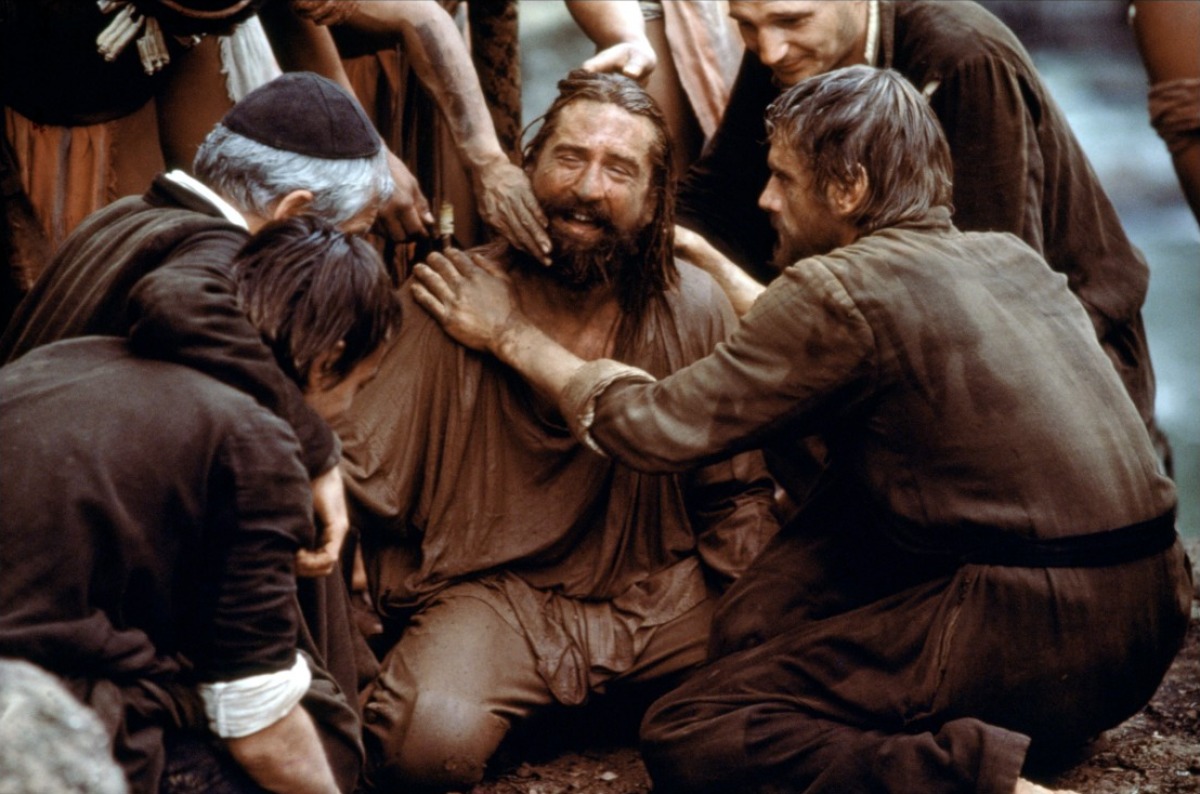
There is a scene in the film The Mission that to me personally, is one the greatest moments in all cinema. Robert DeNiro plays a slave trader in colonial Latin America. He had dedicated himself to capturing Indians and selling them as slaves. Jeremy Irons plays a Jesuit missionary who helped convert the Indians, and who defended them.

When DeNiro is thrown in prison for murder, Irons shows him mercy, and ransoms him to come serve in the jungle mission. DeNiro insists on making the long journey to the mountain mission dragging his armor in a bundle behind him. He drags the weight of his sin and his filth to the top — where he meets the same people, now Christians, whose families he had been pressing into slavery. And where, if they killed him, justice would have been served.

As DeNiro is on his knees in the mud with the burden of his past tied to his back, the chief gives an order. Someone picks up a knife and runs to DeNiro and pulls his head upward 047_robert_de_niro_theredlistwith his face pointing to the very people he had hunted down like animals. The knife flashes and glints in the sunlight as the chief gives another order and the knife cuts the rope to the burden on DeNiro’s back. It tumbles down over a waterfall hundreds of feet; the same waterfall he had just climbed.

He is confused.  He looks into the faces of his former enemies for understanding.  And one by one they begin to laugh.  Not the laughter of contempt, the laughter of forgiveness and delight. And suddenly the face etched in pain and agony for all the guilt of his selfish life begins to melt away to first a smile, then a grin, and finally an open-mouth laugh of joy.

God treasures the tears of repentance.  They are His precious jewels because they cost so much.  The price of our pain when we walked away from Eden and the pain of the cross when Jesus walked up a hard-panned road to a hill called Calvary and died to bring life, love to a creation designed to pulse with beauty.

You number my wanderings; put my tears into Your bottle.  Psalm 56:8

Posted in Uncategorized | Tagged , , , , | 1 Comment

Tell Me A Story

When I was in college at Howard Payne University and feeling stressed about school work (which looks odd to type given my lack of success in school) I would often take a novel, usually Louis L’Amour, and read it over a weekend.  I would do it to escape. I didn’t want to deal with where I was so I would travel to some rugged place in the fictional west and vicariously be a hero.

In fifty years of being in a sentient relationship with my father, I have never known him to have ever read a novel.  He jokingly would list reading novels as sin when he preached—a sin for him.  But given the fact that I never saw or heard of him reading them, I suspect he actually believed that his preaching was accurate.  This is odd given the fact that as a young boy my earliest fiction was books called Mountain Pony,  Midnight,  Gumpy, son of Spunk—all with his name scrawled in the flyleaf indicating he had read them when he was a boy.

Gumpy

Somewhere along life’s path, Dad quit reading fiction.  I imagine he felt that it was a waste of time when there was so much other information that he could be processing that would help him know God better or understand people better. I should pull that thread with him and ask him about that.

I read fiction, without shame or guilt.  In fact, I will go so far as to say that if a person wants to really understand the human soul he or she must read fiction.  I used the word “must” intentionally. Something happens behind the veil of the analytical mind when you read a story.  You get under the protagonist skin.  You get inside their head.  You feel what they feel and understand their motives.

Also, when we analyze all information before it finds lodging in our souls we fail to savor it.  It’s like listening to a ballad sung by a throaty diva, a stand-up base, piano and brushes on a drum—it’s easy and safe to analyze technique instead of being swept away when the breathy saxophone comes into play a rift.

It’s like being a scientist who explains that the blood-red sunset is due to the fact that there is probably a forest fire somewhere that is causing the light to be diffused in the smoke particles.  It’s like a biologist explaining the act of reproduction between a man and a woman.  If non-fiction is only about information then why do we want to believe that there is more going on between a man and a woman that the desire for pleasure and reproduction when they make love?  Only the poets will adequately be able to tell us. And they don’t tell us so much as show us.

So, here’s my thing:  Read more fiction.  If you want to be a better teacher, read more fiction. If you want to be a better preacher, read more fiction. If you want to be a better sales person, read more fiction.  If you want to be a better father, mother, friend, husband, wife—read more fiction. If you wan to be a better person, read more fiction.  For we are a story-telling people.

Also, how can you tell good stories if you are not a reader of good stories?  It’s like trying to play better music and never listening to good music.  It’s like trying to be a better cook without tasting good food.  If you want to be a better communicator, then you must (there’s that word again) read and absorb good stories.

Good fiction is heart-language.  I believe you can gain knowledge from reading non-fiction, but if you want to acquire deeper wisdom you find it in good fiction. Notice I said read good fiction.  This would not include Louis L’Amour.  When I was a child read as a child, but now that I am a man I have put away childish things.

As a rule, popular literature is not good literature.  Much like popular music is not going to stand up to the test of time and be considered classic, popular fiction will not stand up over time.  I’m not saying it is a sin to read John Grisham or Dean Koontz or Nicholas Sparks (well maybe Nicholas Sparks). I am saying read fiction that will be revered two generations from now.

A good place to start:

The Old Man and The Sea

Grapes of Wrath

A Good Man is Hard to Find

To Kill a Mockingbird

Light in August

One final reason to read good fiction: If you abide by the rule that you will never read fiction, and you are faithful to your self-imposed moratorium, you must abstain from reading about 40% of the red-letter words in your New Testament.  In a word they are called parables. If Jesus used that much fiction to teach the most important aspects of the with-God life, then who am I to teach without it? Who am I to live without reading fiction?

It all started in a mountain home with books my father read as a boy. Those books were passed down to us kids and my brother and sisters devoured them—creating readers out of all of us.

When some folks have described my teaching style I’ve heard them say, “He’s not a preacher.  He’s just a storyteller.” They usually mean that in some pejorative sense, but I take it as the highest compliment.

“Storyteller”

I’d be in good company with that moniker.

With many stories like these, (Jesus) presented his message to them, fitting the stories to their experience and maturity. He was never without a story when he spoke. Mark 4:33 (MSG)

Posted in Uncategorized | 5 Comments

My Top Reads of 2013

I thought I would share with you my top reads for 2013 and why I liked them so much.  You will see that they fall into three basic categories, History, Novels and Church related.  I read other genres but these are the three streams that keep me energized throughout the year. I have included portions of the book descriptions from the publisher to give you a better idea of what the book is about.

oldbooks

1. Gilead, by Marilynne Robinson

In 1956, toward the end of Reverend John Ames’s life, he begins a letter to his young son, an account of himself and his forebears. Ames is the son of an Iowan preacher and the grandson of a minister who, as a young man in Maine, saw a vision of Christ bound in chains and came west to Kansas to fight for abolition: He “preached men into the Civil War,” then, at age fifty, became a chaplain in the Union Army, losing his right eye in battle. Reverend Ames writes to his son about the tension between his father–an ardent pacifist–and his grandfather, whose pistol and bloody shirts, concealed in an army blanket, may be relics from the fight between the abolitionists and those settlers who wanted to vote Kansas into the union as a slave state. And he tells a story of the sacred bonds between fathers and sons, which are tested in his tender and strained relationship with his namesake, John Ames Boughton, his best friend’s wayward son.

This is also the tale of another remarkable vision–not a corporeal vision of God but the vision of life as a wondrously strange creation. It tells how wisdom was forged in Ames’s soul during his solitary life, and how history lives through generations, pervasively present even when betrayed and forgotten.

Gilead is the long-hoped-for second novel by one of our finest writers, a hymn of praise and lamentation to the God-haunted existence that Reverend Ames loves passionately, and from which he will soon part.

It is rare to find such powerful prose, good enough to win the Pulitzer Prize, that puts faith in general and pastors in particular in such an honorable light.  I took my time reading and soaking in this novel.  I suspect, like I Heard the Owl Call My Name, I will make this an annual read for the rest of my life.  It is that good.

2. Let Your Life Speak: Listening for the Voice of Vocation, by Parker Palmer

With wisdom, compassion, and gentle humor, Parker J. Palmer invites us to listen to the inner teacher and follow its leadings toward a sense of meaning and purpose. Telling stories from his own life and the lives of others who have made a difference, he shares insights gained from darkness and depression as well as fulfillment and joy, illuminating a pathway toward vocation for all who seek the true calling of their lives.

My favorite section is when he describes discerning God’s will for his vocation and asks a wise and older Quaker woman about the “way opening” before him without success.  She responded, “I’ve never had way open before me.  But a lot of way has closed behind me, and that’s had the same guiding effect.”

3. Soul Custody: Choosing to Care for the One and Only You, by Stephen W. Smith

Every day, inner and outer violence ravages the soul, leaving us weak, fearful, and malnourished. In Soul Custody, Stephen W. Smith presents eight choices to help readers reclaim custody of their one and only life—choices about silence, community, vocation, honoring the body, finding one’s true self, and more. As Smith reminds readers, allowing God to shape the soul leads to the deep, full, and satisfying life that God had in mind all along.

This is not a self-help book. It is not a book of easy steps to a happy life. It is an invitation to the life God dreams for each of His children. It is a call to start living—to let the soul wake up to life as God intended.

I read this when I hiked the Pacific Crest Trail last summer and it so moved me that it made me want to shift the focus of my ministry to writing and soul care.  It was like all my life has been moving towards both of these new adventures.  I got to meet Steve and spend some time with him on a Soul Care retreat last fall and found him to be as real and wise as his book.

4. The Sparrow, by Mary Doria Russell

Emilio Sandoz is a remarkable man, a living saint and Jesuit priest who undergoes an experience so harrowing and profound that it makes him question the existence of God. This experience – the first contact between human beings and intelligent extraterrestrial life – begins with a small mistake and ends in a horrible catastrophe. Sandoz is a part of the crew sent to explore a new planet. What they find is a civilization so alien and incomprehensible that they feel compelled to wonder what it means to be human. The priest is the only surviving member of the crew and upon his return he is confronted by public inquisition and accusations of the most heinous crimes imaginable. His faith utterly destroyed, crippled and defenseless, his only hope is to tell his tale. Father John Candotti has been charged with discovering the truth, but the truth may be more than Earth is willing to accept.

What a remarkable book.  The theological discussions in this novel were wonderful.  I found myself thinking about this book long after I finished reading it.  It is filled with provocative questions about theology and how our faith works itself out in our lives.  Don’t think of this as Christian fiction.  It is not.  But it is a wonderful book about faith.

5. Mariette in Ecstasy, by Ron Hansen

In this quiet and forceful study of religious passion, Hansen ( The Assassination of Jesse James by the Coward Robert Ford ) places an extraordinary spiritual experience in the center of a deftly evoked natural world, namely, rural upstate New York just after the turn of the century. At summer’s end, when she is 17, Mariette Baptiste, educated daughter of the local doctor, enters the cloistered convent of Our Lady of the Afflictions as a postulant. Her religious fervor, understated but determined, makes an impact on the small community of nuns whose days and nights are measured in a round of prayer and farm work changing only with the seasons. Their ordered life is disrupted, however, as Mariette begins to fall into a series of trances from which she awakens with stigmata, which heal as spontaneously as they appear. The feelings of skepticism, jealousy and adoration evoked in the nuns, Mariette’s own response and that of the Mother Superior are delicately, indelibly drawn in Hansen’s authoritative prose.

I loved this book.  I couldn’t put it down.  As a lifelong Southern Baptist I am not very familiar with the culture of the Catholic tradition.  This was an exploration of that culture and also a provocative study about what the unusual or miraculous would do to a closed community.  How it would distract or disrupt the rhythms of daily life.  And I have not been as moved by and ending of a novel like this one since Grapes of Wrath.  Powerful.

6. Lincoln’s Battle with God: A President’s Struggle with Faith and What It Meant for America, by Stephen Mansfield

Abraham Lincoln is the most beloved of all U.S. presidents. He freed the slaves, gave the world some of its most beautiful phrases, and redefined the meaning of America. He did all of this with wisdom, compassion, and wit.

Yet, throughout his life, Lincoln fought with God. In his early years in Illinois, he rejected even the existence of God and became the village atheist. In time, this changed but still he wrestled with the truth of the Bible, preachers, doctrines, the will of God, the providence of God, and then, finally, God’s purposes in the Civil War. Still, on the day he was shot, Lincoln said he longed to go to Jerusalem to walk in the Savior’s steps.

So much myth has grown up around this president.  What I like about this book is that he doesn’t assert definitively that Lincoln was a Christ-follower.  But he does leave open the possibility and does a remarkable job showing the theological growth of this complicated man.

7. Longing for God: Seven Paths of Christian Devotion,  by Richard Foster

Think of the moment you last experienced God.  Do you know him that closely in this moment?

Truly experiencing the love of God gives us a taste of his goodness and his love for us, but often those moments are fleeting. We get distracted by life. Our awareness and understanding fade while our longing to experience him that way again increases.

In these pages you can begin to fill that longing by developing your capacity to receive and respond to God’s love. Spiritual formation is the process through which one’s inner self is opened to the work of the Holy Spirit, who forms us into the image of the Son. Here Richard Foster and Gayle Beebe, both experienced leaders in spiritual formation, introduce you to people from the past who have known God deeply. Each person helps you to grasp one of the seven primary paths to intimacy with God that have been developed throughout Christian history. Chapters are divided into sections, each segment surrounding a key figure and concluding with a reflection and prayer.

Richard Foster gives a tremendous sketch of the important traditions that have come down to us since the birth of the Church.  From John Calvin to John Wesley and many less known saints of God, this book was inspirational as well as informative for me.

8. The Dog Stars, by Peter Heller

I love dystopian stories.  Surviving a pandemic disease that has killed everyone he knows, a pilot establishes a shelter in an abandoned airport hangar before hearing a random radio transmission that compels him to risk his life to seek out other survivors.

This is set in my home state of Colorado and the prose are sparse as the eastern planes of that state.  A quick and entertaining read.

9. Jesus the Pastor: Leading Others in the Character and Power of Christ, by John Frye

For decades, Paul has been the model for today’s pastors. But Pastor John Frye says we must instead look to Jesus as our model. ‘While we may lift Christ up as Savior, as we bow down to him as Lord, as we marvel at his offices of Prophet, Priest, and King, as we walk with him as Friend, we seem to ignore him as the supreme Senior Pastor.’

Sharing thought-provoking, biblical insights and personal experiences, Frye calls other pastors to become apprentices to Jesus himself. He is the One who invites pastors to watch him in action and draw close so he can shape who they are and how they fulfill their ministry.

I’ve come to love my vocation late.  A couple of years ago I read Eugene Peterson’s memoir, The Pastor and fell in love with or remembered with affection my call; my calling to be a pastor.  This book is in that vein.  Yet it looks at the life and lifestyle of Jesus a the beta pastor for all of us to emulate.  I really liked this book.

10. West with the Night, by Beryl Markham

Beryl Markham’s life was a true epic, complete with shattered societal expectations, torrid love affairs, and desperate crash landings. A rebel from a young age, the British-born Markham was raised in Kenya’s unforgiving farmlands. She learned to be a bush pilot at a time when most Africans had never seen a plane. In 1936, she accepted the ultimate challenge: to fly solo across the Atlantic. Her successes and her failures—and her deep, lifelong love of the “soul of Africa”—are all chronicled here with wrenching honesty and agile wit. Hailed by National Geographic as one of the greatest adventure books of all time, West with the Night is the sweeping account of a fearless and dedicated woman.

Some of the best writing I’ve laid eyes on in years.

***********

Now, a word as to why I read so much fiction.  I believe that the deepest wisdom we learn is through stories.  We think in narratives.  We remember in narratives.  We speak in narratives.  We make meaning of our lives by telling stories.

To only read non-fiction is to feed the mind and yet  leave the soul without the proper nutrients that will make growth a possibility.  I think of the mind as seed and the heart/soul as soil.  What good is all the best seed planted in shallow and bland soil?  Fiction ploughs the soil of the soul and prepares it for the seed of non-fiction books.

The reading preacher will discover that great writers know the road to the human heart and, once at their destination, know how to move our hearts.~~Cornelius Plantinga, Jr., Reading for Preaching   

Besides, the greatest short story ever told was by none other than our own Lord and Savior, Jesus Christ.

It starts out like this: “A certain man had two sons…”

 

Posted in Uncategorized | 1 Comment

Listening with a Friend

“Attention is the rarest and purest form of generosity.” – Simone Weil

C.S. Lewis understood as well as many, that hearing God and living the With-God life requires community. He believed it so much that he wanted children to learn it from the beginning. Lucy, Edmund, Susan, and Peter go into Narnia…together.

Lewis’s good friend J.R.R. Tolkien embedded this idea of community in his great work as well. When Frodo starts on his epic journey, he begins relatively alone, then he is in a fellowship, and finally, it is winnowed down to two on the side of the mountain of Doom. But while he feels alone, he is never truly alone. He always has Sam. And they discover and fulfill their destiny—together.

The writer of Hebrews knew this truth as well:

“And let us consider one another in order to stir up love and good works, not forsaking the assembling of ourselves together, as is the manner of some, but exhorting one another, and so much the more as you see the Day approaching.” Heb. 10:24-25

The Quakers have what they call a “Clearness Committee” that they use to discern the will of God. A clearness committee is a group of Friends appointed to help a member of the meeting find clarity around a leading.

Recently I sat with a friend and, together, we leaned towards heaven to hear the voice of God. It was a sacred moment that lingered with me for hours after we parted company. The aroma of our conversation is present and pleasant even today. I have reflected and pondered our conversation, his questions, his insights, and, surprisingly, my own words that would not have been uttered without the presence of my friend.

Friendship-old-men-on-bench-300x216

“For where two or three are gathered together in my name, there am I in the midst of them.” Matthew 18:20

Meet Jesus in the midst of fellowship. For one does not simply walk into Mordor…with out a friend.

Posted in Uncategorized | 1 Comment

An Older Place than Eden

There is no place like home. ~~Frank Baum, “The Wizard of Oz”

 You can’t go home again. ~~Thomas C. Wolfe

Which is it?

For most of us, the idea of home has a powerful gravitational pull in our emotional life and our imagination.  Home evokes deep desire that all of us share for belonging—for security.

It calls out of us a deep desire for place.

Many feel like nomads.  They’ve moved so many times they don’t know where to call home.  This sense of “home” is absent in our lives.  I read recently that 43 million Americans move every year. That is about 16% of the population.  The average American will move 14 times in their lifetime.  I wonder what that transiency does to the soul.

People move, ostensibly, for work.  Their job takes them to different parts of the country.  Often those are choices that we make to further our careers.  And for many Americans career has usurped “place” in terms of the Summum bonum of life.  The ultimate value is my career. But I wonder if underneath our transience there is a deeper dynamic at work here.  I think for many the narrative they live by; that keeps them packing boxes and renting U-Haul’s again and again, is that after they get where they think they will find security and significance they discover that all the places are pretty much the same.

Being exiled is one of the primary images of the Bible to depict a life being lived in separation from God.  We have all been exiled east of Eden.  We are estranged from our Creator.  It is why we are profoundly restless.  We were created to be deeply at home in God’s presence, glory and love—and we have wandered away.

All we like sheep have gone astray; we have turned every one to his own way…  Isaiah 53:6

Sheep don’t get lost because they go on a dead run away from the Shepherd, they nibble from one clump of grass to the next until they raise their little nappy head, look around, and wonder, “Where is the Shepherd?  How can he be so cruel to abandon me?  Where is he?”

Away from the Shepherd, they find themselves in a far country either by their own nibbling or from the circumstances of life—and they feel displaced.

Most people assume that the Bible presents a world view that mankind is primarily a rule-breaker and that Christianity is basically a set of rules to be kept and as long as you keep the rules you are in good standing with an irritated God.  They think that Christianity is about a list of things that must be done and a longer list of things that must NOT be done.  Sin, therefore, is rule-breaking.

If the essence of sin is rule-breaking or rule-keeping then the best Christian in my home is Bella the Wonder Dog.  Because except for her pathological addiction to unguarded trash which she can’t seem to say no to, she keeps the rules better than anyone.

But the Bible teaches a much more profound and sophisticated picture of what is wrong with us in this world.  It tells a story that we all were originally created to be home with God, to walk with him in the cool of the afternoon, to have an intimate fellowship with Him—but we literally nibbled our way out of His presence and hid in the underbrush and we have been homeless and homesick ever since.

We are in exile east of Eden.

“Thou hast made us for thyself, and our hearts are restless until they find their rest in thee.”~~St. Augustine

Our main problem is not that we have broken a few ancient rules or modern-day social conventions, our main problem is that we were made to find our home in God and we are looking for a home in all the wrong places.

But there is good news; we could have a homecoming. 

A highway shall be there,

    and it shall be called the Holy Way;

the unclean shall not travel on it,

    but it shall be for God’s people;

    no traveler, not even fools, shall go astray.

And the ransomed of the Lord shall return,

and come to Zion with singing;

everlasting joy shall be upon their heads;

they shall obtain joy and gladness,

and sorrow and sighing shall flee away.  Isaiah 35:8, 10

Historically that actually happened. When the Babylonian empire fell the Israelites were allowed to return to their homeland.  But, of course, as caravan after caravan arrived on the banks of the Jordan River you know that the birds didn’t begin singing and the flowers suddenly begin to blossom again.  Creation didn’t begin to dance upon their return.

Why, then, does Isaiah say this is so in such picturesque language?  Because even though they had returned to their homeland—they aren’t home yet.   They were home but they weren’t all the way home.  They got what they wanted—but it wasn’t enough.  They were still exiled from their Creator-God.  That even though they were home with their land they were yet to be home with their Lord. God has something larger in mind than a change of geographic location.  God pictures a day in which He would act in the world in such a way that the Universe itself would break forth in song.

Paul said the earth groans for the day when the King would return; Jesus said that the rocks, the very stones are willing and ready to shout praises to the King of Kings.  Isaiah is promising that a day is coming when all that is wrong is going to be put to rights.

“Wrong will be right, when Aslan comes in sight,

At the sound of his roar, sorrows will be no more,

When he bares his teeth, winter meets its death,

And when he shakes his mane, we shall have spring again.”

― C.S. Lewis, The Lion, the Witch, and the Wardrobe

We are restless, homeless, and homesick because we are exiled from God.  But, in Jesus, God brings us home again.

Chambers Cabin

In fact, in Jesus, God is willing to become homeless Himself in order to bring us home. Jesus is born homeless, in a rodent-infested, damp, low-ceilinged cave of a barn and placed in a common feed trough.  He was displaced.  And soon after His birth, the family fled to Egypt to escape the murderous Herod.  Jesus lived most of his ministry without a home.

Foxes have holes, and birds of the air have nests; but the Son of man hath no where to lay his head.          Luke 9:58

…Jesus also suffered outside the city gate…  Hebrews 13:12 (NRSV)

Jesus died outside of the city, away from hearth and home; away from family and friends. He died alone far away from Nazareth but even further away from Heaven.  God became homeless so we could come home.  Jesus became exiled so we could have a homecoming.

The House of Christmas

By G.K. Chesterton

A Child in a foul stable,

Where the beasts feed and foam;

Only where He was homeless

Are you and I at home;

We have hands that fashion and heads that know,

But our hearts we lost – how long ago!

In a place no chart nor ship can show

Under the sky’s dome.

To an open house in the evening

Home shall men come,

To an older place than Eden

And a taller town than Rome.

To the end of the way of the wandering star,

To the things that cannot be and that are,

To the place where God was homeless

And all men are at home.

We are all limping our way back home to God, you might consider joining us on the road and limp along with us.  We won’t always limp.  When we get home we will dance.  And the joy of the Lord will be our strength.

Posted in Uncategorized | 1 Comment

Ugly Trees*

I grew up nine miles from town, three miles from our nearest neighbor, at an elevation of 9,000 feet in Colorado.  One year my dad, brother, sister, and I went to the woods half a mile away to find our Christmas tree. We post-holed through the crusted snow from tree to tree.  “How about this one, Dad?”   Again and again he said no. “But it’s perfectly shaped,” we would respond.  “Let’s leave the pretty ones in the forest.”  “Why, Dad?” “So God can enjoy them in his forest,” my dad replied.

Finally, we heard, “Here it is.”  We groaned at the first sight of it. It was medium height, sparsely branched, and one side was almost bereft of branches.  The crown drooped.  The color was a pale green.  The trunk was crooked as a dog’s hind leg.  “Perfect,” Dad said.  “Your mom can make it beautiful once we get it into the house.” Down on his knees in the crunchy snow, he placed the bow saw against its bark and began to cut down the tree.

ugly-treejpg-7ab70e7001f78853

I remember looking at my brother and sister with raised eyebrows.  I think one of them said, “Mom’s not going to like this.”

I don’t remember how my mom felt about the perfectly imperfect tree, but she and we threw every ornament in the house on it. We turned the bareness towards the wall.  We threw silver streaming icicles on the branches; we shredded cotton balls and threw them on the desperate needles for snow.  Large baseball-sized globe ornaments went on the bottom and incrementally smaller ones towards the top.  Egg-sized lights were strung all around.  A star was placed at the bent crown.   With an adjustment here and there, a final turn of the tree for the best angle in the family room, and we were finished.

“See? I told you,” Dad said with a smile. “Beautiful.”

I don’t remember ever doing it that way again. My mom probably drew a line in the snow about bringing weeds into the house and passing them off as Christmas trees in a private conversation with Dad. I was associated with about 20 Christmas trees in my family as a boy growing up.  I don’t remember a single one but this one.

The ordinary became extraordinary.

The ugly became beautiful.

The unwanted became wanted.

The obscure became remembered.

That can happen again this year in your home around your tree.  The reason we celebrate gifts under a tree is because of another tree; a rough-sawn, blood-soaked tree.  One no one wanted but is now treasured.  Not because of its own intrinsic beauty, but because by dying on that ugly tree, Jesus made it beautiful.

On a hill far away stood an old rugged cross,

The emblem of suff’ring and shame;

And I love that old cross where the dearest and best

For a world of lost sinners was slain.

cross-on-mount-rastkogel-austria-304415

Linger at that ugly, ancient tree and receive your gift of acceptance, love and hope.


*previously published

Posted in Uncategorized | 2 Comments

Christmas Love

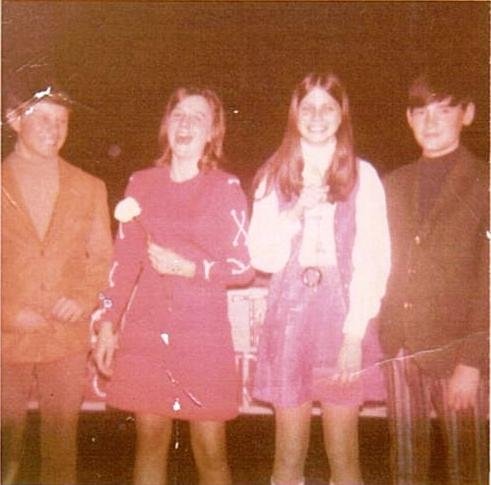
When I was a boy there was a girl; her name was Mary Patterson.  She was tall, which was important to me, with dark brown hair to the middle of her back.  Her bright smile dazzled me.

When she laughed she had a way of throwing her head back as if to let the joy of her soul escape to the sky.  She mostly wore dresses to school and tall socks that came up to her knees.  Oh, those socks…man those were some fine socks.  She had the best knee-high socks in 8th grade. (if you know what I mean)

I loved her.  She was the only one for me.  When she walked by my desk, I caught the faint waft of Prell shampoo.  She made my knees weak, my mouth dry, and my palms sweat.  Words, phrases and whole sentences betrayed me.  I opened my mouth to speak and nothing but air would come out.  She would just smile, toss her hair over her shoulder, and walk on by.  All I had was the scent of Prell.

Sweetheart Banquet

My best friend, Tim Peggram, had a girlfriend at the time, Connie Schlosser, and we wanted to double date to the Valentine’s Day Sweetheart banquet.  Well, the only one for me to ask was Mary.  It took me a long time to get the courage to pass the note in class.  She was pretty good friends with Connie, so the three of us felt I had a chance at her agreeing to go with me. She could at least talk with Connie if my mouth went AWOL again.

I sent the note before lunch and got a response after lunch.  The note was folded so tightly you would have thought it held national secrets.  It was slipped to me with the slight of hand and secrecy that only happens in the CIA and junior high.  I was almost too afraid to open it.  Not knowing was better than being turned down.  Tim kept bugging me, “Open it, you big baby.”  Sure he had a girlfriend.  That was easy for him to say.  I needed this moment of suspense.  Finally, he threatened to ask her in front of the entire class what her answer was. That did it. I opened it, carefully unfolding the note as if it were some ancient treasure map.

There in black and white in her delicately flared handwriting, was her answer…YES! (Okay, I added the caps and exclamation point, but it’s my story, so leave me alone.)

You can’t imagine what that did to my 8th-grade self-esteem.  Walking down the hall after that, I had a walk.  It was the walk of a man who had the girl of his dreams.

We all went to the Sweetheart Banquet.  It went well.  My mouth did not fail me.  We all talked and laughed and laughed.  What a great time.  That was the happiest day of my short life.

The banquet was on Saturday night.  At school on Monday morning, I got another note from my future wife, Mary Patterson; she was breaking up with me.  I was devastated.  I wrote a terse little note back asking why.  She wrote back saying, “I want to go out with older boys.  Besides I don’t really get you…kind of goofy.”

That was my first experience with unrequited love.  Not the last…but certainly, the one that hurt the most.  Donnie Osmond had a song out at this time called Puppy Love.  My love may have only been puppy love, but it was real to this puppy.

What do you do with unrequited love?  Ever think that God’s love was unrequited? How do you get a date with someone who doesn’t even know you exist?

The best way is an introduction.  Like having a friend pass a note to see if the girl of your dreams is interested in going to a Sweetheart Banquet with you.   As far as God is concerned, the Old Testament prophets were the introducers.

“Therefore the Lord himself will give you a sign: The virgin will be with child and will give birth to a son and will call him Immanuel.”    Isaiah 7:14

“For a child is born to us, a son is given to us.  And the government will rest on his shoulders.  These will be his royal titles: Wonderful Counselor, Mighty God, Everlasting Father, Prince of Peace.”    Isaiah 9:6

“But you, O Bethlehem, are only a small village in Judah.  Yet a ruler of Israel will come from you, one whose origins are from the distant past.”      Micah 5:2

It’s an old movie plot.  The woman is a minor actress in a play or a dancer in a musical.  Her secret admirer sits in the audience every night.  Night after night she receives a dozen roses with no name attached, just a card that reads “From a secret admirer.”  She wonders who he could be, dreams of what he looks like; she thinks of him often.  And then finally he asks her to dinner, and they fall in love and live happily ever after.

Rose

That is what God has done.  We didn’t know Him, but He was watching us.  He knew us and loved us.   He sent roses.  Sometimes those roses were the prophets.  Sometimes He whispered His love in the trees and the sunsets and in the laughter of children.

And then at Christmas, God signed the card.

Posted in Uncategorized | Tagged , , , , , , | 1 Comment