My Top Reads of 2016

A person who won’t read has no advantage over one who can’t read.~ Mark Twain

rarebooks-1-2Every year’s end I post a list and summary of my top ten reads for the previous year.  In doing this I have to be selective in what I post because I read significantly more than ten books in a year. (Sorry if that sounded arrogant. No, I’m not sorry.) I will list the title, the publisher’s summary and a comment or two.

So here goes my top reads for 2016 in no particular order:

Reading Your Life’s Story, by Keith R. Anderson

Spiritual mentoring is a particular kind of friendship in which, according to Keith R. Anderson, “two or more people walk together in heightened awareness of the presence of yet Another”—the Holy Spirit.

“Spiritual mentoring is not a complicated process that requires technical training and complex protocol,” Anderson continues. “It is essential, authentic, and maybe even natural human speech that is focused, disciplined and nurtured by training for one of the hardest natural things we do: listening reflectively to another. It is sacred companionship as life is lived and story told. Available to almost all, it requires deliberate recruitment, preparation and practice.”

These pages unfold a vision for mentoring that invites us to read our own lives as narrative and to learn how to enter the narrative of another life. The book covers the scope of the mentoring relationship through various seasons, offering helpful and inspiring metaphors for mentoring. All are invited to enter the mentoring story.

My comments…

I’m currently working on certification program through Potter’s Inn in Divide, Colorado. I’ve had to range far and wide in my reading for that program. It has been wonderful. But this book is one of the best books on Soul Care and mentoring I have ever read. I can’t recommend it highly enough.

I will give it away to others and read it again and again for years to come.

Soul Feast, by Marjorie Thompson

First released in 1995, this spiritual classic continues to be a best-seller, as thousands each year accept Marjorie Thompson’s invitation to the Christian spiritual life. Offering a framework for understanding the spiritual disciplines and instruction for developing and nurturing those practices, Soul Feast continues to be a favorite for individual reflection and group study. Many new additions, including a new chapter on keeping the Sabbath, make this newly revised edition of Soul Feast a must-have.

My comments…

This book fed my soul very deeply. I found the prose very readable and the content extremely practical. If you want to give yourself some really good tools to deepen your walk with Jesus, this is a great book to help you on that journey.

A Public Faith In Action,  by Miroslav Volf

Christian citizens have a responsibility to make political and ethical judgments in light of their faith and to participate in the public lives of their communities–from their local neighborhoods to the national scene. But it can be difficult to discern who to vote for, which policies to support, and how to respond to the social and cultural trends of our time.

This nonpartisan handbook offers Christians practical guidance for thinking through complicated public issues and faithfully following Jesus as citizens of their countries. The book focuses on enduring Christian commitments that should guide readers in their judgments and encourages legitimate debate among Christians over how to live out core values. The book also includes lists of resources for further reflection in each chapter and “room for debate” questions to consider.

My comments…

The three worst days for our country in my life time:

November 22, 1963

September 11, 2001

November 6, 2016

2016 saw the election of Donald Trump. Many people I love very much voted for him. I shiver at that thought. I may have even lost a few followers on my blog when I wrote about why my wife and I could not vote for him. Decency still matters to us.

How do we then live? Miroslav Volf is one of the brightest and most dedicated Christian thinkers of our day. This book has helped me find a language to think about my faith and how it should shape my public discourse. If you are looking for red meat on your particular “hot button issues” this is not your book.

I love this book.

Rebuilding Your Broken World, by Gordon McDonald

What happens when your ideals and desires, plans and strategies, all go awry? From what sources might one find the resolve to begin a rebuilding process? “The fact is,” writes Gordon MacDonald in Rebuilding Your Broken World, “the God of the Bible is a God of the rebuilding process. And not enough broken people know that.”

No stranger himself to brokenness, Gordon MacDonald draws from personal experience and discusses the likely sources of pain, the humiliation, and the long- and short-range consequences of a broken personal world. And he offers encouraging answers to the questions everyone asks when their worlds fall apart: Is there a way back?

My comments…

As a broken world person and pastor this booked helped me in so many ways. My broken world was many years ago, and there was limited resources available to help guide me as Humpty Dumpty (me) began rebuild my life. I owned this book back then, but had misplaced it and suffered through the restoration process without it. Now, in God’s providence, I dusted it off and re-read it and found it resonating with my soul more now than it might have even back 17 years ago when I broke my world.

There are many really stood out but the two that spoke particularly to my heart where I am not this side of the mess were: Chapter 14 and 15 “The Peace Ledge Principles, and Chapter 18 “Rebuilt”

Today I am trying to position myself to help restore, or to use the author’s term, rebuild broken souls. This is a powerful, practical and inspiring guide in that restoration process. I can’t recommend it highly enough. Someone you know needs this book. Maybe even you.

A New Heaven and a New Earth, by J. Richard Middleton

In recent years, more and more Christians have come to appreciate the Bible’s teaching that the ultimate blessed hope for the believer is not an otherworldly heaven; instead, it is full-bodied participation in a new heaven and a new earth brought into fullness through the coming of God’s kingdom. Drawing on the full sweep of the biblical narrative, J. Richard Middleton unpacks key Old Testament and New Testament texts to make a case for the new earth as the appropriate Christian hope. He suggests its ethical and ecclesial implications, exploring the difference a holistic eschatology can make for living in a broken world.

My comments…

A man told me recently that he didn’t pray for peace in the world because his eschatology teaches that things have to get bad before they get better and he didn’t want to pray contrary to God’s will for the second coming of Christ.

My jaw hung open.

Our culture is in desperate need of a hopeful eschatology, properly interpreted from the ancient book that we love. Don’t be a “Panmillennialist.” (I’ll all pan out in the end.)  Eschatology impacts our culture, geopolitical strategies, and even environmental perspectives.

Destiny and Power: The American Odyssey of George Herbert Walker Bush, by Jon Meacham

In this brilliant biography, Jon Meacham, the Pulitzer Prize–winning author, chronicles the life of George Herbert Walker Bush. Drawing on President Bush’s personal diaries, on the diaries of his wife, Barbara, and on extraordinary access to the forty-first president and his family, Meacham paints an intimate and surprising portrait of an intensely private man who led the nation through tumultuous times. From the Oval Office to Camp David, from his study in the private quarters of the White House to Air Force One, from the fall of the Berlin Wall to the first Gulf War to the end of Communism, Destiny and Power charts the thoughts, decisions, and emotions of a modern president who may have been the last of his kind. This is the human story of a man who was, like the nation he led, at once noble and flawed.

My comments…

George Herbert Walker Bush has become one of my favorite POTUS. He was a good man. Perhaps a man born out of season. He would have been a successful leader in a more patrician age. But, alas, time waits for no one.

This is a good book about a decent and much more complicated man than you might imagine.

American Ulysses: A Life of Ulysses S. Grant , by Ronald C. White

In his time, Ulysses S. Grant was routinely grouped with George Washington and Abraham Lincoln in the “Trinity of Great American Leaders.” But the battlefield commander–turned–commander-in-chief fell out of favor in the twentieth century. In American Ulysses, Ronald C. White argues that we need to once more revise our estimates of him in the twenty-first.

Based on seven years of research with primary documents—some of them never examined by previous Grant scholars—this is destined to become the Grant biography of our time. White, a biographer exceptionally skilled at writing momentous history from the inside out, shows Grant to be a generous, curious, introspective man and leader—a willing delegator with a natural gift for managing the rampaging egos of his fellow officers. His wife, Julia Dent Grant, long marginalized in the historic record, emerges in her own right as a spirited and influential partner.

Grant was not only a brilliant general but also a passionate defender of equal rights in post-Civil War America. After winning election to the White House in 1868, he used the power of the federal government to battle the Ku Klux Klan. He was the first president to state that the government’s policy toward American Indians was immoral, and the first ex-president to embark on a world tour, and he cemented his reputation for courage by racing against death to complete his Personal Memoirs. Published by Mark Twain, it is widely considered to be the greatest autobiography by an American leader, but its place in Grant’s life story has never been fully explored—until now.

One of those rare books that successfully recast our impression of an iconic historical figure, American Ulysses gives us a finely honed, three-dimensional portrait of Grant the man—husband, father, leader, writer—that should set the standard by which all future biographies of him will be measured.

My comments…

This book. This man. I’ve read a couple of biography’s about Grant. I know his story, but I never get used to the way he died. So brave. So heroic. Here is a man who failed at everything he ever tried to do except about three things: His marriage. (He had one of the great marriage in our country’s history. War. He was a great leader of men in the Civil War. Writing. He wrote the definitive autobiography of any POTUS. All other memoirs of presidents are measured against Grant’s. They all fall short, according to historians and writers.

This is a great book about a great man.

A Man Called Ove, by Fredrik Backman

Meet Ove. He’s a curmudgeon—the kind of man who points at people he dislikes as if they were burglars caught outside his bedroom window. He has staunch principles, strict routines, and a short fuse. People call him “the bitter neighbor from hell.” But must Ove be bitter just because he doesn’t walk around with a smile plastered to his face all the time?

Behind the cranky exterior there is a story and a sadness. So when one November morning a chatty young couple with two chatty young daughters move in next door and accidentally flatten Ove’s mailbox, it is the lead-in to a comical and heartwarming tale of unkempt cats, unexpected friendship, and the ancient art of backing up a U-Haul. All of which will change one cranky old man and a local residents’ association to their very foundations.

My comments…

Reckon if you read this book you will say, “That’s you, Joe Chambers.” Maybe that is why I was attracted to it. A friend recommended it to me and I was mesmerized by the tender love story and the humor of the author. If you want to laugh and cry, sometimes in the same paragraph, then read this book.

The Hero of the Empire, by Candace Millard

At age twenty-four, Winston Churchill was utterly convinced it was his destiny to become prime minister of England one day, despite the fact he had just lost his first election campaign for Parliament.  He believed that to achieve his goal he must do something spectacular on the battlefield.  Despite deliberately putting himself in extreme danger as a British Army officer in colonial wars in India and Sudan, and as a journalist covering a Cuban uprising against the Spanish, glory and fame had eluded him.

Churchill arrived in South Africa in 1899, valet and crates of vintage wine in tow, there to cover the brutal colonial war the British were fighting with Boer rebels. But just two weeks after his arrival, the soldiers he was accompanying on an armored train were ambushed, and Churchill was taken prisoner.  Remarkably, he pulled off a daring escape–but then had to traverse hundreds of miles of enemy territory, alone, with nothing but a crumpled wad of cash, four slabs of chocolate, and his wits to guide him.

The story of his escape is incredible enough, but then Churchill enlisted, returned to South Africa, fought in several battles, and ultimately liberated the men with whom he had been imprisoned.

Churchill would later remark that this period, “could I have seen my future, was to lay the foundations of my later life.” Millard spins an epic story of bravery, savagery, and chance encounters with a cast of historical characters—including Rudyard Kipling, Lord Kitchener, and Mohandas Gandhi—with whom he would later share the world stage. But Hero of the Empire is more than an adventure story, for the lessons Churchill took from the Boer War would profoundly affect 20th century history.

My comments…

This book of history reads like a good fiction. Most of us know the elder Churchill. The goat of WWI and the hero of WWII. But this is a fascinating look at a young and precocious 24-year-old Churchill.  You can see he had stuff of greatness even at that age.

Good read.

The Aviators, by Winston Groom

Written by gifted storyteller Winston Groom (author of Forrest Gump), The Aviators tells the saga of three extraordinary aviators–Charles Lindbergh, Eddie Rickenbacker, and Jimmy Doolittle–and how they redefine heroism through their genius, daring, and uncommon courage.

This is the fascinating story of three extraordinary heroes who defined aviation during the great age of flight. These cleverly interwoven tales of their heart-stopping adventures take us from the feats of World War I through the heroism of World War II and beyond, including daring military raids and survival-at-sea, and will appeal to fans of UnbrokenThe Greatest Generation, and Flyboys.

With the world in peril in World War II, each man set aside great success and comfort to return to the skies for his most daring mission yet. Doolittle, a brilliant aviation innovator, would lead the daring Tokyo Raid to retaliate for Pearl Harbor; Lindbergh, hero of the first solo flight across the Atlantic, would fly combat missions in the South Pacific; and Rickenbacker, World War I flying ace, would bravely hold his crew together while facing near-starvation and circling sharks after his plane went down in a remote part of the Pacific. Groom’s rich narrative tells their intertwined stories–from broken homes to Medals of Honor (all three would receive it); barnstorming to the greatest raid of World War II; front-page triumph to anguished tragedy; and near-death to ultimate survival–as all took to the sky, time and again, to become exemplars of the spirit of the “greatest generation.”

My comments…

I love how the author overlays these heroes of flight. A quick and easy read. Hard to put down.

How Great is the Darkness, By Jamie Greening

Pastor Butch Gregory is a quiet man who only wants to serve the Lord and the small congregation he loves. His dream of peaceful ministry is shattered by a murderous conspiracy. One by one, pastors in his small Western Washington town fall victims to murder. What is going on? Why? Things get worse when it is apparent the murderers have targeted Pastor Butch for death. Pastor Butch, his colleague Terence Harrison, and an old familiar face try to find the killers while they also fight to stay alive.

My comments…

What a great read! The pace and character development kept me reading. The author balances a wholesome book and redemptive qualities with a very dark subject matter: corrupt clergy and a vigilante group of “Christians.” Nicely done. For me the star of the show was Wyoming. I really liked his street smarts and edgy character.

There were so many others that I could have mentioned, but this is already longer than most of you will have read. I hope you will go to a library, or your favorite bookstore and get your hands on some of these books.

You will be the better for it.

Posted in Uncategorized | Tagged , , , , , | Leave a comment

The Name

You shall call His name Jesus, for He will save His people from their sins.” – Matthew 1:21

I performed a wedding for a couple who lived in Tacoma’s hilltop area and they had a baby in which they wanted to name the child from the bible. Know what they named the little fella? Messiah. It’s in the Bible, alright. 


Ever wonder how Jesus got His name?

What does this naming event of Jesus tell us? In the Bible, a person’s name was never just a label. Kids never got names because their parents just liked the sound of it. Kids never got a name because the name was the name of the favorite soap opera character or of the mother or the father’s uncle.

 Whoever gives you your identity is your authority. Your name always shows you your purpose. It tells you what you’re to live for, what you’re here to do. If you know these two things, the Bible says, you know who you are.

 Now let’s apply it to Jesus. Who is Jesus’authority? The reason God will not let Joseph or Mary name this child is because they are not allowed to think they have authority over him. 

Do you remember when God brought the animals to Adam and said, “I want you to name these animals?”Was God just out of ideas? He says, “Creation is a hard work. I’ve named all the various botanical species and there are just thousands of them. But I need someone to name these animals. I’ve run out of ideas. Would you give these things labels?”

No, he wasn’t saying that. When he asked Adam to name the animals, he meant, “I want you to take charge of them. I want you to take care of them. You’re not here to exploit, but to care for. You’re responsible for these.”

Therefore, it was normal for parents to name their children, because at least in the early days of the child’s life, a parent was responsible, had authority over the child. But what we have here is God showing up and teaching us that Jesus Christ is not JUST a human being. No one has the right to name Jesus.

Because the minute he was born he was already older than his parents. He was not a mere human being. His parents were supposed to, from the beginning, recognize that. He is the King of Kings. He’s the Lord of Lords. No one has authority over him. 

What is Jesus’Purpose? We’re even told in the passage, “You shall call his name Jesus.”Why? Because of his life’s work. “…he will save his people from their sins.”His name was Joshua, and Yeshua breaks down into: “Ye,” the Lord; “shua,” saves. 

God saves. 

He is the Redeemer. He is the Restorer. That is His purpose. Think about it: Jesus had what today we call a strong sense of identity. Nothing rattled him …nothing. Whenever you read about him, you have this sense. He knew who He was. There are a lot of things Jesus wrestled with. He was a man of sorrows. He was a man who felt pain. He was a man who felt grief. He was a man who didn’t trust people. He experienced all these sorts of things, but the one thing you don’t see in the Bible at all is that he ever wrestles with his identity. He has the clearest sense of self you could possibly ask for. It unnerved people. It intimidated people everywhere. 

He knew who he was. Why? Because he knew these two things: He knew where his name came from, his Father, and he knew what he was about.

God wants to name you. What that means is as a Christian you can have a last name and a first name. 

Your last name is God’s family name.

 But as many as received Him, to them He gave the right to become children of God, to those who believe in His name.                                                                                            John 1: 12 

We must stop trying to name ourselves. What it means to become a Christian is to say, “Jesus is my Savior, my Redeemer, my Restorer, and my King.”

That is the foundation for your new identity. Your last name is not so much a label as it is an identity. Until you say, “Jesus is my Savior, my Lord, and my King. He is the One who gives me validation. He is the One who makes me acceptable. He has done it all for me. In him, the Father loves me and accepts me completely,”you’ll go on being unhappy. 

I wonder how many of us are Christ-followers but our lives are filled with angst and pain and worry and insecurities. Why? Because we have forgotten Whose we are. And we have tried to have too many names. I’m here to remind you of who you are. You have a last name: “You are the “Favored daughter or son of God—Beloved.”

Christians also have a first name. (Or as my Cajun friend Mark Hebert says, “Your Front Name”) 

The first name comes from finding your gifts and finding the kinds of people God wants you to help, finding the kind of ministry he wants you to do. The first name comes as time goes on. The longer you walk with God the clearer your “front name”will become. 

How do you find your first name? How do you find your niche in the kingdom economy? Only by getting down to obedience, getting down to serving. It takes all your life.

 Slowly, incrementally your first name is revealed to you. It’s only by obeying, it’s only by reaching out, it’s only by submitting to him completely and saying, “The most important thing is to serve you and know you,”do you find your first name, in increments. 

I’ve been walking with him for over 50 years and am still learning my “front”name. But unless you let God name you, you’ll never find out who you are. 

Let me remind you that for all of eternity Jesus and His father had known divine intimacy and oneness. And, if you remember, in the Garden of Gethsemane he agonized over what was coming on the cross. Jesus said, Father let this cup pass from me. Nevertheless, not my will be done, but Thine

Then on the cross he cried out, My God, My God why has Thou forsaken me?”

He lost his name so you could find yours.

Posted in Uncategorized | Leave a comment

The Wonder

“My soul magnifies the Lord…For He who is mighty has done great things for me…  ~ Mother Mary

Growing deep inside Mary’s body was the Son of God.  His eyes were being formed, his dimpled little hands were growing, and the lips that would speak the Sermon on the Mount and tell the story of the Prodigal Son was growing inside her.  It was happening to her!

And every time she felt her interior organs get pushed to one side, she had to remember that it was the One who would one day turn water into wine.  Every time the baby kicked she had to wonder where those little feet would take him in the Holy Land.

I imagine there being times, as that little mother rested her hands on her swelling tummy, that she just smiled and shook her head in deep wonder.

What makes you shake your head in wonder?

Several years ago, Lynette had done a load of laundry and had several more to go. There were clothes strewn all over the laundry room floor. Right in the middle of the floor was a drain.

Our bedroom was next door to the laundry room and I was in it trying to do some reading. Suddenly I heard a shriek as if someone were being assaulted coming from the laundry room. I ran into the room and my wife had her eyes wide open, horror etched on her face and her left hand up. I said, “Hey, I am trying to read in here!” She pointed to her hand and said, “It’s gone!” I looked. Her hand was still there. Her fingers were still there. Her ring was still there. What is gone? I asked. She said, “My diamond!”

She started to cry while she ran her hand around the tub of the washer. Frantically, she started looking everywhere tossing the piles of clothes aside as if they were guilty of this thievery. I just stared at her. She snapped at me, “Why aren’t you helping me? I said, “What makes you think you are going to find it if you have been poking your hand down in a churning washing machine? All that water, soap, and anything the size of that diamond is washed away. It is gone.” I wasn’t too upset about it. (I knew how much I had paid for it.)

But she was beside herself. So we looked. She tried to get me to undo some plumbing, but I balked and distracted her by looking intently down that drain into Mordor. Nothing.  After what seemed like an hour of searching I decided the practical thing to do was to get some sleep. So I went back to bed and I talked her into going to bed too.  I tried to comfort her, but she cried and cried.  I remember thinking that I don’t really understand my wife very well.

Later she told me that while in bed she whispered, “God, I know it is just a little thing. But could you help me find my diamond?”

Directly, she got up and went back to look again. I was almost asleep when I heard screaming and shouting. I bolted out of bed again thinking she had lost something else. But she came running into the bedroom, grabbed me hugged me and kissed me, and said. “I found it!” Right in the middle of the laundry room floor on top of a pair of blue jeans laid her diamond.

She crawled back into bed, lay her head on my chest, and through quite a few sniffles said, “Can you believe God gave that back to me?”

That is wonder.

The next day I would watch her and from time to time she would just shake her head and smile.

Do you sometimes just marvel at the thought that God would seek you out?  If God came to you just like he came to Mary, and said “I want to be born through you. I want to use your body to bring the savior to the world.” What would you say?

Because that is exactly what he asks all of us to do.

The Christmas song, “I Wonder as I Wander” had its origins in a song fragment collected on July 16, 1933, by folklorist and singer John Jacob Niles.

While in the town of Murphy in Appalachian North Carolina, Niles attended a fundraising meeting held by evangelicals who had been ordered out of town by the police. In his unpublished autobiography, he wrote of hearing the song:

A girl had stepped out to the edge of the little platform attached to the automobile. She began to sing. Her clothes were unbelievably dirty and ragged, and she, too, was unwashed. Her ash-blond hair hung down in long skeins…. But, best of all, she was beautiful, and in her untutored way, she could sing. She smiled as she sang, smiled rather sadly, and sang only a single line of a song.

Niles left with “three lines of verse, and a garbled fragment of melodic material. Based on this fragment, Niles composed the version of “I Wonder as I Wander”.

I wonder as I wander out under the sky
How Jesus the Saviour did come for to die
For poor on’ry people like you and like I;
I wonder as I wander out under the sky

And so, dear friend, may you wonder at the grace that God lives inside of someone as on’ry as you.

Posted in Uncategorized | Tagged , , , , | 2 Comments

Overcoming a Joyless Christmas

Let every heart

Prepare Him room ~ Isaac Watts

I love to laugh, tease others, and delight in life—but as a rule, I run a low-grade melancholic fever.  I suppose it’s part of my temperament. Or it might be the lack of spiritual formation that God is still working on deep inside me. Nevertheless, I keep it in check with a daily dose of prayer, journaling, reading, exercise, and large bowls of ice cream.

We are told that Christmas, for Christians, should be the happiest time of year, an opportunity to be joyful and grateful to family, friends, and colleagues. Yet, according to the National Institute of Health, Christmas is the time of year when people experience a high incidence of depression. Hospitals and police forces report high incidences of suicide and attempted suicide. Psychiatrists, psychologists, and other mental health professionals report a significant increase in patients complaining about depression. One North American survey reported that 45% of respondents dreaded the festive season.

shadowsI must admit that occasionally, darkness will play across my heart like cloud shadows on a valley floor.  They come suddenly, send a chill, and then are gone. They are fleeting but when they come they are rather intense.  Often my thoughts go to places that I don’t like: places of inadequacies, insecurities, and fear.

When those clouds come, I have a few tools I use until the shadow moves on:

  1. Check my thinking.

I remind myself that I am the beloved of God. I quote John 3:16 in the first person singular. I ask myself if God has changed His mind about how much He loves me. I look at my journal to see if I’m focusing on the earthly disproportionately from the Heavenly. Where or on whom is the focus of my thinking?

  1. Ask for Prayer

I have always believed that Christians get in trouble in their interior life because they try to do battle there alone. We need each other to enter the fray with us. Jesus did this in the Garden of Gethsemane. That is one of the main reasons we have brothers and sisters in Christ. Without the prayerful fellowship of the saints, we would all be less human and more hideous than we already are. I’ve never found my brothers and sisters irritated at me or think less of me when I ask for prayer for my shadowed heart.

  1. Keep Walking

My temptation is to stop, nurse, and coddle my sadness. As if I deserve the despair; as if the darkness is confirmation of my inadequacies. That always happens when I stop and sit down on the curb of life. So much of any success in our spiritual life is simply to keep putting one foot in front of the other. Get up and keep moving. The longer I sit the stiffer I become and soon spiritual inertia sets in and I won’t want to move again.

 “Do not sorrow, for the joy of the Lord is your strength.”  Nehemiah 8:10

Don’t walk alone in the darkness, but keep walking and you will find the presence of the Lord with you in the With-God life.

And joy won’t be far behind.

No more let sins and sorrows grow,

Nor thorns infest the ground;

He comes to make His blessings flow

Joy to the World, the Lord has come!

Posted in Uncategorized | Tagged , , , , , , | 5 Comments

Here Comes the Judge!

Judge not, that you be not judged.~ Jesus

Judging others makes us blind, whereas love is illuminating. By judging others we blind ourselves to our own evil and to the grace which others are just as entitled to as we are. ~Dietrich Bonhoeffer

We all do it. We label other. I’ve done it. I’ve had it done to me. As a pastor, I get labeled more often than most because my role necessitates that I inform and lead. And when you do that you will inevitably be labeled.

When I was returning to my home state to pastor a mountain church someone in authority in our state asked my father, “Is Joe a liberal?”

Recently a person indicated that I was flirting with New Age doctrine because of my choice of authors and mentors. Another person said that I couldn’t be a Christian if I voted for a Democrat. Another person said I had no right having an opinion about the morality of another person because of my past history.

We play the game of labeling as if it were our favorite indoor sport.

How do you play?

judgingFirst, find something you don’t like about the person. That’s not hard to do since most people are much more demanding of others than themselves. This can be anything from style of worship, to the way they dress, or even their doctrine. (non-essential doctrines.)

Second, trust only in what you see on the outside. This is an essential requirement since you can’t see what is on the inside of a person’s heart.

Next, form a censorious and critical opinion about the person.

After that, jump to several inaccurate conclusions. This follows naturally, because there is always an inability to know all the facts.

Then, mentally slap a label on the person in question. That saves time…keeps you from having to verify all the details and actually have a conversation with the person.

Lastly, freely share all your findings and identifying labels with others, by sharing prayer requests so others can “pray more intelligently.” And if you can’t wait for prayers meeting at church then just go ahead and share in on Social Media.

Actually, there is another name for the game. It doesn’t sound nearly as nice or inviting, but it is the term Jesus used in his mountain message: judging.

Jesus said we would be wise to not judge. That if we do we will get what we give. I’ve thought a lot about what judging is and is not.

Judging is not making an observation about the rightness or wrongness of someone’s behavior. Police officers, teachers and a whole host of other professions must do that. Neither is it “judging” when one holds someone accountable for violating basic human decorum. When special counsel to the Army Joseph Welch confronted Senator Joseph McCarthy in a congressional hearing he famously said, “You’ve done enough. Have you no sense of decency, sir, at long last? Have you left no sense of decency?”

Judging happens when, in my mind or my words, what a person does or says becomes who they are. When their behavior becomes their identity—I have judged them.

That is something a Christ follower cannot afford to do. And the reason is because it affects how we interact with them. We will not sufficiently pray God’s favor on someone we’ve judged. We won’t consistently sew seeds of love and kindness to someone we have judged. We won’t be as quick to show compassion on or mercy towards someone we have judged. We won’t give them the benefit of the doubt. We will, from the moment the judging begins, forever leap to conclusions about them that may or may not be founded in reality. That is called pre-judging. And it is the basis of that hideous problem of prejudice.

How do we stop the game of labeling? Because the game can become addictive. In fact, judging can become such a habit we hardly know we are doing it. But that neither excuses it nor removes the consequences. Here are four suggestions that may help you as much as they have helped me.

  1. Examine yourself before being tempted to inspect others. Self-examination does wonders when we are tempted to find fault. Have I remembered that I am so bad that Christ had to die for me—me, The Judge?
  2. Confess your faults before confronting another. It brings humility to the surface, and humble, gentle confronters are the best confronters.
  3. Try to understand the other person’s struggle. Why are they behaving the way they are behaving? What is going on in their soul? Have I remembered they are so loved by God that Christ was glad to die for them—them, The Sinner?
  4. Remember, the goal is restoration, not probation. I wish there was a support group in the Church called “Doctrine-police-judgers-gossipers-critics-anonymous.” It would be a great place for folks to go who cannot control the urge to judge…to malign…to put labels on those with whom they disagree.

The game goes on. Let’s Label is still a favorite among many who call themselves followers of Christ. Judging continues in the name of Jesus, even though He is the One to commanded that we stop it.

But, I intend to–by God’s grace, I intend to.

Posted in Uncategorized | Tagged , , , , , , | Leave a comment

The Loss

And he was there in the prison.  But the Lord was with Joseph …  Genesis 39:20-21

There is nothing we would like to avoid more if we could than a crisis. But what if we could?

Imagine that you had a child, and when that child enters the world, for the first five minutes of that child’s existence, you are given a script of what will be that child’s entire life. And you get an eraser, and you can edit it. You can take out whatever you want to take out of your child’s life.

The script says that your child will have a learning disability in grade school, that reading, which comes easily for some kids, will be laborious for yours. Then, when your child gets to high school, the script says that he will make a great circle of friends, but one of those friends will die of cancer.

Then, after high school, they will get into a college that they wanted to attend, but while there, they will be in a car crash and lose a leg and go through a hard depression. A few years later, they will get a great job, and then they will lose that job in an economic downturn.

Then a little while after that, they will get married, but then they go through the grief of a separation.

So, you get this script for your child’s life, and you have five minutes to edit it the very first day. What would you erase? Wouldn’t you want to take out all the stuff that would cause him pain and grief and hardship?

Is it possible that in some ways, people can grow from, maybe somehow even need, adversity, setbacks, difficulties, heartache, to reach the fullest level of humanity, and development?

Did you hear about the man whose wife ran off and left him? Not long after that he had to file for bankruptcy. Then in a freak accident, his house burned down.  Two days later, he was walking across street, got hit by car; as he laid there in the street, he cried out to heaven, “God, why me?”

A voice echoed from the heavens that said, “Sam, there’s something about you that just ticks me off.”

That’s a funny story, but it’s not true.  We live in a fallen world.  And that means there is going to be suffering.

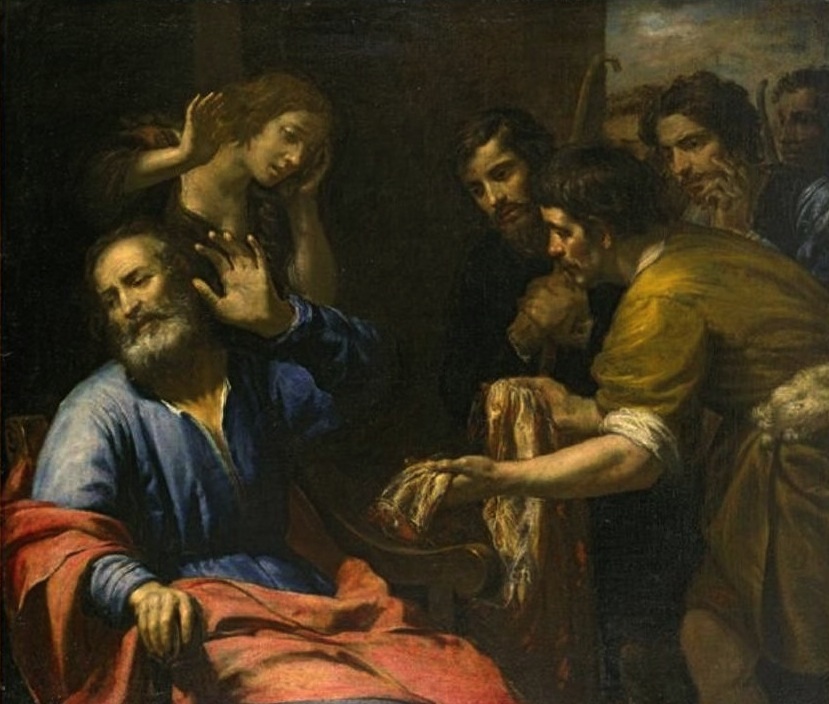
It is interesting that from chapter 42 through 50 in the book of Genesis the Scriptures record no less than six instances of Joseph weeping. Sometimes weeping so loudly that his friends wondered about his sanity.

In the last chapter in Genesis, his father is on his deathbed, “Joseph threw himself upon his father and wept over him.”

He is the biggest crybaby in the Bible!

joseph-coatI think if Joseph’s father could have had a script of Joseph’s life and erased all his tears ahead of time so that Joseph could have experienced nothing but sunshine and prosperity and applause and all his dreams coming true.

It is an amazing thing about Jesus, do you remember what the shortest verse in the Bible is? It’s found in John 11:35 where it says, “Jesus wept.” His friend Lazarus had died. In Jesus, we have a God who cries.

I don’t know of any other system of thinking about God that tells us that in Jesus, God cried.

When a person weeps, it is a very intimate thing to wipe the tears off their face. You only do that for somebody that you are very close to, usually a parent with a little child—it is intimate.  It is very tender.

“Now the dwelling of God is with men, and he will live with them. They will be his people, and God himself will be with them and be their God. He will wipe every tear from their eyes.         Revelation 21:3-4

In Jesus, God cries with you. In Jesus, our hope is that one day God will set this world to rights. Now imagine that day, you come before God with all the hurt in your heart, and with all the gentleness and compassion in the universe, the God who made everything, looks at you, and wipes the tears from your eyes.

No more crying now.  That is our script. That is our God.

Posted in Uncategorized | Tagged , , , , , , , | 2 Comments

The Struggle

Then Jacob was left alone; and a Man wrestled with him until the breaking of day. Genesis 32:24

 “. . . together through ages of the world we have fought the long defeat.” ~ Galadriel

Jacob is one of our ancestors in the faith who is in the fight of his life and this is a long defeat that becomes a profound transformational moment.

Jacob stood alone on the northern bank of the river: before him the roaring waters; behind him a wall of Nubian sandstone, perpendicular from its foot to the tangled black forest on its brow; right of him there was nothing except a stony, wet plateau; and left of him, nothing

Night was descending. The gorge grew gloomier, leaving only a path of sky above him, where stars filled the blackness with such tiny lights that he felt small and solitary.

14736-jacob-landsc-1200w-tnIt had been Jacob’s intent to make a private crossing of the Jabbok. But maybe he trusted the swimming stroke of his strong arm better in daylight than in the dark; and maybe the nigh fell faster within the walls of the gorge than he had expected. Whatever the reason, he did not dive into the waters. He did not move. He stood transfixed, surrounded by sound and soon by an absolute darkness—for even the tiny stars were suddenly swallowed as if by a beast of horrible size.

Jacob felt wind, then chill.

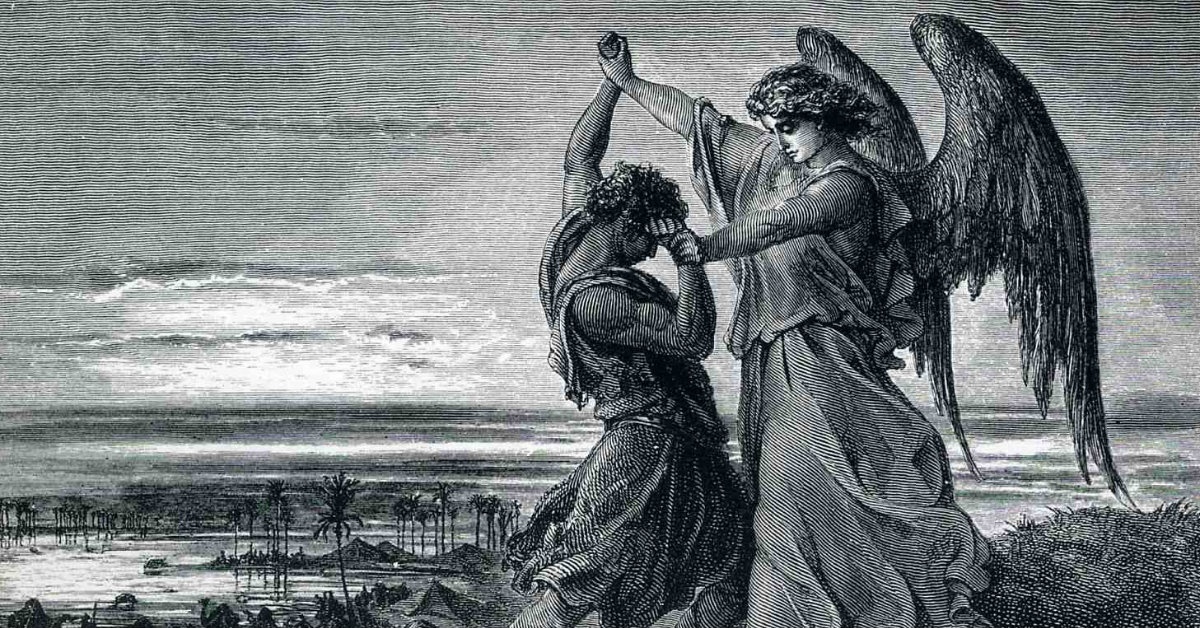
Someone came flying down the riverbank. Jacob felt what he could not see. Then someone attacked him, struck him to the stony ground, and began to wrestle with him. They wrestled by the river. They whirled and heaved each other against the sheer rock wall. In a breathless silence, they wrestled all night until a high grey dawn began to streak the sky.

Jacob’s adversary touched the hollow of his thigh and put his thigh out of joint. Jacob threw his arms around a huge waist and held on.

Crippled and bone-tired, in that liminal space between night and day, he sees the face of his adversary. And it is fiercer than the face of death itself—he discovers that he is looking at the face of love.

Darkness is the felt absence of God. This is when you do not see God working in your heart. This is when you are praying and praying and praying…and no answers. This is when you’re reading and reading and reading…and getting nothing out of it. It is completely bone dry. These are desert times. These are winter times. This is when God is painfully absent.

Could it be that your frantic struggle for approval; for someone to know you completely and still love you; your life-long wrestle for security; your desperate ache for love—at the bottom of that is an ache for God? Could it be possible that all your life has been leading and preparing you for this moment in the darkness to see the fierce face of love—God?

But it is in the wrestling with God that we have the invitation to realize that God is all that we need. If we have Him, we have everything.

God seldom massages me into maturity and transformation.; God wrestles me into spiritual maturity.

This is how it worked with Alexander Solzhenitsyn a Russian novelist, historian, and short story writer. He was an outspoken critic of the Soviet Union and communism and helped to raise global awareness of its Gulag forced labor camp system.

He was successful and cynical in his prime as a writer until he spoke ill of Josef Stalin privately to a friend who turned him in. He spent the next decades of his life in the Gulag in Siberia. Listen to his words about his struggle…

It was only when I lay there on rotting prison straw that I sensed within myself the first stirrings of good. Gradually it was disclosed to me that the line separating good and evil passes not through states, nor between classes, nor between political parties either—but right through every human heart—and through all human hearts…. That is why I turn back to the years of my imprisonment and say, sometimes to the astonishment of those about me: “Bless you, prison!”.

This is someone whom God wrestled into transformation. His darkness and struggle forced him out of his comfort and caused him to hang on to God for dear life.

Is it possible that in your darkest moments that the living God is trying to get a hold of you? Is it possible that the living God is graciously nearby? And there, in the dark, he allows you to struggle with Him; to ask your questions, and during those questions God, with a feather-lite touch, wrestles you into a transformed life.

That is a magnificent defeat.

Posted in Uncategorized | Leave a comment

An Open Letter to My Sons

Love suffers long and is kind… bears all things, believes all things, hopes all things, endures all things. ~Saint Paul

“What punishments of God are not gifts?” ~ J.R.R. Tolkien.

I know you are looking at what happened last Tuesday and see that it is being widely reported that 81% of white evangelicals voted to elected Donald Trump as president. I am white and an evangelical and, while I didn’t vote for Donald Trump or Hillary Clinton, my cohort voted to make him our leader.

I have something to say to you about that.

I can’t do anything about what Mr. Trump does in office. I can’t do anything about the fact that my tribe was crucial for him getting elected. But, now that he is our president, I will pray for him and grieve the choices that helped put him in the highest office of our land.

For you, perhaps, the future does not look good. I make the following promise to you as I follow the Carpenter from Nazareth:

6e7fb22f4dc830bb9186ff310685ce3c

Langston Hughes

I promise to you to be kind to those who don’t agree with me. This is hard, for I am a passionate man and do not suffer disagreements with my world views well. But going forward I pledge I will pray for my enemies. I will love them the way Jesus loved His enemies all the way to that point on the cross where he whispered with a hoarse voice, “Father, forgive them for they know not what they do.” I promise to be kind.

I promise to be careful with my words. I realize what Jesus said that it is not what comes out of our mouths that is the problem, that what comes out of our mouths is only an indication of what is already in our hearts. My pledge to you is to submit my heart to the hand of God to massage and press out of my heart the poison that would leak out in words and thus do harm to you or anyone in this world. I promise to be work on my heart and be careful with my words.

I promise to humble myself. I will make obscurity my friend. I will seek out ways to not be known. Not out of shame or hiding, but out of respect for how God has restored my life. Hubris is a drug for me and it is just as deadly as cocaine. I will be small to stay connected to a large God. If you see me promising more than I can deliver, if you see me behaving in ways that make you think that you can’t talk to me about a flaw in my character, show me these words I have written and remind me that I gave you permission to challenge me. I will look for ways to serve my world in anonymity. I promise to live a life of smallness.

I promise to love and respect your mother and serve her the rest of my life and by extension all women everywhere. Especially Ashley, Rachel, and Mindy—the women that you have pledged your life to. I want all of these women and my granddaughters to know down to the core of their being that there is a white evangelical man who will never objectify them or talk down to and about them and their sisters on this planet. I will get her coffee in the mornings. I will fix her dinner in the evenings. I will open the door for her. I will clean off the snow from her windshield here in the mountains. I will pump her gas. I will love her, protect her, and submit to her when she is right. I promise to treat her and all women with respect.

I promise to embrace people of color. They are precious to our Lord. I will go out of my way to communicate that they matter to me. That they don’t have to fear being around me. That if they need anything and I can give it to them I will do everything I can to see that they are well-cared for.

Jesus showed me the way in this. He was kind to people of color, for He was a person of color. He was a mid-eastern man. He loved the oppressors (Romans). He loved the mixed races (Samaritans) He loved and accepted the sexually confused. He loved the immigrants. He loved the diseased. He loved the poor. I promise I will love and embrace your friends exactly the way they are without trying to change them. They will never be condemned or mocked by me. I will love them; for I love you. They have intrinsic value as they are without changing one iota.

And I promise to never, ever mock a person of disabilities. Or defend anyone who does.

My fear is that you will never hear the soft sound of sandaled feet approach you with gentleness and grace and call your name softly and tenderly and that you will never know the Jesus that I talk to every day.

Don’t say no to Jesus because so many of my tribe said yes to Mr.Trump.

Look at this 59-year-old white man who loves Jesus of Nazareth with all his heart.

Look at me. Look at me.

I would lay down my life for you Cole and Ashley, Clinton and Rachel, and Caleb and Mindy.

Follow me as I follow Jesus.

These are my promises, so help me God.

Here is the world. Beautiful and terrible things will happen. Don’t be afraid. ~ Frederick Buechner

Posted in Uncategorized | Tagged , , , , , , | 8 Comments

Clinton, Trump…Or?

For God is not the author of confusion but of peace… Let all things be done decently and in order. ~ Saint Paul

“Let the lie come into the world, let it even triumph. But not through me.” ~ Alexander Solzhenitzen

Of two evils, choose neither . ~ Charles Haddon Spurgeon 


This article will not change anyone’s mind about who they are going to vote for. If you are a Hillary hater or a Trump supporter, nothing I am going to say is going to change your mind. If you hate Trump and love Hillary, the same is true of you.

(Don’t confuse me with the facts, my mind is made up)

20161020_094145I will not be able to convince what we used to call Yellow Dog Democrats to change their vote. Yellow Dog Democrats was a political term applied to voters in the Southern United States who voted solely for candidates who represented the Democratic Party. The term originated in the late 19th century. These voters would allegedly “vote for a yellow dog before they would vote for any Republican”.

To be fair there are Yellow Dog Republicans too.

So this article is not for the Yellow Dogs or the single issue fanatics (pick an issue: abortion, climate change, gun control, trickledown economics, welfare state, etc.). I am writing more for myself than anyone else, but there is a growing group who are repulsed by both major party candidates and are tired of being shamed and put down with the false argument that to not vote for Hillary is to vote for Trump and vice versa.

To that point, the math is not valid that to fail to vote for candidate A means you are wasting your vote and by default you are voting for candidate B. Someone much smarter than me has written and excellent article about the math in that scenario. You can read it by clicking here.

Both major party candidates are flawed in their character and policies that are beyond the pale. You can read a much better article outlining that position by clicking here.

Here is my position: I cannot vote for Hillary because of her hubris to be President, her untrustworthy character, and her rabid support of even partial birth abortion is chilling. Her unequivocal support of extreme LGBTQ issues is a fundamental assault of the traditional family according to the Judeo-Christian values that I hold dear. Her entire public life is strewn with scandal after scandal. The ACLU’s support of her candidacy alone makes me shudder.

I cannot vote for Trump because he behaves like an immature twelve-year-old boy. (apologies to all twelve-year-old boys) He insults anyone who disagrees with him. He mocks women, speaks of and allegedly has assaulted women, mocks fat women, mocks the disabled. He is part owner of many casinos that promote the sin of gambling (remember when Christians were against that vice?) and inside those casinos are strip clubs where women are exploited and objectified. He brags about his infidelity while married. His equivocation on accepting the results of the election are unprecedented. (His extreme supporters frighten me.)

America’s white nationalists have spoken, and they’ve spoken loud and clear: Donald Trump is their presidential candidate of choice.

From former Ku Klux Klan grand wizard David Duke on down, the proudly racist fringe of the American electorate supports Trump.

Trump is unrepentant about his past behavior. He doesn’t believe he needs to apologize for anything.

My Christian convictions will not allow me to vote for either of these immoral people, platform or no; Supreme Court Justices or no; executive orders run amok, or no. Decency still matters to me. To vote for the lesser of two evils is still voting for evil.

Christians, please. Stop viewing this election through the eyes of pragmatism and start looking at it through the eyes of faith. ~ Carey Green

I recently had a conversation that went as follows:

Big Church Pastor: Joe, don’t you think Donald beat Killary tonight on the debates?

Me: No. In fact, I think America lost in the debate.

Big Church Pastor: Don’t tell me you aren’t voting against Killary.

Me: I’m writing in a candidate I’d be proud to have as a president.

Big Church Pastor: By not voting for Trump, you will be voting for Killary.

Me: No. I will be voting for my candidate and sleeping with a clear conscience.

Big Church Pastor: You *purests* are going to hand her the election.

Me: If I’m a *purest* does that make you an impurest?

Big Church Pastor: ____________.

The other day Lynette and I were driving to town and she made a simple, but profound observation. She said there is going to come a day when God and history will look back on this election and see three columns on the ballot. One column will be all those who voted for Hillary. The second will be all those that voted for Trump. But there will be a third column who said to the Democratic party and the Republican Party and to the American people, “No!”

Then she said, “I want my vote to be in the third column; the column for decency.”

There is a painting in which Faust is playing chess with the Devil. Faust has only a few pieces left on the board and seem to be check-mated.  The expression on his face Faustforetells his doom.  The Devil, who seems to be very much in control, has a sneer of glee.

Through the years people would come to the gallery where the picture was displayed and gaze and ponder the hopelessness of the situation.  As they would leave, most left with the sense that the artist had captured the essence of their own situation.

Then one day, a great chess master came into the gallery.  He stood for hours focused on the painting and specifically the chessboard.  Day after day, he would return studying the portrait.  Finally, with a shout that disturbed everyone in the gallery, “It’s a lie!  You still have a move.”

Our move is to sign our name in the third column.

Speaking of Faust…

For what shall it profit a man, if he shall gain the White House, and lose his own soul?

Posted in Uncategorized | 8 Comments

The Journey

By faith Abraham obeyed when he was called to go out to the place which he would receive as an inheritance. And he went out, not knowing where he was going.  Hebrews 11:8

There is a difference between an adventure and a quest. An adventure is a there and back again experience or story. It’s an exciting thing you choose. You go and have your adventures, and you have all your thrills, and it spices up your life. Then you come home again, and you pick your life up again where it left off.

A quest is not something you choose; it comes to you. You sense a requirement. You’re called to it because of what’s involved, and you never come back from a quest. In a quest you either die for the quest, or if you do come back, you’re so changed you never, in a sense, come back. You’re never the way you were. You’re changed so radically.

In the way I have described the difference between an adventure and a quest—Christianity is not an adventure; it is a quest. It’s not there and back again. It’s not like, “I want to have some fun. I want to enrich my life.”

Christianity is a quest. God says, “Go! You’re going to be radically changed. Don’t ask me whether or not what I’m about to do will fit into your agenda. Christianity is a whole new agenda. Don’t say, ‘How is this going to enrich my life?’ Christianity is a whole new life.” What does it mean to set out on this journey? It means to go, not knowing where you’re going.

The life of journeying with God becomes a primary image in the Bible for what the life of faith is like. The Christian journey is all about faith. It’s all about hearing God in the Scriptures and responding—even if you, like Abraham, are not entirely sure where you are headed.

Because as you follow Jesus, you can’t fit your Christian life into your agenda for life. He refuses to be an add-on. Or as I heard one person say, “If Jesus is the Son of God, creator of the universe—you don’t make him your assistant in life. He is not a junior partner in your firm. He is not a co-manager in your shop. He is King.”

Walking with Jesus gives you a new agenda for life. It sends you in a new direction. Walking with Jesus is a journey where our entire lives are re-directed by God’s grace. It’s about faith.

But we don’t exist for ourselves. We exist for others; to be dispensers of God’s grace to those who are not in the forever family yet.

I want to be the kind of person that doesn’t retreat from the world. I want to be more like first responders, who run in when others are running out—I want to be a man that is running into the burning building of our culture. I am for this world. I love what God loves and He so loved the world that He gave His only begotten Son.

As I think about this ancient story I see that God graces Abraham, failure that he is, and will continue to show himself to be, and yet God stays faithful to his children who turn out to be just as flawed as he is, and God graces them one-by-one. And on down the line through the centuries, until when you look at the first chapter of Matthew in the New Testament we see, in the family tree of Jesus Christ Himself, that our Lord is called a “Son of Abraham.”

And in that “son of Abraham” God would explode His blessing, life, and abundance on the entire cosmos. The Son of Abraham lives for us, suffers for us, and then dies for us. He takes upon Himself our curse so that we can have the blessing of the With-God life. Because of the call of grace and the sacrifice of Jesus—we have the possibility of being restored to our true vocation of being the humans God imagined when He created Eden.

Following the journey of faith with Jesus might, at times, feel as if you don’t know where you are going. You might not know where you will end up. You might find yourself in the undiscovered country. You may not always know where you are going but you will never be lost.

In the Fellowship of the Ring, shortly after the hobbit Frodo Baggins is called to carry the ring that will undo the forces of darkness that threatens his world, there’s a moment in the story in which he is staying at an inn and feeling the weight of his mission—he is terrified at the journey ahead of him. And while he is at this inn he receives a letter from Gandalf the Gray, the wise old wizard, where Gandalf tells him of a long promised King named Aragorn who will wind up overthrowing the forces of darkness bringing healing to the land.

20161015_090214He tells Frodo about Aragorn by means of a little poem:

All that is gold does not glitter,
Not all those who wander are lost;
The old that is strong does not wither,
Deep roots are not reached by the frost.

From the ashes a fire shall be woken,
A light from the shadows shall spring;
Renewed shall be blade that was broken,
The crownless again shall be king.

That is a stunning picture of what Jesus does for us. Jesus sparks the fire of God’s love out of the ashes of our death. Jesus bursts God’s light into our shadows. Jesus, the King of the universe, becomes crownless, broken, and rejected so that you and I can be blessed and graced by God.

So, if you follow Jesus it may seem at times that you wander in life, but you will never be lost.


Posted in Uncategorized | Tagged , , , , | Leave a comment